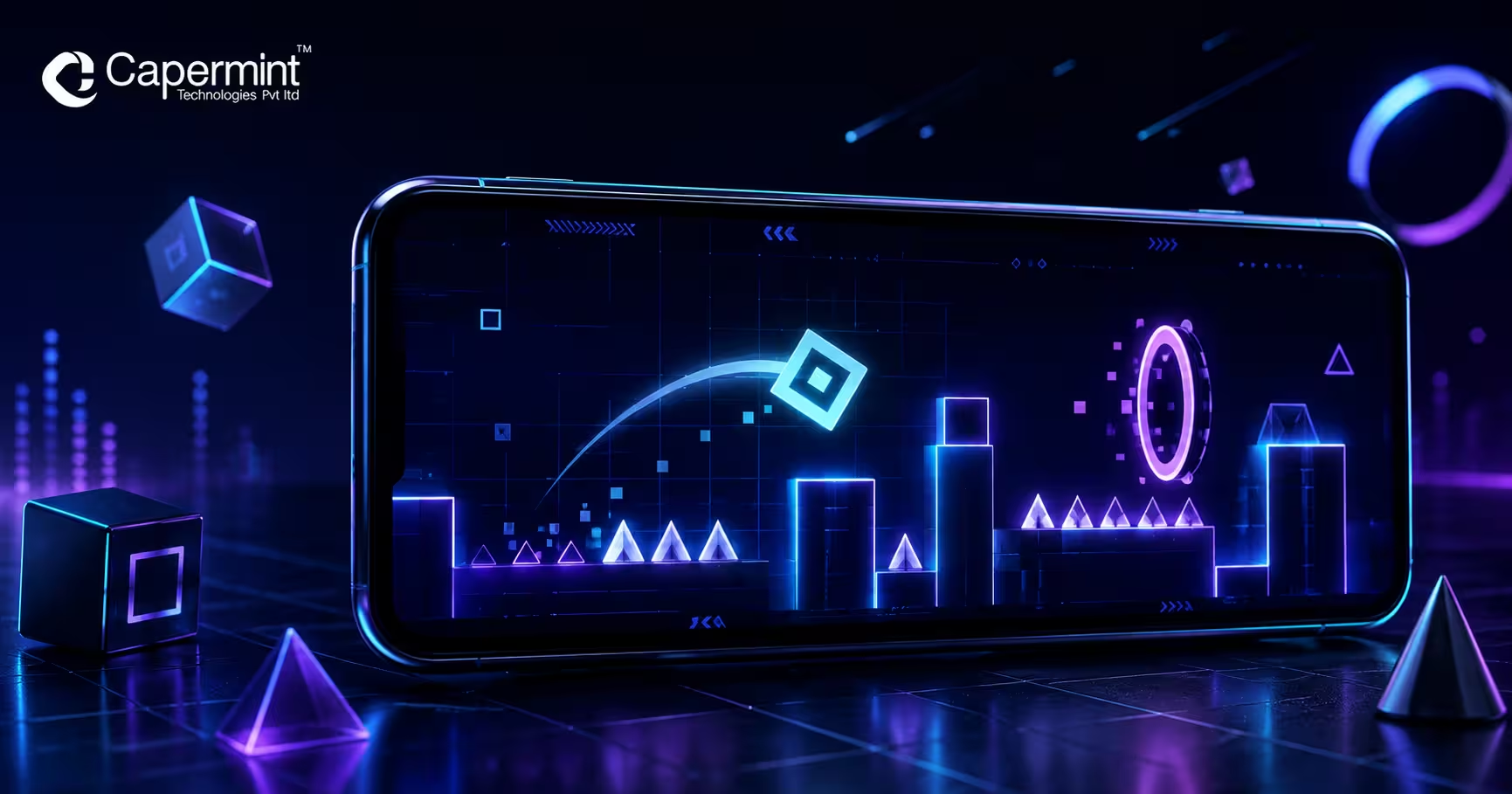
One developer. Four months. No in-app purchases. 242 million downloads and $500,000 a month in 2024. Geometry Dash is the definitive proof that a perfectly designed rhythm platformer, built around community and creativity, can outlast every free-to-play competitor in the market.
In August 2013, a Swedish civil engineering student named Robert Topala uploaded a game he had built in four months on the Cocos2d engine. The game was called Geometry Dash. It asked players to guide a small geometric icon through an obstacle course precisely synchronised to electronic music. You tapped once to jump. You died if you touched anything. You started over from the beginning.
That loop, absurdly simple and brutally unforgiving, became one of the most enduring games in mobile history. By 2018 the game had 242 million downloads and $21 million in revenue from a $1.99 one-time purchase with no in-app purchases. In 2025 it was still pulling in 17.4 million monthly active users, a record high. In December 2025, during a Steam sale, it hit 92,000 concurrent players simultaneously — for a 12-year-old game.
This guide breaks down everything you need to know to build a rhythm platformer inspired by Geometry Dash: the mechanics, the community engine that drives its longevity, the monetisation philosophy that sets it apart from every other mobile game, and what it takes to build a competitive version with Capermint's game development team.
What Is Geometry Dash?
Geometry Dash is a side-scrolling rhythm-based action platformer developed and published by Robert Topala through his company RobTop Games, founded in Sweden in 2012. It was released on iOS and Android on August 13, 2013, and on Steam on December 22, 2014.
"Geometry Dash is the most compelling evidence in mobile gaming that quality, community, and a fair pricing model can outperform every free-to-play competitor in the long run."
Key Facts
- Developer: Robert Topala (RobTop), RobTop Games, Sweden
- Released: August 13, 2013 (iOS and Android); December 22, 2014 (Steam)
- Built on: Cocos2d game engine; took approximately 4 months to build
- Price: $1.99 on mobile, $3.99 on Steam. Zero in-app purchases in the full version
- Free version: Geometry Dash Lite (ad-supported, limited levels) — free on Google Play and App Store
- Total mobile downloads: 242 million+ by September 2018; continuing to grow
- Monthly active users: 17.4 million peak (January 2025); 10 million average
- Daily active users: 1.2 million average; 1.7 million current
- Steam concurrent players: 88,000+ at update 2.2 launch (December 2023); 92,000 peak (December 2025)
- Revenue: $21M by 2018; $500K+ in January 2024 alone; $300K+/month consistently by mid-2024
- Day 1 retention: 39% — strong for any genre
- Day 30 retention: 14% — comparable to successful casual game benchmarks
- Official levels: 26 (22 classic auto-scrolling + 4 platformer levels)
- Game modes: 8 distinct modes (Cube, Ship, Ball, UFO, Wave, Robot, Spider, Swing)
- Latest version: 2.208 (January/February 2026)

The Market Opportunity
Geometry Dash occupies a specific and underserved niche: the rhythm-platformer genre sits between pure rhythm games (Beat Saber, Guitar Hero) and pure platformers (Super Mario, Celeste). Players in this genre are typically 13 to 30 years old, highly engaged, and intensely community-driven. They share content on YouTube and TikTok, watch others play on Twitch and YouTube, and spend significant time creating levels rather than just consuming them.
Geometry Dash Monthly Revenue Trend (USD) — Update 2.2 Impact
How Geometry Dash Works: The Core Gameplay Loop
Geometry Dash strips game design down to its absolute minimum. One input controls everything. The entire game is built on a single tap or hold. Yet inside that simplicity is a system capable of generating infinite complexity because the levels, the obstacles, and the music synchronisation create a new challenge every time. Understanding this loop is the foundation of building anything in this genre.
The Geometry Dash Gameplay Loop: Why Players Keep Coming Back
Choose a Level
Official or community. Easy to Extreme Demon. Music instantly sets the tone.
Music Begins
The track plays. Every obstacle, portal, and speed change is synchronised to the beat.
Navigate or Die
Tap, hold, or release. Touch anything and restart from zero. One mistake, every time.
Learn the Pattern
Each attempt reveals a few seconds further. Practice mode lets you checkpoint-drill specific segments.
Complete and Share
Beat the level. Star or Moon reward. Upload your time. Share to YouTube or TikTok. The community sees it.
The restart loop is the engine of addiction. Every death teaches the player what comes next. The game never feels unfair because all information is available on the screen. Failure is always the player's fault, which means improvement feels entirely personal.
Difficulty System
Geometry Dash uses a tiered difficulty system that gives players a clear progression path and the community a rating framework for user-created levels. Classic levels earn Stars; platformer levels earn Moons.
The Demon tier system is Geometry Dash's retention engine for advanced players. Completing a Hard or Extreme Demon is a genuine achievement that players post to YouTube, which drives organic discovery and new installs. Building a robust community verification and rating system for user-created levels is essential for any game in this genre.
The 8 Game Modes
Geometry Dash's replay depth comes from its 8 game modes. Each mode has completely different physics, a different input model, and different design constraints. Levels switch between modes using portals, creating constantly shifting challenges within a single level. Any rhythm platformer you build needs a comparable mode variety to hold long-term player attention.
Cube
Default mode. Tap to jump. Hold to hold a jump. Gravity affects all movement. The foundational mode every player learns first.
Ship
Hold to fly upward, release to descend. Controls a rocket through tight corridors. Requires sustained precision over long passages.
Ball
Rolls along surfaces. Tap to flip gravity, switching between floor and ceiling. The ball cannot jump — only gravity-flip through portals and timing.
UFO
Each tap gives a short upward boost. UFO descends between taps. Requires rhythmic micro-tapping. Precise burst control at high speed.
Wave
Hold to move diagonally upward. Release to move diagonally downward. Continuous diagonal zigzag through gaps, often pixel-perfect.
Robot
Hold longer for a higher jump. Variable jump height based on hold duration. Requires judging precise vertical distances mid-level.
Spider
Tap to teleport instantly between the floor and ceiling. No arc — immediate transition. Timing-critical at high speeds. Added in update 2.1.
Swing
Tap to swing upward. Tap again to swing downward. Gravity reverses with each input. A rhythmic zigzag using momentum rather than position.


The Level Editor: Why the Community Is the Product
The single most important feature in Geometry Dash is not a game mode or a difficulty system. It is the level editor. RobTop built a tool that lets any player create a shareable level from the same objects, triggers, and physics that he used to build the official levels. Then he built a server infrastructure for those levels to be uploaded, rated, featured, and discovered. That decision turned Geometry Dash from a game with 26 levels into a game with millions of levels — and it is still growing after 12 years.
What the Level Editor Contains
- Full Object Library: Every block, spike, orb, ring, portal, and decorative element used in official levels is available to creators. Object placement is grid-based with snap-to-grid and fine-position options.
- Trigger System: Triggers control movement, colour, opacity, speed changes, camera shake, and more. Triggers fire based on the player's position in the level, enabling cinematic sequences and complex mechanics beyond simple obstacle placement.
- Camera Controls (added in 2.2): Creators can zoom the camera in and out, rotate it, and create dynamic tracking shots. This enabled a generation of levels that look like animated music videos.
- Shader System (added in 2.2): Advanced visual effects including chromatic aberration, blur, and colour grading applied directly inside the editor. No external tools required.
- Particle Editor (added in 2.2): Custom visual bursts: sparks, trails, explosions, and glowing dust particles synchronised to music or player events.
- Sound Effects Library: Over 100,000 SFX options added in update 2.2. Creators can add environmental sounds, mechanical sounds, and ambient noise that fire on triggers throughout the level.
- Music Library: Newgrounds integration plus 1,200+ NoCopyrightSounds tracks added in June 2024. Creators select any track and the level editor shows the song's waveform for beat-accurate obstacle placement.
- Auto-Build Tools: Pattern generators that create repeating structures automatically, reducing manual object placement for large-scale backgrounds and decorative layers.
- Platformer Mode Support (added in 2.2): A second level type where the camera does not auto-scroll and players control left/right movement. Four official platformer levels were added. Creators can build adventure-style stages distinct from classic auto-scrolling levels.
- Level Sharing and Online Play: Completed levels can be uploaded to the GD server, given a name, description, and difficulty rating, and discovered by millions of players. The Featured, Hall of Fame, and Weekly Demon systems curate the best content.
- Stars and Moons Rating: Classic levels earn Stars on completion; platformer levels earn Moons. Both feed leaderboards that motivate players to attempt harder community content.


The Revenue Model: Why the Paid Model Beat Free-to-Play
Geometry Dash's monetisation model is one of the most studied case studies in mobile gaming. In a market dominated by free-to-play games with gacha mechanics, daily login bonuses, energy systems, and aggressive IAP prompts, Robert Topala charged $1.99 upfront, added no in-app purchases, and let the game speak for itself. The result was $21 million in revenue by 2018 — and the game is still earning $300,000+ per month in 2024 from new downloads alone. There is a powerful lesson here for anyone building a game in this genre.
The Paid Model (GD Full)
$1.99 on mobile, $3.99 on Steam. Zero in-app purchases. Zero ads. The full game, all official levels, full level editor, and all community content is included in the one-time price. Players who pay once never see another payment prompt. This creates enormous goodwill and generates word-of-mouth. Players feel they are getting infinite value for two dollars. Every positive review and YouTube video is organic marketing driven by a player who feels no resentment toward the developer.
Geometry Dash Lite (Free)
Free on both Google Play and App Store. Ad-supported. Limited to a subset of official levels. No level editor or community level access. Serves as a trial funnel: players experience the core loop, get hooked, and convert to the $1.99 paid version. Lite has millions of downloads and acts as the primary discovery vehicle, particularly for younger players who discover GD on YouTube or TikTok before ever visiting the App Store.
Building Your Own Model
For a new rhythm platformer in 2026, a hybrid model is the recommended approach: free download with a limited level set and ads (comparable to Lite), with a one-time unlock IAP ($1.99 to $4.99) that removes all ads and unlocks the full level editor and community features. This mirrors GD's philosophy while reducing the friction of requiring payment before the player has experienced the core loop. A cosmetic IAP layer (icons, colour packs, themes) can add supplementary revenue without affecting fairness.
Geometry Dash Player and Revenue Growth: Update-Driven Spikes (Illustrative)
Competitor Landscape
| Game | Model | Strength vs GD | Weakness vs GD |
|---|---|---|---|
| Geometry Dash (RobTop) | $1.99 paid, no IAP | The benchmark. 242M downloads, 92K concurrent Steam players, unmatched UGC community | Infrequent major updates; one-person studio creates bottlenecks |
| Geometry Dash Lite (RobTop) | Free, ad-supported | Same brand; acts as a conversion funnel into the paid version | Limited levels; intentionally incomplete to drive upgrade |
| Beat Saber (Meta) | Paid + DLC music packs | VR market leader; licensed music from major artists | VR-only; no mobile version; no level editor for casual creators |
| Osu! | Free, community-donated | Massive PC community; supports mouse, keyboard, touch, and tablets | PC-first; mobile version is weaker; no auto-scrolling platformer mechanics |
| Thumper | Paid, no IAP | Critically acclaimed; polished AAA visual quality | Fixed linear levels; no editor; no community; minimal replayability |
| The Impossible Game | Paid/Free | Inspired GD; simple and accessible | Far fewer features; no level editor; effectively superseded by GD |
| Dashmetry | Free, browser-based | Geometry Dash-style mechanics; web accessible; growing community | Early-stage; much smaller community and level library than GD |
Must-Have Features for a Geometry Dash-Style Game
Building a rhythm platformer in 2026 means competing with a decade of community-built content in Geometry Dash. You do not need to match GD's library of millions of levels on day one. You need to be better on at least two dimensions that a specific audience cares about: better mobile UX, better onboarding, better social sharing, better monetisation fairness, or better accessibility for younger players.
Core Game Systems
| Feature | Description | Why Essential |
|---|---|---|
| Rhythm-Sync Engine | All obstacle placement, speed changes, and portal triggers are tied to specific millisecond timestamps in the audio track. Physics must resolve at the exact frame where the beat lands. | The genre-defining mechanic. If the music and obstacles feel out of sync by more than 50ms the game feels broken. Audio latency compensation on different devices and OS audio APIs is a dedicated engineering task. |
| Multiple Game Modes | Minimum 4 to 6 distinct physics modes (Cube, Ship, Ball, Wave equivalent). Each mode should require different timing and mental models. | Mode variety is the primary driver of level design diversity. Without mode switching, levels become repetitive within hours of release. |
| Portal and Trigger System | In-level triggers that switch mode, change speed, flip gravity, alter camera, and trigger visual/audio effects at precise positions in the level. | Portals create the moment-to-moment surprise that keeps experienced players engaged. Without a trigger system your level editor cannot produce professional-quality levels. |
| Practice Mode with Checkpoints | Players can place checkpoints at any point in the level and respawn from those checkpoints rather than restarting from the beginning. | Critical for accessibility and retention. Without practice mode, hard levels become impenetrable for new players and churn spikes. GD's 39% Day 1 retention is partly attributable to practice mode lowering the barrier to progression. |
| Icon Customisation | Unlockable character skins, trail effects, colours, and death effects. GD has 700+ unlockable icons. Unlocks are earned through gameplay achievements, not purchased. | Drives long-term session length. Players continue playing to unlock new cosmetics even after completing all official levels. Achievement-gated cosmetics avoid pay-to-win criticism and create organic progression loops. |
| Official Level Set | A curated set of developer-designed levels covering Easy through Demon difficulty. GD shipped 26 official levels across 12 years. Quality matters far more than quantity at launch. | The official levels are the benchmark against which all community content is measured. Low-quality official levels signal a low-quality platform. A small set of excellent official levels is far better than many mediocre ones. |
| Music Integration | A licensed or royalty-free music library with waveform display in the level editor. Support for custom audio uploads. | Music IS the game. A weak soundtrack kills the experience before the gameplay begins. NCS and Newgrounds integrations are the gold standard for royalty-free rhythm game music. |
| Level Editor | Full-featured object placement, trigger support, and a playtest mode that lets creators test their level in real time within the editor. | The level editor converts players into long-term creators. Creators invest hundreds of hours building levels, which makes churn essentially zero for that cohort. This is the UGC flywheel that drives GD's 12-year longevity. |
| Level Upload and Community Browser | Server infrastructure for uploading, browsing, rating, and downloading community levels. Search, filter, difficulty tags, and trending/featured curation. | Without community infrastructure the level editor has no purpose. The server system, CDN for level data, and moderation tools for content curation are backend requirements at launch, not later additions. |
| Leaderboard System | Global and friend leaderboards for level completion percentage, Stars/Moons earned, and specific achievement metrics like Demon completions. | Competitive players are the most vocal and most influential segment of the player base. They post to YouTube and TikTok. A well-designed leaderboard turns this segment into organic marketing. |
Advanced Features for Higher Market Position
| Feature | Description | Competitive Value |
|---|---|---|
| Platformer Mode | A second game type with full left/right movement control and physics, distinct from auto-scrolling levels. Camera does not auto-scroll; the player controls all lateral movement. | GD added this in update 2.2 after 10 years. A new rhythm platformer that launches with platformer mode from day one offers something GD's huge legacy player base only recently received. |
| Shader and Visual Effects System | In-editor post-processing effects (blur, chromatic aberration, colour grading) that apply to the full screen based on trigger events in the level. | The feature that enabled GD creators to produce viral cinematic levels. Levels built with shaders generate 3x to 5x more social sharing than standard obstacle levels. |
| Multiplayer Mode | Race mode where 2 to 4 players attempt the same level simultaneously. First to complete wins. | GD has VS Mode buttons in the UI that have never been fully activated. A competitor that ships functional multiplayer first captures a feature GD's community has requested for years. |
| AI Level Generation | An AI assistant in the level editor that generates obstacle sequences based on the audio waveform of the selected track. | Dramatically lowers the barrier to level creation for casual players who want to create but lack the time or skill to hand-place every object. Expands the creator funnel significantly. |
| Cross-Platform Progress Sync | Cloud save with account system that syncs level completion, Stars, icons, and editor progress between mobile and PC. | GD supports this and it is a baseline expectation for any modern game in the genre. Players who cannot access their progress across devices churn significantly faster. |
| Daily and Weekly Content | A curated daily level selected from the community pool, and a weekly Demon challenge. Both reward completion with in-game currency. | Daily content gives players a reason to open the app every day even if they are not actively building or grinding a personal Demon. Drives DAU without requiring new developer content. |
Tech Stack for a Rhythm Platformer
Building a rhythm platformer introduces engineering challenges that most mobile game frameworks are not designed for by default. The physics engine, audio synchronisation layer, and level data format all require custom work regardless of which game engine you choose.
| Layer | Recommended Approach | Rhythm-Game-Specific Reasoning |
|---|---|---|
| Game Engine | Unity (C#) or Godot 4 (GDScript/C#) | Unity powers 51% of top 1,000 mobile games including most casual and hyper-casual titles. It has the strongest cross-platform 2D tooling and a mature audio API. Godot 4 is free, MIT-licensed, and excellent for 2D rhythm games — ideal for indie or budget-conscious studios. The original Geometry Dash was built on Cocos2d, but Unity or Godot are the modern equivalents for new projects. |
| Audio Engine and Sync Layer | FMOD Studio + custom beat-map parser | The most critical technical component. Unity's built-in AudioSource has variable latency on different Android devices that makes sub-frame audio sync unreliable. FMOD provides sample-accurate timing with compensated latency, which is required for a rhythm game. Beat-map data stores obstacle timestamps as millisecond offsets from the audio start, not frame numbers. |
| Physics Engine | Custom 2D physics (not Box2D) | Unity's built-in physics uses Box2D which adds interpolation and collision resolution overhead that creates inconsistent hit detection at high speeds. GD uses its own collision detection. A custom AABB (axis-aligned bounding box) collider with fixed-timestep resolution gives the sub-pixel hit accuracy that players in this genre demand. "Feels unfair" complaints always come from imprecise collision. |
| Level Data Format | Custom binary or compressed JSON with versioning | GD uses a custom compressed XML format for level data. For a new game, a versioned binary format or compressed JSON with schema versioning is recommended. Level data must be compact for fast community level downloads. A 5MB level should compress to under 200KB for smooth streaming discovery. |
| Level Editor Architecture | Entity-Component System (ECS) with undo/redo stack | The level editor must support thousands of objects on screen simultaneously without frame drops. An ECS architecture with spatial partitioning handles this efficiently. An undo/redo stack is non-negotiable for creator UX — any editor without it will be abandoned immediately by creators. |
| Backend and Community Server | Node.js + PostgreSQL + Redis + CDN | The community server handles level uploads, downloads, ratings, leaderboards, and account authentication. Node.js handles concurrent API requests efficiently. PostgreSQL stores structured level metadata. Redis caches trending/featured level lists. A CDN (Cloudflare or AWS CloudFront) delivers level binary data globally at low latency. This is the same architecture used for most mobile game backends. |
| Cross-Platform Build | Unity's multi-platform export pipeline | Target iOS, Android, and PC (Windows/Mac via Steam) from a single codebase. Unity's export pipeline handles platform-specific builds with per-platform audio settings, resolution scaling, and input handling. Steam integration (Steamworks SDK) is required for leaderboards and achievements on PC. |
| Shader and Visual Effects | Unity ShaderGraph or HLSL custom shaders with URP | The visual effects that made GD 2.2 levels go viral (chromatic aberration, blur, colour grading) are implemented as full-screen post-processing shaders. Unity's Universal Render Pipeline with custom ShaderGraph nodes handles this efficiently on mobile hardware. Maintain a fallback path for low-end devices that skips shader effects. |
| Analytics and Retention | Unity Analytics + GameAnalytics | Track level completion rates by difficulty tier, practice mode usage, session length by content type, and editor session length. This data tells you exactly which official levels are causing churn (too hard, too early) and which editor features creators actually use (versus which ones you can deprioritise in updates). |
| Monetisation SDK | Google Play Billing + StoreKit 2 (iOS) + Unity IAP | Unity IAP wraps both store payment APIs into a single C# interface. Handle receipt validation server-side to prevent exploit. For the ad layer in the free version, use Unity Ads or ironSource mediation with AdMob as a demand source. |
Development Timeline
| Phase | Core Rhythm Platformer (MVP) | Full GD-Style with Editor | Full-Featured with Multiplayer + AI |
|---|---|---|---|
| Discovery and Game Design | 3 to 4 weeks | 4 to 5 weeks | 5 to 6 weeks |
| Core Engine and Physics | 4 to 6 weeks | 5 to 7 weeks | 7 to 9 weeks |
| Audio Sync Layer (FMOD) | 3 to 4 weeks | 3 to 4 weeks | 4 to 5 weeks |
| Game Modes (4 to 8) | 3 to 4 weeks | 5 to 6 weeks | 6 to 8 weeks |
| UI/UX Design | 3 to 4 weeks | 4 to 5 weeks | 5 to 7 weeks |
| Official Level Design (10 to 26 levels) | 4 to 6 weeks | 6 to 10 weeks | 8 to 12 weeks |
| Level Editor (full-featured) | Not included (MVP) | 8 to 12 weeks | 10 to 14 weeks |
| Community Server and Level Sharing | Not included (MVP) | 5 to 7 weeks | 7 to 10 weeks |
| Icon Customisation System | 2 to 3 weeks | 3 to 4 weeks | 3 to 5 weeks |
| Leaderboards and Achievements | 2 to 3 weeks | 3 to 4 weeks | 4 to 5 weeks |
| Multiplayer / Race Mode | Not included | Not included | 6 to 8 weeks |
| Shader and Visual FX System | Not included | 3 to 5 weeks | 4 to 6 weeks |
| QA, Load Testing, Device Matrix | 3 to 4 weeks | 4 to 5 weeks | 5 to 6 weeks |
| App Store Submission and Review | 1 to 2 weeks | 1 to 2 weeks | 1 to 2 weeks |
| Total Timeline | 5 to 8 months | 9 to 14 months | 13 to 18 months |
Engagement Models and Market Pricing
A rhythm platformer is not a live-service game with seasonal content drops. It is a craft product that lives or dies by its core quality. Choose an engagement model that reflects how much creative control you need during development and how you want to operate post-launch.
- Full scope, feature list, and budget agreed before development starts
- Milestone-based payments tied to engine, game modes, levels, and store submission
- Studio absorbs scope and timeline risk
- Full budget visibility, no surprises
- Best for an MVP that validates the concept before investing in a level editor
- Includes audio sync engine, 4 to 6 game modes, and 10 to 15 official levels
- QA, device matrix testing, and app store submission included
- Less flexible if the core mechanic needs significant iteration during development
- Full-time embedded team: Game Engineer(s), Unity Developer, Level Designer, UI/UX, QA, PM
- Adapts scope continuously as physics feel and level editor UX are refined through playtesting
- 100% code and IP ownership for you from day one
- Direct sprint access and weekly builds for playtesting
- Scale team up for level editor sprint, down for polish phase
- Best for long-term games that need ongoing content updates post-launch
- Continuing to add official levels, shader packs, and game modes post-release
- Optimal ROI for a product you intend to run and grow for years
- Billed by actual hours logged per sprint
- Scope can evolve freely — ideal when testing custom physics or audio sync approaches
- Transparent time tracking with detailed sprint reports every two weeks
- Lower upfront commitment than fixed-price
- Best for studios still deciding between Cocos2d, Unity, or Godot for the base engine
- Allows course corrections after early playtests without change-order costs
- Requires active product owner involvement in sprint reviews
- Full code ownership and IP transfer at project completion
Market Cost Ranges for Reference
The following ranges reflect market data from publicly available development guides. Capermint does not apply standard rates — all engagements are quoted individually based on your specific scope and requirements.
Rhythm Platformer Game Development Cost: Market Reference Ranges (USD)
Why Choose Capermint for Your Rhythm Platformer?
Audio Synchronisation Expertise
We build FMOD-based audio engines with sub-frame sync accuracy and per-device latency compensation. Your obstacles will land exactly on the beat on every device, from low-end Android to high-refresh-rate iPad Pro.
Custom Physics for Rhythm Games
We build AABB collision detection with fixed-timestep physics resolution specifically for rhythm platformers, eliminating the "unfair death" complaints that follow Box2D-based implementations. Pixel-perfect hit detection is not optional in this genre.
Level Editor Development
We have built professional-grade in-game level editors with full trigger systems, undo/redo stacks, waveform display for beat mapping, and in-editor playtesting. The editor is the product. We treat it that way.
Cross-Platform from Day One
We build for iOS, Android, and PC (Steam) simultaneously using Unity's multi-platform pipeline. Your level data format, cloud save system, and community server work consistently across all platforms from the first build.
Dedicated Game Team
Game Engineer(s), Unity Developer, Level Designer (who actually plays the game), UI/UX Designer, QA tester, and Project Manager on your project. Not shared across 15 clients. Fortnightly playable builds. Full transparency every sprint.
Post-Launch Content Pipeline
A rhythm platformer needs ongoing official levels, new game modes, shader packs, and community curation tools after launch. Capermint provides dedicated team retainers for post-launch development so your game grows every update cycle.
Ready to Build Your Rhythm Platformer?
Tell us your vision: the mechanics you want, the audience you are targeting, and the features that will differentiate your game. We scope it, estimate it, and build a development plan aligned to your launch goals.
Try the Reference Games
Download both versions of Geometry Dash to understand the paid vs free model and experience the current state of the art firsthand:
Frequently Asked Questions
How much does it cost to develop a game like Geometry Dash?
How long does it take to develop a rhythm platformer game?
What game engine should I use to build a Geometry Dash-style game?
What is the most technically challenging part of building a rhythm platformer?
Should I charge upfront like Geometry Dash or use a free-to-play model?
How important is the level editor? Can I launch without it?
How does the music licensing work for a rhythm game?
Does Capermint provide ongoing support after launch for game updates?
Build Your Rhythm Platformer Game
Geometry Dash proved that the right mechanic, the right community, and the right pricing model can generate $500,000 a month from a 12-year-old game. Your rhythm platformer can own a corner of that market. Capermint will build the physics, the editor, the community infrastructure, and the levels that make it last.