

Scalable Tech Stack
Native or cross-platform apps with live-scoring backends load-tested for game-day traffic.

Experienced Team
Reimagine your business with our mobile app development services.

Multiple Platform
Building custom solutions across Android, iOS, and Native platform.


Fantasy App Development solutions
At Capermint, we offer multiple fantasy sport solutions for daily, season-long and pick'em contests, with the player features and admin controls each format needs. Here are the various Fantasy Sports App Development solutions we offer.

Fantasy Sports App Development
We have a team of proficient developers who are experts at developing scalable and feature-packed Fantasy Sports Mobile App.

Fantasy Sports AR/VR Solutions
Provide your users with a breath-taking and immensely beautiful experience with the help of AR/VR packed apps with Capermint'sCapermint's Fantasy Sports AR/VR App Development.

Fantasy App Blockchain Development
We embed blockchain into your Fantasy app to facilitate the control and management of all the real-time activities in our Fantasy App Blockchain Development service.

Fantasy Game Analytics Software
Our developers develop appealing and easy-to-use Fantasy Game Analytic software that helps you in creating and maintaining the real-time database and real-time information.

Custom Fantasy Scoring System
We create custom scoring systems for each sport and contest format, with points per stat, bonuses, multipliers and tie-break rules.

Fantasy Sports Web App
As a note-worthy and reliable Fantasy Sports Web App development company, we deliver custom-made, scalable, and responsive web applications.
Fantasy Sports Genre We Develop
For Fantasy Sports, we provide app development services for a large number of sports. We build fantasy apps for the sports your users follow, from American football, basketball, baseball and hockey to soccer, cricket, golf and motorsport. Here is a list of fantasy sports app that we develop.




Fantasy Sports App Development
We have a professional fantasy sports app development team that will quickly grasp your idea and turn it into a working product. We provide real-time scores and results for sports enthusiasts, predictions by experts, the latest breaking news, huge pools to play in, and much more. Let's start by discussing your needs, target markets and budget.
What is a Fantasy Sports App?
A fantasy sports app is software that is used to play fantasy games online. In fantasy games, the players can use their expertise, knowledge, and skills to create a virtual or imaginary team from the players that are playing the match. The player's team will earn points based on the real-time performance of the player that is in their team. In the end, the player whose team scores the best score wins the game.
Fantasy sports apps can be free-to-play (funded by ads, sponsorships or subscriptions) or, where local law and the operator's license allow, paid-entry contests with cash prizes. There can be a single winner or multiple winners based on the rules of the match.


Fantasy App Development Services For Android and iOS
Many fantasy sports players play on mobile apps. The smartphone market is dominated by two operating systems, namely Android and iOS. Our team of developers use cutting-edge solutions to develop solutions that are in sync with all the latest trends. To allow our clients to reach their target audience without any hurdles, we develop a cross-platform Fantasy Sports app, and therefore you can target all the operating systems that you want. Get the most out of your app by launching it on Android and iOS platforms.

Rising Demand
The demand of fantasy sports app platforms is on the rise, with a burgeoning user base actively participating in these applications.

Year-Round Sports Calendar
Sports leagues run around the world throughout the year, so a fantasy app can keep offering contests from one season to the next.

Earning Revenue Through Contests
During periods without major sports events, you can organize engaging contests such as quizzes and puzzles, charging users an entry fee to participate where local law and your license allow. This approach not only fosters user engagement but also serves as a source of income.

Legitimacy of Fantasy Sports
Fantasy sports are legal in many markets, but paid contests are regulated market by market: US state rules, Ontario's regulated iGaming market in Canada, and a ban on online money games in India under the Online Gaming Act 2025. Operators are responsible for licensing; we build to the technical requirements of each target market.

Brand Outlook
Within the fantasy industry, you can enhance your brand visibility through the significant traffic in this sector at present. Establish a stronger brand awareness and presence by owning a fantasy sports app software.

Global Reach
Utilizing our software's multilingual support, you can effortlessly broaden your fantasy business and launch contests in new markets where local rules allow.
How much does it cost to develop a Fantasy Sports App?
Typical ranges are $10K–$40K for a free-to-play, single-sport MVP (8–12 weeks), $40K–$120K for a multi-sport app on Android, iOS and web (12–20 weeks), and $60K–$180K for a custom paid-entry DFS or pick'em platform with wallet, KYC and geolocation (4–6 months). Final quotes follow a scoping call.
The cost also depends on the company that you choose.

$15 - $40 / hour
Charges of a small company
$50 - $100 / hour
Charges of an Intermediate company
$100 - $300 / hour
Charges of an Enterprise-level companyIf you are looking for a game and app development company to develop a Fantasy Sports App, you can contact us. We have solid technical app developers who have developed various Fantasy Sports Apps. To know more about our Fantasy Sports App development, Contact Us.
Fantasy App Features
We offer a wide range of features for Fantasy Sports apps from simple, to advanced, to various new features that you can choose from for your Fantasy Sports app. Here is a list of Fantasy Sports features:
- Live Match Score Updates
- Live Score API Integration
- Real-Time Player Stats
- Create/Join Tournaments
- Create a Team
- Place high and low biddings
- Match Highlights
- Player information with performance history

- Score Prediction
- Match History
- GPS Location Tracking
- Smart Push Notifications
- Custom Mail Notifications
- Upcoming Tournament Notification
- Quick and lucky draw daily reward points
User Control Features for Fantasy Sports App Development
The user control features allow you to take control of your app and make any necessary changes that you want. You can manage and control your Fantasy Sports app with these features. Here is a list of the User Control features that we provide for Fantasy Sports App

Dashboard
Dashboard refers to a very important feature that shows you how your game is performing against other games.

Game settings and management
Various game settings are available, like language, sound option, two-factor authentication, game tutorials, etc.

Role-Based User Management
Manage and control the activity of all the users, based on their roles, using the Role-Based User Management feature.

Leaderboard Management
Showcase the most skillful and earning players on the leaderboard to provide inspiration to others and to praise the top players.

Match Management
Manage the match and the betting amount. The ultimate control of the match and all the related controls are in your hand.

Category Management
Manage the category of all the ongoing and upcoming live sports matches using this feature. You can manage categories anytime.

Payment and Wallet Management
The payment and wallet management feature will let you know how many coins have been bought and redeemed by the users.

Referral Management
The reach of the game can be easily increased by providing rewards to players who refer their friends and family to download your game.

Team Management
The users can select the players that are going to perform in the live match, You can allow only the playing players to be selected.

Reward Point Management
This feature lets you create a loyalty program in your game. The player that uses your game daily will get bigger rewards.

Ads Management
You can use all types of ads anytime that you like. This feature provides you complete control of all the in-app advertisements.

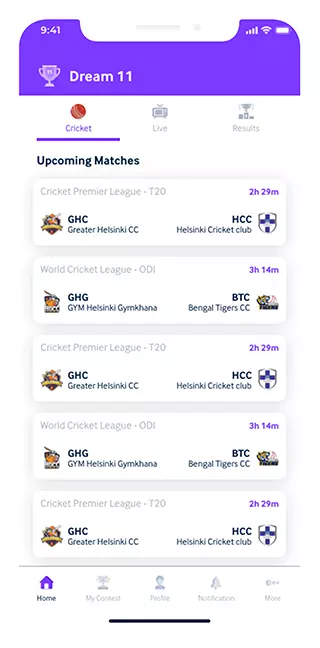
Next Level Fantasy Cricket App
We build fantasy cricket apps for cricket fans worldwide. For India, we build free-to-play formats, since the Online Gaming Act 2025 prohibits online money games. Share your fantasy cricket idea with us to get started.
Contact UsFantasy Football App Development
We build fantasy football apps with a draft room, lineup builder, waivers and trades, and live scoring through every week of the season. Just share your ideas and requirements with us, and kick start your journey in the realm of online fantasy football apps with a head starter mobile app loaded with multiple advanced features.
Contact Us
Capermint Advantages for Fantasy Sports App Development
Our fantasy sports app developers build each solution around your sports, contest formats and target markets. Here is a list of advantages of choosing Capermint as your Fantasy Sports App Development company:
-
1
Anti-Fraud System
-
2
Smooth and Scalable Gameplay
-
3
Cross-Platform Functionality
-
4
Supports multiple currencies
-
5
Multi Language Preference
-
6
Easy to install and use Fantasy Sports App
-
7
Realtime voice, video, and chat functionality
-
8
Multiple Payment Options
Why Capermint for Fantasy Sports App Development?
Capermint has built games and apps since 2014, with over 200 specialists across game design, art, engineering and QA. From the planning stage to the launch, we will provide effective results in all the stages. Here are some advantages of choosing Capermint as your fantasy sports app development company.

Multiplayer Game/App Development Specialist
Our developers have years of experience building real-time multiplayer mobile games and apps.

Supports cross-platform
Your game should get full exposure, and therefore, we develop games that support cross-platform functionality.

Seamless gaming experience
Our games are designed to work seamlessly and effortlessly across all devices and platforms.

Attractive UI and UX
We design clear, user-friendly UI and UX for the lobby, draft room, lineup builder and live-scoring screens.

Expert 2D and 3D Game Developers
We have a team of expert 2D and 3D game developers who are experienced in developing 2D and 3D games.

Experienced Game Developers
Capermint reports 650+ customers worldwide, with a portfolio of games built for mobile devices.

Fantasy sports app development: what we build and for whom
Capermint is a fantasy sports app development company that builds daily, season-long and pick'em fantasy apps for Android, iOS and web for operators, media brands, leagues and startups in the US, Canada and worldwide. A free-to-play MVP typically takes 8–12 weeks from $10K; a custom paid-entry DFS platform with KYC and geolocation typically runs $60K–$180K over 4–6 months.
| Item | Details |
|---|---|
| Engagement models | Fixed-scope project, dedicated team (monthly) or co-development/staff augmentation with your engineers. |
| Business models | Free-to-play (ads, sponsorships, subscriptions), sweepstakes-model or paid-entry contests, where local law and the operator's license allow. |
| Fantasy formats | Salary-cap daily fantasy (DFS), season-long snake or auction drafts, best ball, pick'em and private leagues, plus non-sports formats such as stock fantasy. |
| Sports | American football, basketball, baseball, hockey, soccer, golf, motorsport, MMA, cricket and esports. |
| Timeline | Free-to-play MVP typically 8–12 weeks; multi-sport app 12–20 weeks; custom paid-entry platform 4–6 months. |
| Typical price (USD) | $10K–$40K single-sport MVP; $40K–$120K multi-sport app; $60K–$180K custom paid-entry DFS or pick'em platform; $200K–$500K+ multi-vertical. Final quote after a scoping call. |
| Stack and integrations | Swift and Kotlin native apps or React Native/Flutter cross-platform apps; Node.js services with WebSockets for live scoring; PostgreSQL and Redis; hosting on AWS or another major cloud; sports data feed, payment, KYC and geolocation integrations. |
| Compliance and testing | Geofencing and state eligibility rules, age and identity checks, responsible-play limits, audit logs and load tests before lineup lock. Operators hold the licenses. |
| Markets | US and Canada first (we schedule calls in US and Canadian business hours), plus UK/EU, LatAm, Africa, the Middle East and APAC; free-to-play and e-sports formats for India. |
What a fantasy sports app includes
Every build has three parts: the app players use, the admin panel your operations team runs, and the integrity controls that keep paid and prize contests fair.
Player app
- Sign-up, profile and age gate
- Contest lobby, draft room and salary-cap lineup builder
- Private leagues with invite codes and chat
- Live scoring, leaderboards and push alerts
- Wallet, deposits and withdrawals for paid contests
- Responsible-play settings and self-exclusion
Admin panel
- Contest builder and reusable templates
- Scoring rules per sport and format
- Slate scheduling and lineup lock
- Stat corrections and re-settlement
- Payouts, refunds, promo codes and referrals
- User and KYC management, reports and exports
Fair play and integrity
- Duplicate-account, device and payment checks
- Bot and scripted-entry detection
- Collusion flags on linked accounts and shared lineups
- Entry limits per contest
- Highly experienced player labels and beginner contests where state rules require them
- Audit log of every admin action
Fantasy app cost and timeline by scope
Typical USD ranges. Price depends on the business model, number of sports and formats, platforms and compliance scope; data licenses and hosting are separate running costs.
| Tier | Scope | Typical price | Typical timeline |
|---|---|---|---|
| Free-to-play fantasy MVP | One sport, one format (daily or season-long), virtual points and leaderboards, one sports data feed, one platform or web, basic admin panel | $10K–$40K | Typically 8–12 weeks |
| Multi-sport fantasy app | Several sports, daily and season-long contests, private leagues, live scoring, push notifications, Android, iOS and web, full admin panel | $40K–$120K | Typically 12–20 weeks |
| Custom paid-entry DFS or pick'em platform | Entry-fee contests and payouts, wallet, KYC and age checks, geolocation and state rules, responsible-play tools, reporting | $60K–$180K | Typically 4–6 months |
| Multi-vertical platform | Fantasy as one vertical next to a sportsbook or casino, with shared accounts, wallet and back office | $200K–$500K+ | Phased; scoped per vertical |
Adding fantasy to a betting product? See sportsbook platform development, or prediction market platform development if your contests are closer to event trading.
Final quotes follow a scoping call; we send a custom, itemized quote once scope, markets and integrations are agreed.
How we build a fantasy sports app
Scoping call and market check (1–2 weeks)
We confirm target markets, business model, sports, formats, platforms and budget, then send a scope, team plan and itemized quote. An NDA is available.
Contest and scoring design
We document contest types, roster and salary-cap rules, scoring tables, lineup lock, tie-breaks, payouts and admin controls.
UX and UI design
Designers produce the lobby, draft room, lineup builder and live-scoring screens, phone-first.
Build and integrations
Engineers build the apps, contest engine, scoring service on your licensed data feed and admin panel, plus wallet, payments, KYC and geolocation for paid contests.
QA and game-day load testing
QA covers devices, payments and geolocation, replays past games to check scoring, and load-tests the spike before lineup lock.
Launch and season operations
We handle store submission, monitor the first slates, then run contest scheduling, stat corrections and new sports through a dedicated team.
See Racing Fantasy 2.0 in our portfolio, MMA and boxing app development for combat sports, or hire sportsbook API integration engineers for your own team.
Fantasy sports markets and compliance
Paid fantasy contests are regulated jurisdiction by jurisdiction. Operators are responsible for licensing; we build to the technical requirements of the target jurisdiction.
- United States: daily fantasy sports is legal in most states under state rules on registration or licensing, fees, audits and player protections. A few states do not allow paid DFS, several restrict pick'em contests or treat them as sports betting, and rules change often.
- US sweepstakes model: sweepstakes-style contests rely on sweepstakes law (dual currency plus a free alternative method of entry), and a growing list of states restrict them.
- Canada: Ontario runs a regulated open iGaming market (AGCO and iGaming Ontario) that paid fantasy operators must join; other provinces operate through provincial lottery corporations.
- UK, EU and other markets: confirm how the national regulator classifies paid fantasy before choosing formats.
- India: the Promotion and Regulation of Online Gaming Act 2025 prohibits online money games, including paid-entry fantasy, so we build free-to-play fantasy and e-sports formats there.
This is a general summary, not legal advice; confirm your format and markets with gaming counsel.
Who builds your fantasy app
Game and iGaming studio
Capermint Technologies was founded in 2014 in Ahmedabad, India, where its delivery studio is based. Capermint-reported: 650+ customers worldwide and over 200 specialists across game design, art, engineering, backend and QA.
4.9/5 from 13 reviews
Independent Clutch rating.
Fantasy and skill-gaming brands
Selected clients and products on our clients page include Real11, Nostragamus, Ludo Fantasy and WinZO.
Fantasy sports app development FAQs
How much does it cost to develop a fantasy sports app?
Typical ranges run from $10K–$40K for a free-to-play, single-sport MVP to $60K–$180K for a custom paid-entry DFS or pick'em platform. A multi-sport app with daily and season-long contests usually falls between $40K and $120K. Data licenses, hosting and legal advice are extra, and final quotes follow a scoping call.
Can you launch a fantasy football app before the NFL season starts?
Usually yes, if work starts early enough. Season-long leagues draft in August, and a free-to-play MVP typically takes 8–12 weeks, so start by about mid-May to be live for draft season. Paid-entry contests need extra time for KYC, geolocation, payments and state registrations, so plan 4–6 months or launch free-to-play first.
Is daily fantasy sports legal in the United States?
Yes, in most states, but the rules differ by state. Many states require operators to register or hold a license, pay fees and pass audits; a few do not allow paid DFS; and several have restricted pick'em contests or treat them as sports betting. Rules change often, so confirm each state with gaming counsel. Operators are responsible for licensing; we build geofencing and state eligibility rules to the technical requirements of each state.
Can I run paid fantasy contests in Canada?
It depends on the province. Ontario runs a regulated open iGaming market, so paid fantasy operators register with the AGCO, sign an operating agreement with iGaming Ontario and follow its player-eligibility rules. Other provinces operate gaming through provincial lottery corporations, so check each province before marketing paid contests there.
What is the difference between daily fantasy, season-long and pick'em apps?
Daily fantasy (DFS) runs contests over a single day, slate or match, usually with a salary cap, so results and payouts come quickly. Season-long leagues use a snake or auction draft, waivers and trades, and keep users engaged for months. Pick'em apps ask users whether players will beat stat projections, which is simpler to play but faces stricter rules in several US states.
Which sports data feeds can you integrate?
We integrate the feed you license, such as Sportradar, Genius Sports, Stats Perform (Opta) or SportsDataIO, or a league or federation feed. The scoring service maps each feed event to your scoring rules, updates points live and lets admins apply stat corrections after a game. The operator signs and pays for the data license, which is a recurring cost.
How do fantasy sports apps make money?
Paid-entry apps mainly earn a platform fee, often called rake, which is the share of entry fees not paid out as prizes. Free-to-play apps earn from ads, sponsorships, premium subscriptions with research tools, and in-app purchases. Many operators add partner revenue, such as media or sportsbook cross-promotion where it is legal.
Should I choose white-label fantasy sports software or a custom build?
Choose white-label if speed matters most and you accept a shared roadmap, recurring license or revenue-share fees and limited control over formats. Choose custom if fantasy is your core product and you want to own the code, data and contest design. A custom build can start as a one-sport, one-format MVP from $10K–$40K, and source-code ownership is set in the contract.
Can I launch a fantasy sports app in India after the Online Gaming Act 2025?
Yes, as a free-to-play or e-sports product. The Promotion and Regulation of Online Gaming Act 2025 prohibits online money games, so paid-entry fantasy contests are not allowed in India. For India, we build free-to-play fantasy with no entry fee or deposit, funded by ads and sponsorships, plus e-sports formats. Confirm prize and registration rules with Indian counsel.
What does a real-money DFS app need that a free-to-play app does not?
It needs age and identity checks (KYC), geolocation that blocks entries from places where paid contests are not allowed, a wallet with deposits and withdrawals, responsible-play tools such as deposit limits and self-exclusion, and records for tax and regulator reporting. Several states also require segregated player funds, controls for highly experienced players and independent audits. These features account for most of the cost gap between free-to-play and paid-entry builds.
How do you keep fantasy contests fair?
We combine account, device and payment checks to catch duplicate accounts, detect bots and scripted entries, flag collusion such as shared lineups across linked accounts, cap entries per contest and log every admin action. Where state rules require it, the app labels highly experienced players and offers beginner-only contests. Stat corrections are re-settled from the licensed data feed with an audit trail.
Planning a fantasy sports app?
Send your sports, formats and target markets, and we will reply with a scope, timeline and itemized quote.