


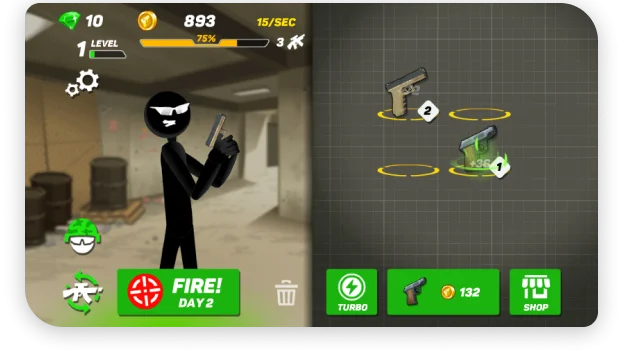


Action
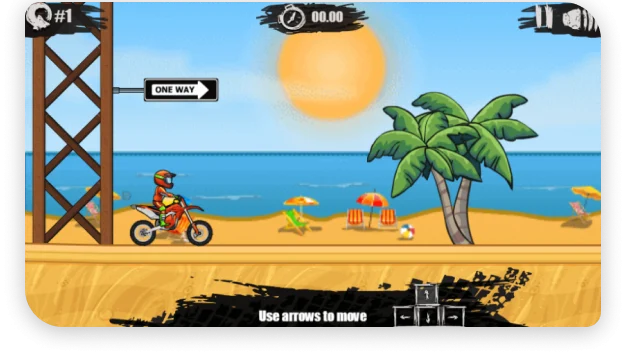
Action is the game genre that focuses on fighting with fists, weapons, or various martial arts. It also focuses on physical challenges and tests the user’s reaction time.

MMO RPG
Massively multiplayer role playting games is currently trending and dominating the market.

Casual
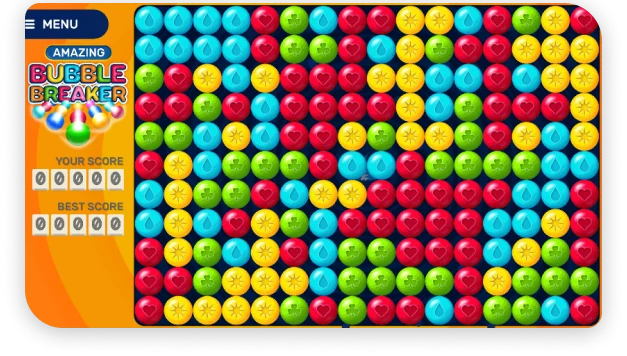
Casual games are games that have simple rules, shooter sessions, and require less learned skills to play. The player can play these games spontaneously.

Puzzle
Puzzle games test the ingenuity and knowledge of the players. The player has to solve the puzzle or mystery by using logic and a lot of brain.

Card
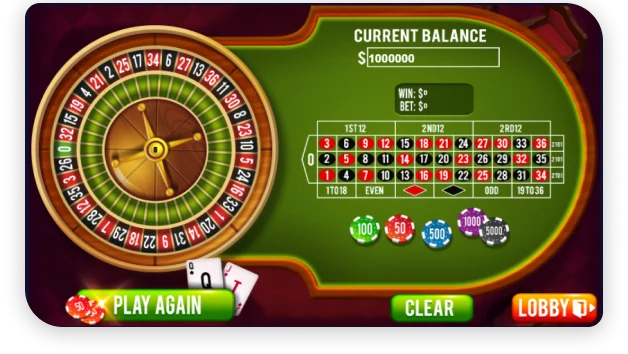
Card games consist of various variations of card games like Teen Patti, Poker, and so on. These games also include fantasy cards like UNO and pokemon cards.

Adventure
Adventure games allow the user to control the main player that is ready to enmark a new journey and pass missions in a fantasy world.

Racing
Racing games allow the player to control a car, bike, or other vehicle and race against the computer or real players.

Arcade
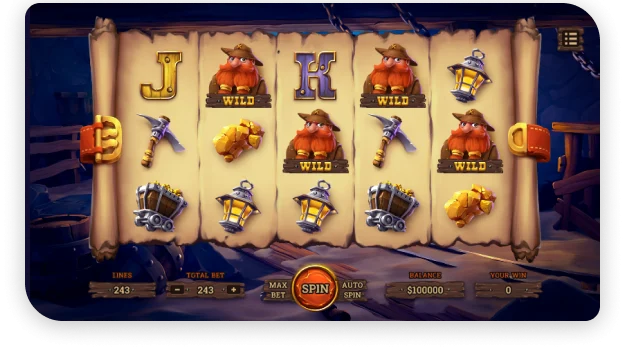
Arcade games focus more on fast-paced gaming activity in which there are various levels in the game with increasing challenges.

Sports
Sports games include Baseball, Cricket, Soccer, Volleyball, Tennis, and so on. The new entry in sports games is fantasy sports game.

Cost Effective
The game developed using HTML5 can work on all the latest mobile devices, and you can target any operating system using the same coding. With small changes, screen-size can be adjusted and therefore HTML5 is a cost effective language.

Earn more revenue
With HTML5 you can use the same code for multiple platforms and you can target a large audience. This provides you more exposure and as a result you will earn more revenue as you will target and get more audience on your app.

Target vast audience
Targeting a single platform will hinder your growth and will provide you with a limited audience. However, with HTML5 games, your game will be available for as many platforms as you want and therefore you will be able to target a vast audience.

Easily integrate advertisements
The HTML5 game allows you to show as many advertisements as you want. Integrating the advertisements in HTML5 games is a comparatively easy task. You can show the advertisements anywhere, you can show them in the game or around the game too.

Flexibility in installation
You can distribute your HTML5 game however you want. You can launch it through app stores, or as it is an HTML5 game, you can always distribute it using the browser. You can also choose if you want your users to install your game, or directly use your game.
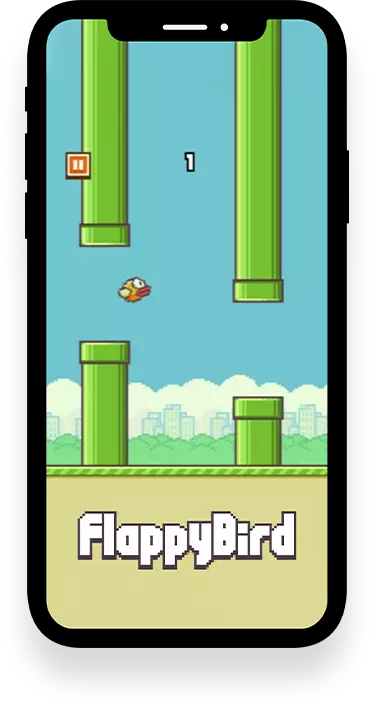

Robust HTML5 Game Performance
The work that we do defines us, so we build and test our HTML5 games to run smoothly across desktop and mobile browsers.

Visionary Game Concepts
Our HTML5 game developers are serious game lovers, and therefore they know what the audience wants and needs, and with this, they can develop visionary game concepts for you.

Creative UI & Character Design
HTML5 provides the developers and designers with all the tools that are needed to develop amazing UI & characters for the game.

Cost-Effective Solutions
We offer fixed-scope projects, dedicated teams and co-development. Typical ranges for a single-game MVP are $10K–$40K, and final quotes follow a scoping call.

End-to-End Support
From planning, design, development, deployment, testing, launching to after services, our HTML5 game development process covers it all.

Maintenance & Support
To keep something up and running, you have to maintain it. We also work on any changes that you want and on the updates too.



Efficient HTML5 Developers
We have a team of efficient HTML5 game developers who build feature-rich games with polished graphics.

Technological Expertise
Our developers have on-hand experience and expertise in using HTML5 to develop ranking and awe-inspiring games.

Effective Development Process
Structured HTML5 game development process helps us in developing the most amazing products.

End-to-end HTML5 Game Development
From planning to post-support, our development process covers it all for HTML5 game development.

Impactful Design
With a pool of designers we design the most graphical and easy to use graphics for HTML5 games.
At a glance
HTML5 game development at a glance: scope, stack and price
Capermint is an HTML5 game development company that builds browser games in Phaser, PixiJS, Three.js and PlayCanvas for studios, publishers, brands and edtech teams in the US, Canada and worldwide. Games play on desktop and mobile browsers with no install. A casual MVP typically costs $10K–$40K and takes about 60–90 days; final quotes follow a scoping call.
| Item | What you get |
|---|---|
| Delivery models | Fixed-scope project, dedicated team (billed monthly), or co-development and staff augmentation inside your studio |
| Typical timeline | About 60–90 days for a casual MVP (simple branded mini-games can be shorter); about 12–20 weeks for a multiplayer game; 4–6 months or more for a large custom 3D browser game. Confirmed in your quote. |
| Price from | Typical casual or advergame MVP $10K–$40K (USD); final quote after a scoping call |
| Tech stack | Phaser, PixiJS, Three.js and PlayCanvas (Cocos Creator where a visual editor is needed) in TypeScript or JavaScript on Canvas and WebGL; Node.js with WebSockets for real-time multiplayer |
| Platforms | Desktop and mobile browsers (Chrome, Safari, Edge, Firefox), website and LMS embeds, Progressive Web Apps, web game portals, Telegram Mini Apps, and App Store or Google Play builds through Capacitor or Cordova wrappers |
| Performance and QA | Download-size, frame-rate and memory budgets agreed in writing at scoping; real-device testing on iOS Safari and Android Chrome, including low-end phones and throttled networks |
| Markets | United States and Canada, with calls scheduled in US and Canadian business hours; also the UK and Europe, India, the Middle East, Africa, Latin America and Asia-Pacific (Capermint-reported 650+ customers worldwide since 2014) |
| Independent reviews | Clutch 4.9/5 from 13 reviews |
Common HTML5 projects include casual and puzzle games, branded advergames, quiz and learning games, and multiplayer party games that open from a single link. For 3D-heavy browser work see our WebGL game development team; for games inside Telegram see Telegram mini game development; for schools, training and LMS embeds see educational game development; and for short-session, ad-funded titles see casual game development. Brand campaigns that need points, rewards or leaderboards around the game fit our gamification services.
Cost and timeline
HTML5 game development cost and timeline
These are typical ranges in USD, not fixed prices. Art volume, multiplayer, backend work and the number of browsers, portals and app-store wrappers you target move a project between tiers.
| Tier | Typical scope | Typical price (USD) | Typical timeline |
|---|---|---|---|
| Casual game or advergame MVP | One core loop (puzzle, arcade, quiz or branded game), 2D art, responsive layout for desktop and mobile browsers, ads or leaderboard, analytics | $10K–$40K | About 60–90 days (simple branded mini-games can be shorter) |
| Mid-scope multiplayer or portal-ready game | Real-time or turn-based multiplayer, player accounts, progression, portal or payment SDKs, admin panel, PWA install | $40K–$120K | About 12–20 weeks |
| Large custom 3D browser game | 3D WebGL game with multiple modes, custom backend, LiveOps tooling, app-store wrapper builds | $120K+ | 4–6 months or more, often in phases |
Final quotes follow a scoping call that confirms features, art volume, target browsers and devices, and integrations.
Need HTML5 developers inside your own team instead of a fixed-scope project? You can hire HTML5 game developers on a dedicated monthly model. Still deciding between web and app stores? Read our Unity 3D vs HTML5 comparison.
Engines and stack
Phaser, PixiJS, Three.js, PlayCanvas or Cocos Creator: choosing the engine
The engine is chosen at scoping from three questions: 2D or 3D, how small the first download must be, and where the game will be published.
| Engine | Best fit | Trade-off |
|---|---|---|
| Phaser | 2D casual, puzzle, arcade, quiz and advergames | Full 2D framework with physics, input, audio and scenes; not designed for 3D |
| PixiJS | Animation- and UI-heavy 2D such as reels, interactive ads and rich menus | Fast 2D renderer only; game logic, physics and audio are added per project |
| Three.js | Lightweight 3D games, product showcases and 3D scenes inside websites | 3D library rather than a full engine; tooling and physics are added per project |
| PlayCanvas | Larger 3D browser games built by a team in a shared visual editor | 3D assets need strict download budgets to load quickly on phones |
| Cocos Creator | 2D or 3D games where your team wants a visual scene editor | Editor-based workflow adds setup for very small games |
Code is written in TypeScript or JavaScript. Real-time multiplayer runs on Node.js with WebSockets (for example Socket.IO or Colyseus) and server-side validation. At scoping we agree three budgets in writing: first-load download size, target frame rate on a named reference phone, and a memory ceiling for iOS Safari. If the game needs native performance or app-store discovery from day one, see our mobile game development services.
Process
How we deliver an HTML5 game
Brief, NDA and scoping
You share the game idea, target browsers and devices, where it will be published and how it should earn. An NDA can be signed before detailed discovery, and you receive a written scope, team plan, timeline and price range.
Game design, engine choice and budgets
We write the game design document, choose the engine (Phaser, PixiJS, Three.js, PlayCanvas or Cocos Creator) against your 2D or 3D needs and publishing targets, and agree download-size, frame-rate and memory budgets.
Playable browser prototype
The core loop goes live on a private link so you can play it on your own phone and laptop and confirm the fun before full production.
Art and production sprints
Artists and gameplay engineers work in sprints, with a shareable browser build after each one. Texture atlases, audio sprites and lazy-loaded levels keep the first load small.
Cross-browser QA and performance tuning
QA covers iOS Safari, Android Chrome and desktop browsers on low-, mid- and high-end devices, throttled networks, touch and keyboard controls, and portal or payment SDK checks.
Launch, handover and LiveOps
We deploy to your domain or CDN, prepare portal, Telegram or app-store builds, hand over source code and documentation as set out in the contract, and offer analytics-led updates after launch.
Children, prizes and real-money games. Most HTML5 games are free-to-play and only need each browser platform, portal or app store's standard rules on ads, data and payments. If a game is directed at children under 13 in the US, COPPA limits the personal information it can collect without verifiable parental consent, so we can build without behavioral ads or account sign-up. Real-money and prize games are regulated jurisdiction by jurisdiction: in the US, online casino is legal in only a handful of states (for example NJ, PA, MI, WV, CT, DE and RI); in Canada, Ontario runs a regulated iGaming market (AGCO and iGaming Ontario) and other provinces operate through provincial lottery corporations; in India, the Promotion and Regulation of Online Gaming Act 2025 prohibits online money games, so for India we build free-to-play, social and e-sports formats. Operators are responsible for licensing; we build to the technical requirements of the target jurisdiction. This is not legal advice.
FAQ
HTML5 game development FAQs
How much does HTML5 game development cost?
A custom HTML5 game typically costs $10K–$40K for a casual game or advergame MVP, $40K–$120K for a multiplayer or portal-ready game, and $120K or more for a large custom 3D browser game. Art volume, multiplayer, backend work and the number of target devices set the price, and the final quote follows a scoping call.
How long does it take to develop an HTML5 game?
A casual HTML5 MVP typically takes about 60–90 days, and simple branded mini-games can be shorter. A multiplayer game takes about 12–20 weeks, and a large custom 3D browser game 4–6 months or more. You play a prototype early and get a browser build after every sprint, so schedule risks show up early.
Is HTML5 good for game development?
Yes, for games that benefit from instant play from a link: casual, puzzle, quiz, advergame, learning and lighter multiplayer games that must run on both desktop and mobile. It is a weaker fit for console-quality 3D, very large downloads or games that depend on app-store discovery, where a native, Unity or Unreal build usually fits better.
Which framework is best for HTML5 game development?
For most 2D browser games, Phaser is the practical default because it bundles rendering, physics, input, audio and scene management and has a large community. PixiJS suits animation-heavy 2D such as reels or interactive ads, Three.js and PlayCanvas suit 3D, and Cocos Creator suits teams that want a visual editor. We confirm the engine at scoping against 2D or 3D needs, download size and publishing targets.
Do HTML5 games work on iPhone and Android phones?
Yes. HTML5 games run in Safari on iPhone and iPad and in Chrome and other browsers on Android, with no app-store install. They need a responsive layout, touch controls and a tight memory budget, so we test on real low-, mid- and high-end devices, including iOS Safari, which handles audio playback and memory differently from desktop browsers.
Can an HTML5 game be published on the App Store and Google Play?
Yes. An HTML5 game can be wrapped as a native app with Capacitor or Cordova, or installed from the browser as a Progressive Web App. Apple's review guidelines reject apps that are only a repackaged website, so a wrapped game needs native-feeling controls, sensible offline behavior and purchases that follow each store's billing rules. If app-store revenue is the main goal, a native or Unity build is often the better fit.
What is the difference between HTML5 games and native mobile games?
HTML5 games run in a web browser from a link, while native games are installed from an app store. HTML5 wins on reach, instant play and one codebase for desktop and mobile; native wins on heavy 3D graphics, offline play, and app-store discovery and billing. Many teams launch on the web first to test the game, then ship native builds.
How do HTML5 games make money?
HTML5 games earn through rewarded and interstitial ads, in-game purchases through web payment providers such as Stripe, licensing or revenue-share deals with game portals, and sponsorship. Brands also commission HTML5 advergames to drive leads and engagement rather than direct revenue. We integrate the ad SDKs, payment flow and analytics your model needs during production.
Can you convert a Flash or Unity game to HTML5?
Yes. Flash games are rebuilt in a modern framework such as Phaser from your original design, art and audio files, because Adobe ended Flash Player support at the end of 2020 and browsers no longer run Flash content. Unity games can be exported to Unity's WebGL target, but large or mobile-focused projects often need a lighter HTML5 rebuild to load quickly on phones, so we review the code and assets before quoting.
Can HTML5 games be multiplayer?
Yes. Real-time HTML5 multiplayer games use WebSockets with a Node.js server, and turn-based games can run on simpler request-based backends. We add matchmaking, rooms, reconnection handling and server-side validation, so players on weak mobile networks can rejoin a match and results are checked on the server rather than trusted from the browser.
Can you publish our HTML5 game on portals such as CrazyGames or Poki?
Yes, we prepare the build for portal submission. Each web game portal has its own SDK, file-size limits and ad rules, so we integrate the required SDK and check the build against that portal's technical requirements before you submit. Acceptance and revenue share are decided by the portal, not by the developer.
Do you work with companies in the United States and Canada?
Yes. Our delivery studio is in Ahmedabad, India, we schedule calls in US and Canadian business hours, and we quote in USD. We also work with clients in the UK and Europe, India, the Middle East, Africa, Latin America and Asia-Pacific.
Get a scoped estimate for your HTML5 game
Send the game idea, target browsers and devices, publishing channels and launch date, and we reply with a scope, team plan, timeline and price range.