Enterprise Gamification Explained: What It Is, What the Examples Teach, and What the Evidence Shows in
Healthcare, Fintech and Retail
Gamification is the use of game design elements — goals, rules, feedback,
progression, reward and status — in non-game contexts to motivate a specific behaviour.
In the enterprise it is judged on one thing: whether the behaviour it targeted actually changed. Most
programmes cannot answer that, which is why Gartner's prediction that 80% of gamified applications would
fail named poor design, not the concept, as the cause. The research is strong in health behaviour and
learning, thin in loyalty and workforce, and from 2026 the design itself is regulated — by EU consumer
law, financial-services supervisors and health data rules.
Updated: September 2026Read time: 64 minFor: CX, CIO and product leaders, compliance officers, heads of loyalty, L&D and
patient engagement
$36.5B
Gamification market, 2026 estimate
80%
Gartner's failure prediction — cause: poor design
Q4 2026
EU Digital Fairness Act proposal expected
27.6%
Retail's share of the market — the largest segment
CT
Capermint Technologies | Game & Engagement Systems Engineering ·
Est. 2014
Enterprise gamification layers for non-gaming businesses · Behavioural
design, rules engines and reward infrastructure · Healthcare, BFSI, retail, streaming,
real estate and education · Offices in Ahmedabad, Atlanta, Montréal, Bella Vista
and Dubai
Published September 2026 · Sources: Gartner's gamification research,
Mordor Intelligence and Precedence Research market data, Gallup workplace engagement data,
peer-reviewed systematic reviews and randomised trials in digital health, FINRA's 2026 Annual
Regulatory Oversight Report, SEC digital engagement practices materials, the European
Commission's Digital Fairness Fitness Check and Digital Fairness Act programme, and Digital
Services Act Article 25 — all cited in full at the end
Looking for the service overview rather than the evidence review? This
article is the research-and-compliance deep-dive behind Capermint's gamification development services. If you want the service scope, the
delivery process and industry-specific capability, go to that page or straight to the sector you
work in: healthcare gamification, banking and fintech gamification, or eCommerce and retail gamification. If you need to know what the research
actually shows, why comparable programmes fail, and what a regulator will ask about your design in
2027, continue here.
How to read the numbers in this guide. Gamification is an unusually noisy evidence
space. A large share of the statistics circulating online — "85% of consumers prefer gamified
loyalty programmes", "gamification lifts engagement 47%", "95% of marketers see ROI within 12 months"
— are recycled between marketing blogs with broken or missing attribution, and several trace back
to vendor surveys rather than controlled research. This guide separates three tiers explicitly:
peer-reviewed research (systematic reviews, randomised trials), industry
analyst and official data (Gartner, Gallup, market research firms, regulators), and
vendor-reported case results, which are useful as existence proofs but are not evidence
of average effect. Where a figure is vendor-reported, it says so.
Gamification has a credibility problem in the enterprise, and it is largely self-inflicted. The category
promises behaviour change, then ships points, badges and a leaderboard. Engagement spikes for a quarter
and decays. Nobody can say afterwards whether the programme moved the business metric it was funded to
move, because nothing was instrumented to answer that question.
Meanwhile the underlying discipline — applying game design and behavioural science to non-game
contexts — has a genuine and growing research base, particularly in health behaviour, learning and
workforce performance. And from 2026 onward it has something it did not have before: regulators
paying direct attention to engagement design, across EU consumer law, financial-services
supervision and platform regulation.
Both of those facts matter to the same decision. If you are considering a gamification programme in
healthcare, financial services or retail, the questions worth answering before budget approval are what
the evidence supports for your specific outcome, what design failures cause comparable programmes to
underperform, how you will prove the effect, and what your design has to satisfy legally by the time it
is live.
Quick Answer
Does enterprise gamification actually work, and what should healthcare, fintech and retail
organisations know before commissioning one?
Enterprise gamification works when it is behavioural design applied to a specific, measurable
behaviour, and fails when it is points and badges applied to an undiagnosed problem.
Gartner's widely cited prediction — that 80% of gamified applications would fail to meet
business objectives — attributed the cause specifically to poor design and a
shortage of game-design talent, not to the concept. The strongest research support is in
health behaviour and learning, where systematic reviews and randomised trials
report real effects on adherence, participation and skill acquisition. Commercial loyalty and
workforce evidence is weaker and dominated by vendor case studies. Three industry-specific
constraints now apply: healthcare programmes touching patient data sit under HIPAA or GDPR and must
not imply unapproved clinical benefit; fintech programmes face explicit supervisory attention, with
FINRA's 2026 report flagging gamified "nudges" that are promissory or misleading; and retail
programmes will be affected by the EU's Digital Fairness Act, expected to be tabled
in Q4 2026, targeting dark patterns and addictive design.
Short answer:Gamification is the use of game design elements in
non-game contexts to motivate a specific behaviour. Enterprise gamification applies
it inside a business system — a customer app, a loyalty programme, a learning platform, a
sales or service workflow — rather than as a standalone game. It is distinct from
serious games (full games built for a non-entertainment purpose), from
PBL (points, badges, leaderboards — the mechanics layer, often mistaken for
the whole discipline), and from dark patterns, which use the same psychological
levers against the user's interest rather than for it.
Gamification
The use of game design elements — goals, rules, feedback, progression, challenge, reward,
status — in non-game contexts, to motivate a defined behaviour. The definition emphasises
design elements, not the addition of a game: a well-gamified system is usually not a
game at all.
Enterprise gamification
Gamification applied inside a commercial or institutional system to move a business or clinical
outcome: patient adherence, savings behaviour, loyalty frequency, training completion, sales
activity, safety compliance. Its distinguishing feature is that success is measured in the host
system's metrics, not in engagement with the game layer.
PBL (points, badges, leaderboards)
The most visible mechanics layer. PBL is a delivery mechanism for feedback and status, not a
motivation strategy. Gartner's critique was precisely that organisations focus on obvious
mechanics rather than the harder design elements — balancing competition and
collaboration, or defining a meaningful economy.
Serious game
A full game designed for a purpose beyond entertainment — training, simulation, therapy,
assessment — with real game structure rather than a mechanics layer on an existing
workflow. Different build, different budget, different evidence base.
Behavioural design
The broader discipline gamification sits inside: deliberately shaping a system so a target
behaviour becomes easier, more motivating or more salient. Game mechanics are one toolkit within
it, alongside defaults, framing, friction, timing and social proof.
Intrinsic vs extrinsic motivation
Intrinsic motivation comes from the activity itself — competence, autonomy, purpose.
Extrinsic motivation comes from an external reward. The central design risk in gamification is
that poorly designed extrinsic rewards can displace existing intrinsic motivation, leaving
behaviour worse once the reward stops.
Dark pattern
An interface design that steers users toward decisions they would not otherwise make, against
their own interest. Regulators now treat several gamified techniques — manufactured
urgency, loss-framed streaks, obscured odds, engagement-maximising nudges — as candidates
for this category. DSA Article 25 already prohibits manipulative interfaces on in-scope
platforms.
Addictive design
Design intended to maximise time or spend rather than user value. It is a named target of the
EU's forthcoming Digital Fairness Act and of the European Parliament's 2023 resolution on
addictive design. It is the boundary that separates enterprise gamification from a compliance
incident.
Engagement vs outcome metric
An engagement metric measures interaction with the gamified layer (sessions, points earned,
badges unlocked). An outcome metric measures the thing the programme was funded to change
(adherence rate, savings balance, repeat purchase rate, time-to-competence). Confusing the two
is the most common reason a programme cannot prove its value.
Enterprise Gamification Examples, by Mechanic and Industry
Short answer: The most instructive examples are not the famous consumer ones but the
mechanic-to-behaviour pairings underneath them. A streak drives daily habit
formation through loss aversion. A tier creates a switching cost through earned
status. A quest or mission drives feature discovery. Progress
visibility drives completion of anything with a defined end. Peer
recognition drives behaviours management cannot observe. Each example below names the
mechanic, the behaviour it targets, and the failure mode it carries.
Mechanic
Behaviour it targets
Where it is used
Failure mode it carries
Streak
Daily or recurring habit formation
Language learning, fitness, medication reminders, budgeting apps, training platforms
Loss-framed by construction. Streak breakage is a documented churn driver, and fixed
daily windows penalise shift workers, carers and the unwell
Tier / status levels
Sustained relationship and increased share of wallet
Airline and hotel programmes, retail loyalty, credit-card benefits, B2B channel partner
programmes
Tier reset is the most sensitive decision in the programme; resetting hard-earned status
reliably produces the loudest complaints
Works only where the set is finite and completion means something
Social and team goals
Collective behaviour and mutual accountability
Workplace wellbeing, department training targets, community health challenges
Creates social pressure that can be experienced as coercion, particularly where
participation is visible to managers
How to use an example rather than copy it. Every famous gamification
example is a mechanic that fitted a particular behaviour, population and business model. A streak
works for language learning because the target behaviour genuinely is daily. It works badly for a
quarterly insurance review, and it works dangerously for a chronic-illness population whose gaps in
activity are symptoms rather than choices. The transferable part of any example is the pairing
— this mechanic, for this behaviour, in this population — not the mechanic itself. When
a vendor presents a case study, the useful question is not "what did they build?" but "what
behaviour were they changing, and is mine similar enough for the same lever to work?"
Market and Adoption Context
Short answer: Market estimates vary widely by methodology — a signal in itself
— but cluster around $26–36 billion in 2026 with forecast CAGRs from
roughly 12% to 27%. Mordor Intelligence puts the 2026 market at $36.46 billion
growing to $112.32 billion by 2031 at 25.24%; Precedence Research estimates $26.66 billion in 2026;
Research and Markets puts it at $34.43 billion. Retail is the largest vertical
segment and cloud deployment dominates. North America holds roughly 36–38% share.
$36.46B
Gamification market, 2026
Mordor Intelligence; to $112.32B by 2031 at 25.24% CAGR
27.55%
Retail's share of the market, 2025
The largest single end-user vertical
67.6%
Cloud share of 2025 deployment revenue
On-premise persists where data sovereignty dominates
36–38%
North America's share of global spend
Asia-Pacific forecast as the fastest-growing region
20%
Employees engaged at work globally, 2025
Gallup; manager engagement fell to 22% — the demand driver behind
workforce gamification
80%
Gartner's predicted failure rate
Attributed to poor design and lack of game-design talent
Treat the market-size spread as information, not noise. Published 2026
estimates for the same market range from roughly $15.7 billion to $36.5 billion, with ten-year CAGRs
from 12.6% to 27%. That is a three-fold disagreement about the size of a market, which tells you the
category boundary is unstable: some analysts count loyalty platforms and LMS modules, others count
only dedicated gamification software. For a buyer, the practical implication is that "market growth"
is not a business case. Nobody approves a programme because a category is growing; they approve it
because a specific behaviour is worth changing and the change can be measured.
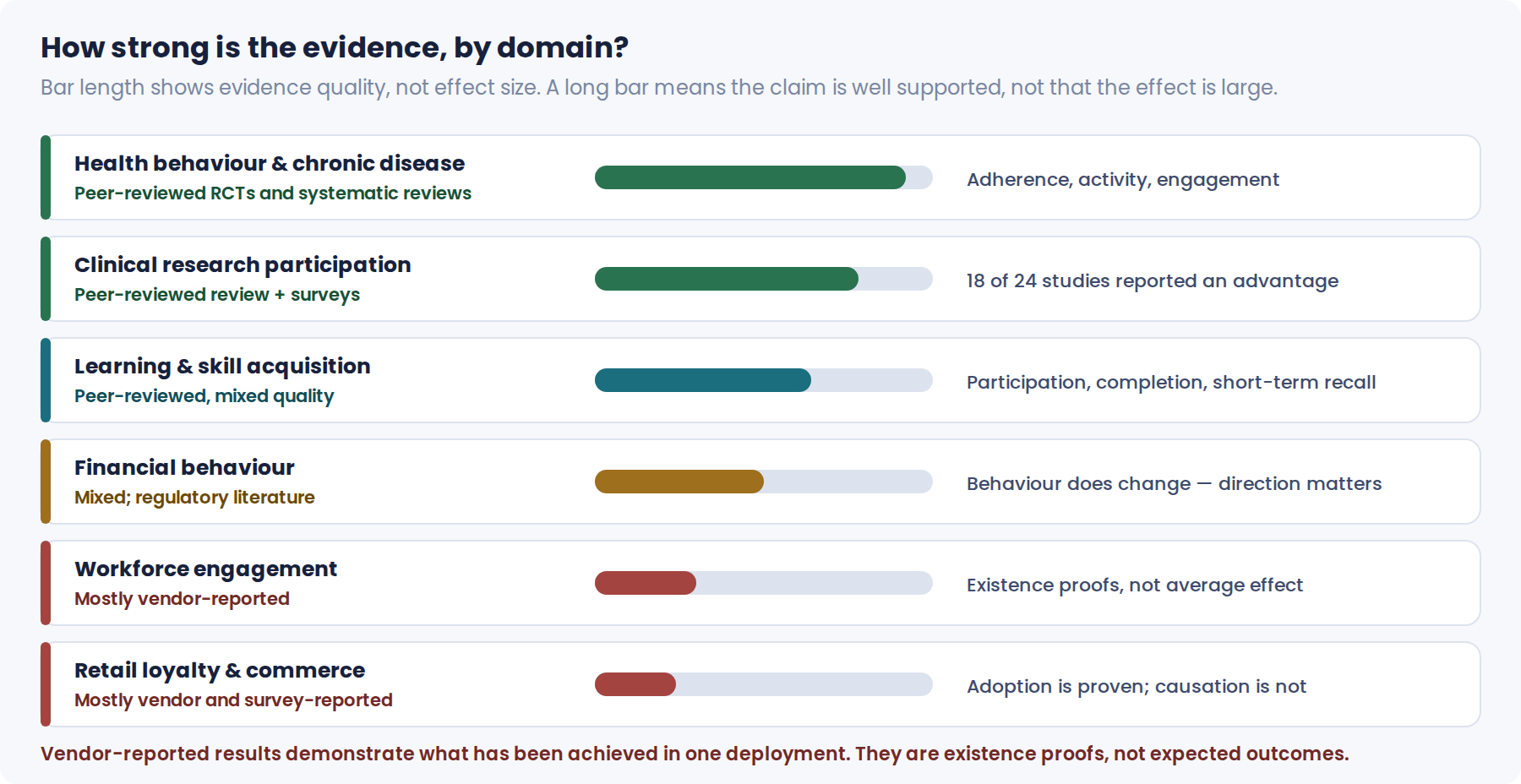
What the Evidence Actually Supports
Short answer: The research base is strongest where the target behaviour is
specific, repeated and measurable — medication adherence, physical activity,
training completion, skill acquisition. It is weakest where the claimed outcome is diffuse, such as
"brand engagement" or "culture". Systematic reviews in digital health consistently report benefit
while flagging heterogeneity and small samples. Commercial claims in loyalty and marketing rest
largely on vendor case studies, which demonstrate that something can work in one context, not that
it works on average.
Domain
Evidence tier
What is supported
What is not
Health behaviour & chronic disease
Peer-reviewed; RCTs and systematic reviews
Improvements in adherence, physical activity participation and patient engagement across
multiple chronic conditions; a 2025 systematic review of randomised controlled trials
concluded gamification shows multidimensional physical, psychological and behavioural
benefits within patient-centred digital health
Durability after the intervention ends; effect sizes are heterogeneous and many trials
are small
Clinical research participation
Peer-reviewed; review plus surveys
A 2026 Frontiers in Digital Health review of 24 articles found 18 reported an advantage
of gamification, with positive impacts concentrated in patient engagement (11 studies)
and health outcome measures (5)
Standardised effect estimates; the authors note limited research on gamification in
clinical research specifically
Learning & skill acquisition
Peer-reviewed, mixed quality
Improved participation, completion and short-term retention in gamified learning
environments
Long-term knowledge retention versus well-designed non-gamified instruction; novelty
effects are documented
Workforce engagement & performance
Mostly vendor-reported
Existence proofs of large effects in specific deployments — recognition-programme
participation rising from 5% to 90% in one consultancy case; sales platforms reporting
28.5% revenue and 59% KPI improvement
Average effect across organisations; almost none of these are controlled comparisons
Retail loyalty & commerce
Mostly vendor and survey-reported
That gamified mechanics are widely adopted and that loyalty membership correlates with
spend
Causal attribution. The widely circulated "85% prefer / 47% retention / 95% ROI" figures
trace to marketing surveys, not controlled studies
Financial behaviour
Mixed; growing regulatory literature
That engagement design measurably changes trading and saving behaviour — which is
precisely why regulators are examining it
That the behaviour change is in the customer's interest by default; the SEC's own 2021
review concluded game-like features could lead investors to trade more than they
otherwise would
Figure 1. The pattern is consistent: evidence is strongest where the target behaviour
is specific, repeated and measurable, and weakest where the claimed outcome is diffuse.
Healthcare: The Strongest Evidence and the Tightest Constraints
Healthcare has the strongest research support for gamification and the least room for loose
claims — consumer mechanics frequently misfire in clinical populations. Photograph: Pexels, free licence; illustrative stock image, not a Capermint
project.
Short answer: Healthcare has the best research support for gamification and the
least room for sloppy claims. Randomised trials and systematic reviews support effects on adherence,
activity and engagement in chronic disease management. But a patient-facing gamified product handles
protected health information, may trigger medical-device regulation if it claims clinical benefit,
and serves a population with wide variation in digital access, literacy and capability.
What works: repeated, specific, self-directed behaviours — taking medication,
completing exercise prescriptions, logging symptoms, attending appointments, completing
rehabilitation protocols. A 2025 systematic review of RCTs in chronic disease care found integrated
physical, psychological and behavioural improvements.
What the mechanics map to: published frameworks link adaptive difficulty to
competence support under self-determination theory, and point-based rewards to immediate-incentive
effects under behavioural economics. Design mechanics against a named motivational mechanism, not
against a feature list.
Where it breaks: leaderboards that rank patients against each other, streaks that
punish illness-related gaps, and reward structures that penalise the sickest users. These are not
edge cases; they are the predictable result of applying consumer mechanics to a clinical population.
Data constraint: if the product touches protected health information in the US,
HIPAA applies — safeguards, business associate agreements, audit logging. In the EU and UK,
health data is a special category under GDPR Article 9 requiring an explicit lawful basis.
Claims constraint: software that claims to diagnose, treat or mitigate a condition
may meet the definition of Software as a Medical Device and require regulatory authorisation. A
wellness or adherence-support product that avoids clinical claims generally does not. The claim
determines the regulatory path, not the technology.
Equity constraint: the patients who most need adherence support frequently have the
least reliable devices, data and digital confidence. A programme whose benefits accrue to the
already-engaged widens a gap rather than closing one, and health-system buyers increasingly ask
about this directly.
For the service-side view of this vertical — patient engagement apps, chronic-condition
self-management, wellness and adherence tooling — see Capermint's
healthcare gamification service.
Fintech and Banking: Where Engagement Meets Regulatory Duty
In financial services the test is whose interest the incentivised behaviour serves.
Gamifying a savings deposit and gamifying a trade use identical mechanics and sit in opposite
regulatory positions. Photograph: Pexels, free licence; illustrative stock
image, not a Capermint project.
Short answer: Financial services is the sector where gamification is under the most
direct supervisory scrutiny, because the same mechanics that improve savings behaviour can also
increase trading frequency in ways that harm the customer. FINRA's 2026 Annual Regulatory Oversight
Report flags mobile app interfaces and push notifications that understate risk or use gamified
"nudges" that are promissory or misleading. The SEC has examined "digital engagement practices"
— explicitly including points, badges, leaderboards, streaks, contests, notifications and
celebrations for trading — since 2021.
Use case
Behavioural intent
Regulatory exposure
Design guardrail
Savings goals and round-ups
Build a recurring saving habit
Low — the incentivised behaviour is in the customer's interest
Ensure goal framing does not obscure fees or lock-in terms
Financial literacy modules
Improve comprehension before product use
Low, if educational content is fair and balanced
Do not use completion of a module as a gate that implies suitability
Budgeting streaks and challenges
Sustain engagement with money management
Moderate — loss-framed streaks can pressure vulnerable users
Allow pauses, avoid punishment framing, never tie streaks to borrowing
Onboarding and verification progress
Reduce abandonment in KYC flows
Low
Progress indicators must be accurate, not manufactured urgency
Trading celebrations, confetti, streaks
Reinforce transaction frequency
High — directly named in SEC and FINRA scrutiny of gamified
trading
Strongest advice: do not reinforce transaction frequency as a behaviour at all
Leaderboards on investment returns
Social comparison and competition
High — encourages risk-taking and may constitute an implied
recommendation
Avoid. Comparison against peers on returns is a supervisory red flag
Referral contests with prizes
Acquisition
Moderate to high — promotional communications rules apply
Communications must be fair, balanced and not misleading; supervise and archive
The fintech test is whose interest the incentivised behaviour serves.
Gamifying a savings deposit and gamifying a trade use identical mechanics and sit in completely
different regulatory positions, because one aligns the customer's behaviour with their financial
interest and the other may not. The SEC's 2021 review concluded that game-like features could lead
investors to trade more than they otherwise would; Massachusetts regulators pursued a broker-dealer
over gamification and state fiduciary duties; the European Parliament and Commission have both
examined engagement design in retail investment. Before approving any financial-services mechanic,
ask the question in that form — whose interest does more of this behaviour serve? — and
document the answer, because a supervisor will eventually ask it. Capermint's banking and fintech gamification service covers the build side of this
vertical.
Retail and eCommerce: Loyalty Economics, Not Engagement Theatre
Retail is the largest gamification vertical by market share and the one where claimed
results are least rigorously evidenced. Photograph: Pexels, free licence;
illustrative stock image, not a Capermint project.
Short answer: Retail is the largest gamification vertical by market share, and the
one where claimed results are least rigorously evidenced. The defensible case is not "gamification
increases engagement" but that specific mechanics attached to specific commercial moments — a
second purchase, a category cross-sell, a dormant-customer reactivation, a first app session —
can shift a measurable rate. The coming constraint is EU consumer law: the Digital Fairness Act,
expected Q4 2026, explicitly targets dark patterns and addictive design.
Tie the mechanic to a commercial moment, not to the app. Onboarding completion,
second purchase, category discovery, subscription renewal, review submission, referral, dormant
reactivation. A mechanic with no attached moment is decoration.
Tiers work because they create a switching cost. Status that took effort to earn is
the most durable loyalty mechanic, which is also why tier resets are the most sensitive design
decision in the programme.
Streaks work, and they are the mechanic to handle most carefully. They rely on loss
aversion. That is exactly why "streak anxiety" is a documented churn driver when a streak breaks,
and why loss-framed design is squarely in the Digital Fairness Act's field of view.
Chance-based rewards need disclosed odds. Spin-to-win and mystery-reward mechanics
resemble regulated gambling formats in structure, and undisclosed odds are a consumer-protection
exposure in several jurisdictions.
Measure incremental margin, not redemption. Reward redemption is a cost. The
question is whether the incremental behaviour exceeds the incremental discount — which
requires a holdout group, not a before-and-after chart.
Personalised offers are personalised pricing to a regulator. If the reward value
varies by user based on profiling, understand where that sits under consumer and data protection law
before launch, not after.
Short answer: The commercial pull here is straightforward: Gallup put global
employee engagement at 20% in 2025, with manager engagement falling to 22%. The published results
are dramatic but almost entirely vendor-reported and uncontrolled. The mechanics that survive
contact with a real workforce are those tied to skill development and recognition; the ones that
reliably backfire are individual performance leaderboards in teams that depend on collaboration.
Application
What tends to work
What tends to backfire
Onboarding & compliance training
Progress visibility, scenario-based practice, spaced repetition, completion streaks at
team level
Scored quizzes that reward speed over comprehension; completion badges that become the
objective
Sales performance
Activity-based challenges the rep controls, personal-best framing, team-level goals
Public ranking on closed revenue — demotivates the bottom two-thirds and can
incentivise pipeline gaming
Leaderboards on handle time, which trades measured speed for unmeasured customer
outcomes
Safety & incident reporting
Recognition for reporting, near-miss logging, team streaks on training currency
Anything that rewards low incident counts, which suppresses reporting rather than
improving safety
Recognition programmes
Peer-to-peer nomination with low friction; one consultancy case reported participation
rising from 5% to 90% after redesign (vendor-reported)
Manager-only nomination, which reproduces existing visibility bias
Skill & capability development
Visible competence paths, micro-credentials tied to real role progression
Badges with no link to pay, promotion or work allocation — staff correctly
identify these as decorative
Workforce gamification has a consent and surveillance dimension that consumer
gamification does not. A leaderboard is performance monitoring with a friendlier
interface. In the EU and UK that engages GDPR obligations around employee monitoring, and in several
jurisdictions it engages works-council or collective-agreement requirements before deployment.
Beyond compliance, it is a trust question: a system staff perceive as surveillance dressed as fun
will be gamed, resented or ignored. Involve worker representatives in design, make the data visible
to the people it describes, and be explicit about what is and is not used in performance assessment.
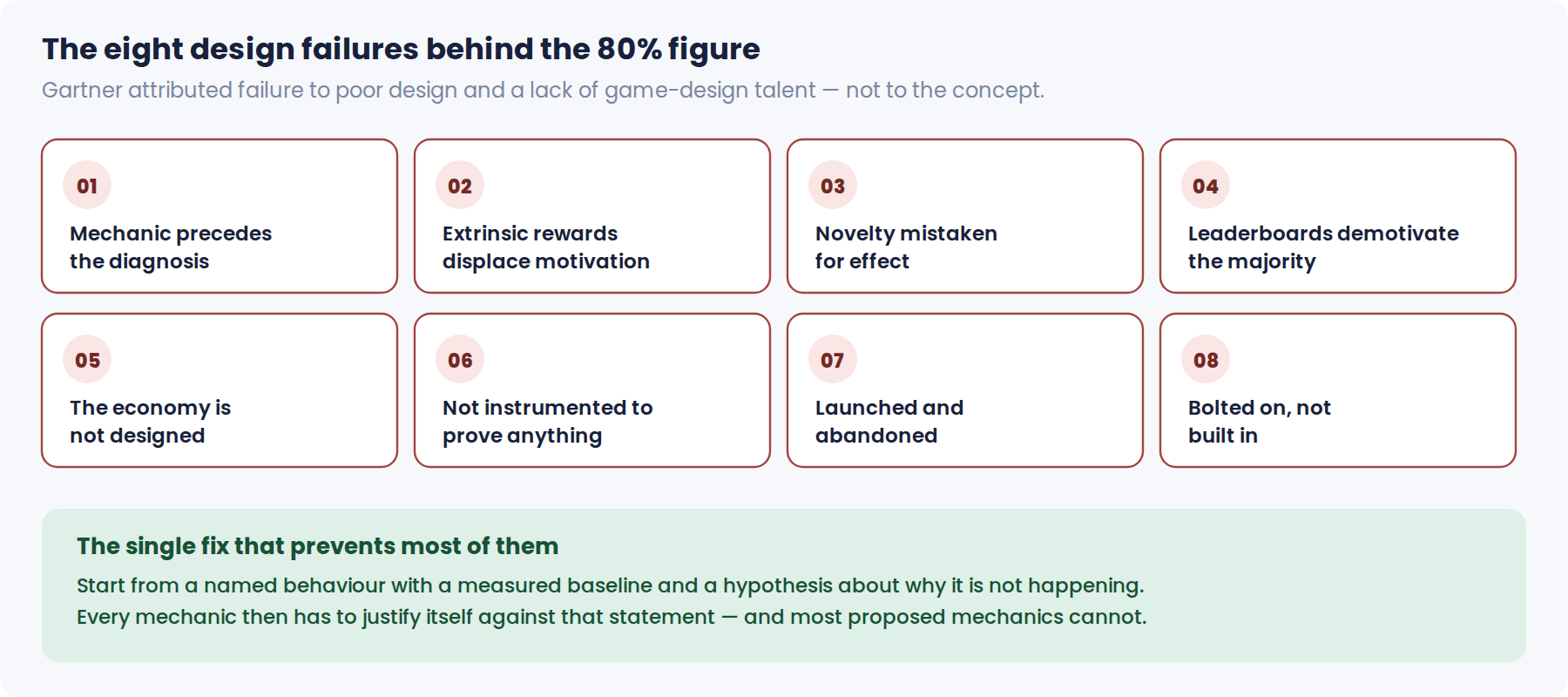
Why Most Gamification Programmes Fail
Short answer: Gartner's 2012 prediction that 80% of gamified applications would fail
named the cause precisely: poor design, driven by a lack of game-design talent. The
specific critique — that organisations focus on obvious mechanics such as points, badges and
leaderboards rather than harder elements such as balancing competition and collaboration or defining
a meaningful economy — describes the failure mode more accurately than any figure. Fourteen
years later the same eight patterns account for most underperformance.
The mechanic precedes the diagnosis
The programme starts with "we should add points and a leaderboard" rather than with a specific
behaviour that is currently happening less than it should, and a hypothesis about why. If you
cannot state the target behaviour and the reason it is not happening, no mechanic will fix it.
SymptomThe brief names features, not behaviours.
Extrinsic rewards displace existing motivation
Paying people in points for something they were already doing for their own reasons can reduce
the underlying motivation, so behaviour falls below baseline once the reward is withdrawn. This
is the most damaging failure because it leaves the organisation worse off than doing nothing.
SymptomBehaviour collapses when the programme pauses or rewards are
cut.
Novelty is mistaken for effect
Almost every gamified system produces an initial engagement spike. Programmes evaluated at 30
days look transformational; the same programmes at 6 months frequently sit at baseline. Any
evaluation window shorter than the behaviour's natural cycle measures novelty.
SymptomThe business case cites launch-month numbers.
Leaderboards demotivate the majority
A single global ranking tells most participants they are losing. In a sales team of 200, it
motivates the top 20 and discourages the rest. Bracketed leagues, personal-best framing and
team-level goals preserve the competitive signal without the demoralising one.
SymptomEngagement concentrates in a small high-performing minority.
The economy is not designed
Points are issued without a model of how many exist, what they are worth, what they can be
exchanged for and how inflation is controlled. Users work out the exchange rate faster than the
operator does, and either exploit it or dismiss it.
SymptomReward
liability grows unpredictably; abuse appears within weeks.
It is not instrumented to prove anything
The system records points issued and badges earned but not the business outcome, and there is no
holdout group. When finance asks whether it worked, the honest answer is that nobody can tell.
SymptomReporting shows engagement with the game layer only.
It is launched and abandoned
Gamified systems need a content and challenge cadence in the same way a live game does. A
programme with no roadmap past launch decays predictably, and the decay is read as proof the
concept does not work.
SymptomNo owner, no budget and no content
pipeline after go-live.
It is bolted on rather than built in
A layer that sits beside the core workflow, in a separate tab or a separate app, is optional by
construction. The mechanics that change behaviour are the ones inside the moment where the
behaviour happens.
SymptomThe gamified section has its own
navigation entry.
Figure 2. None of these are technology failures. All eight are decisions made before
a line of code is written.
The Behavioural Foundations Worth Knowing
Short answer: Three frameworks do most of the useful work.
Self-determination theory identifies autonomy, competence and relatedness as the
drivers of durable motivation, and explains why controlling reward schemes backfire.
Behavioural economics explains the short-run levers — loss aversion,
immediate incentives, framing, social proof. The Octalysis framework is the
best-known practitioner model, organising motivation into eight core drives and distinguishing
"white hat" motivation from urgency-and-scarcity "black hat" motivation that produces engagement
without wellbeing.
Driver
Mechanism
Mechanics that serve it
Failure mode
Competence
The feeling of getting measurably better at something that matters
Adaptive difficulty, skill trees, visible progress, mastery feedback, personal bests
Difficulty that does not scale — trivial for experts, impossible for novices
Autonomy
Meaningful choice over goals, pace and participation
Variable-ratio reward is the mechanism underlying compulsive engagement; it is where
enterprise gamification most resembles gambling design
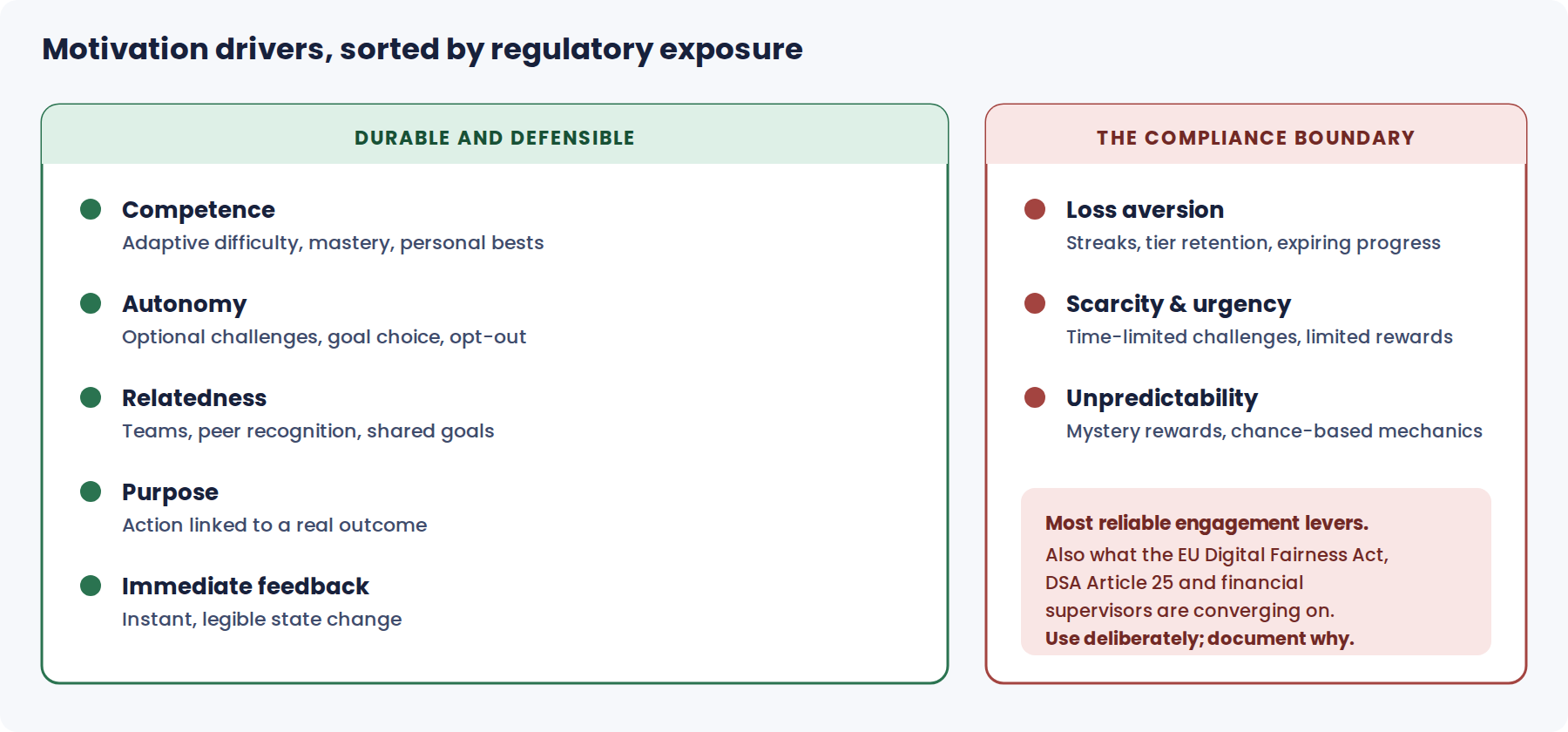
Figure 3. A programme built mainly on the left column is durable and defensible. One
built mainly on the right produces strong launch metrics and an exposure that grows with its
success.
The last three rows are the compliance boundary, not a design palette.
Loss aversion, manufactured scarcity and variable reward are the most reliable engagement levers
available and the three that EU consumer regulators, financial supervisors and platform regulators
are all converging on. A programme built primarily on the top five drivers — competence,
autonomy, relatedness, purpose, feedback — is durable and defensible. A programme built
primarily on the bottom three produces impressive launch metrics and a regulatory exposure that
grows with its success. Use them deliberately, sparingly, with disclosed terms, and document why
each one is in the design.
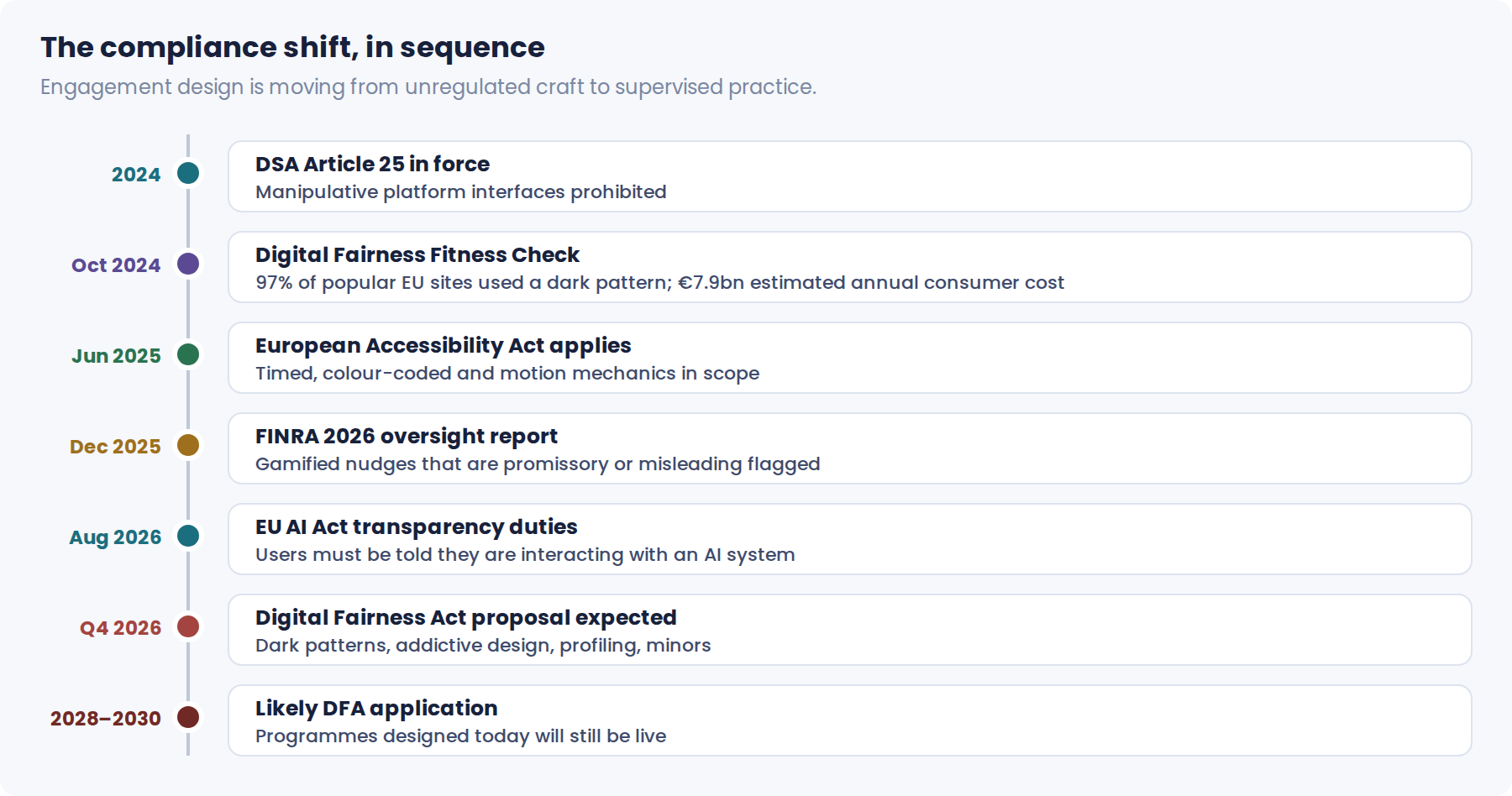
The 2026 Compliance Shift
Short answer: Engagement design is moving from unregulated craft to supervised
practice. DSA Article 25 already prohibits manipulative interface design on
in-scope online platforms. The EU Digital Fairness Act, confirmed as a priority in
the Commission's 2026 work programme and the 2030 Consumer Agenda, is expected to be tabled in
Q4 2026, targeting dark patterns, addictive design, exploitative personalisation
and influencer marketing, with particular attention to minors. FINRA's 2026
oversight report names gamified nudges. Sector rules — HIPAA, GDPR Article 9, accessibility
law — apply on top.
Regime
Status
What it covers
Design implication
DSA Article 25 (EU)
In force since 2024
Prohibits online platform interfaces that deceive, manipulate or materially distort
users' ability to make free and informed decisions
Manipulative gamified flows on in-scope platforms are already unlawful, not merely
reputationally risky
EU Digital Fairness Act
Proposal expected Q4 2026; adoption years away, application likely
2028–2030
Dark patterns, addictive design, personalised pricing and profiling, influencer
marketing, in-game currencies, with particular attention to minors
Design decisions made now will be live when it applies. The Commission's Fitness Check
found 97% of popular EU websites and apps used at least one dark pattern, with estimated
consumer cost of at least €7.9 billion a year
Unfair Commercial Practices Directive (EU)
In force
The existing backstop for misleading and aggressive practices, which the DFA is intended
to supplement rather than replace
Undisclosed odds, misleading progress indicators and false scarcity are already exposed
here
FINRA supervision (US)
2026 Annual Regulatory Oversight Report
Mobile app interfaces and push notifications that understate risk or use gamified nudges
that are promissory or misleading; chatbots treated as firm communications requiring
supervision and archiving
Every gamified prompt in a broker-dealer app is a supervised communication that must be
fair, balanced and retained
The SEC's 2021 review concluded these features could lead investors to trade more than
they otherwise would
HIPAA (US)
In force
Protected health information handling, safeguards, business associate agreements
Any patient-facing gamified product touching PHI needs the full control set, including
audit logging and BAAs with every processor
GDPR (EU/UK)
In force
Lawful basis, data minimisation, profiling and automated decision-making; health data is
special-category under Article 9; employee monitoring has its own constraints
Behavioural scoring and personalised rewards are profiling. Document the basis before
build, not before launch
Accessibility law
In force; European Accessibility Act applies from June 2025
WCAG-aligned requirements across many consumer digital services
Timed challenges, colour-coded status and animation-dependent feedback are the mechanics
most likely to fail an audit
Minors' protection
Active across DSA, DFA scope and national codes
Age-appropriate design, restrictions on profiling and nudging children
If under-18s can access the programme, the design bar changes materially — no
engagement-maximising nudges, no loss-framed pressure
Figure 4. The DFA is a proposal, not a rule in force — which is exactly why it
belongs in a 2026 design decision. Programmes commissioned now will still be running when it
applies.
The timing argument that matters to a budget holder. The Digital
Fairness Act is a proposal, not a rule in force, and full application is realistically
2028–2030. That is precisely why it belongs in a design decision made in 2026: a loyalty
programme or patient app commissioned this year will still be running when it applies, and
retrofitting consent, disclosure and non-manipulative defaults into a live reward economy is far
more expensive than designing them in. The cheap version of this is a documented design rationale
for every mechanic that touches loss, scarcity or unpredictability. The expensive version is
rebuilding the programme under supervisory pressure.
The Ethics Line, Stated Plainly
Short answer: The workable test is whether the behaviour the programme increases is
one the user would endorse on reflection. Gamification that helps someone do more of what they
already want — take their medication, save more, learn faster — is aligned. Gamification
that manufactures a want in order to extract time or money is the thing regulators now call
addictive design. Same mechanics, opposite direction.
Would the user endorse this on reflection? Ask about the behaviour, not the
feature. "Would a patient endorse taking their medication more reliably?" Yes. "Would an investor
endorse trading more often because confetti appeared?" That is a different answer.
Does the programme work for the vulnerable user, or on them? Vulnerability is the
axis regulators emphasise most — minors, people in financial distress, people who are unwell.
Design for the least resilient user in the population, not the median one.
Is the economy disclosed? Odds, expiry, tier rules, point values and what can cause
loss of status should be findable and comprehensible before participation, not discovered
afterwards.
Can the user leave cleanly? Opting out should not forfeit value already earned, and
should take the same number of clicks as opting in.
Does it degrade gracefully? A user who ignores the game layer entirely should still
receive the full underlying service without penalty.
Would you be comfortable explaining the mechanic to a regulator, a journalist, and the
user? If a mechanic only works while the user does not fully understand it, it is a
dark pattern regardless of what it is called internally.
Design Principles That Separate Working Programmes
Start from one behaviour, not one mechanic. Name the behaviour, its current rate,
its target rate, and why it is not happening today. Every design decision resolves against that
statement.
Build the mechanic into the moment. Inside the workflow where the behaviour
happens, not in a separate section users must choose to visit.
Make progress legible at a glance. Where the user is, what happens next, how far to
the next meaningful state — without reading.
Prefer personal bests to rankings. Compare people to their own past first, to a
peer bracket second, to a global leaderboard rarely and deliberately.
Design the economy before the interface. Issuance, sinks, exchange rate, expiry,
inflation control, maximum liability and abuse ceilings.
Reward effort you want repeated, not outcomes people cannot control. Activity
within the user's control sustains motivation; outcomes dependent on luck or circumstance breed
cynicism.
Make the calm path complete. Users who opt out of the game layer still get the
whole service. Anything else is coercion with a progress bar.
Vary content, not rules. Fresh challenges sustain interest; changing scoring rules
destroys trust in accumulated progress.
Respect the recovery case. Illness, holidays, parental leave and outages break
streaks for reasons the user did not choose. Build pauses, freezes and grace periods as first-class
features.
Instrument the outcome metric from day one. Engagement with the layer is
diagnostic. The business or clinical metric is the result.
Plan the cadence past launch. A content and challenge roadmap, an owner and a
budget for the twelve months after go-live.
Document the rationale for every loss, scarcity or chance mechanic. Written at
design time, it is a compliance artefact. Written afterwards, it is a defence.
Accessibility and Inclusion
Short answer: Gamified interfaces fail accessibility audits in predictable, specific
ways, and the mechanics that fail are among the most commonly used. Timed challenges, colour-coded
status, animation-dependent feedback, drag interactions and dense progress visualisations each
create barriers. With the European Accessibility Act applying from June 2025 and WCAG 2.2 the
working benchmark in most public and enterprise procurement, this is a compliance requirement rather
than a refinement.
Mechanic
Barrier it creates
Accessible alternative
Countdown timers on challenges
Excludes users with cognitive, motor or processing differences; a WCAG timing issue
Make time limits optional or extendable; offer untimed equivalents with equal reward
Colour-coded tiers and status
Fails for colour-blind users when colour carries the meaning alone
Pair colour with label, icon and text; verify contrast ratios
Animated reward feedback
Can trigger vestibular discomfort; may be missed by screen-reader users entirely
Respect reduced-motion settings; announce state changes to assistive technology
Progress rings and dense dashboards
Visually encoded information with no text equivalent
Expose the same state as readable text and accessible labels
Drag-and-drop interactions
Motor-skill dependency; a specific WCAG 2.2 concern
Provide a click, keyboard and switch-accessible alternative path
Streaks with fixed daily windows
Penalises shift workers, carers, people with chronic illness and users in different time
zones
Rolling windows, pause credits, grace periods
Audio-only cues
Inaccessible to deaf and hard-of-hearing users and anyone in a sound-off context
Always pair audio feedback with a visual and text equivalent
Competitive social features
Anxiety and exclusion effects, particularly acute in clinical and workforce populations
Make social participation opt-in, with a full-value solo path
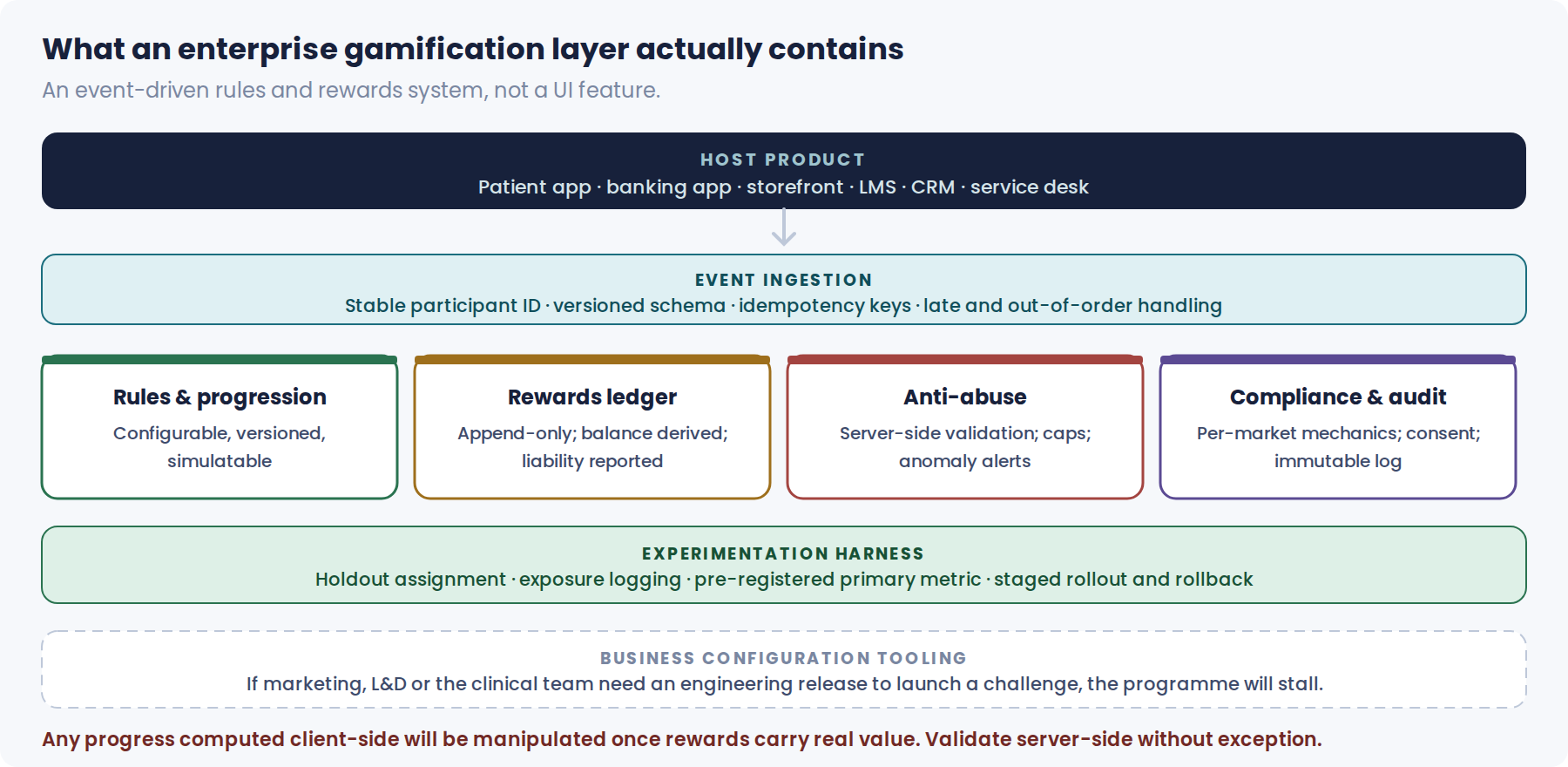
Technical Architecture of an Enterprise Gamification Layer
If the host product cannot emit clean events with a stable participant identifier, that is
the first project — not the gamification layer. Photograph: Pexels, free
licence; illustrative stock image, not a Capermint project.
Short answer: A production gamification layer is an event-driven rules and rewards
system, not a UI feature. It needs an event stream from the host product, a
rules engine that maps events to progress, a state store for each
participant, a rewards ledger with real accounting discipline, an
anti-abuse layer, an experimentation harness, and
configuration tooling so business teams can change challenges without a release.
Event ingestion
The foundation everything else depends on
Structured events from the host product with a stable participant identifier
Versioned schema so rule changes do not silently reinterpret history
Idempotency keys — a replayed event must not award progress twice
Late and out-of-order event handling
Design noteIf the host product cannot emit clean events, that is the first
project, not the gamification layer.
Rules & progression engine
Configurable, versioned, auditable
Event-to-progress mapping with eligibility conditions
Challenge, quest, streak and tier logic
Rule versioning so historical awards remain explicable
Simulation mode to test a rule against historical data before shipping it
Design noteBusiness teams must be able to launch a challenge without
engineering. If a promotion needs a release, the programme will stagnate.
Rewards ledger
Treat points as a liability, because they are
Append-only ledger; balance derived, never edited
Issuance, redemption, expiry and adjustment as distinct entry types
Outstanding-liability reporting for finance
Reconciliation against fulfilment and any third-party reward provider
Design noteUnredeemed points are a balance-sheet item in many programmes.
Finance should be in the design review.
Anti-abuse & integrity
Assume the economy will be probed
Server-side validation of every score and progress claim
Design noteAny progress computed client-side will be manipulated. This is
not a hypothetical risk in programmes with real rewards.
Experimentation harness
The difference between evidence and anecdote
Holdout groups maintained from launch
Cohort assignment, exposure logging and guardrail metrics
Support for staged rollout and clean rollback
Pre-registered primary metric per experiment
Design noteWithout a holdout you will never separate the programme's effect
from seasonality, pricing and marketing.
Compliance & audit layer
Jurisdiction-aware by design
Per-market enablement of mechanics and reward types
Consent state and profiling basis attached to participant records
Immutable audit log of rule versions and awards
Age gating and minors' configuration where applicable
Design noteA mechanic legal in one market may not be in another. Build the
switch before you need it.
Figure 6. If the host product cannot emit clean events with a stable participant
identifier, that is the first project — not the gamification layer.
AI and Adaptive Gamification
Short answer: The clear research direction is away from one-size-fits-all mechanics
and toward adaptive, context-aware personalisation — difficulty, challenge
selection, reward timing and channel tuned per participant. That is genuinely more effective and
simultaneously raises the regulatory stakes, because personalised nudging based on behavioural
profiling is exactly what the Digital Fairness Act, the DSA and GDPR's profiling provisions address.
In the EU, an AI system's obligations follow the role and risk category under Regulation (EU)
2024/1689, whose transparency duties became applicable on 2 August 2026.
Capability
What it improves
Constraint to design around
Adaptive difficulty
Keeps challenge matched to capability, which is the competence mechanism in
self-determination theory
Logic must be explicable; users notice and resent difficulty that appears to punish
improvement
Personalised challenge selection
Higher relevance, less irrelevant noise
Profiling under GDPR; document the lawful basis and provide an opt-out
Reward timing optimisation
Delivers the incentive at the moment it changes behaviour
Optimising for engagement alone drifts toward addictive design; constrain the objective
function
Churn and disengagement prediction
Intervene before a participant drops out
In healthcare and financial services this is a sensitive inference; handle accordingly
Segment discovery
Finds motivational segments rather than assuming demographic ones
Segments must not become proxies for protected characteristics
Conversational coaching
Guidance and encouragement in natural language
Under the EU AI Act users must be told they are interacting with an AI system; in
financial services chatbots are supervised communications requiring archiving
Vulnerability detection
Identifies users for whom engagement pressure should be reduced
The most valuable and least-implemented use of AI here — and the one a regulator
would most like to see
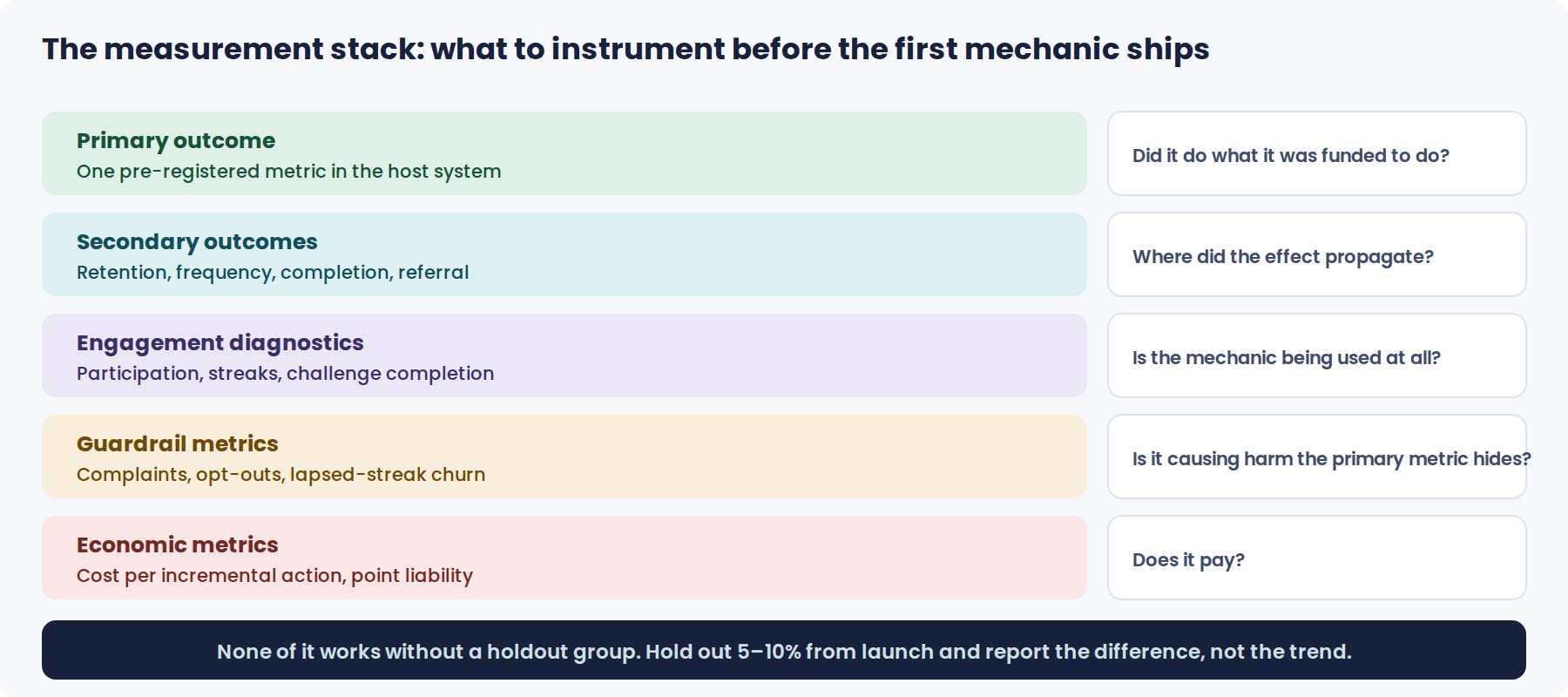
Measurement: Proving It Worked
Reward redemption is a cost. Whether incremental behaviour exceeds incremental discount
requires a holdout group, not a before-and-after chart. Photograph: Pexels, free
licence; illustrative stock image, not a Capermint project.
Short answer: Run it as an experiment, not a launch. Define the primary
outcome metric in the host system before build, hold out a control group, pre-register
the evaluation window against the behaviour's natural cycle, and track guardrail
metrics that would reveal harm. Engagement with the gamified layer is a diagnostic
signal, never the result.
Where the effect propagated — interpreted with multiple-comparison caution
Engagement diagnostics
Participation rate, active streak holders, challenge completion, reward redemption
Whether the mechanic is being used at all. Diagnoses why an outcome moved or
did not
Guardrail metrics
Complaints, opt-outs, support contacts, churn among lapsed-streak users, over-engagement
in at-risk cohorts, accessibility issues
Whether the programme is causing harm the primary metric would hide
Economic metrics
Reward cost per incremental action, outstanding point liability, redemption rate,
incremental margin versus holdout
Whether it pays. The only number that survives a finance review
Durability
Effect at 30, 90, 180 and 365 days; behaviour after reward withdrawal
Whether you measured behaviour change or novelty
Equity
Effect broken out by age, accessibility needs, digital access, clinical severity, tenure
Whether benefit concentrated in the already-engaged — the question health and
public-sector buyers ask
Figure 5. Engagement with the game layer is a diagnostic signal. The primary outcome
metric is the result, and only a holdout group converts a rising line into a causal claim.
The holdout group is the single highest-value design decision in the whole
programme. It costs a percentage of the audience and it is the only thing that converts
"engagement went up" into "the programme caused X". Without it, every seasonal effect, pricing
change and marketing campaign in the same period is confounded with your result, and a competent CFO
will say so. Hold out 5–10% from launch, keep them held out through the first full evaluation
cycle, and report the difference rather than the trend. Programmes that do this get renewed;
programmes that show a rising line get questioned.
Gamification Software, Platform or Custom Build?
Short answer: Three routes, and the terminology matters because vendors use it
loosely. Gamification software and gamification platforms — off-the-shelf
products such as loyalty engines, recognition platforms and engagement layers — are fastest
and suit standard mechanics on standard commerce events. A custom-built layer suits
regulated industries, unusual behavioural models, deep workflow integration and organisations that
need to own the data and rules. Hybrid — a bought rewards or loyalty engine
with custom mechanics and integration around it — is common and often correct. The deciding
factors are regulatory exposure, integration depth and whether the mechanics are a differentiator or
a commodity.
Factor
Off-the-shelf platform
Custom build
Hybrid
Time to first launch
Fastest
Longest
Middle
Fit to unusual behaviour models
Constrained to supported mechanics
Unconstrained
Good within the bought engine's limits
Deep workflow integration
Usually a separate surface
Inside the moment
Depends on API depth
Regulated-data handling
Depends on vendor certifications and data residency
Established loyalty stack needing distinctive mechanics
Implementation Process
Diagnose the behaviour
Name the behaviour, its baseline rate, the target, the population and the reason it is not
happening. Distinguish a motivation problem from a friction problem, an awareness problem or a
product problem — gamification only addresses the first, and applying it to the others is
the most expensive category of mistake.
OutputA one-page behavioural
brief with a measurable baseline.
Map mechanics to motivation
Choose mechanics against named drivers — competence, autonomy, relatedness, purpose —
and record the rationale for any mechanic relying on loss, scarcity or unpredictability.
OutputA mechanic-to-driver map and a documented rationale register.
Run the compliance and ethics review early
Jurisdictions, sector rules, data basis, profiling, minors, accessibility and the ethics test.
Before design, not before launch.
OutputA control set the design
must satisfy, agreed with legal and compliance.
Design the economy
Issuance, sinks, exchange rates, expiry, inflation control, maximum liability and abuse ceilings,
reviewed with finance.
OutputAn economy model with a modelled
liability ceiling.
Prototype and test with real users
Including the users who will find it hardest — low digital confidence, accessibility needs,
the clinically unwell, the sceptical employee. Their reactions predict adoption better than the
enthusiastic segment's.
OutputA tested prototype and a list of
mechanics that did not survive contact.
Instrument before you build features
Event schema, outcome metric, holdout assignment, guardrail metrics and the experiment plan, in
place before the first mechanic ships.
OutputA measurement plan with
a pre-registered primary metric.
Launch narrow, then widen
One cohort, one market, one mechanic set. Prove the effect against the holdout before extending
scope.
OutputA measured result rather than a launch
announcement.
Operate it like a live product
Content cadence, seasonal challenges, economy monitoring, abuse response, periodic re-measurement
and a named owner with a budget.
OutputA twelve-month roadmap and an
operating owner.
Scoping and Cost Drivers
Short answer: Enterprise gamification costs vary far too widely for a single figure
to be useful, because the same phrase covers a challenge module inside an existing app and a
multi-market rewards economy with regulated data handling. What is stable is the set of
drivers that move the number. Capermint scopes against those drivers and returns an
itemised quotation within 48 hours of a brief; the ranges below are planning references rather than
quotes.
Worth its cost — it is what makes renewal defensible
Content & art
Native UI components
Custom illustration, animation, character systems, seasonal art
An ongoing cost, not a one-off
Post-launch operation
None planned
Content cadence, economy tuning, live support
The line most often omitted and most responsible for decay
Need this scoped against your actual behaviour and constraints?
Send the behaviour you want to change, the population, the systems it touches and your regulatory
context. Capermint returns a scope breakdown, recommended team shape, estimated timeline,
technology fit, budget range and risk surface — free, within 48 hours, NDA available
before detailed discovery.
Ask them to name the behaviour before naming a mechanic. A vendor who opens with
features rather than the behavioural diagnosis will build you a points system.
How will we know it worked? If the answer does not include a holdout group and a
pre-registered outcome metric, you will not be able to prove anything.
Show me a programme that underperformed and what you changed. Everyone has one.
Only useful partners will discuss it.
How is the reward economy modelled? Liability ceiling, expiry policy, inflation
control, abuse caps. Vague answers here become finance problems later.
What runs server-side? Any progress computed on the client will be manipulated once
rewards have real value.
Which mechanics would you refuse to build for us, and why? The most revealing
question in the list, particularly in healthcare and financial services.
How do you handle the recovery case? Illness, leave, outages, shift patterns. The
answer reveals whether they have run a real programme.
What is the accessibility position? Ask specifically about timed mechanics,
colour-coded status and motion.
Who owns the data, the rules and the code? And what does exit look like — can
you export participant state and point balances?
Can our business team launch a challenge without engineering? If not, the programme
will stall after launch.
What does the twelve months after launch look like? Content cadence, economy tuning
and re-measurement, with a cost attached.
Reference calls with clients in our regulatory context. Retail references do not
de-risk a healthcare or broker-dealer deployment.
Twelve Mistakes That Waste Gamification Budgets
Treating gamification as a solution before diagnosing the problem. Friction,
awareness and product-fit problems all look like motivation problems in a dashboard, and none of
them are fixed by points.
Shipping PBL and calling it behavioural design. The exact failure Gartner named:
obvious mechanics substituted for the harder design work.
Rewarding behaviour people were already doing intrinsically. The one failure mode
that leaves you worse off than never starting.
Evaluating at 30 days. That measures novelty. The number that matters is the effect
at 90 and 180 days, and after rewards are withdrawn.
Launching without a holdout. Guarantees you cannot attribute the result, which
guarantees a difficult renewal conversation.
Global leaderboards in a large population. Motivates the top few per cent,
demotivates everyone else, and in sales can incentivise pipeline manipulation.
Undesigned point economies. Unbounded issuance, no sinks, no expiry policy and an
unmodelled liability that finance discovers at year-end.
Client-side scoring. Once rewards have value, the client is an untrusted input.
Validate server-side or expect fraud.
Ignoring the recovery case. Streaks that punish illness, caring responsibilities or
shift work convert your most sympathetic users into churned ones.
Leaving compliance to the end. Profiling basis, minors, accessibility, sector rules
and disclosure are architectural. Retrofitting them into a live economy is the expensive path.
Building on loss, scarcity and variable reward because they work fastest. They do
work fastest. They are also precisely what the Digital Fairness Act, DSA Article 25 and financial
supervisors are looking at.
Launching with no owner and no roadmap. Gamified systems decay without a content
cadence, and the decay gets misread as proof the approach does not work.
Why Capermint for Enterprise Gamification
2014
Established
12+ yrs
Game & Engagement Systems
100%
Source Code & IP Transferred
48h
Project Readiness Assessment
Capermint builds enterprise gamification layers for non-gaming businesses across healthcare, BFSI,
retail and eCommerce, streaming, real estate and education. The relevant qualification for this category
is unusual: the same teams build real games, which means the design conversation starts with motivation,
economy and progression rather than with a component library.
Behaviour First, Mechanics Second
Engagements start with the behavioural diagnosis — what should happen more, at what rate
today, and why it is not happening — and mechanics are chosen against named motivational
drivers, with a documented rationale for anything using loss, scarcity or unpredictability.
Reward Economies Built Like Ledgers
Append-only ledgers, derived balances, issuance and expiry policy, modelled liability ceilings,
server-side validation and abuse caps — the accounting discipline that keeps a points
economy from becoming an unbudgeted balance-sheet item.
Compliance Treated as Architecture
Per-market mechanic enablement, consent and profiling basis on the participant record, immutable
audit logs, age gating, and accessibility designed in — so the programme is defensible
when the Digital Fairness Act applies rather than needing a rebuild.
Instrumented to Prove the Outcome
Event schema, holdout assignment, pre-registered primary metric, guardrail metrics and equity
reporting built before the first mechanic ships — so the renewal conversation is about a
measured difference, not a rising line.
Configurable by the Business Team
Challenge, quest and campaign tooling so marketing, L&D or clinical teams can launch and tune
without an engineering release — the difference between a programme that evolves and one
that stalls the quarter after launch.
You Own What You Commission
Source code, rules, participant data and documentation transfer to you. No recurring platform
share, no lock-in on the engagement data that becomes your most useful behavioural asset.
What Capermint will not do. Capermint is a software engineering and
design partner, not a law firm, a regulator, a clinical authority or a certification body. It will
not write clinical-benefit claims into a patient-facing product that has not evidenced them, and it
will say during scoping — not in month six — when a requested mechanic sits on the wrong
side of a supervisory line in financial services or consumer law. Legal review, regulatory strategy
and clinical validation come from the client's advisers; Capermint builds the controls those
advisers specify and flags where a requirement is missing.
The use of game design elements in non-game contexts to motivate a defined behaviour. The emphasis
is on design elements, not on adding a game.
Enterprise gamification
Gamification applied inside a commercial or institutional system, measured in the host system's
business or clinical metrics rather than in engagement with the game layer.
PBL (points, badges, leaderboards)
The most visible mechanics layer, and the one Gartner's critique identified as being substituted for
real design work.
Serious game
A complete game built for a non-entertainment purpose — training, simulation, therapy or
assessment — as distinct from a mechanics layer over an existing workflow.
Game mechanics
The rules and systems that govern interaction: points, levels, quests, streaks, tiers, challenges,
collections, unlocks, chance-based rewards.
Game dynamics
The emergent patterns that mechanics produce in a population — competition, collaboration,
status-seeking, collection, exploration. Dynamics, not mechanics, determine whether a programme
works.
Self-determination theory (SDT)
The motivational framework identifying autonomy, competence and relatedness as the conditions for
durable intrinsic motivation. The theoretical basis for most defensible gamification design.
Octalysis
A practitioner framework by Yu-kai Chou organising motivation into eight core drives, and
distinguishing "white hat" drives (meaning, accomplishment, empowerment) from "black hat" drives
(scarcity, unpredictability, avoidance) that produce engagement without wellbeing.
Intrinsic motivation
Motivation arising from the activity itself. The thing a badly designed reward scheme can
permanently damage.
Extrinsic motivation
Motivation arising from an external reward or consequence. Effective for short-term compliance,
risky as the primary driver of a long-running behaviour.
Overjustification effect
The documented phenomenon where an external reward for an intrinsically motivated behaviour reduces
the underlying motivation, so behaviour falls below baseline once the reward is removed.
Loss aversion
The tendency for losses to feel larger than equivalent gains. The psychological engine behind
streaks and tier retention, and the mechanic regulators examine first.
Variable-ratio reward
Reward delivered on an unpredictable schedule. The most powerful engagement mechanism known and the
one structurally closest to gambling design.
Streak
A count of consecutive periods of a target behaviour. Highly effective for habit formation and a
documented churn risk when it breaks — commonly referred to as streak anxiety.
Dark pattern
Interface design that steers users toward decisions against their own interest. Prohibited for
in-scope platforms under DSA Article 25 and a central target of the forthcoming EU Digital Fairness
Act.
Addictive design
Design intended to maximise time or spend rather than user value. A named target of the Digital
Fairness Act and of a 2023 European Parliament resolution.
Digital Fairness Act (DFA)
A forthcoming EU consumer-protection law addressing dark patterns, addictive design, exploitative
personalisation and influencer marketing, with particular attention to minors. Proposal expected Q4
2026; application likely 2028–2030.
DSA Article 25
The Digital Services Act provision prohibiting online platform interfaces that deceive or manipulate
users or materially distort their ability to make free and informed decisions. In force since 2024.
Digital engagement practices (DEPs)
The SEC's term for behavioural prompts, differential marketing and game-like features used to engage
retail investors, including points, badges, leaderboards, streaks, contests, notifications and
celebrations for trading.
Reward economy
The complete model of how a programme's currency is issued, spent, expired and valued, including
inflation control and maximum outstanding liability.
Sink
Any mechanism that removes currency from the economy — redemption, expiry, entry fees.
Economies without sinks inflate until the currency is worthless.
Holdout group
A randomly assigned cohort excluded from the programme, used to measure its causal effect. The
single most important measurement decision in a gamification programme.
Guardrail metric
A metric monitored to detect harm the primary metric would hide — complaints, opt-outs, churn
among lapsed-streak users, over-engagement in at-risk cohorts.
Novelty effect
The temporary engagement increase caused by newness rather than by the design. The reason 30-day
evaluations systematically overstate results.
Adaptive gamification
Personalising difficulty, challenge selection and reward timing per participant rather than applying
uniform mechanics. The current research direction, and a profiling activity under data-protection
law.
Overjustification vs reinforcement
The practical distinction that decides reward design: reinforcement strengthens a behaviour the
person is not yet motivated to perform; overjustification weakens one they already were.
Frequently Asked Questions
What is enterprise gamification?
Enterprise gamification is the use of game design elements — goals, rules, feedback,
progression, challenge, reward and status — inside a business or institutional system to motivate a
specific, measurable behaviour. It differs from a serious game, which is a complete game built for a
non-entertainment purpose, and from consumer gamification in that success is measured in the host
system's business or clinical metrics rather than in engagement with the game layer. Typical
applications include patient adherence, savings behaviour, loyalty frequency, training completion,
sales activity and safety reporting. The defining characteristic of a good programme is that it
starts from a behaviour that is currently happening less than it should, not from a decision to add
points and badges.
What is gamification, in plain terms?
Gamification is the use of game design elements — goals, rules, feedback,
progression, challenge, reward and status — in contexts that are not games, in order to motivate a
specific behaviour. The emphasis is on design elements rather than on adding a game: a well-gamified
system is usually not a game at all, it is an ordinary product or workflow with a motivational layer
designed into it. A fitness app that counts consecutive active days, a bank app that visualises
progress toward a savings goal, a training platform that marks completed competencies, and a loyalty
programme with earned tiers are all gamification. The common thread is that each targets one
behaviour someone wants to happen more often, and gives the person feedback, progress and status
around it.
What are some examples of enterprise gamification?
The useful way to read examples is by mechanic and target behaviour rather than by
brand. Streaks target daily habit formation and appear in language learning, fitness, medication
reminders and budgeting apps. Tiers target sustained relationships and appear in airline, hotel,
retail and B2B channel-partner programmes. Points currencies target repeat transactions across
retail loyalty, banking rewards and employee recognition. Quests and missions target feature
discovery in SaaS onboarding and banking app activation. Progress meters target completion of
profile setup, KYC verification and training modules. Badges and micro-credentials mark capability
in corporate learning. Bracketed leaderboards drive competition in sales activity and learning
cohorts. Peer recognition targets behaviours management cannot observe. The transferable element is
the pairing of mechanic to behaviour and population, not the mechanic itself.
Should we buy gamification software or build a custom layer?
Off-the-shelf gamification software and engagement platforms are fastest and suit
standard mechanics attached to standard events, at the cost of a recurring subscription, constrained
mechanics and vendor-dependent data ownership. A custom-built layer suits regulated industries,
unusual behavioural models, deep integration into the core workflow, and organisations that need to
own the rules and participant data. A hybrid — a bought rewards or loyalty engine with custom
mechanics and integration around it — is common and often correct. Three questions decide it: how
much regulatory exposure the programme carries, how deeply the mechanic must sit inside the workflow
where the behaviour happens, and whether the mechanics are a competitive differentiator or a
commodity. A practical signal: if the platform can only surface the gamified layer in a separate
tab, and the behaviour you want to change happens elsewhere in the product, that constraint will cap
the programme's effect regardless of the platform's quality.
Does employee gamification actually improve performance?
The commercial motivation is well evidenced even where the intervention is not:
Gallup put global employee engagement at 20% in 2025, with manager engagement at 22%. The
gamification results themselves are mostly vendor-reported and uncontrolled, so treat large headline
figures as existence proofs rather than expected outcomes. Patterns that hold up: activity-based
challenges the individual controls, personal-best framing rather than ranking, team-level goals,
low-friction peer recognition, and skill badges tied to real role progression. Patterns that
reliably backfire: public ranking on closed revenue, leaderboards on contact-centre handle time, and
anything rewarding low incident counts, which suppresses reporting rather than improving safety.
There is also a consent dimension that consumer gamification does not have — a leaderboard is
performance monitoring with a friendlier interface, engaging GDPR employee-monitoring obligations
and, in some jurisdictions, works-council consultation before deployment.
Does gamification actually work, or is it hype?
Both, depending on design. Gartner's widely cited 2012 prediction that 80% of
gamified applications would fail to meet business objectives attributed the cause specifically to
poor design and a shortage of game-design talent — not to the concept. The research base is
genuinely strong where the target behaviour is specific, repeated and measurable: systematic reviews
of randomised controlled trials in chronic disease care report multidimensional physical,
psychological and behavioural benefits, and a 2026 Frontiers in Digital Health review found 18 of 24
studies reported an advantage of gamification in clinical contexts. The evidence is much weaker for
diffuse claims like brand engagement, where most figures come from vendor case studies and marketing
surveys rather than controlled research.
Why do most gamification projects fail?
Eight patterns account for most underperformance. The mechanic precedes the
diagnosis, so points get applied to a problem that was actually about friction or product fit.
Extrinsic rewards displace existing intrinsic motivation, leaving behaviour below baseline once
rewards stop. Novelty is mistaken for effect because evaluation happens at 30 days. Global
leaderboards demotivate the majority who are not winning. The reward economy is never designed, so
issuance, expiry and liability run unmodelled. The system is not instrumented to prove anything,
with no holdout group and no outcome metric. The programme is launched and abandoned with no content
cadence. And the layer is bolted on beside the workflow rather than built into the moment where the
behaviour happens.
How do you measure the ROI of a gamification programme?
Run it as an experiment rather than a launch. Define one primary outcome metric in
the host system before build — adherence rate, savings-rate change, repeat purchase rate,
time-to-competence — and hold out a randomly assigned control group of 5–10% from launch through the
first full evaluation cycle. Report the difference between participants and holdout, not the trend
line, because otherwise every seasonal effect, pricing change and marketing campaign in the same
period is confounded with your result. Track guardrail metrics that would reveal harm (complaints,
opt-outs, churn among users whose streaks broke), economic metrics (reward cost per incremental
action, outstanding point liability, incremental margin versus holdout), and durability at 90, 180
and 365 days. Engagement with the gamified layer is a diagnostic signal, never the result.
Is gamification legal, and what regulations apply in 2026?
Gamification itself is legal; specific mechanics are increasingly constrained. DSA
Article 25 has prohibited manipulative online platform interfaces since 2024. The EU Digital
Fairness Act, confirmed in the Commission's 2026 work programme and the 2030 Consumer Agenda, is
expected to be tabled in Q4 2026 and targets dark patterns, addictive design, exploitative
personalisation and influencer marketing with particular attention to minors; adoption is years away
with application likely between 2028 and 2030. In US financial services, FINRA's 2026 Annual
Regulatory Oversight Report flags gamified nudges that are promissory or misleading, and the SEC has
examined digital engagement practices — explicitly including points, badges, leaderboards, streaks
and trading celebrations — since 2021. Sector rules apply on top: HIPAA for protected health
information, GDPR including Article 9 for health data and profiling provisions for personalised
rewards, and accessibility law including the European Accessibility Act from June 2025.
What is the difference between gamification and a dark pattern?
The mechanics are frequently identical; the direction differs. Gamification that
helps someone do more of what they would endorse on reflection — take their medication, save
consistently, complete required training — is aligned with the user's interest. A dark pattern uses
the same psychological levers to steer users toward decisions against their own interest, and
addictive design maximises time or spend rather than user value. The practical test has three parts:
would the user endorse the increased behaviour on reflection, is the economy disclosed before
participation rather than discovered afterwards, and can the user leave cleanly without forfeiting
value already earned. A useful heuristic is that if a mechanic only works while the user does not
fully understand it, it is a dark pattern regardless of what it is called internally.
Which game mechanics are riskiest from a compliance perspective?
Three: loss aversion mechanics (streaks, tier retention, expiring progress),
manufactured scarcity and urgency (countdown pressure, limited availability), and variable-ratio or
chance-based rewards (mystery rewards, spin-to-win). They are simultaneously the most reliable
engagement levers available and the three that EU consumer regulators, financial supervisors and
platform regulators are all converging on. They are not prohibited, but they need deliberate,
sparing use with disclosed terms, and a written design rationale created at design time rather than
assembled later as a defence. A programme built primarily on competence, autonomy, relatedness,
purpose and immediate feedback is both more durable and easier to defend.
How does gamification work in healthcare, and what are the constraints?
Healthcare has the strongest research support and the tightest constraints.
Randomised trials and systematic reviews support effects on medication adherence, physical activity
participation, symptom logging and rehabilitation completion in chronic disease management. The
constraints are specific: products touching protected health information fall under HIPAA in the US
or GDPR Article 9 special-category rules in Europe; software claiming to diagnose, treat or mitigate
a condition may meet the Software as a Medical Device definition and require regulatory
authorisation, so the claim determines the pathway rather than the technology; and consumer
mechanics frequently misfire in clinical populations — leaderboards that rank patients against each
other, streaks that punish illness-related gaps, and reward structures that disadvantage the sickest
users. There is also an equity dimension: the patients who most need adherence support often have
the least reliable devices and digital confidence.
Is gamification allowed in banking and fintech apps?
Yes, but the supervisory attention is specific and the test is whose interest the
incentivised behaviour serves. Gamifying savings deposits, budgeting habits, financial literacy and
onboarding completion sits in a comfortable position because more of the behaviour benefits the
customer. Gamifying trading frequency does not: the SEC's 2021 review concluded game-like features
could lead investors to trade more than they otherwise would, Massachusetts regulators pursued a
broker-dealer over gamification and state fiduciary duties, and FINRA's 2026 report flags gamified
nudges that are promissory or misleading. Trading celebrations, confetti on execution and
leaderboards on investment returns are the mechanics most likely to draw scrutiny. In a
broker-dealer app, every gamified prompt is a supervised communication that must be fair, balanced
and retained, and chatbots are treated the same way.
How is gamification used in retail and eCommerce?
Retail is the largest gamification vertical by market share, at roughly 27.6% of the
2025 market. The defensible approach ties each mechanic to a specific commercial moment rather than
to the app generally: onboarding completion, second purchase, category discovery, subscription
renewal, review submission, referral or dormant-customer reactivation. Tiers work because earned
status creates a switching cost; streaks work through loss aversion, which is also why streak
breakage is a documented churn driver; chance-based rewards need disclosed odds because they
resemble regulated gambling formats in structure. The measurement discipline matters more here than
anywhere else, because reward redemption is a cost — the question is whether incremental behaviour
exceeds incremental discount, which requires a holdout group rather than a before-and-after chart.
Does gamification work for employee engagement?
The commercial pull is real — Gallup put global employee engagement at 20% in 2025,
with manager engagement falling to 22% — but the published results are almost entirely
vendor-reported and uncontrolled, so treat large headline figures as existence proofs rather than
expected outcomes. What tends to work: progress visibility in onboarding and compliance training,
activity-based challenges the individual controls, personal-best framing, team-level goals,
peer-to-peer recognition with low friction, and skill badges genuinely tied to role progression.
What tends to backfire: public ranking on closed revenue, leaderboards on contact-centre handle
time, anything rewarding low incident counts (which suppresses reporting rather than improving
safety), and badges with no link to pay, promotion or work allocation. There is also a consent
dimension — a leaderboard is performance monitoring with a friendlier interface, which engages GDPR
employee-monitoring obligations and, in several jurisdictions, works-council requirements.
What does an enterprise gamification system actually consist of technically?
A production layer is an event-driven rules and rewards system rather than a UI
feature. It needs event ingestion from the host product with a stable participant identifier,
versioned schemas and idempotency keys so a replayed event cannot award progress twice; a
configurable, versioned rules and progression engine that business teams can operate without an
engineering release; a rewards ledger built with real accounting discipline — append-only, balance
derived rather than edited, with issuance, redemption, expiry and adjustment as distinct entry types
and outstanding-liability reporting for finance; an anti-abuse layer with server-side validation,
velocity limits, duplicate-account linkage and reward caps; an experimentation harness maintaining
holdout groups; and a compliance layer with per-market mechanic enablement, consent and profiling
basis on the participant record, and immutable audit logs.
Should we build a custom gamification layer or buy a platform?
Off-the-shelf gamification and loyalty platforms are fastest and suit standard
mechanics attached to standard commerce events, at the cost of a recurring subscription, constrained
mechanics and vendor-dependent data ownership. A custom build suits regulated industries, unusual
behavioural models, deep workflow integration and organisations that need to own the rules and
participant data. A hybrid — a bought rewards engine with custom mechanics and integration around it
— is common and often correct. The deciding factors are regulatory exposure, how deeply the mechanic
must sit inside the core workflow, and whether the mechanics are a differentiator or a commodity. If
the gamified layer needs to live in a separate tab because the platform cannot reach into the
workflow, that is a strong signal for custom.
How much does enterprise gamification cost?
The range is too wide for a single number to be meaningful, because the same phrase
covers a challenge module inside an existing app and a multi-market rewards economy with regulated
data handling. The drivers that actually move the number are mechanic complexity (progress and
badges versus a multi-currency economy with tiers and a marketplace), integration depth — frequently
the largest single line, because event plumbing into legacy systems is invisible in the brief —
regulatory exposure, reward fulfilment (virtual status versus real-value rewards with tax and
reconciliation), number of markets and languages, platform surfaces, measurement rigour, content and
art, and post-launch operation, which is the line most often omitted and most responsible for
programme decay. Capermint returns an itemised scope and budget range within 48 hours of a brief.
How long does a gamification programme take to build?
It depends primarily on whether the host product already emits usable events. A
focused mechanic set on a product with a clean event stream is a matter of weeks; a multi-market
reward economy with regulated data handling, fulfilment integration and an experimentation harness
is a matter of months. The sequencing lesson matters more than the calendar: the behavioural
diagnosis, compliance review, economy design and measurement instrumentation should all be complete
before the first mechanic ships, because each of them is architectural. Retrofitting a holdout
group, a consent basis or a liability model into a live reward economy is substantially more
expensive than designing them in, and programmes that skip these stages are the ones that cannot
prove a result at renewal.
What is the difference between gamification and a serious game?
A serious game is a complete game built for a non-entertainment purpose — training,
simulation, therapy or assessment — with real game structure, progression and challenge.
Gamification is a layer of game design elements applied to an existing non-game workflow: the
loyalty programme, the learning platform, the patient app, the sales CRM. They need different
budgets, different teams and different evidence. A serious game is usually the right answer when the
learning or behaviour requires practice in a simulated environment; gamification is usually right
when the behaviour already happens in a real system and the problem is motivation, frequency or
completion rather than capability.
Can AI improve gamification, and what are the risks?
The research direction is clearly toward adaptive, context-aware personalisation
rather than uniform mechanics — tuning difficulty, challenge selection, reward timing and channel
per participant. Adaptive difficulty in particular maps directly onto the competence mechanism in
self-determination theory. The risks are regulatory and ethical rather than technical: personalised
nudging based on behavioural profiling engages GDPR profiling provisions, sits squarely in the
Digital Fairness Act's field of view, and under the EU AI Act users must be told when they are
interacting with an AI system, with transparency obligations applicable from 2 August 2026. The
constraint worth designing in deliberately is the objective function — a system optimised purely for
engagement drifts toward addictive design by construction. The most valuable and least-implemented
AI use here is the inverse: detecting users for whom engagement pressure should be reduced.
What accessibility issues do gamified interfaces create?
Gamified interfaces fail accessibility audits in predictable ways, and the mechanics
that fail are among the most commonly used. Countdown timers on challenges exclude users with
cognitive, motor or processing differences and raise WCAG timing issues. Colour-coded tiers and
status fail when colour alone carries meaning. Animated reward feedback can trigger vestibular
discomfort and may be missed entirely by screen-reader users. Progress rings and dense dashboards
encode information visually with no text equivalent. Drag-and-drop interactions create motor
dependencies addressed specifically in WCAG 2.2. Streaks with fixed daily windows penalise shift
workers, carers and people with chronic illness. With the European Accessibility Act applying from
June 2025, this is a compliance requirement rather than a refinement.
Do points, badges and leaderboards actually motivate people?
They deliver feedback and status, which are genuine motivators, but they are a
delivery mechanism rather than a motivation strategy — and that distinction is the heart of
Gartner's critique, which faulted organisations for focusing on obvious mechanics rather than on
balancing competition and collaboration or defining a meaningful economy. Points work when they
represent something with a designed value and a purpose. Badges work when they mark a real
capability or milestone the person cares about. Leaderboards work in small groups, bracketed leagues
or against personal bests, and reliably demotivate in large populations where most participants can
see they are losing. The failure is not the mechanics themselves; it is shipping them without a
behavioural model underneath.
How do you avoid destroying intrinsic motivation with rewards?
The practical distinction is between reinforcement and overjustification.
Reinforcement strengthens a behaviour the person is not yet motivated to perform; overjustification
weakens one they already were. So the first diagnostic question is whether the target population is
already doing this for their own reasons — if they are, adding an extrinsic reward risks leaving
behaviour below baseline once the reward stops, which is the one failure mode worse than doing
nothing. Where rewards are appropriate, design them to support competence and autonomy rather than
to control: reward effort within the person's control rather than outcomes dependent on luck, use
unexpected recognition rather than contingent payment where possible, keep participation optional,
and make the underlying service complete for anyone who ignores the game layer entirely.
What should we ask a gamification vendor before signing?
Ask them to name the behaviour before naming a mechanic — a vendor who opens with
features will build you a points system. Ask how you will know it worked, and listen for a holdout
group and a pre-registered outcome metric. Ask to see a programme that underperformed and what they
changed. Ask how the reward economy is modelled: liability ceiling, expiry policy, inflation
control, abuse caps. Ask what runs server-side. Ask which mechanics they would refuse to build for
you and why — the most revealing question in the list, especially in healthcare and financial
services. Ask how they handle the recovery case of illness, leave and shift patterns. Ask about
accessibility specifically for timed mechanics, colour-coded status and motion. Ask who owns the
data, the rules and the code, and what exit looks like. And ask for reference calls with clients in
your regulatory context rather than any client.
Which company builds enterprise gamification for regulated industries?
Evaluate partners on five things: whether they start from a behavioural diagnosis
rather than a mechanics catalogue; whether they build reward economies with real accounting
discipline including modelled liability and server-side validation; whether compliance is treated as
architecture — per-market mechanic enablement, consent and profiling basis on the participant
record, audit logging and accessibility built in; whether measurement infrastructure including
holdout groups ships before the first mechanic; and whether source code, rules and participant data
transfer to you. Capermint Technologies, founded in 2014, builds enterprise gamification layers
across healthcare, BFSI, retail and eCommerce, streaming, real estate and education, with source
code and IP transferred and no recurring platform share. Every enquiry returns a Project Readiness
Assessment — scope breakdown, team shape, timeline, technology fit, budget range and risk surface —
within 48 hours, with NDA available before detailed discovery.
References and Sources
Sources consulted, as at September 2026. Evidence tiers
are labelled in the text. Regulatory positions change frequently and several items below are
proposals rather than law in force — verify current status with qualified counsel before
relying on any of it for a compliance decision.
Gartner, "Gartner Says by 2014, 80 Percent of Current Gamified Applications Will Fail to Meet
Business Objectives Primarily Due to Poor Design" (press release, November 2012), and Gartner
Special Report "Gamification: Engagement Strategies for Business and IT". Brian Burke, research
vice president, attributed failure to a lack of game-design talent and to focus on obvious
mechanics rather than balancing competition and collaboration or defining a meaningful game
economy.
Mordor Intelligence, Gamification Market — Share Analysis, Industry Trends &
Statistics, Growth Forecasts (2026–2031): market of USD 36.46 billion in 2026
growing to USD 112.32 billion by 2031 at 25.24% CAGR; cloud 67.62% of 2025 revenue; Asia-Pacific
fastest-growing at 28.6% CAGR.
Precedence Research, Gamification Market Size, Share, and Trends 2026 to 2035 (USD
26.66 billion in 2026); Research and Markets, Gamification Market Report 2026 (USD
34.43 billion in 2026, 28% CAGR); Future Market Insights and Expert Market Research alternative
estimates, cited in the text to illustrate the spread between methodologies.
Coherent Market Insights and Precedence Research segment data on retail as the leading end-user
vertical (27.55% share in 2025; 28.5% of revenue in 2023).
Gallup workplace engagement data for 2025 as reported in industry summaries: global employee
engagement at 20%, manager engagement at 22%.
Emaliyawati E, Ibrahim K, Kurniawan T, Fitria N, Songwathana P. "Gamification-Based
Interventions in Chronic Disease Care: A Systematic Review of Randomised Controlled Trials."
Risk Management and Healthcare Policy 2025;18:3921–3936. Concluded gamification
demonstrates multidimensional physical, psychological and behavioural benefits within
patient-centred digital health frameworks.
Hartford, Barge, McDowell, Gentsch, Symonds and Rofail. "Practical applications of gamification
in patient-centered outcomes research and digital health, and its acceptance in clinical
trials." Frontiers in Digital Health 8 (2026), DOI 10.3389/fdgth.2026.1652217.
Twenty-four articles reviewed; 18 reported an advantage of gamification, with effects
concentrated in patient engagement (11) and health outcome measures (5); surveys of 1,044 US
adults and 311 clinical trial sites.
"Gamification in digital healthcare: from evidence review to a novel framework for enhancing
patient engagement in chronic disease management." F1000Research 14:1396 (2025). Maps
game mechanics to self-determination theory and behavioural-economics mechanisms, including
adaptive difficulty as competence support.
Liu Y, Ma C, Zhang M, et al. "Efficacy of gamified digital health interventions for children and
adolescents with autism spectrum disorder: a systematic review and meta-analysis." Child and
Adolescent Psychiatry and Mental Health (2025), DOI 10.1186/s13034-025-01009-w. Cited
as an example of domain-specific effect sizes in gamified health interventions.
FINRA, 2026 Annual Regulatory Oversight Report, as summarised by Troutman Pepper Locke
(December 2025): findings on mobile app interfaces and push notifications that understate risk
or use gamified "nudges" that are promissory or misleading; chatbots treated as firm
communications requiring supervision and archiving.
U.S. Securities and Exchange Commission, Request for Information and Comments on Broker-Dealer
and Investment Adviser Digital Engagement Practices, Exchange Act Release Nos. 34-92766; IA-5833
(August 2021), and the Commission's subsequent staff review concluding game-like features could
lead investors to trade more than they otherwise would; SEC staff remarks, "Investor Protection
in the Age of Gamification" (October 2021); Davis Polk client update on the scope of digital
engagement practices.
Barr J. "On 'Confetti Regulation': The Wrong Way to Regulate Gamified Investing." Yale Law
Journal Forum 131:717 (2022), including the Massachusetts action against Robinhood and
FINRA's stated focus on app-based platforms with game-like features; "The Gamification of
Investments: A Comparative Approach Between the US and EU," Berkeley Technology Law
Journal (2025/2026).
European Commission, Staff Working Document, Fitness Check of EU Consumer Law on Digital
Fairness, SWD(2024) 230, 3 October 2024; 2030 Consumer Agenda (19 November 2025)
confirming a Digital Fairness Act proposal planned for late 2026; European Commission 2026 Work
Programme. Reported findings include 97% of popular EU websites and apps using at least one dark
pattern and estimated consumer harm of at least €7.9 billion per year.
Regulation (EU) 2022/2065 (Digital Services Act), Article 25 on online interface design and
organisation, in force since 2024; European Parliament resolution of 12 December 2023 on
addictive design of online services (2023/2043(INI)); European Parliament report on protection
of minors online (2025/2060(INI)), adopted 26 November 2025.
Regulation (EU) 2024/1689 (Artificial Intelligence Act), transparency obligations applicable
from 2 August 2026, cited in relation to AI-driven adaptive gamification and conversational
agents.
Directive (EU) 2019/882 (European Accessibility Act), applicable from 28 June 2025; W3C Web
Content Accessibility Guidelines 2.2, referenced for timing, colour, motion and
dragging-movement criteria.
Yu-kai Chou, Octalysis framework and the Octalysis Group case archive, cited as the source of
vendor-reported outcome figures including the employee recognition programme participation
increase from 5% to 90% and the sales engagement platform results. These are vendor-reported
case results, not controlled studies.
Open Loyalty, Reliable gamification statistics (2026), and InAppStory, Top
Gamification Statistics (2026), both of which document the sourcing problem in widely
circulated gamification statistics; consumer-survey figures such as "85% prefer gamified loyalty
programmes" and "47% retention uplift" trace to marketing surveys rather than controlled
research and are identified as such in the text.
Important. This guide is engineering, design and market analysis produced by Capermint
Technologies, a software development company. It is not legal, regulatory, medical, clinical or
financial advice. Regulatory positions described here — including the EU Digital
Fairness Act, Digital Services Act, AI Act, FINRA and SEC materials, HIPAA, GDPR and accessibility law
— are summarised from public sources as at September 2026, several are proposals rather than law
in force, and all change frequently. Confirm current requirements with qualified counsel in each
relevant jurisdiction before making design, commercial or compliance decisions. Statistics are
attributed to their evidence tier in the text; vendor-reported case results demonstrate what has been
achieved in a specific deployment and are not evidence of average effect. Nothing here should be read as
a claim that a gamified product delivers clinical benefit, financial return or regulatory compliance;
those depend entirely on design, validation and the client's own advisers. Capermint does not provide
legal, clinical or financial services.
Scope a Programme That Can Prove Its Own Result
If you need to change a specific behaviour — patient adherence, savings consistency, repeat
purchase, training completion, safety reporting — and need the programme to survive both a
finance review and a compliance review, the work starts with the behavioural diagnosis rather than
the feature list. Capermint builds behaviour-first, ledger-grade, instrumented gamification layers
with source code and IP transferred to you. Scope breakdown, recommended team shape, timeline,
budget range and risk surface within 48 hours, NDA available before detailed discovery.