AI-Native iGaming Platform: Build Infrastructure You Own, Not Another White-Label
A technical and commercial reference for operators, founders and investors evaluating an
iGaming platform build. It defines what "AI-native" means architecturally, breaks the platform down module
by module, sets out the real economics of white-label versus turnkey versus owned infrastructure, and covers
PAM and wallet design, sportsbook plus betting exchange, jurisdiction-aware configuration, AI governance
under current regulation, certification, payments, migration, build costs and timelines.
Updated: September 2026Read time: 75 minFor: Operators, founders, CTOs, investors, land-based groups going online, B2B
suppliers
$121.9B
Online gambling market, 2026 estimate
15–40%
Of GGR typically paid away under white-label revenue share
€47,450
Annual Curaçao B2C licence fee under the LOK regime
2 Aug 2026
EU AI Act transparency obligations applicable
CT
Capermint Technologies | Game & Platform Engineering · Est. 2014
Unity, Unreal, HTML5 and native mobile · Real-money and social gaming
systems · Modular backend and API engineering · 100% source code and IP ownership
transferred · Offices in Ahmedabad, Atlanta, Montréal, Bella Vista and Dubai
Published September 2026 · Sources: market research from Mordor, Grand
View, Research and Markets and Statista; official fee schedules and rules from the Curaçao
Gaming Authority, Malta Gaming Authority, UK Gambling Commission, Brazil's SPA and AGCO Ontario;
Regulation (EU) 2024/1689; GLI standards; and published operator and supplier benchmarks —
all cited in full at the end
Scope and standing. This guide is written for licensed and licensable operators
building in regulated or regulating markets. It is engineering and commercial analysis, not legal
advice. Gambling law is jurisdiction-specific and changes frequently; nothing here authorises an
operator to offer gambling anywhere, and every figure quoted should be confirmed against the regulator's
current published schedule before it is put in a budget. Capermint builds software. It does not hold
gaming licences, does not operate gambling services, and does not advise on whether a particular market
may lawfully be served — that is a question for qualified gaming counsel in the relevant
jurisdiction.
The iGaming industry has changed dramatically. Operators are expected to launch faster, enter multiple
markets, support different currencies and languages, integrate dozens of third-party services, run
sportsbook and casino products side by side, personalise player experiences, and satisfy regulators
whose technical requirements grow every year — all while keeping technology and operating costs
under control.
Yet many operators still depend on rigid, vendor-controlled platforms. Adding a payment provider can
require a development cycle. Launching in another country can mean rebuilding parts of the platform.
Changing the sportsbook, wallet, bonus engine or reporting system may depend on a third party's roadmap.
And scaling the business often means scaling the cost of the technology stack at the same time.
This is where an AI-native iGaming platform becomes relevant. An AI-native platform is not a traditional
casino platform with a chatbot bolted onto the dashboard. It is an architecture designed around
automation, intelligence, modularity and operator ownership from the beginning — and, in 2026,
around the fact that both gambling regulators and AI regulators now take an active interest in how
automated decisions are made inside it.
Quick Answer
What is an AI-native iGaming platform, and why does the architecture matter commercially?
An AI-native iGaming platform is an operator-owned, modular gaming infrastructure in
which automation and machine intelligence sit inside the architecture — in segmentation,
personalisation, risk, fraud, support and reporting — rather than being attached as a feature.
It matters commercially because the platform model determines how much revenue an operator keeps and
how fast it can move. White-label arrangements typically cost 15–40% of gross gaming
revenue in perpetual revenue share, and the operator does not own the codebase, the
business logic or, critically, the player data. A turnkey or custom-built platform carries a higher
upfront cost but converts that recurring share into an owned asset with infrastructure-only running
costs. The architectural requirement that makes this possible is modularity: a core
PAM and single wallet, with casino, sportsbook, exchange, bonus, payment, compliance and
intelligence modules that can be added, replaced or reconfigured per market without rebuilding the
platform.
Core ideaOwn the infrastructure; rent only what is genuinely commodity
ArchitectureModular services around one PAM and one wallet
AI's jobIntelligence and repetitive work — with human oversight retained
Cost modelCapex now instead of a permanent share of GGR
Market entryConfiguration per jurisdiction, not a separate stack
ConstraintLicensing, certification and AI governance are design inputs, not afterthoughts
Short answer: An iGaming platform is the software stack that runs
an online casino or sportsbook: player accounts, wallet, games, betting, payments, bonuses,
compliance and reporting. Its centre is the PAM (player account management system),
which owns the player record. Operators obtain a platform in one of three commercial models —
white-label (rent the platform and often the licence, pay a share of revenue),
turnkey (a production-ready platform delivered and owned by the operator), or
custom build (designed and built to the operator's specification). "AI-native"
describes how intelligence is embedded in that architecture, not which commercial model is used.
iGaming platform
The core software stack behind an online casino or sportsbook: player accounts, authentication,
wallet, transactions, game and bet integration, bonusing, compliance controls, back office and
reporting. Everything a player touches, plus everything the operator and the regulator need
behind it.
PAM (player account management)
The system that owns the player record — identity, wallet balance, transaction history,
KYC status, bonus entitlements and responsible-gambling limits. It is the source of truth every
other system reads from and writes to, and the place where server-side controls such as deposit
limits and self-exclusion are enforced so a client, a second device or another brand cannot
bypass them.
AI-native architecture
An architecture in which machine learning and automation operate on unified operational data
inside the platform — segmentation, recommendation, churn and VIP prediction, fraud and
risk signals, support automation, anomaly detection and reporting — rather than being
added later as an isolated tool on top of fragmented systems.
White-label
The operator launches a brand on a provider's technology, licence, content and payment
infrastructure. Fast and capital-light; the operator rents the engine and owns the paint job.
Published market ranges put setup at roughly $5,000–$20,000 at entry tier and
$50,000–$150,000+ at enterprise tier, with ongoing cost as revenue share or a fixed
monthly fee.
Turnkey platform
A production-ready platform delivered to the operator with source code, documentation and IP
transferred at handover. No perpetual revenue share; ongoing cost is infrastructure and
development. Typically positioned between white-label and full custom on both price and
timeline.
Custom build
A platform designed and engineered to the operator's specification, usually where the product
itself is the differentiator — a novel exchange model, a specific market's mechanics, a
proprietary risk engine, or an existing land-based business that must be mirrored online.
Game aggregator
A supplier that delivers content from many studios through one integration. The major
aggregators publish libraries in the range of 30,000–45,000 games from 150–300+
providers, which is the practical alternative to negotiating, integrating and certifying every
studio individually.
Sportsbook vs betting exchange
A sportsbook prices markets and takes the other side of the bet, earning the overround
built into its odds. An exchange matches players against each other on back and lay sides and
earns a commission on net winnings, typically in the 2–5% range. Different
economics, different risk profile, different liquidity requirements — and they can share
one platform.
Where Traditional iGaming Platforms Break
Short answer: A conventional platform gets an operator to market quickly, but speed
at launch does not translate into flexibility at scale. Four structural problems recur:
vendor dependency across a dozen third parties, every business change
becoming a development project, cost that scales with the business rather than
against it, and fragmented data that makes both intelligence and
regulatory reporting harder than they should be.
1. Too Much Vendor Dependency
Operators frequently depend on separate external providers for casino management, sportsbook, payments,
KYC, CRM, bonuses, risk management, analytics, game aggregation, reporting and affiliate management.
Each dependency introduces another contract, integration, API, commercial relationship and point of
failure. The result is a platform that technically belongs to the operator but operationally depends on
several vendors — and, increasingly, a supply chain that regulators examine directly. The UK
Gambling Commission raised its risk rating for gambling software suppliers from low to medium in its
July 2026 assessment, and supervisory attention on B2B supply chains is rising across jurisdictions.
2. Every Change Becomes a Development Project
Introduce a new wallet rule. Change a bonus structure. Add a payment provider. Create a region-specific
promotion. Modify sportsbook exposure limits. Add a currency. With a rigid architecture, each of these
relatively small business changes can require developers, external vendors, a place in someone else's
release queue and additional cost. The commercial damage is not the invoice; it is the tempo. An
operator that needs six weeks to test a new bonus mechanic competes badly against one that needs an
afternoon.
3. Scaling Can Become Expensive
A platform may work perfectly for one market. When the operator expands into several, complexity grows on
every axis at once: languages, currencies, payment methods, sports, casino content, regulations, player
behaviours, bonus structures, tax treatment and reporting formats. A platform designed for one market
can become expensive to adapt for five or ten — and under a revenue-share model, the technology
bill grows in direct proportion to success, which is precisely backwards.
4. Data Is Often Fragmented
Casino, sportsbook, payments, CRM and player activity frequently live in separate systems with separate
identifiers and separate definitions of the same event. This makes a complete view of the player journey
hard to assemble, and it is the single biggest practical obstacle to useful AI: models are only as good
as the unified operational data behind them. Fragmentation also has a compliance cost, because
source-of-funds review, affordability signals, self-exclusion enforcement and regulatory returns all
assume one coherent player record.
The dependency that matters most is the player data. Under a
white-label arrangement the player record typically sits in the provider's environment on shared
infrastructure. That has three consequences operators tend to discover late: the operator cannot
freely use its own behavioural data for modelling, migration becomes materially harder because the
data does not simply travel with the brand, and at exit the acquirer is buying a brand and a
contract rather than an asset. Player data is the compounding asset in this business. Where it lives
is an architectural decision with a valuation consequence.
What "AI-Native" Actually Means
Short answer: AI-native means automation and intelligence are part of the platform
architecture, operating on unified operational data, rather than a feature added on top. Practically
it covers player segmentation, personalisation, bonus recommendation, fraud and risk signals,
support automation, content recommendation, operational analytics, marketing optimisation, churn
analysis, behaviour analysis, automated reporting and anomaly detection. It does not mean AI makes
every decision: regulators increasingly expect lawful, transparent and explainable implementation
with meaningful human oversight, and the EU AI Act's transparency obligations became applicable on 2
August 2026.
The distinction is architectural, not marketing. A chatbot attached to a back office reads from whatever
data it is given. An AI-native platform is designed so that every material event — registration,
deposit, bet, session, bonus grant, support contact, withdrawal, limit change — lands in a
consistent event stream with a stable player identifier, so that models can be trained, evaluated,
versioned and audited against the same record the regulator would examine.
Capability
What it does operationally
What it needs from the architecture
Governance requirement
Player segmentation
Groups players by value, behaviour, product mix and lifecycle stage, continuously rather
than in monthly batches
Unified event stream, stable player ID across casino, sportsbook and payments
Segments used for marketing must exclude self-excluded and flagged players by
construction, not by filter
Personalisation & recommendation
Orders the lobby, surfaces relevant content and times offers. Supplier-published results
for lobby personalisation include 12–16% growth in average turnover per user and
9–12% more active days in one two-market implementation
Real-time feature store, content metadata, latency budget in the lobby render path
Must not intensify play for at-risk players; personalisation and safer-gambling logic
have to read the same signals
Churn and VIP prediction
Flags disengagement before it appears in revenue and identifies future high-value
players earlier
Historical cohort data, labelled outcomes, model monitoring for drift
Predicted VIP status must not override affordability and interaction requirements
Device and session telemetry, payment events, graph linkage between accounts
The UKGC's 2026 assessment highlights AI-generated fake documents, deepfakes and face
swaps used to bypass KYC — detection must itself be adversarially tested
Safer-gambling detection
Behavioural markers of harm surfaced for trained human review and intervention
Industry guidance is explicit that the model is AI informing trained human oversight,
not replacing it
Support automation
Handles routine contacts, routes the rest with context attached
Access to account state through the PAM, not a parallel copy
Article 50 transparency: people must know they are interacting with an AI system
Operational analytics & reporting
Automated regulatory returns, anomaly detection in GGR, margin, payment approval and bet
patterns
One warehouse fed by the same event stream that serves the product
Figures reported to a regulator must be reproducible from immutable records
The objective is not "AI makes every decision". The objective is that AI handles
more of the intelligence and repetitive work while the operator retains control. That
is both an ethical position and an operational one. Where an automated system influences customer
access, payments or risk classification, an operator needs to be able to explain what information
fed the decision, how the model was tested, and when staff should override or investigate the
output. Build that explainability in at design time and it costs very little; retrofit it under
regulatory pressure and it costs a great deal.
Modular Architecture: Use What You Need, Add What You Do Not
Short answer: The future of iGaming platforms is unlikely to be one giant system
where every operator receives identical functionality. A modular architecture lets a business
assemble its stack around actual requirements: a core platform holding player, wallet and account
services, with casino, sportsbook, exchange, bonus and gamification, and intelligence modules
attached around it. The advantage is that the platform does not have to be rebuilt every time the
business evolves — modules are added, removed or upgraded.
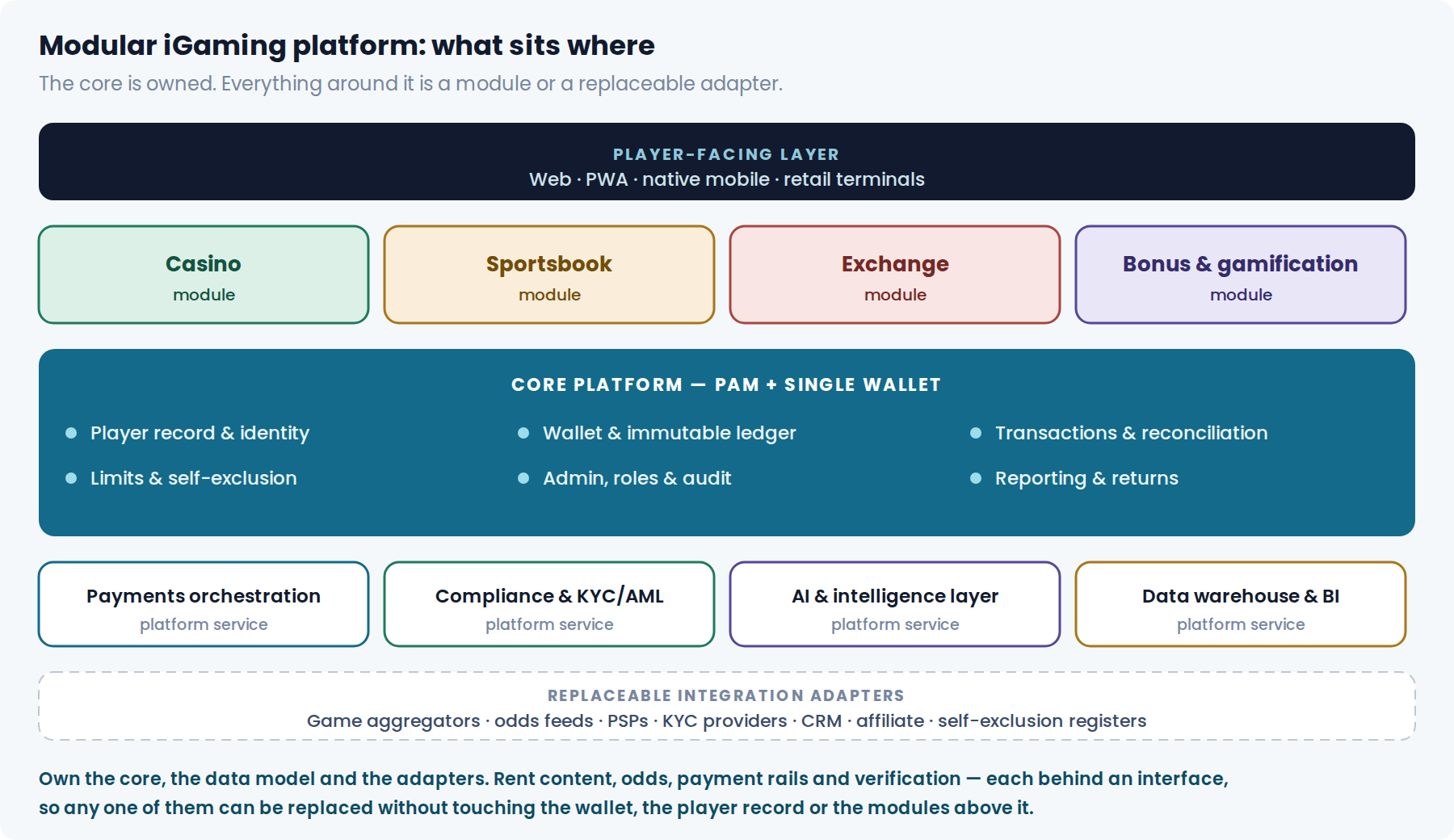
Figure 1. The boundaries are the architecture. If a module cannot be replaced without
touching the wallet, the platform is monolithic regardless of how it is described.
Core platform
Always required · the thing you must own
Player management and account lifecycle
Wallet and balance management
Authentication, sessions and device binding
Transaction management and ledger
Admin panel and role-based back office
Reporting and regulatory returns
Notifications and messaging hooks
Design noteThis is the PAM. Every server-side control — limits,
self-exclusion, cooling-off, KYC gates — belongs here so it cannot be bypassed by a client
or a second brand.
Casino module
Content-heavy · integration-led
Casino lobby and merchandising
Game aggregation and provider management
Remote game server (RGS) integration
Jackpot and tournament management
Game-level configuration and RTP variants by market
Bonus configuration for casino mechanics
Design noteTreat content as pluggable. Aggregator relationships change; the
lobby, merchandising logic and player-facing experience should survive a change of supplier.
Sportsbook module
Latency-critical · risk-bearing
Pre-match and in-play betting
Odds feed ingestion and margin configuration
Bet placement, acceptance rules and settlement
Risk management and exposure limits
Event, market and competition management
Sportsbook-specific reporting and liability views
Design noteDecide early whether you consume priced odds or run your own
pricing from raw data. Most operators consume priced feeds; proprietary pricing is a
trading-team business, not a software feature.
Betting exchange module
Liquidity-dependent · order-book mechanics
Back and lay markets with an order book
Bet matching engine
Market creation, suspension and settlement
Exposure and liability controls per user
Commission calculation on net winnings
Exchange wallet and unmatched-stake handling
Design noteThe hard problem is liquidity, not code. Plan how markets are
seeded and which events get depth before committing to the vertical.
Bonus & gamification
Where product velocity is won or lost
Welcome bonuses, free bets, free spins, cashback
Loyalty tiers, missions, tournaments, reward systems
Wagering requirement engine and contribution rules
Campaign targeting, scheduling and caps
Bonus cost accounting and abuse controls
Design noteThis module should be configurable by the commercial team
without a release. If a promotion needs a developer, the platform is not finished.
Payments module
Revenue-critical · multi-provider by default
Cashier with market-specific methods
Multi-PSP routing, retry and failover
Payout workflows, approvals and limits
Reconciliation against the ledger
Chargeback and dispute handling
Currency and FX handling, crypto where lawful
Design noteBuild the orchestration layer as your own; treat individual PSPs
as replaceable. Approval rates vary by market and by provider, and no single PSP is best
everywhere.
Compliance & player protection
Jurisdiction-configurable · audited
KYC/AML workflows and screening
Deposit, loss, stake and session limits
Self-exclusion, including national register integration
Geolocation and market blocking
Affordability and customer-interaction workflows
Immutable audit logging and regulatory reporting
Design noteEvery control needs a jurisdiction dimension from day one.
Retrofitting "which rule applies to this player" into a single-market schema is one of the most
expensive rewrites in this industry.
AI & intelligence layer
Reads everything · decides nothing alone
Segmentation and personalisation services
Churn, VIP and lifetime-value prediction
Fraud, collusion and bonus-abuse signals
Safer-gambling behavioural markers
Recommendation for content and offers
Automated insight, alerting and anomaly detection
Design noteVersion every model, log every inference that affects a player,
and keep a documented human-override path. This is what turns "we use AI" into something you can
show a regulator.
The advantage of this structure is simple: the platform does not need rebuilding every time the business
evolves. Modules are added, removed or upgraded independently. An operator can launch casino-only, add
sportsbook in month nine without touching the wallet, and replace an aggregator in month twenty without
disturbing the bonus engine — provided the contracts between modules were designed properly at the
start.
The PAM and the Single Wallet: The Part You Must Own
Short answer: The PAM is the system of record for durable player and monetary state:
identity, balance, transactions, KYC status, bonus entitlements and responsible-gambling limits.
Games, payment providers, CRM and reporting all treat it as the authority. The architectural reason
controls belong in the PAM rather than the front end is enforcement location
— a deposit limit enforced in the account record cannot be bypassed by a client, another
device or a second browser tab, and a self-exclusion held at the player record travels with the
player across every brand on the platform.
If an operator owns exactly one thing in its stack, it should be this. Content can be aggregated, odds
can be licensed, PSPs can be swapped, and CRM tools come and go. The player record and the wallet are
what the business actually is.
PAM versus CRM: A Boundary Worth Settling Early
Vendors on both sides claim the overlap, which makes the distinction worth stating plainly.
Architecturally the split is clean: the PAM owns state; the CRM consumes events and makes
decisions. Registration, verification status, balances, transactions and bonus state live
in the PAM. Segmentation, journey orchestration, message selection and campaign triggering live in the
CRM. Some suppliers deliberately blur this by bundling segmentation and triggers inside the PAM, which
is commercially convenient and architecturally muddy — it is also the reason some operators find
they cannot change CRM without changing platform.
Single Wallet Architecture
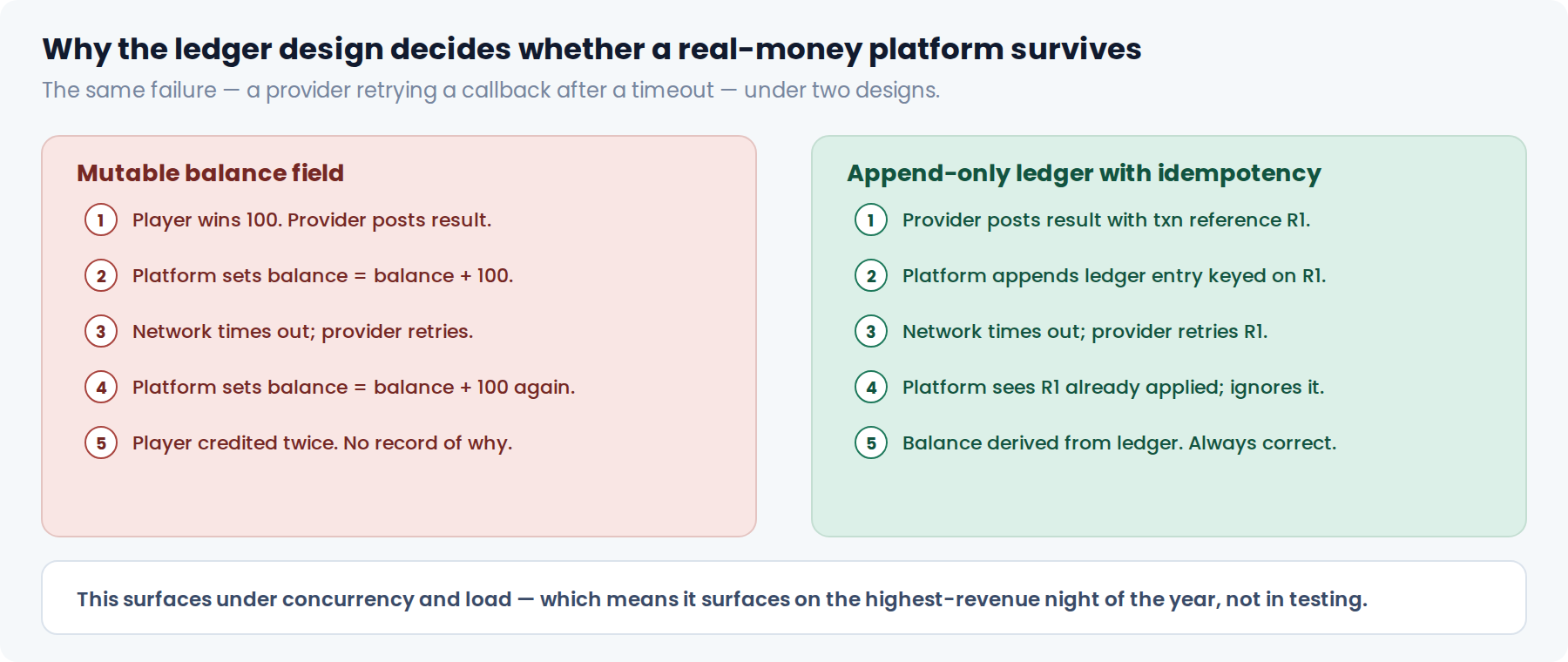
Figure 4. Idempotency and an immutable ledger are not architectural preferences. They
are the difference between a platform that reconciles and one that quietly loses money.
A single wallet means one player balance shared across casino, live casino, sportsbook and exchange. It
is what allows a player to move between products without transferring funds, and it is what allows the
operator to see one coherent financial position per player. The engineering requirements are unglamorous
and non-negotiable: an append-only ledger as the source of truth rather than a mutable balance field;
idempotent transaction handling so a retried game-round callback cannot double-credit; strict
reconciliation between the ledger, provider transaction reports and PSP settlement files; and
deterministic handling of the failure modes that actually occur in production — a bet debited
while the game provider times out, a partially settled exchange order, a withdrawal approved while a
chargeback lands.
Immutable ledger, derived balance. Balance is a projection of the ledger, never a
field that is directly edited. Every adjustment, including manual ones by staff, is an entry with an
actor, a reason code and a timestamp.
Idempotency everywhere money moves. Every provider callback carries a unique
transaction reference; replays are recognised and ignored rather than reprocessed. This is the
single most common source of real financial loss in poorly built platforms.
Segregation of bonus and cash funds. Wagering contribution, withdrawal eligibility
and bonus expiry must be computed from ledger state, and the player must be able to see which
portion of their balance is which.
Server-side limits, always. Deposit, loss, stake, session and cooling-off controls
are evaluated in the PAM on every relevant request, not enforced by hiding a button in the UI.
Self-exclusion that travels. Across brands, products, devices and — where the
market requires it — into national registers. Ontario's Registrar's Standards, for example,
require registered operators to support the centralised self-exclusion registry and enforce account
restrictions within one hour of registration, with direct marketing to self-excluded individuals
ceasing immediately. Sweden's SIFS 2026:3 sets out a comparable technical connection to Spelpaus.
Full audit trail. Every action logs, and reporting reads from the same store as the
product rather than a parallel one. If your regulatory return and your BI dashboard can disagree,
you have two problems, not one.
One Platform, Multiple Markets
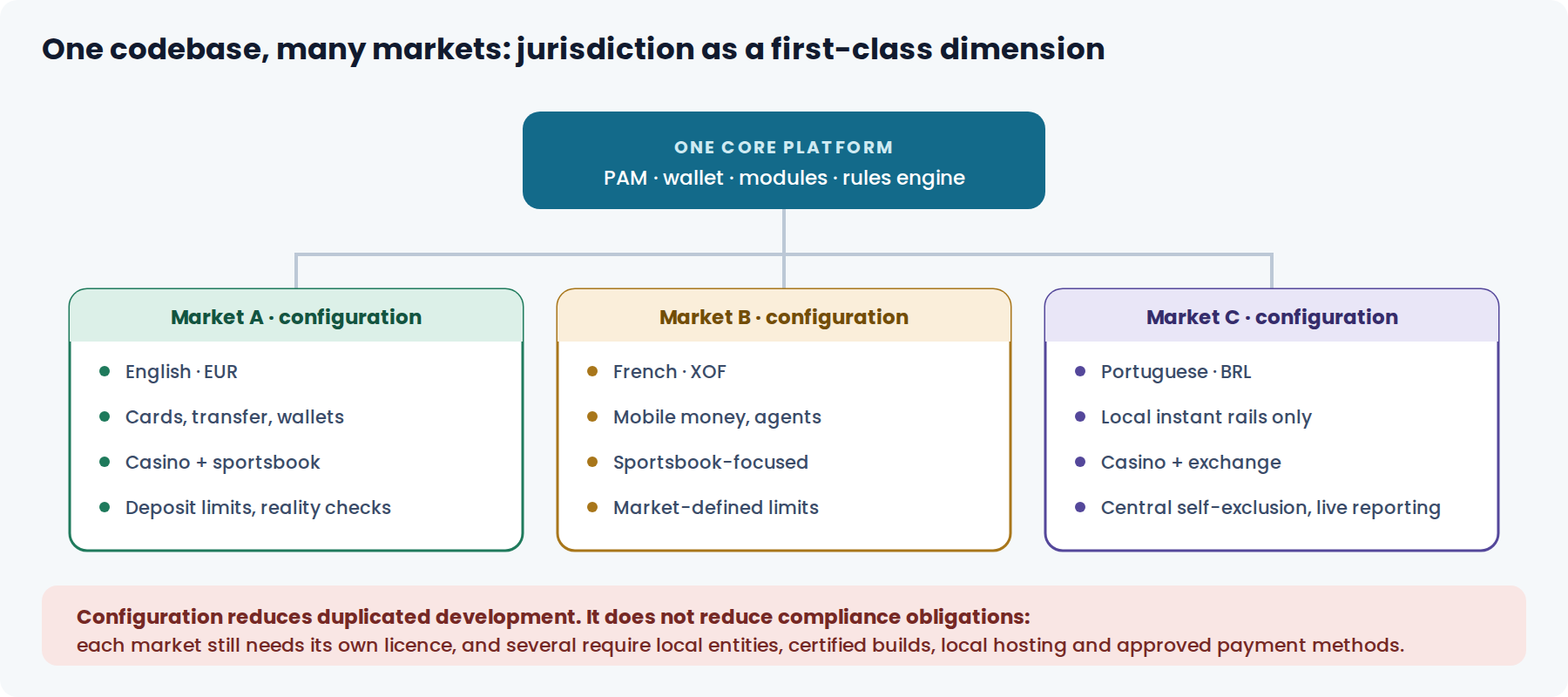
Figure 6. Every player, transaction, bonus and report carries its market, and every
rule resolves against it at runtime. Retrofit this in year two and it is a schema migration, not a
setting.
Short answer: International expansion becomes far easier when the platform is
designed for localisation from the beginning. An AI-native modular architecture supports multiple
regions, languages, currencies, payment methods, sports, casino content and business rules through
market-specific configurations inside the same core platform, rather than separate
technology stacks per territory. The underlying platform stays the same; the configuration changes.
Each deployment must still comply with the laws, licensing conditions, technical standards and
market-specific requirements of that jurisdiction.
Multi-market expansion is a configuration problem in the platform and a licensing problem
outside it. The architecture can only solve the first. Photograph: Pexels, free
licence; illustrative stock image, not a Capermint project.
Configuration dimension
Market A
Market B
Market C
Language
English
French
Portuguese
Currency
EUR
XOF
BRL
Payments
European cards, bank transfer, wallets
Local mobile money and agent networks
Local instant transfer rails; pre-funded methods only where required
National tax-ID verification, local entity requirement
Player protection
Deposit limits, reality checks, national self-exclusion
Market-defined limits, local helpline references
Centralised self-exclusion and mandated messaging
Content availability
Full library
Restricted game list, lower-bandwidth builds
Certified content only; local game restrictions
Tax & reporting
Per-jurisdiction gaming duty
Local turnover tax model
GGR tax plus real-time regulatory data link
This is illustrative, not prescriptive; the specific rules for any market must come from local counsel
and the regulator's current published requirements. The architectural point stands regardless of which
markets an operator chooses: jurisdiction is a first-class dimension in the data model.
Every player, every transaction, every bonus, every game session and every report carries the market it
belongs to, and every rule is resolved against that market at runtime. Operators who discover this in
year two typically face a schema migration rather than a configuration change.
Configuration reduces duplicated development; it does not reduce compliance
obligations. A single codebase serving five markets still needs five sets of licence
conditions satisfied, and in several markets it needs locally certified builds, local hosting or
data-residency arrangements, local entities and locally approved payment methods. Brazil, for
instance, requires a locally incorporated entity, a real-time data link to the regulator's system, a
mandated domain suffix and specific payment restrictions. The platform makes this manageable. It
does not make it optional.
Sportsbook + Betting Exchange: One Betting Ecosystem
In-play betting concentrates traffic into minutes around live events, which is why
sportsbook architecture is judged on peak-load behaviour rather than average throughput. Photograph: Pexels, free licence; illustrative stock image, not a Capermint
project.
Short answer: Conventional platforms treat sportsbook and exchange as entirely
separate products. They are different business models — a sportsbook prices markets and takes
the other side, earning the overround; an exchange matches users against each other and earns
commission on net winnings, typically 2–5% — but they can share player, wallet, event,
reporting and risk infrastructure. Combining them lets one operator serve conventional bettors and
price-sensitive, higher-volume users from a single ecosystem.
Traditional sportsbook
Betting exchange
Counterparty
The operator takes the other side of the bet
Other users take the other side; the operator runs the marketplace
Revenue model
Overround (margin) built into the odds
Commission on net winnings, commonly 2–5%
Risk position
Operator carries liability and manages exposure actively
Operator carries matching and settlement risk, not market risk
Pricing
Priced by trading team or supplied by an odds feed
Determined by the order book; market-driven
Core constraint
Trading capability and risk management
Liquidity depth — thin markets are unusable
Product fit
Recreational bettors, accumulators, bet builders, promotions
Experienced bettors, traders, in-play position management
Engineering focus
Odds ingestion, bet acceptance rules, settlement, exposure limits
Matching engine, order book integrity, unmatched-stake handling, commission accounting
Certification
Event wagering systems standards (GLI-33 family)
Same wagering-system scope, with exchange-specific market and settlement mechanics
Combining the two creates flexibility. An operator can serve customers who want conventional sports
betting alongside exchange-style markets where that is appropriate and permitted. The same underlying
ecosystem can also support different operational models across online and physical channels —
online sportsbook, online exchange and retail betting operations connected through shared player,
wallet, event, reporting and risk infrastructure — subject to local legal and commercial
requirements, which differ substantially between jurisdictions and often treat retail and online as
separate licensable activities.
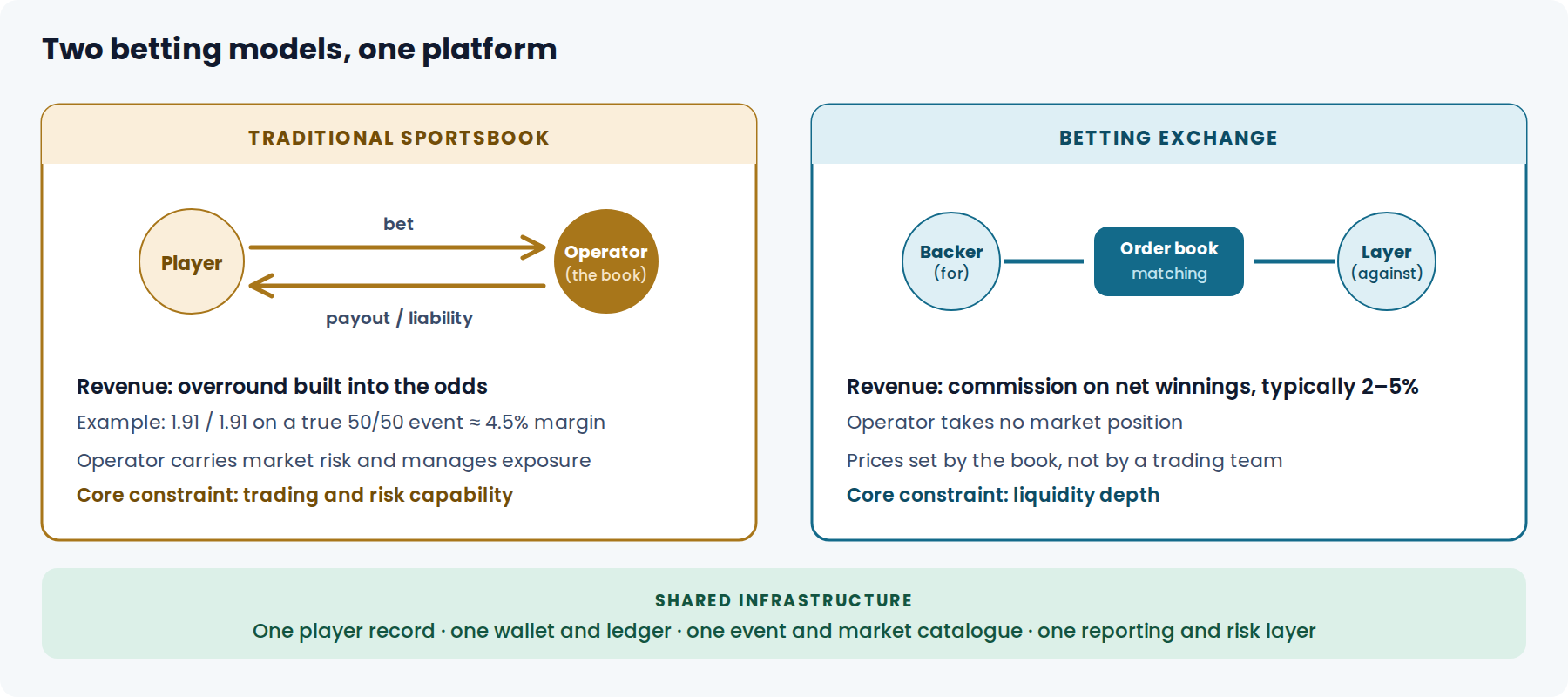
Figure 3. Different economics and different risk, but the same player, wallet, event
and reporting infrastructure — which is why they belong on one modular platform rather than
two stacks.
The honest constraint on exchange products is liquidity, and no amount of
engineering solves it. An exchange with thin markets offers worse prices than a
sportsbook and frustrates the exact users it is designed to attract; published comparisons note that
illiquid markets can leave backers taking worse odds than they would get from a bookmaker. Operators
launching an exchange need a credible answer to how markets get seeded, which events carry depth,
and whether market-making arrangements are commercially and legally viable in the target
jurisdiction. Build the matching engine second. Answer the liquidity question first.
Operator Ownership: Stop Renting Your Technology
Ownership is architectural before it is commercial: the codebase, the player record and the
ledger either sit in your infrastructure or in somebody else's. Photograph:
Pexels, free licence; illustrative stock image, not a Capermint project.
Short answer: The biggest difference between a white-label solution and an owned
platform is control. Under white-label the operator typically does not control the underlying
architecture, the development roadmap, data structures, business logic, integrations, customisation
or scaling strategy, and remains exposed to the provider's vendor dependencies. With ownership of
the core technology, the operator decides what gets built, integrated, changed, scaled and removed
— and the platform becomes a business asset rather than a monthly technology expense.
White-label is a legitimate choice, and for a first market test it is frequently the right one. The
mistake is not starting there; the mistake is staying there past the point where the economics turn. The
trade is straightforward: the provider carries setup, licensing and operational load, and is paid for it
out of a share of the operator's gross gaming revenue for as long as the arrangement lasts.
Middle — commonly positioned in the low-to-mid six figures
Highest — typically six to seven figures
Ongoing cost
Revenue share, commonly cited at 15–40% of GGR, or fixed monthly
fees
Infrastructure, support and your own roadmap
Infrastructure, support and your own roadmap
Time to launch
Weeks
Weeks to a few months
Months to a year, depending on scope
Source code & IP
Provider's
Transferred to the operator
Operator's
Player data
Typically in the provider's shared environment
Operator's infrastructure
Operator's infrastructure
Customisation
Limited to what the provider exposes
Substantial; you hold the code
Unlimited by definition
Roadmap control
Provider's priorities
Yours
Yours
Licence
Often provided or facilitated by the provider
Operator's responsibility
Operator's responsibility
Switching cost later
High — migration means rebuilding and moving data you do not
control
Low — you already hold everything
Low
Best fit
First market, limited capital, testing demand
Operators with proven volume ready to stop paying revenue share
Product is the differentiator, or an existing business must be mirrored
Figures above are published market ranges from platform vendors and comparison sources, not quotations;
they vary widely by scope, market, content and support model, and several of these sources sell one of
the models they compare. Treat them as orders of magnitude for planning and get written quotations
against a defined scope before committing capital.
Working out whether an owned platform is the right call for your volume?
Share your current model, monthly GGR range and target markets. Capermint will map the
architecture, the module scope and an itemised build estimate against your actual numbers
— under NDA, before any commercial conversation.
Short answer: Building an owned platform requires investment. The objective is not
to make the initial development cost disappear — it is to reduce the total cost of
technology ownership over time. The traditional stack accumulates platform fees,
aggregator fees, per-module fees, vendor development charges, integration charges, customisation
fees, scaling costs and multiple contracts. The modular owned model concentrates spend into core
platform, required modules, required integrations, infrastructure and ongoing development —
and the operator invests in its own roadmap instead of repeatedly paying vendors to modify their
product.
Cost line
Traditional / white-label approach
Modular owned platform
Platform access
Platform fee plus revenue share on GGR
One-time build; no share of revenue
Game content
Aggregator fee, often layered on top of the platform's own margin
Direct aggregator or studio contracts, negotiated by the operator
Additional verticals
Per-module fees for sportsbook, exchange, live casino, lottery
Build or integrate the module once; it is then yours
Changes & customisation
Vendor development charges, queued behind other clients
Your backlog, your priorities, your team or partner
New integrations
Integration charges per provider
Engineering time against a documented integration pattern
Growth
Cost scales with revenue by design
Cost scales with infrastructure and usage, not with margin
Contract overhead
Multiple vendor contracts, each with its own terms and renewal risk
Fewer, more targeted contracts under the operator's control
Asset position
No asset created; value accrues to the provider
Codebase, data and integrations are balance-sheet assets
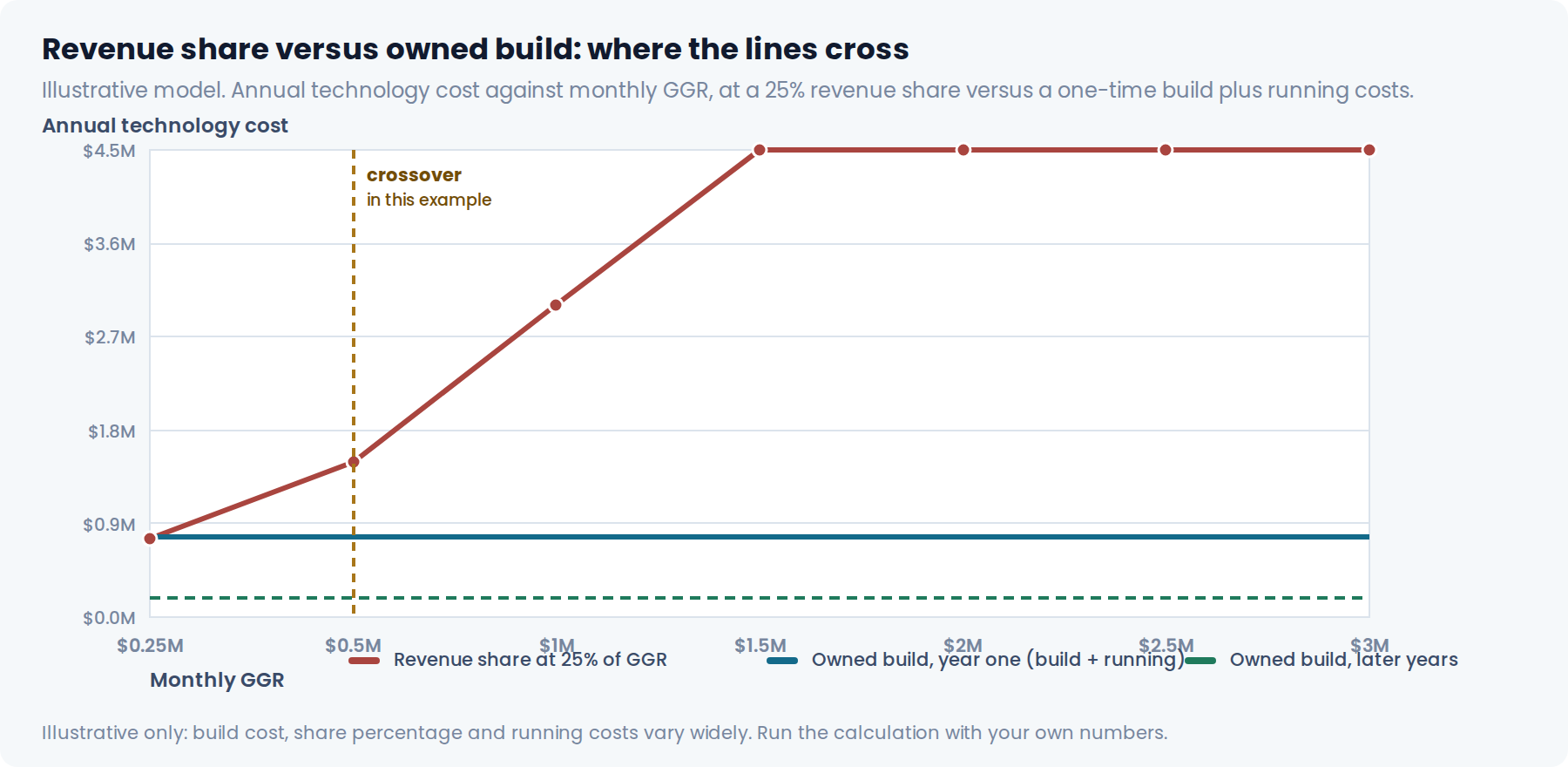
The crossover arithmetic is worth doing explicitly before any platform decision, because it is simple and
it is decisive. If an operator generates monthly GGR of X and pays a revenue share of Y%, the annual
cost of the arrangement is X × Y × 12. Compare that number against a one-time build plus annual
infrastructure and support. At low volume, white-label wins comfortably. As monthly GGR rises, the
revenue share compounds while the build cost does not, and at some point the operator is paying for the
platform several times a year without ever owning it. The right time to model this is before signing the
white-label contract, not after — because the same contract usually governs how difficult it will
be to leave.
Figure 2. The shape is the point, not the numbers: revenue share scales with success,
an owned build does not. Model it with your own GGR, share percentage and quoted build cost.
Three costs operators routinely leave out of the comparison. First, the
licence and compliance stack, which is independent of the platform model and can exceed the
platform bill: regulator fees, certification, audits, MLRO and compliance salaries, legal counsel
and local substance. Second, migration cost — if the player data sits with a
provider, the cost of leaving is a project, not a notice period. Third, enterprise value:
an operator that owns its platform, its data and its integrations is selling a different asset at
exit than one selling a brand attached to somebody else's infrastructure. The first two are line
items. The third is usually the largest number in the whole analysis.
Scale Without Rebuilding Everything
Short answer: A platform should not become a bottleneck when the business grows. A
modular architecture can be designed to scale horizontally across players, transactions, bets,
games, sports events, operators, brands, regions, languages and currencies — which means an
operator can start with a focused deployment and add capability in phases rather than building
everything on day one.
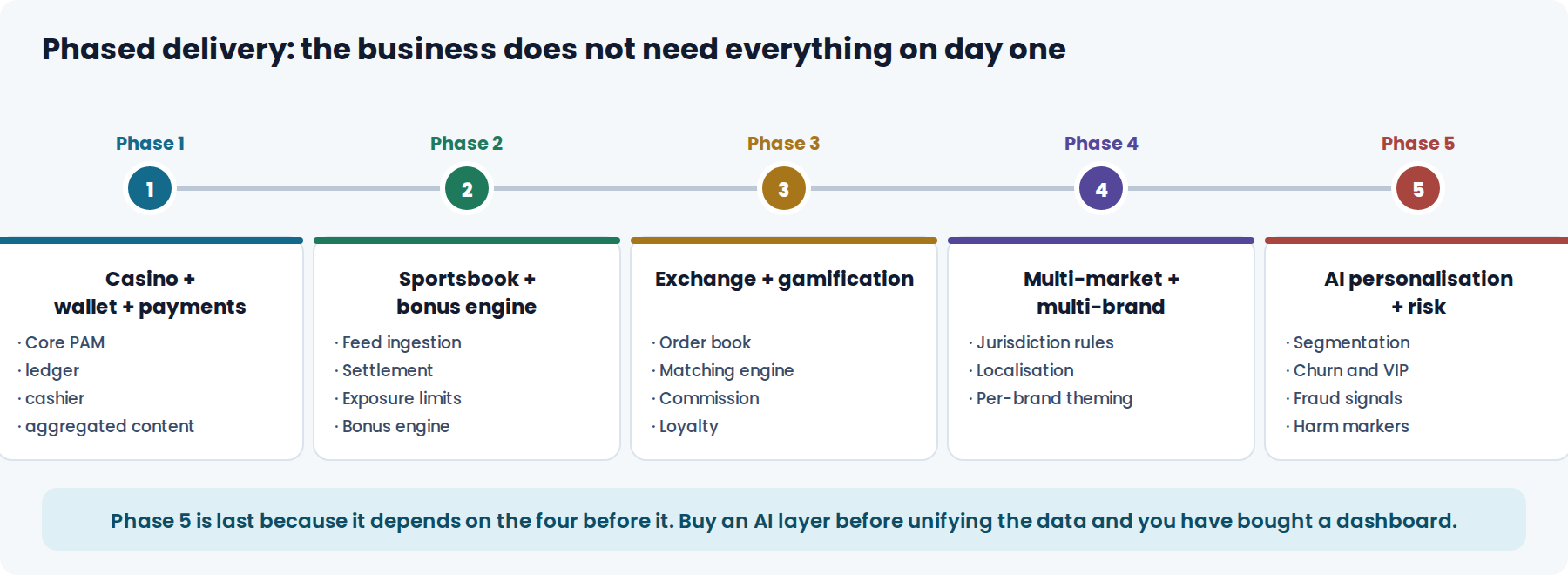
Phase 1 — Casino, wallet, payments
Core PAM, single wallet, ledger, cashier with two or three well-chosen payment providers,
aggregated casino content, back office, and the compliance controls the launch market requires.
This is the smallest configuration that is a real business.
ProvesThat players register, deposit, play and withdraw without friction, and
that the money reconciles.
Phase 2 — Sportsbook and bonus engine
Odds feed ingestion, bet placement and settlement, exposure controls, and a bonus engine the
commercial team can operate without engineering support. Sportsbook shares the wallet and player
record established in phase one.
ProvesThat a second vertical can be
added without disturbing the first.
Phase 3 — Betting exchange and gamification
Order book, matching engine, commission accounting and exchange-specific exposure handling, plus
loyalty, missions and tournaments across products. Only worth doing once liquidity has a
credible source.
ProvesThat the platform supports a fundamentally
different economic model on the same infrastructure.
Phase 4 — Multiple markets and multiple brands
Jurisdiction-aware configuration, localisation, market-specific payment and content sets,
per-brand theming and separate regulatory reporting, all from one core.
ProvesThat expansion is a configuration exercise rather than a second
build.
Phase 5 — AI-driven personalisation, risk intelligence and automation
Segmentation, recommendation, churn and VIP models, fraud and safer-gambling signals, automated
insight and reporting — trained on the unified data the previous four phases have been
accumulating.
ProvesThe reason the architecture was built this way:
the models have clean data to work with.
The sequence matters more than the calendar. Phase 5 is listed last not because intelligence is an
afterthought but because it is the phase that depends on everything before it. An operator who buys an
AI layer before unifying the data buys a dashboard.
Built for Different Regulatory Environments
Figure 8. Each phase should cost less to deliver than the one before it. If expansion
keeps costing the same, the modularity was nominal.
Short answer: Global iGaming is not one market. Jurisdictions differ substantially
on licensing, player protection, payments, AML, responsible gambling, technical standards and
reporting. An international platform should never assume one configuration works everywhere; the
architecture should support jurisdiction-aware configuration across registration
flows, KYC requirements, responsible-gambling controls, deposit and loss limits, payment
restrictions, game availability, betting markets, tax configuration, reporting, geolocation and
compliance workflows.
Configurable control
Why it differs by market
Where it must be enforced
Registration & onboarding flow
Required identifiers, age thresholds, mandatory disclosures and pre-deposit steps
differ; some markets require a limit-setting prompt before the first deposit
PAM, as a market-resolved workflow definition
KYC and verification timing
Some markets require verification before play, others before withdrawal; accepted
document types and data sources vary
PAM plus compliance module, with provider abstraction
Deposit, loss and stake limits
Mandatory versus optional, default values, stake caps on specific products
Server-side in the PAM, evaluated per request
Self-exclusion
Operator-level in some markets; national registers with defined technical connections
and enforcement windows in others
PAM, with a register-integration adapter per market
Payment restrictions
Credit-card bans, crypto prohibitions, mandated local rails and pre-funded-only rules
appear in several markets
Payments module, driven by market configuration
Game and market availability
Certified content lists, prohibited game types, restricted bet types and event
categories
Casino and sportsbook modules, with per-market catalogues
Geolocation and blocking
Point-of-consumption rules mean location, not company domicile, determines legality
Edge and session layer, logged for audit
Tax and reporting
GGR, turnover and hybrid tax models; return formats; in some markets a real-time data
link to the regulator
Reporting layer reading immutable ledger and event data
Advertising & bonus rules
Restrictions on incentives, wagering requirements, product mixing in promotions and
affiliate conduct
Bonus and campaign modules, with per-market rule sets
Data residency & hosting
Some markets require local hosting or approved-jurisdiction servers
Infrastructure topology, decided before the first deployment
This approach lets an operator configure the platform for the markets in which it is legally permitted to
operate. That distinction matters more each year, as regulators strengthen oversight of player
protection, AML and technology-driven risk.
The Licensing Landscape, Compared
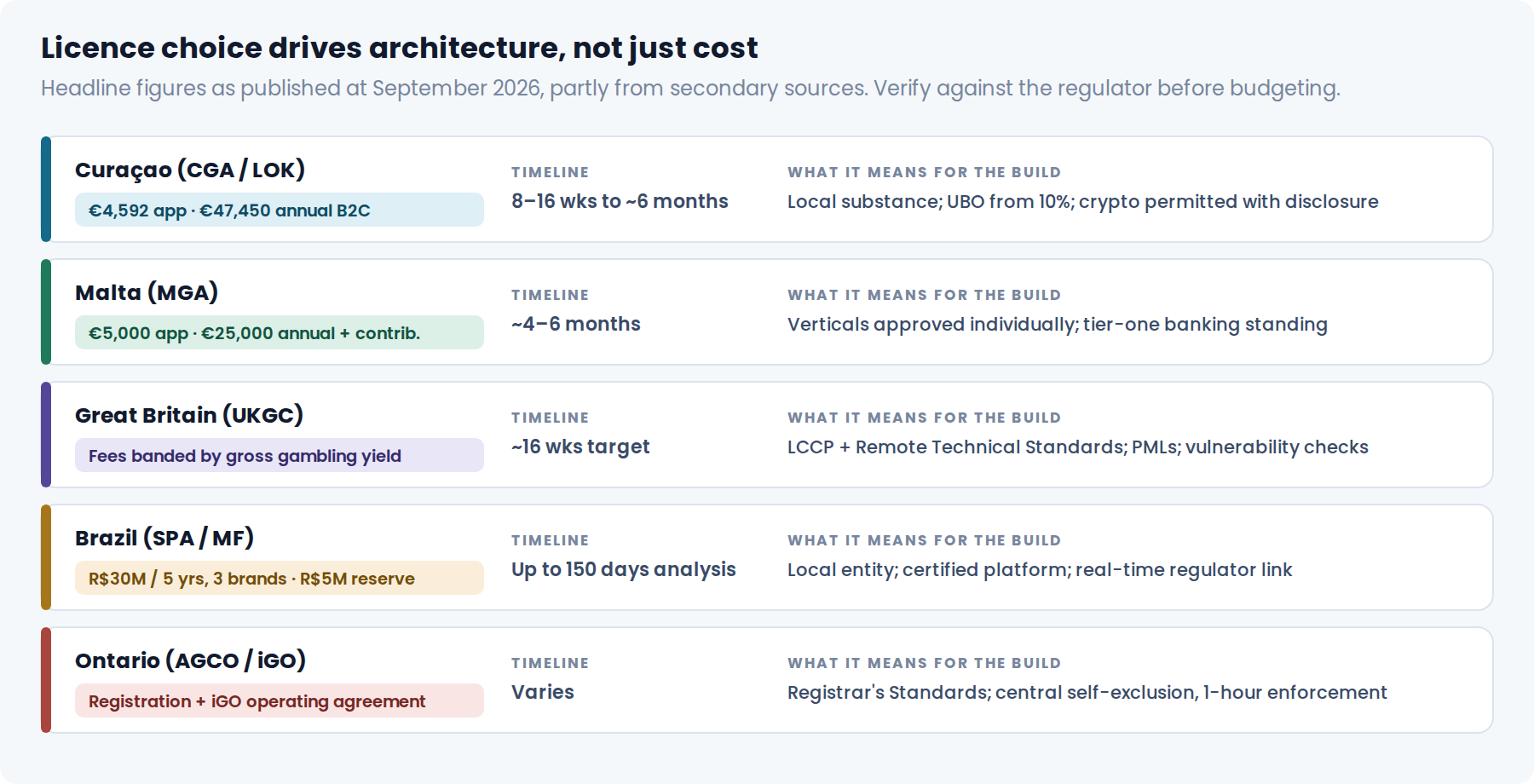
Short answer: Licence choice drives architecture, cost and market access, and the
options have diverged sharply. Curaçao's LOK reform replaced the old master/sub-licence model with
direct CGA licensing at roughly €4,592 application and €47,450 annual B2C fees.
Malta's MGA charges a €5,000 application fee and €25,000 annual B2C fee plus a
compliance contribution that scales with revenue. The UK requires a UKGC licence for any operator
transacting with or advertising to consumers in Great Britain, with fees banded by gross gambling
yield. Brazil requires a local entity and a R$30 million five-year authorisation.
Ontario requires AGCO registration against detailed Registrar's Standards.
Jurisdiction
Headline cost
Timeline
Platform implications
Curaçao (CGA, LOK)
€4,592 application; €47,450 annual B2C (€24,490 treasury + €22,960 supervisory) per the
CGA fee schedule v2.0; B2B and per-domain fees separate
Commonly quoted at 8–16 weeks for a clean file; some advisers report 6–8
months
Direct CGA licensing, public register, UBO investigation from 10% equity, local
substance requirements with key-person hiring phased to April 2027, AML/CFT obligations,
colour-coded digital seal on licensed domains. Crypto permitted but with wallet
disclosure and on-chain monitoring expectations.
Malta (MGA)
€5,000 application; €25,000 annual B2C Gaming Service licence (€10,000 for Type 4 only);
compliance contribution scaling by game type and GGR; gaming tax on Maltese-player
revenue
Roughly 4–6 months for a well-prepared application; 6–12 months with complex
ownership
Verticals approved individually rather than as one blanket authorisation. Share capital
requirements, local key functions, MLRO and compliance roles, annual audits, penetration
testing. Buys tier-one banking and payment acceptance.
Great Britain (UKGC)
Application and annual fees banded by gross gambling yield; Remote Gaming Duty applies
Commission targets approximately 16 weeks for a complete application
LCCP and Remote Technical Standards compliance, personal management licences for
specified roles, financial vulnerability checks, mandated pre-deposit limit prompts,
key-event and regulatory-return reporting. Required for any operator transacting with or
advertising to GB consumers regardless of domicile.
Brazil (SPA / Ministry of Finance)
R$30 million for a five-year authorisation covering up to three brands, payable within
30 days of approval; R$5 million reserve; inspection fee on GGR
Statutory analysis period of up to 150 days after submission
Brazilian legal entity with local headquarters and minimum local shareholding; certified
platform from an approved laboratory; mandated domain suffix; real-time data link to the
regulator's system; payment restrictions excluding credit cards and crypto; centralised
self-exclusion.
Ontario (AGCO / iGaming Ontario)
Registration fees plus the commercial arrangement with iGaming Ontario
Varies with registration and operating-agreement process
Registrar's Standards for Internet Gaming covering information security, game integrity,
player awareness and responsible gambling; centralised self-exclusion support with
account restriction enforced within one hour and immediate cessation of direct
marketing.
Other regimes
Isle of Man, Kahnawake, Anjouan, Tobique and others occupy different points on cost,
timeline and reputational standing
Varies widely
Banking and PSP acceptance is usually the practical differentiator. A cheaper licence
that no tier-one processor will bank is not cheaper.
Figure 5. Every regime here imposes different technical obligations — local
hosting, certified builds, register integrations, real-time reporting. That is why licence strategy
has to precede architecture.
Fees and rules in this table change frequently and are quoted from secondary
sources as at September 2026. Curaçao's own transition has been turbulent, with
reporting in 2026 describing supervisory-board resignations and disputes over provisional licences;
Malta's gaming tax structure was rewritten by legal notice during 2026; the UK's duty rates and
White Paper measures have moved on a rolling timetable; Brazil's regulator has issued successive
normative instructions to manage certification capacity. Verify every figure against the
regulator's current published schedule and take local legal advice before budgeting or
building. The architectural lesson is the durable part: build for rule change, because
the rules will change.
Certification and Technical Standards
Short answer: Most regulated markets require independent technical certification
before launch, and many base their technical rules on the GLI standards family.
GLI-19 covers interactive gaming systems — online casino and remote game
servers. GLI-33 covers event wagering systems — sportsbook and betting. They
use separate testing protocols, so a GLI-19 report does not substitute for a GLI-33 audit or the
reverse; a platform offering both verticals needs both certification tracks, planned in sequence.
RNG certification, ISO 27001 for information security management, and per-market delta testing sit
alongside them.
Standard / audit
Scope
When you need it
What it means for the build
GLI-19 (Interactive Gaming Systems)
Online casino systems and remote game servers
Before launch in most regulated casino markets
Testable game round lifecycle, deterministic settlement, recoverable interrupted rounds,
audit logging and reporting that a lab can verify against transaction records
GLI-33 (Event Wagering Systems)
Wagering engine, client devices and background systems for sports betting
Before launch in most regulated sportsbook markets
Labs scrutinise wagering engine logic most heavily: payout calculation, complex
multi-leg handling, consistent minimum and maximum bet limits, and no single point of
failure that can compromise a market or player funds
RNG certification
Randomness and fairness of game outcomes
For any proprietary game content; aggregated third-party content arrives certified
Only relevant if you build your own games; if you aggregate, verify certificates rather
than duplicating the work
ISO 27001
Information security management system — the company, not the product
Increasingly expected by large operators and by regulators reviewing suppliers
Documented controls, access management, incident response, supplier management, evidence
trails. It is an organisational programme, not a code change
Per-market delta testing
Local specifics on top of an existing certification
Each new jurisdiction
This is the practical payoff of building to GLI standards: labs run a reduced delta test
rather than a full re-evaluation, which is why standards-aligned architecture speeds up
expansion
Penetration testing
Application and infrastructure security
Annually in several regimes; commonly a licence condition
Budget for remediation time, not just the test. Findings land close to launch by
definition
Regulator-specific technical standards
For example the UK's Remote Technical Standards; Ontario's and Alberta's Registrar's
Standards
Per market
These are prescriptive documents covering session management, display of information,
error handling and player-protection mechanics. Read them before designing the UI, not
after
The practical sequencing lesson: certification is not a stage at the end of the project. Labs test what
the architecture allows them to test. Systems built with immutable transaction logs, reproducible game
and bet histories, clean separation between engine and presentation, and complete audit trails pass with
modest remediation. Systems built without them fail on findings that require re-engineering, at the
point in the schedule where re-engineering is most expensive.
Payments, Orchestration and the Cashier
Short answer: Payments are where iGaming revenue quietly leaks. No single PSP
performs best in every market: approval rates, bank rules and player preferences vary by country,
and card networks classify gambling under a dedicated merchant category code that changes the terms
available. The architectural answer is payment orchestration — a routing
layer across multiple providers with rules, performance data, automatic retries and failover.
Industry sources put approval rates anywhere from roughly 75% to 95% depending on routing, and smart
routing with failover is reported to recover a meaningful share of otherwise-lost deposits.
Multi-PSP by default, single-PSP never. Each market needs its own method mix
— local instant transfer rails, wallets, cards, vouchers, bank transfer — and provider
performance varies by geography and over time. Orchestration is the layer that makes providers
replaceable.
Route, retry, fail over. Declines are not uniform. Soft declines can be retried
through an alternative route; hard declines should not be. The rules engine that distinguishes them
is worth building properly.
Treat the first failed deposit as an emergency. Research cited across the payments
industry indicates a large majority of customers who experience a payment failure do not return to
the transaction or the business. A failed deposit wastes the acquisition spend before the player
ever reaches the product.
Payouts are a separate discipline. Deposits and withdrawals follow different risk,
liquidity and compliance rules. Many payment setups fail not at deposit but at settlement, reserves
and payout-partner requirements. Withdrawal speed is also a retention feature, not just an
operations metric.
Reconcile against the ledger, daily. PSP settlement files, provider transaction
reports and your own ledger must agree. Automated three-way reconciliation with exception queues is
cheaper than the alternative, which is discovering discrepancies during an audit.
Crypto is a market-by-market question, not a philosophy. Some regimes permit it
with wallet disclosure and on-chain monitoring; others prohibit it outright as a deposit method. The
cashier must be able to enable or disable rails per jurisdiction without a release.
Chargebacks are a compliance signal as well as a cost. High dispute volumes read to
a regulator as either undetected fraud or insufficient verification at deposit. They show up in the
payment review and the compliance review simultaneously.
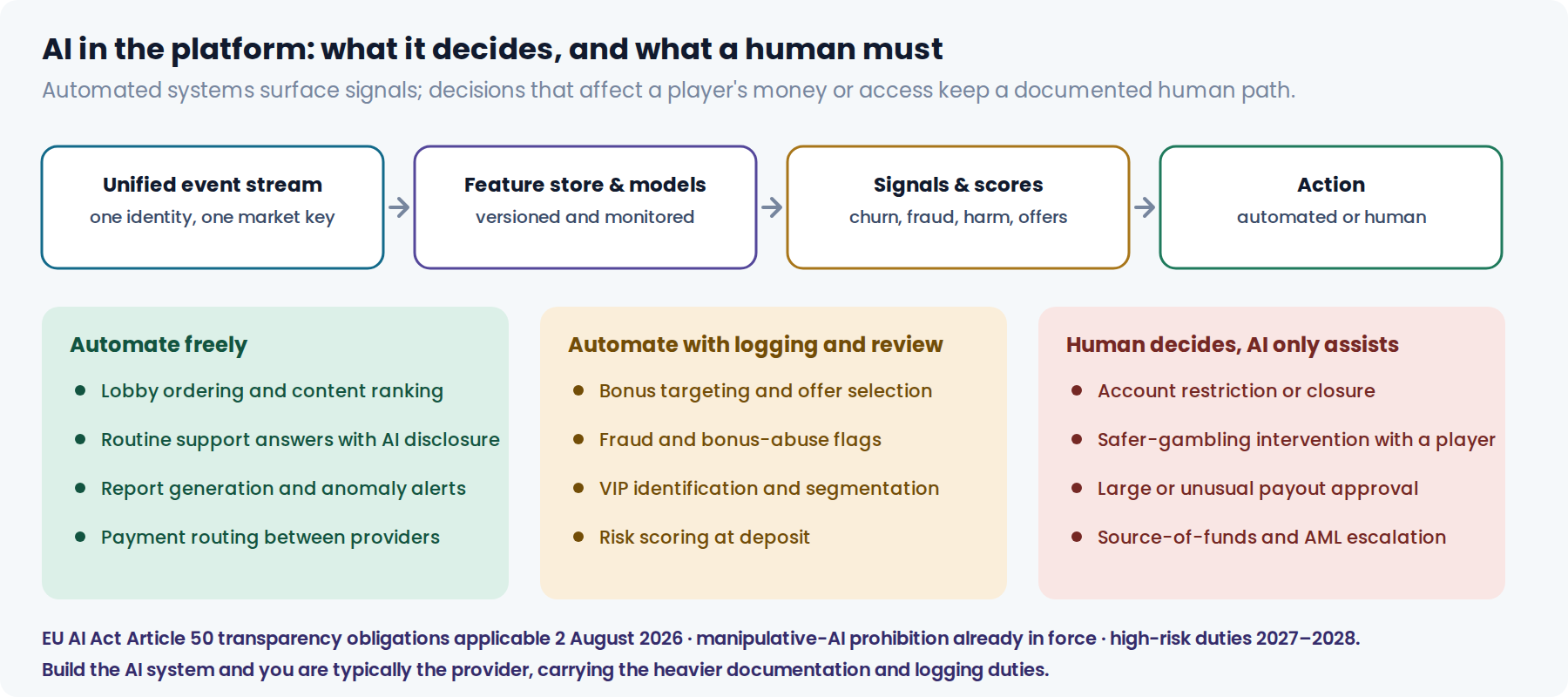
AI Governance: Where Regulation Now Bites
Short answer: AI in gambling is now governed from two directions at once. Gambling
regulators expect lawful, transparent and explainable use with meaningful human oversight, and the
UKGC's 2026 assessment flags AI-driven threats including synthetic documents, deepfakes and face
swaps used to bypass KYC — it raised the risk rating for gambling software suppliers from low
to medium. Separately, the EU AI Act's Article 50 transparency obligations became applicable on
2 August 2026, with high-risk obligations phased into 2027 and 2028, and the
prohibition on manipulative AI already in force. If you build the AI system you are typically the
provider under the Act, and providers carry the heavier duties.
Requirement
What it means in the platform
Design consequence
Transparency to affected people
Users must know when they are interacting with an AI system, and certain synthetic
content must be labelled
Disclosure in support interfaces; labelling in automated marketing output;
affiliate-generated synthetic creatives are in scope too
Meaningful human oversight
Staff must understand what fed a decision, how the model was tested, and when to
override or investigate
Inference logging with feature attribution, documented override paths, and staff
training records — especially where AI influences account access, payments or risk
classification
Technical documentation and logging
Providers of AI systems hold documentation and logging duties, and operators need models
they can genuinely audit
Model registry with versions, training-data lineage, evaluation results and change
history retained alongside the product
No manipulative practices
The prohibition on manipulative AI is already applicable
Personalisation that exploits vulnerability is not a growth tactic; safer-gambling
signals must be able to suppress commercial targeting, and that suppression should be
architecturally enforced rather than left to campaign hygiene
Vendor liability
Liability is shifting toward strict compliance indemnities on the supplier side
If you buy an AI module, the contract matters as much as the model. If you build it, you
are the provider
Adversarial KYC threats
Synthetic documents, deepfakes and face swaps used against verification
Liveness and injection-attack detection, document forensics, and periodic adversarial
testing of your own verification stack
Figure 7. The right-hand column is what regulators ask about. Version the models, log
the inferences, and keep the override path documented before anyone asks to see it.
Read the delay headlines carefully. Coverage of the EU AI Act during
2026 has described timetable changes for high-risk obligations, and some businesses responded by
pausing their compliance programmes entirely. That is the wrong reading: the transparency rules are
applicable now, the prohibition on manipulative AI is already in force, and the high-risk duties
arriving in 2027 and 2028 require preparation that takes longer than the remaining window. For a
platform build, the practical response is unremarkable engineering discipline — version your
models, log your inferences, document your data, and keep a human in the loop on any decision that
affects a player's money or access.
Data Architecture: The Part That Makes AI Work
Unified operational data is what makes the intelligence layer work. Models trained on
fragmented events produce confident output that nobody can verify. Photograph:
Pexels, free licence; illustrative stock image, not a Capermint project.
Short answer: AI becomes useful when the platform can work with unified operational
data. That means one event stream carrying every material action with a stable player identifier and
a market dimension, an immutable ledger as the financial source of truth, a warehouse fed from the
same stream that serves the product, and a feature store that serves models in real time without
querying production databases directly.
One event schema, versioned. Registration, login, deposit, bet, game round, bonus
grant, limit change, support contact, withdrawal and KYC outcome all emit structured events with a
shared identity and market key. Schema changes are versioned, not overwritten.
Ledger as financial truth. Analytics may aggregate; regulatory reporting reads from
the immutable record. If the two can diverge, the figures you file and the figures you manage by are
different figures.
Real-time and batch from the same source. The lobby personalisation service and the
monthly regulatory return should not disagree because they read different pipelines.
Feature store for models. Precomputed behavioural features served with a latency
budget, so that recommendation and risk scoring can run inside a page render or a bet acceptance
without hitting core transactional systems.
Retention and residency policy, defined early. Different markets impose different
retention minimums and residency constraints, and data-protection law imposes its own limits. These
decisions shape storage topology, so make them before the first deployment.
Reproducibility. Any number shown to a regulator, an auditor or an acquirer should
be reproducible from raw records, by someone who was not there when it was produced.
Security, Uptime and Integrity
Short answer: An iGaming platform is a real-money financial system operating under
adversarial conditions and regulatory scrutiny. The non-negotiables are availability during peak
events, correctness under concurrency, defence against fraud and account takeover, and demonstrable
integrity of game and bet outcomes. Content suppliers publish availability targets in the region of
99.999% for game APIs; your own platform is judged against the peaks, not the averages.
Design for the peak, not the mean. Traffic in this business is event-driven: a
major fixture, a jackpot, a marketing burst. Capacity planning that uses average load produces
outages precisely when revenue is highest.
Concurrency correctness in the wallet. Simultaneous bets, settlements, bonus grants
and withdrawals against one balance is the hardest correctness problem in the platform. Solve it
with the ledger and idempotency, not with optimistic assumptions.
Account takeover and multi-accounting defence. Device fingerprinting, session
anomaly detection, graph linkage between accounts, and step-up verification on high-risk actions.
Bonus abuse and collusion detection. Both are pattern problems that the
intelligence layer is well suited to, and both are materially cheaper to detect than to claw back.
Segregation of duties in the back office. Role-based access, four-eyes approval on
manual balance adjustments and large payouts, and an audit trail that names the actor on every
privileged action.
Disaster recovery that has actually been tested. Defined RPO and RTO, tested
restores, and a documented process for resolving in-flight bets and game rounds after an incident.
Regulators ask about this; so do acquirers.
Supply-chain security. With supplier risk ratings rising, third-party libraries,
provider integrations and vendor access paths all belong in the threat model and the review cycle.
From Platform to Operating System
Short answer: The opportunity is larger than building another casino backend. An
AI-native iGaming platform can become the operating system for the entire gaming business —
one technology layer connecting players, wallet, casino, sportsbook, exchange, payments, CRM,
bonuses, risk, analytics, AI and business intelligence — instead of a collection of
disconnected products held together by integrations and spreadsheets.
The practical test of whether an operator has reached this point is not architectural elegance. It is
whether a business question can be answered without an engineering ticket. Can the commercial team
launch a market-specific promotion this afternoon? Can the compliance team produce a complete player
history for a regulator in minutes? Can the finance team reconcile yesterday without exporting three
files? Can a product manager see which cohorts respond to which content without asking an analyst to
write SQL? When those answers are yes, the platform has stopped being a cost centre and started being
the operating system of the business.
Need the architecture mapped before you commit to a vendor or a build?
Send your target markets, product mix and current stack. Capermint will return a module map,
integration plan, certification path and phased build estimate — under NDA, within 48
hours, at no cost.
The boundary contracts between modules are the part worth over-thinking: they decide whether
the platform is still modular after a year of commercial pressure. Photograph:
Pexels, free licence; illustrative stock image, not a Capermint project.
Short answer: The stack follows the product, not fashion. The core platform is a
transactional backend problem — services, an event bus, a strongly consistent store for the
ledger and a fast store for session and feature data. The player-facing layer is a web and mobile
client problem, where HTML5 removes installation friction and native apps win on retention and push
where app-store rules permit. Game clients are a game-engine problem. The one decision worth
over-thinking is the boundary contracts between modules, because those determine whether the
platform stays modular after the first year of pressure.
Core services and APIs A service architecture with explicit contracts, an
event bus for asynchronous propagation, an ACID store for the ledger and player record, and caching
for read-heavy paths such as lobby rendering and odds display.
HTML5 and web clients The default player-facing layer.
No installation, instant updates, and progressive web app delivery where native distribution is
restricted.
Native mobile applications Where app-store policy
permits real-money gambling in the target market, native brings push, biometrics and better
retention. Store policies and market restrictions decide this, not preference.
Unity for proprietary game content If you build your own
slots, table games, crash or instant-win titles rather than aggregating, this is the standard route
to one codebase across web and mobile.
Unreal Engine Where visual fidelity is the product,
typically in high-production live-adjacent or immersive formats.
Gamification layers Missions, tiers, tournaments and
reward systems built as a service over the event stream, so mechanics can be changed without
touching the wallet or the games.
Integration adapters Aggregators, odds feeds, PSPs, KYC providers and CRM
tools each behind an internal interface. This is what makes suppliers replaceable and what keeps a
supplier's outage from becoming a platform outage.
Infrastructure Containerised deployment, per-market topology where
residency requires it, autoscaling tuned to event peaks, and observability that covers business
metrics (deposit approval rate, bet acceptance latency, settlement lag) as well as system metrics.
How to Build an AI-Native iGaming Platform: Step by Step
Short answer: Eight steps: fix the market and licence strategy first because it
dictates architecture; define the module scope and the phase sequence; design the PAM, ledger and
event model before any feature work; establish the integration layer as replaceable adapters; build
the compliance and player-protection controls server-side from the first sprint; layer intelligence
on the unified data; certify and launch one market properly; then expand by configuration and add
verticals by module.
Fix market and licence strategy before architecture
Which markets, under which licence, with which product mix. This decides data residency,
certification path, payment methods, player-protection controls and reporting obligations
— all of which are architectural, not cosmetic. Take gaming counsel in each target market
before the design phase, not after it.
OutputA market and licence
plan with the technical obligations of each jurisdiction extracted as requirements.
Define module scope and the phase sequence
Decide what is built, what is integrated and what is deliberately deferred. Casino-first or
sportsbook-first, exchange later or never, which bonus mechanics are needed at launch. Write
down what phase two and three add, so that today's interfaces anticipate them.
OutputA module map with build/buy/defer decisions and the contracts between
modules named.
Design the PAM, ledger and event model first
Player record, wallet, immutable ledger, idempotency rules, event schema, jurisdiction dimension
and audit logging. Nothing else should be built until this is settled, because every other
module depends on it and retrofitting it is a rewrite.
OutputData
model, event catalogue and ledger specification, reviewed against reporting and certification
requirements.
Build the integration layer as replaceable adapters
Aggregators, odds feeds, PSPs, KYC and CRM behind internal interfaces with defined failure
behaviour, timeouts, retries and circuit breakers. Assume every external provider will fail, be
replaced or be repriced within three years, because most of them will.
OutputA documented integration pattern and at least two working providers in
any category that matters.
Implement compliance and player protection server-side, from sprint one
Limits, self-exclusion, cooling-off, KYC gating, geolocation, market blocking, audit trails and
regulatory reporting, all resolved per jurisdiction in the PAM. These are not a pre-launch
workstream; they are load-bearing structure.
OutputControls
demonstrable in a test environment against each target market's rule set.
Layer intelligence on the unified data
Segmentation, recommendation, churn and VIP models, fraud and safer-gambling signals — with
a model registry, inference logging, evaluation results and documented human-override paths.
Start with the use cases that pay for themselves quickly: fraud, bonus abuse and churn.
OutputModels in production with monitoring, versioning and an auditable
decision trail.
Certify and launch one market properly
Lab testing against the applicable standards, penetration testing, remediation, regulator
sign-off and a controlled launch with real money at low volume before scale. Resist the
temptation to open three markets at once to justify the build.
OutputA certified, licensed, live platform with reconciliation and reporting
proven on real volume.
Expand by configuration; add verticals by module
New markets become configuration plus delta certification. New verticals become modules attached
to the existing PAM and wallet. Each expansion should cost less than the one before it —
if it does not, the modularity was nominal.
OutputA repeatable
market-entry runbook and a platform whose marginal expansion cost is falling.
Migrating Off a White-Label Without Breaking the Business
Short answer: Migration is a data, licensing and trust problem more than a code
problem. The three decisive questions are: what player data can you actually extract and in what
form, what does your current contract say about notice, exclusivity and data portability, and how do
you move active players with balances, open bets and bonus state without a reset. Plan it as a
programme with a parallel-run phase, not a cutover weekend.
Read the contract before the architecture. Notice periods, exclusivity clauses,
data-portability terms, transition-assistance obligations and post-termination restrictions
determine what is possible and when. Get this reviewed by counsel early — it frequently
changes the sequencing.
Establish what data you can extract. Player identities, KYC status and documents,
transaction history, bonus state, responsible-gambling settings, self-exclusions, affiliate
attribution and communication consents. Anything you cannot extract has to be reconstructed or
re-collected from the player, which costs conversions.
Secure the licence position first. If the white-label provided the licence, the
migration is also a licensing project, with its own timeline that usually exceeds the engineering
one.
Rebuild verification state carefully. Re-verifying an entire base is a mass-churn
event. Where documentation can be transferred lawfully and the regulator accepts it, transfer it;
where it cannot, stagger re-verification by segment rather than all at once.
Preserve responsible-gambling state absolutely. Self-exclusions, limits and
cooling-off periods must survive migration intact and be enforceable on day one. A player who
self-excluded and can log in to the new platform is a serious regulatory failure, not a migration
bug.
Parallel-run before cutover. Run the new platform on a small cohort, reconcile both
environments daily, and resolve every discrepancy before moving the base.
Move the money state last and carefully. Open bets, pending withdrawals and active
bonuses need a defined treatment agreed in advance, communicated to players and documented for the
regulator.
Communicate as a product improvement, not an outage. Players tolerate change they
were warned about. Support volume during migration is a planned cost; understaffing it turns a
technical success into a retention failure.
Cost and Timeline
Short answer: Indicative ranges for an owned build: a focused
single-vertical platform (PAM, wallet, cashier, aggregated casino, back office, one
market's compliance controls) typically runs $120,000–$280,000 over 4–7
months. A multi-vertical platform adding sportsbook, bonus engine,
multi-PSP orchestration and multi-market configuration runs $300,000–$700,000 over
8–14 months. An exchange-inclusive or enterprise multi-brand
platform runs $700,000–$1.5M+ over 12–24 months. Licence
fees, certification, content, data feeds and compliance staffing sit entirely outside these figures
and frequently exceed them.
Tier 01 · Focused
$120K–280K
4 to 7 months
PAM, single wallet, immutable ledger
Cashier with multi-PSP routing
Aggregated casino content and lobby
Bonus engine, configurable without releases
Back office, roles and audit trail
One market's compliance control set
100% source code and IP transferred
Best forFirst owned platform; leaving white-label
Tier 02 · Multi-vertical
$300K–700K
8 to 14 months
Everything in Tier 01
Sportsbook: feed ingestion, settlement, exposure
Multi-market jurisdiction configuration
Multi-brand and multi-currency support
Payment orchestration with routing rules
Intelligence layer: segmentation, churn, fraud
Certification-ready logging and reporting
Best forOperators scaling across products and
regions
Tier 03 · Enterprise
$700K–1.5M+
12 to 24 months
Everything in Tier 02
Betting exchange: order book and matching engine
Retail and omnichannel integration
Proprietary game content or RGS
Advanced risk and trading tooling
Multi-region infrastructure and residency
Full model governance and audit tooling
Best forMulti-brand groups, exchange operators,
land-based going online
Outside the build budget entirely: licence application and annual fees; corporate
structuring and local substance; certification and laboratory testing per standard and per market;
annual audits and penetration testing; compliance, MLRO and risk staffing; gaming counsel; game content
revenue share or minimum guarantees; sports data feed licensing; PSP fees, rolling reserves and
chargebacks; cloud infrastructure at production scale; customer support operations; marketing and
affiliate costs; and gaming duty. For most operators the platform build is a minority of first-year
cost. Any comparison that weighs a build quotation against a white-label revenue share without these
lines is not a real comparison.
The KPIs an Owned Platform Should Move
Metric
Why the platform affects it
What good looks like
Deposit approval rate
Routing, provider mix, retry logic and cashier UX
Measured per market and per provider, with soft-decline recovery tracked separately
Time to first deposit
Registration flow, KYC gating and cashier friction
Minutes, not hours; every additional step is measurable drop-off
Withdrawal time
Payout workflow, approval automation and provider selection
A retention metric, not just an operations one
D1 / D7 / D30 retention by cohort
Onboarding, content relevance, personalisation and payment experience
Tracked by acquisition source and market; casual-app benchmarks are not a valid
comparison
Bonus cost as a share of GGR
Bonus engine precision, abuse controls and targeting quality
Falling while retention holds — the test of whether personalisation is working
Time to launch a promotion
Whether the commercial team needs engineering
Same day. If it needs a release, the platform is not finished
Time to add a payment provider or market
Quality of the integration layer and jurisdiction model
Days for a provider; weeks for a market, excluding licensing
Fraud and bonus-abuse loss rate
Intelligence layer and verification stack
Tracked as a percentage of GGR, with detection latency measured
Regulatory return preparation time
Data architecture and reporting design
Automated and reproducible from raw records
Technology cost as a share of GGR
The entire point of the ownership argument
Falling as revenue grows — the opposite of the revenue-share curve
Vendor Evaluation: Questions That Separate Serious Suppliers
Vendor selection turns on a handful of specific questions — IP transfer, data extraction,
certification evidence, jurisdiction modelling and ledger design. Photograph:
Pexels, free licence; illustrative stock image, not a Capermint project.
Is source code and IP transferred at handover, in writing, with no residual licence back to
you? Ask for the clause, not the assurance.
Where does the player data live, who can access it, and how do I extract all of it?
Request a sample export schema during evaluation.
Is there any revenue share, per-seat fee or usage royalty after delivery? Including
on modules added later.
Which certifications has this exact codebase passed, in which markets, and can I see the
reports? Generic "GLI-certified" claims are not an answer; the standard, version and
lab matter.
How is jurisdiction modelled? Ask to see where a market-specific limit rule is
resolved. If the answer involves environment variables or separate deployments per market, the
architecture is single-market with paint.
Show me the ledger design and the idempotency strategy. A supplier who cannot
discuss double-credit prevention in detail has not run a production wallet.
Which integrations are already built, and what does a new one cost in time? Ask for
the integration pattern documentation.
How are AI models versioned, logged and overridden? Relevant to both regulators and
your own risk team.
What are the SLAs, and what is the escalation path at 2am during a major fixture?
Get names and response times.
What does handover include? Documentation, runbooks, infrastructure-as-code,
knowledge transfer sessions and a support-transition period.
Who owns the roadmap after delivery, and can my own team extend the codebase?
Ownership is meaningless if only the vendor can work on it.
Reference calls with operators at similar scale in similar markets. Ask them what
went wrong, not what went well.
Twelve Mistakes That Cost Operators Most
Choosing the platform model before modelling the revenue share. The crossover
arithmetic takes an hour and frequently changes the decision.
Treating jurisdiction as configuration added later. It is a dimension in the data
model. Retrofitting it is a schema migration across every table that matters.
Building the wallet without an immutable ledger. Mutable balances plus concurrency
plus retries produces real, unrecoverable financial loss.
Skipping idempotency on provider callbacks. The most common cause of double
credits, and it surfaces under load, which means it surfaces on your biggest night.
Enforcing player-protection controls in the front end. A limit that a client can
bypass is not a limit; it is a regulatory finding waiting to happen.
Leaving certification to the end. Labs test what the architecture permits.
Remediation discovered at week 40 costs many times what design discipline costs at week 4.
Single-PSP dependency. Approval rates vary by market and providers de-risk gambling
merchants without much notice. One provider is one outage away from zero deposits.
Buying an AI layer before unifying the data. Models trained on fragmented,
inconsistent events produce confident nonsense, and nobody discovers it until a decision goes wrong.
Deploying AI that influences player access or payments without logging and override
paths. Regulators now ask what fed the decision. "The model decided" is not an answer.
Launching an exchange without a liquidity plan. Thin markets deliver worse prices
than a sportsbook and drive away exactly the users the product targets.
Opening several markets simultaneously to justify the build cost. Each market
multiplies compliance, payments, content and support load. Prove the platform in one, then expand by
configuration.
Underestimating everything around the platform. Licence, certification, content,
feeds, compliance staffing and duty usually exceed the build. A business plan that budgets only for
software is not a business plan.
Why Capermint for Platform Engineering
2014
Established
100%
Source Code & IP Transferred
0%
Revenue Share After Delivery
48h
Itemised Scope Turnaround
Capermint builds games and interactive platforms across Unity, Unreal, HTML5 and native mobile. In this
category Capermint works as an engineering partner to operators, founders and land-based groups who hold
the commercial and licensing expertise, and who need a team able to turn that into modular,
instrumented, certification-ready software that the client owns outright.
Modular by Construction
Core PAM and wallet with casino, sportsbook, exchange, bonus, payments, compliance and
intelligence as separate modules behind explicit contracts — so a supplier change, a new
vertical or a new market is an addition rather than a rebuild.
Ledger-First Wallet Engineering
Immutable ledger, derived balances, idempotent transaction handling and three-way reconciliation
designed in from the first sprint — the unglamorous engineering that decides whether a
real-money platform survives concurrency and scale.
Compliance as Architecture
Jurisdiction modelled as a first-class dimension; limits, self-exclusion, KYC gating, geolocation
and audit trails enforced server-side; logging and reporting structured so a testing laboratory
can verify them rather than infer them.
Instrumented for Intelligence
One versioned event schema, a warehouse fed from the same stream that serves the product, and a
feature store that lets models run in the render path — with model versioning, inference
logging and documented override paths built alongside.
Migration and Handover Discipline
Parallel-run migration planning, data extraction and mapping, responsible-gambling state
preservation, plus documentation, runbooks, infrastructure-as-code and knowledge transfer
— so your own team can extend what you own.
You Own What You Commission
100% of source code and IP transferred at handover. No revenue share, no per-seat royalty, no
dependency on Capermint's roadmap. The platform is an asset on your balance sheet, not a line in
your monthly costs.
What Capermint does not do. Capermint is a software engineering
company. It does not hold gaming licences, does not operate gambling services, does not act as a
master licensor, and does not advise on whether a particular market may lawfully be served —
those require gaming counsel and a regulator, and any supplier who tells you otherwise is selling
you a risk. Capermint will also say during scoping, rather than in month eight, when a requirement
implies a licensing route, a certification path or a trading capability that has to come from the
client's side.
Have a platform decision to make — build, buy, or migrate?
Send your target markets, product mix, current stack and volume range. You receive a module map,
integration plan, certification path, phased build estimate and itemised quotation within 48
hours — under NDA, at no cost, with no obligation.
Online real-money gambling, covering casino, live casino, sports betting, betting exchange, poker,
bingo and lottery products delivered over the internet. Distinct from social casino, where no
real-money prize is available.
PAM (Player Account Management)
The system of record for durable player and monetary state: identity, wallet balance, transactions,
KYC status, bonus entitlements and responsible-gambling limits. Server-side enforcement of player
controls belongs here.
Single wallet
A wallet architecture where one player balance is shared across casino, live casino, sportsbook and
exchange, so funds do not have to be transferred between products.
Immutable ledger
An append-only record of every financial movement, from which the balance is derived. It is what
makes reconciliation, dispute resolution and regulatory reporting possible, and what prevents
balances from being silently edited.
Idempotency
The property that processing the same request twice has the same effect as processing it once. In a
wallet, it is the defence against double credits when a provider retries a callback.
Game aggregator
A supplier delivering content from many game studios through one integration and one contract. Major
aggregators publish libraries of 30,000–45,000 games from 150–300+ providers.
RGS (Remote Game Server)
The server that runs game logic and outcomes and communicates results back to the platform.
Certification scope for interactive gaming systems covers this boundary closely.
Overround (vigorish, margin)
The percentage by which the implied probabilities of all outcomes in a sportsbook market exceed 100%
— the operator's built-in margin. A market priced at 1.91/1.91 on a true 50/50 event carries
roughly a 4.5% margin.
Back and lay
On an exchange, backing is betting that an outcome will happen; laying is betting that it will not,
effectively taking the bookmaker's side. The exchange matches the two and charges commission on net
winnings, commonly 2–5%.
Liquidity (exchange)
The depth of money available to match bets at a given price. Thin liquidity produces worse prices
than a sportsbook and is the principal reason exchange launches fail.
GGR / NGR
Gross gaming revenue is stakes minus winnings. Net gaming revenue deducts bonus cost and, depending
on definition, certain fees and duties. Revenue-share contracts and gaming taxes may use either, so
the definition in a contract matters as much as the percentage.
White-label
Launching a brand on a provider's platform, licence, content and payment infrastructure, typically
in exchange for a share of GGR. Fast and capital-light; the operator does not own the code or,
usually, the player data.
Turnkey platform
A production-ready platform delivered with source code, documentation and IP transferred to the
operator, with no perpetual revenue share.
Payment orchestration
A middleware layer routing transactions across multiple payment providers using rules and
performance data, with retries and failover, to improve approval rates and reduce single-provider
dependency.
Soft decline vs hard decline
A soft decline is a temporary or recoverable failure that can be retried through an alternative
route; a hard decline is a definitive refusal that should not be retried. Distinguishing them
correctly is where recovered deposit revenue comes from.
KYC / AML
Know Your Customer and Anti-Money Laundering: identity verification, screening, source-of-funds
review and transaction monitoring obligations that apply to licensed gambling operators under the
applicable regime.
Responsible gambling / safer gambling
The set of controls protecting players from harm: deposit, loss, stake and session limits, reality
checks, cooling-off, self-exclusion, and customer-interaction workflows triggered by behavioural
markers.
Self-exclusion register
A centralised list of players who have excluded themselves from gambling in a jurisdiction, which
licensed operators must check and honour. Several markets define the technical connection and
enforcement window in regulation.
GLI-19
Gaming Laboratories International standard for interactive gaming systems, covering online casino
platforms and remote game servers.
GLI-33
GLI standard for event wagering systems, covering sportsbook wagering engines, client devices and
background systems. Separate from GLI-19; a platform offering both verticals needs both.
Delta testing
A reduced re-test when an already-certified system enters a new jurisdiction, covering only local
specifics rather than the whole platform. The practical reason to build to recognised standards.
ISO 27001
International standard for an information security management system. Certifies how the organisation
manages security, not how the product behaves — large operators increasingly expect both.
SaMD-style AI classification
Under Regulation (EU) 2024/1689, obligations depend on the role (provider or deployer) and the risk
category of the AI system. Building the system generally makes you the provider, with heavier
documentation and logging duties.
Point of consumption
The principle that the player's location, not the operator's domicile, determines which regulator
applies. It is why a licence in one jurisdiction does not authorise service in another.
Jurisdiction-aware configuration
An architecture in which market is a dimension on every record and every rule is resolved against it
at runtime, so one codebase can serve multiple regulated markets with different obligations.
Churn (iGaming)
Player attrition, commonly measured by cohort at day 1, day 7 and day 30. Industry sources place
monthly churn for many operators in a 20–30% range, which is why retention economics dominate
acquisition economics.
LTV (lifetime value)
Expected net revenue from a player over their lifecycle. In iGaming, revenue is heavily concentrated
in a small share of players, so average LTV without cohort and concentration analysis is a
misleading number.
Frequently Asked Questions
What is an AI-native iGaming platform?
An AI-native iGaming platform is an operator-owned, modular gaming infrastructure in
which automation and machine intelligence sit inside the architecture rather than being attached as
a feature. AI operates on unified operational data across player segmentation, personalisation,
bonus recommendation, fraud and risk signals, support automation, content recommendation,
operational analytics, marketing optimisation, churn analysis, behaviour analysis, automated
reporting and anomaly detection. The distinction from a conventional platform with a chatbot is
architectural: every material event lands in a consistent event stream with a stable player
identifier, so models can be trained, evaluated, versioned and audited against the same records a
regulator would examine. It does not mean AI makes every decision — regulators expect lawful,
transparent implementation with meaningful human oversight retained.
How is an AI-native platform different from a traditional iGaming platform with AI
features added?
A traditional platform with AI added reads from whatever fragmented data it is given:
casino, sportsbook, payments and CRM often sit in separate systems with separate identifiers and
separate definitions of the same event. An AI-native platform is designed so that registration,
deposits, bets, game rounds, bonus grants, support contacts, withdrawals and limit changes all emit
structured events into one stream with a shared identity and market key, backed by an immutable
ledger as the financial source of truth. Models trained on fragmented data produce confident but
unreliable output. This is why buying an AI layer before unifying the data typically produces a
dashboard rather than a capability.
Should we choose white-label, turnkey or a custom-built iGaming platform?
It depends on capital, volume and how much of the business you intend to own.
White-label is fastest and cheapest upfront — published ranges put setup at roughly $5,000–$20,000
at starter tier and $50,000–$150,000+ at enterprise tier — but ongoing cost is typically a revenue
share commonly cited at 15–40% of GGR, and the operator does not own the code or usually the player
data. Turnkey delivers a production-ready platform with source code and IP transferred, removing the
perpetual revenue share in exchange for higher upfront cost. Custom build suits operators whose
product itself is the differentiator, or land-based businesses mirroring existing operations. The
decisive calculation is simple: monthly GGR multiplied by the revenue share percentage, multiplied
by twelve, compared against a one-time build plus annual infrastructure and support. Do that
arithmetic before signing a white-label contract, because the same contract usually governs how hard
it will be to leave.
How much does it cost to build an iGaming platform?
Indicative ranges for an owned build: a focused single-vertical platform with PAM,
wallet, cashier, aggregated casino content, back office and one market's compliance controls
typically runs $120,000–$280,000 over 4–7 months. A multi-vertical platform adding sportsbook, bonus
engine, payment orchestration and multi-market configuration runs $300,000–$700,000 over 8–14
months. An exchange-inclusive or enterprise multi-brand platform runs $700,000–$1.5 million or more
over 12–24 months. These figures cover software only. Licence fees, corporate structuring and local
substance, laboratory certification, annual audits and penetration testing, compliance and MLRO
staffing, gaming counsel, game content revenue share, sports data feeds, PSP fees and reserves,
production infrastructure, support operations, marketing and gaming duty all sit outside the build
and frequently exceed it.
What is a PAM system and why does it matter so much?
PAM stands for Player Account Management. It is the system of record for durable
player and monetary state: identity, wallet balance, transaction history, KYC status, bonus
entitlements and responsible-gambling limits. Games, payment providers, CRM tools and reporting all
treat it as the authority. It matters because of enforcement location — a deposit limit enforced in
the account record cannot be bypassed by a client, a different device or a second browser tab, and a
self-exclusion held at the player record travels with the player across every brand on the platform.
If an operator owns exactly one component of its stack, it should be the PAM and the wallet: content
can be aggregated, odds licensed and PSPs swapped, but the player record and the ledger are what the
business actually is.
What is the difference between PAM and CRM?
Architecturally the split is clean: the PAM owns state, the CRM consumes events and
makes decisions. Registration, verification status, balances, transactions and bonus state live in
the PAM. Segmentation, journey orchestration, message selection and campaign triggering live in the
CRM. Commercially the boundary is often deliberately blurred, because some platform suppliers bundle
segmentation and campaign triggers inside their PAM. That is convenient at launch and constraining
later: it is the reason some operators discover they cannot change CRM without changing platform.
Keeping the boundary explicit in the architecture preserves the ability to replace either side.
What does modular iGaming architecture actually mean in practice?
It means a core platform holding player management, wallet, authentication,
transactions, admin and reporting, with casino, sportsbook, betting exchange, bonus and
gamification, payments, compliance and intelligence attached as separate modules behind explicit
contracts. In practice the test is whether an operator can launch casino-only, add sportsbook in
month nine without touching the wallet, and replace a game aggregator in month twenty without
disturbing the bonus engine. If any of those requires a rebuild, the modularity was nominal. The
commercial benefit is that the platform does not have to be rebuilt every time the business evolves
— modules are added, removed or upgraded independently.
Can one platform serve multiple markets, or do we need a separate stack per
country?
One platform can serve multiple markets if jurisdiction is modelled as a first-class
dimension from the start: every player, transaction, bonus, game session and report carries the
market it belongs to, and every rule is resolved against that market at runtime. Market-specific
configuration then covers language, currency, payment methods, registration and KYC flow,
player-protection controls, content availability, betting markets, tax treatment and reporting
format. The underlying platform stays the same and the configuration changes, which substantially
reduces duplicated development. It does not reduce compliance obligations: each deployment still
requires the applicable licence, and several markets additionally require local entities, locally
certified builds, local hosting or data residency, and locally approved payment methods. Operators
who retrofit the jurisdiction dimension in year two face a schema migration rather than a
configuration change.
What is the difference between a sportsbook and a betting exchange?
A sportsbook prices markets and takes the other side of the bet, earning the
overround built into its odds — a fair 50/50 event priced at 1.91/1.91 carries roughly a 4.5%
margin. A betting exchange matches users against each other on back and lay sides and earns a
commission on net winnings, commonly 2–5%, without taking market risk itself. The economics, risk
profile and engineering focus all differ: a sportsbook needs trading capability, bet acceptance
rules and exposure management, while an exchange needs a matching engine, order-book integrity and
commission accounting. The binding constraint on an exchange is liquidity, not code — illiquid
markets deliver worse prices than a sportsbook and frustrate the experienced bettors the product is
meant to attract. They can share one platform through common player, wallet, event, reporting and
risk infrastructure.
Which gambling licence should we apply for?
It depends entirely on target markets, capital and banking requirements, and it is a
question for qualified gaming counsel rather than a software vendor. As context: Curaçao's post-LOK
regime involves direct CGA licensing at roughly €4,592 application and €47,450 annual B2C fees, with
local substance requirements and key-person hiring phased to April 2027. Malta's MGA charges a
€5,000 application fee and €25,000 annual B2C fee plus a compliance contribution scaling with
revenue, approves verticals individually, and is generally chosen for tier-one banking and payment
acceptance. Great Britain requires a UKGC licence for any operator transacting with or advertising
to GB consumers regardless of domicile, with the Commission targeting around 16 weeks for a complete
application. Brazil requires a local entity and a R$30 million five-year authorisation plus a R$5
million reserve. Ontario requires AGCO registration against detailed Registrar's Standards. Verify
all figures against current published schedules before budgeting.
Does our platform need GLI certification, and what is the difference between GLI-19
and GLI-33?
Most regulated markets require independent technical certification before launch, and
many base their technical rules on the GLI standards family. GLI-19 covers interactive gaming
systems — online casino platforms and remote game servers. GLI-33 covers event wagering systems —
the sportsbook wagering engine, client devices and background systems. They use separate testing
protocols, so a passing GLI-19 report cannot substitute for a GLI-33 audit or the reverse; a
platform combining casino and sportsbook needs both tracks, planned in sequence. RNG certification
applies to proprietary game content, and ISO 27001 certifies the organisation's information security
management rather than the product. A practical advantage of building to these standards is that
entering an additional jurisdiction often requires only a reduced delta test rather than a full
re-evaluation.
How does the EU AI Act affect an iGaming platform?
Regulation (EU) 2024/1689 applies to AI systems placed on or used in the EU market,
and gambling operators using AI are squarely in scope. Article 50 transparency obligations became
applicable on 2 August 2026, the prohibition on manipulative AI is already in force, and high-risk
obligations are phased into 2027 and 2028. If you build the AI system you are typically the
provider, and providers carry the heavier duties around technical documentation, logging and
auditability; if you buy one, liability allocation in the contract matters. Practically this means
disclosing when users interact with AI, labelling synthetic marketing content including affiliate
creatives, maintaining a model registry with versions and evaluation results, logging inferences
that affect players, and keeping documented human-override paths for any decision touching customer
access, payments or risk classification. Coverage describing a delay refers to the high-risk tier;
the transparency and prohibition rules are live now.
What do gambling regulators expect when AI is used for player decisions?
The consistent expectation across regulators is lawful, transparent and explainable
use with meaningful human oversight. Operators need to understand what information contributed to a
decision, how models are tested, and when staff should override or investigate an automated result —
particularly where the system influences customer access, payments or risk classification. In
responsible gambling specifically, industry guidance frames the correct model as AI informing
trained human oversight rather than replacing it: machine learning can surface risk, prioritise
outreach and personalise early intervention, while trained professionals remain responsible for
support. Regulators are also examining AI as a threat vector: the UK Gambling Commission's July 2026
assessment raised the risk rating for gambling software suppliers from low to medium, citing
AI-generated fake documents, deepfakes and face swaps used to bypass KYC.
How long does it take to build and launch an iGaming platform?
For an owned build, roughly 4–7 months for a focused single-vertical platform, 8–14
months for a multi-vertical platform with sportsbook and multi-market configuration, and 12–24
months for an exchange-inclusive or enterprise multi-brand build. Those are engineering timelines.
The licensing and certification timeline runs in parallel and is frequently the critical path: the
MGA process commonly takes four to six months for a well-prepared application, the UKGC targets
around sixteen weeks for a complete file, Brazil's regulator has a statutory analysis period of up
to 150 days, and laboratory certification plus remediation adds further weeks. Plan the licence
application and the build to start together, not sequentially.
What does it take to migrate off a white-label platform?
Migration is a data, licensing and trust problem more than a code problem. Start with
the contract — notice periods, exclusivity, data-portability terms and transition-assistance
obligations determine what is possible and when. Then establish exactly what data can be extracted
and in what form: player identities, KYC status and documents, transaction history, bonus state,
responsible-gambling settings, self-exclusions, affiliate attribution and communication consents. If
the white-label provided the licence, the migration is also a licensing project with its own longer
timeline. Preserve responsible-gambling state absolutely, because a self-excluded player who can log
in to the new platform is a serious regulatory failure. Run the new platform in parallel on a small
cohort with daily reconciliation before moving the base, define treatment for open bets, pending
withdrawals and active bonuses in advance, and staff support for the transition.
How do payments work for an iGaming platform, and why does orchestration matter?
Card networks classify gambling under a dedicated merchant category code, which
changes the terms available, and no single payment provider performs best in every market — approval
rates, bank rules and player preferences vary by country. Payment orchestration is a routing layer
across multiple providers that selects routes using rules and performance data, retries recoverable
soft declines through alternatives, and fails over when a provider has problems. Industry sources
put approval rates anywhere from roughly 75% to 95% depending on routing, and smart routing with
failover is reported to recover a meaningful share of otherwise-lost deposits. This matters because
a failed deposit wastes acquisition spend before the player reaches the product: research cited
across the payments industry indicates a large majority of customers who experience a payment
failure do not return to the transaction or the business. Payouts are a separate discipline with
different risk, liquidity and compliance rules, and withdrawal speed functions as a retention
metric.
Should we build our own games or use a game aggregator?
For most operators, aggregate. Major aggregators publish libraries in the range of
30,000–45,000 games from 150–300 or more providers through a single integration and a single
contract, which is the practical alternative to negotiating, integrating and certifying every studio
individually. Building proprietary content makes sense when the game itself is the differentiator,
when a market requires content that does not exist, or when margin on high-volume in-house titles
justifies the studio cost — and it brings its own RNG certification obligations. The architectural
rule either way is to treat content as pluggable: the lobby, merchandising logic and player-facing
experience should survive a change of aggregator, because aggregator relationships do change.
What is a single wallet and why is ledger design so important?
A single wallet means one player balance shared across casino, live casino,
sportsbook and exchange, so players move between products without transferring funds and the
operator sees one coherent financial position per player. The engineering requirements are
unglamorous and non-negotiable: an append-only ledger as the source of truth with balance derived
from it rather than stored as an editable field; idempotent transaction handling so a retried
game-round callback cannot double-credit; segregation of bonus and cash funds computed from ledger
state; and daily three-way reconciliation between the ledger, provider transaction reports and PSP
settlement files. Mutable balances combined with concurrency and retries produce real, unrecoverable
financial loss, and the failure typically surfaces under peak load — meaning it surfaces on the
operator's highest-revenue night.
Can AI personalisation actually improve retention, and what are the limits?
Supplier-published results suggest measurable effects: one two-market implementation
of lobby personalisation reported 12–16% growth in average turnover per user, 9–12% more active days
and 13–32% more game variety explored per player without increased marketing spend. A 2026 study
from the UNLV International Gaming Institute and KPMG found 81.5% of gambling companies using
generative AI and 60.5% using predictive AI for purposes including retention and CRM. Retention
economics justify the attention — industry sources place monthly churn for many operators at 20–30%,
and Bain and Harvard Business School research is widely cited for the finding that a 5% increase in
retention can raise profits by 25–95%. The limits are firm: personalisation must not intensify play
for at-risk players, safer-gambling signals and commercial targeting must read the same behavioural
data, and suppression of marketing to flagged or self-excluded players should be enforced
architecturally rather than left to campaign hygiene. Vendor-reported uplift figures are also
marketing material and should be validated against your own cohorts.
Who owns the player data in each platform model?
Under white-label the player record typically sits in the provider's environment on
shared infrastructure, which has three consequences operators tend to discover late: limited freedom
to use behavioural data for modelling, materially harder migration because the data does not travel
with the brand, and a weaker position at exit, where the acquirer is buying a brand and a contract
rather than an asset. Under turnkey and custom models the codebase, platform logic and player data
sit in the operator's infrastructure. Player data is the compounding asset in this business, so
where it lives is an architectural decision with a direct valuation consequence.
What technology stack suits an iGaming platform?
The stack follows the product. The core is a transactional backend problem: services
with explicit contracts, an event bus for asynchronous propagation, a strongly consistent store for
the ledger and player record, and caching for read-heavy paths such as lobby rendering and odds
display. The player-facing layer is usually HTML5 and progressive web apps, which remove
installation friction and app-store gatekeeping, with native iOS and Android where store policy
permits real-money gambling in the target market and push and biometrics justify it. Proprietary
game content is typically Unity, or Unreal where visual fidelity is the product. The decision worth
over-thinking is the boundary contracts between modules and the integration adapters for
aggregators, odds feeds, PSPs, KYC providers and CRM — those determine whether the platform is still
modular after a year of commercial pressure.
What are the most expensive mistakes in an iGaming platform build?
In rough order of cost: treating jurisdiction as configuration to be added later,
which turns into a schema migration; building a wallet without an immutable ledger or without
idempotency on provider callbacks, which produces real financial loss under load; enforcing
player-protection controls in the front end where a client can bypass them; leaving certification to
the end, since laboratories test what the architecture permits and remediation late in a schedule is
expensive; single-PSP dependency in a sector where providers de-risk merchants with little notice;
deploying AI that influences player access or payments without inference logging and override paths;
launching an exchange without a liquidity plan; opening several markets at once to justify the
build; and budgeting only for software while licence, certification, content, data feeds, compliance
staffing and duty quietly exceed the build cost.
Do we need a gaming licence before we start building the platform?
You need the licence strategy before you start building, even if the application runs
in parallel. The target markets and licence route determine data residency, certification path,
payment methods, player-protection controls, reporting obligations and in some cases local hosting
and entity requirements — all of which are architectural decisions rather than configuration.
Starting development without that clarity is the most common cause of expensive rework. In practice,
most operators run the licence application and the build in parallel, because licensing timelines
frequently exceed engineering ones. Whether a particular market may lawfully be served is a question
for qualified gaming counsel in that jurisdiction, not for a software supplier.
Which company can build a custom iGaming platform?
Evaluate suppliers on five things. First, whether source code and IP transfer at
handover in writing, with no residual licence back and no revenue share on modules added later.
Second, where player data lives and whether you can extract all of it — ask for a sample export
schema during evaluation. Third, certification evidence for the specific codebase, naming the
standard, version, laboratory and market, rather than a generic claim. Fourth, how jurisdiction is
modelled: ask to see where a market-specific limit rule is resolved, because if the answer involves
separate deployments per market the architecture is single-market. Fifth, whether the supplier can
discuss ledger design and idempotency in detail, which distinguishes teams who have run a production
wallet from those who have not. Capermint Technologies, founded in 2014, builds modular platforms
and game content across Unity, Unreal, HTML5 and native mobile, with 100% source code and IP
transferred and no revenue share after delivery. Every enquiry begins under NDA and returns a module
map, integration plan, certification path and itemised quotation within 48 hours.
References and Sources
Sources consulted for this guide, as at September 2026.
Regulatory fees, tax rates and technical requirements change frequently and several are quoted from
secondary sources; verify every figure against the regulator's current published schedule and take
qualified legal advice before relying on any of it. Cost ranges for platform models are published
market ranges from vendors and comparison sites, some of whom sell one of the models compared
— they are indicative, not quotations.
Market sizing: Mordor Intelligence, Online Gambling Market (2026 estimate of USD 121.93
billion, 11.99% CAGR to 2031; Europe 49.25% revenue share in 2025; mobile and tablet 57.14% of
2025 revenue); Grand View Research, Online Gambling Market Size And Share Report,
2026–2033; Research and Markets, Online Gambling Market Report 2026;
Statista Market Forecast, Gambling — Worldwide.
Platform model economics: SourceCodeLab, iGaming Platform Comparison: Custom, White-Label or
Turnkey? and White Label Casino Solution Guide 2026 (setup
$5,000–$20,000 starter to $50,000–$150,000+ enterprise; ongoing 10–25% of GGR
or $2,000–$15,000 monthly); GoodFirms, White Label vs Turnkey vs Custom iGaming
Platform; dot.iGaming, Turnkey Casino vs White Label vs Custom Development
(revenue share cited at 15–40% of GGR); GamSystem, White Label vs Custom Build vs
Turnkey; Symphony Solutions, Turnkey vs White Label vs No-Rev-Share;
SoftGamings, Turnkey Casino vs White Label 2026.
PAM architecture: Interexy, Player Account Management (PAM) for iGaming Operators
(system of record, server-side enforcement, PAM/CRM boundary); Track360 glossary, Player
Account Management; Tecpinion, Why is PAM the Backbone of the Online Gambling
Business?.
Curaçao: National Ordinance on Games of Chance (LOK), in force 24 December 2024; Curaçao Gaming
Authority LOK fee schedule v2.0 (15 October 2025) as reported by Point Legal, Curaçao Gaming
Licence Cost (2026) (€4,592 application; €47,450 annual B2C comprising €24,490 National
Treasury and €22,960 CGA supervisory); Zitadelle AG and Coincub on UBO investigation from 10%
equity, local key-person requirements phased to 1 April 2027, two-phase assessment and the
February 2026 public warning on fraudulent seals; Legarithm, Curacao Gaming Licence 2026:
LOK Reform Explained, on transition difficulties reported during 2026.
Malta: Malta Gaming Authority fee structure as reported by CSB Group, iGaming Tax and
Licence Fees in Malta; GamingCompliance, MGA Licence Requirements; Equilex,
Malta Gaming License in 2026 (Legal Notice 84 of 2026 rewriting gaming tax rates);
Vantegris and Point Legal on all-in cost and timeline.
Great Britain: UK Gambling Commission, Licence Conditions and Codes of Practice and Remote
Technical Standards; LCCP changes from 30 August 2024 introducing SR Code 3.4.4 financial
vulnerability checks and the SR Code 3.4.6 financial risk assessment pilot; pre-deposit limit
requirements effective 31 October 2025; GamingCompliance, UKGC Licence Requirements
2026 (approximately 16-week target for complete applications).
Brazil: Law 14.790/2023 and Decree 11,907/2024; SPA/MF authorisation at R$30 million for five
years covering up to three brands, R$5 million reserve, analysis period up to 150 days, local
entity and minimum local shareholding, mandated domain, SIGAP data link and payment
restrictions, as reported by SOFTSWISS, iGaming Business, Henk Wolff and Legal Bison; SPA
Normative Instruction No 3/2025 on certification documentation.
Ontario and Sweden: AGCO Registrar's Standards for Internet Gaming, section 2.14.1 on
centralised self-exclusion support, one-hour account restriction and immediate cessation of
direct marketing; Spelinspektionen regulation SIFS 2026:3 on technical connection to Spelpaus,
decided 23 April 2026 and effective 1 August 2026, as summarised by GamingCompliance, Q1
2026 Regulatory Roundup.
AI regulation: Regulation (EU) 2024/1689 (Artificial Intelligence Act), Article 50 transparency
obligations applicable from 2 August 2026, with high-risk obligations shifted to 2027 and 2028
and the prohibition on manipulative AI already applicable, as analysed in GamingTechLaw, EU
AI Act for the Gambling Sector — Transparency Obligations Now Applicable.
AI risk in gambling: UK Gambling Commission money laundering and terrorist financing risk
assessment, July 2026, raising the risk rating for gambling software suppliers from low to
medium and citing AI-generated fake documents, deepfakes and face swaps used to bypass KYC, as
reported by World Casino Directory and Fincrime Central; Gaming Laboratories International,
The Promise and the Limits of AI in Responsible Gambling (AI informing trained human
oversight).
Certification: Gaming Laboratories International standards library; Wizards, GLI-33
Certification Explained for Sportsbook Operators (event wagering scope across wagering
engine, client devices and background systems; GLI-19 and GLI-33 as separate, non-substitutable
tracks); Legarithm, Game Provider Certifications Explained (GLI-19 for interactive
gaming systems, RNG certification, ISO 27001, delta testing across jurisdictions).
Payments: MoreFin, Failed Transactions in iGaming (approval rates ranging roughly
75–95% by routing and orchestration; smart routing with failover recovering up to 20% of
lost deposits); SDLC Corp citing Raconteur and BridgerPay research that 62% of customers
experiencing a payment failure do not return; GR8 Tech, The Biggest iGaming Payment Trends
in 2026; Finera and Track360 on multi-PSP orchestration and market-specific method
mixes.
Content and data supply: iGaming Express, Top Casino Game Aggregators in 2026
(published libraries of 40,000+ games from 300+ providers and 45,000+ game portfolios);
SOFTSWISS Game Aggregator documentation (99.999% uptime SLA); Track360, Sports Betting Data
Feed & Odds API Providers Guide 2026 and SourceCodeLab, Sports Betting API
Integration (odds feed versus raw data models; Sportradar, Genius Sports, Stats Perform
and LSports as reference suppliers).
Exchange mechanics: Track360 glossary, Betting Exchange and Betting Exchange vs
Sportsbook (commission on net winnings typically 2–5%; overround as the
sportsbook's built-in margin); BetHero, Betting Exchanges Explained (illustrative 4.5%
hold on a 1.91/1.91 two-way market; exchange prices typically 2–5% better on liquid
markets); BettingUSA on liquidity limitations and commission levels.
Retention and personalisation: Yogonet, Infingame and The Playa on AI recommendation
systems (12–16% growth in average turnover per user, 9–12% increase in
active days and 13–32% more game variety explored in a two-market implementation);
European Gaming, Player retention strategies in iGaming (UNLV International Gaming
Institute and KPMG 2026 finding 81.5% of gambling companies using generative AI and 60.5% using
predictive AI; Bain and Harvard Business School research on retention and profit); Cevro AI on
monthly churn ranges of 20–30%.
Important. This guide is technical and commercial analysis produced by Capermint
Technologies, a software engineering company. It is not legal, regulatory, tax or financial
advice, and it is not an invitation or inducement to gamble. Gambling is regulated
differently in every jurisdiction and is prohibited entirely in some; operating or offering gambling
without the required authorisation is a criminal offence in many places. Nothing here should be read as
a statement that any particular product may lawfully be offered in any particular market. Licence fees,
tax rates, technical standards and AI obligations quoted in this guide reflect published information as
at September 2026, are drawn in part from secondary sources, and change frequently — confirm all
of them with the relevant regulator and with qualified gaming counsel in each target jurisdiction before
making commercial or engineering decisions. Cost and timeline ranges are planning estimates that vary
substantially with scope, market and content strategy. Capermint does not hold gaming licences, does not
operate gambling services and does not provide licensing or legal advice. Operators should also
implement effective player-protection measures; in Great Britain, free confidential support for anyone
affected by gambling harm is available from the National Gambling Helpline on 0808 8020 133, and
equivalent services exist in most regulated markets.
Scope a Platform You Actually Own
If your growth is constrained by a vendor roadmap, a revenue share that scales with your success, or
a platform that cannot be configured for the next market, the constraint is architectural —
and it is solvable. Capermint builds modular, instrumented, certification-ready iGaming platforms
across Unity, Unreal, HTML5 and native mobile, with 100% source code and IP transferred to you and
no revenue share after delivery. Module map, integration plan, certification path and itemised
quotation within 48 hours, under NDA, at no cost.