Prediction Market Compliance Engineering: Building for a Legal Map That Changes Every Month
Prediction market compliance engineering is the practice of building a platform whose
jurisdiction rules, market availability, location controls and fee logic can change without a code
release. In 2026 that stopped being an architectural preference. Kalshi agreed to install
third-party geofencing in Nevada by 12 August 2026 or pay $120,000 a day. The CFTC has sued six states over
preemption. Kentucky legislated a 14.25% excise tax on operator transaction fees effective January 2027.
Courts in different circuits reached opposite conclusions within weeks of each other. A platform that needs
a deployment to withdraw a contract from one state is a platform that cannot operate in this market.
Updated: September 2026Read time: 47
minFor: Founders, CTOs, heads of compliance and product at prediction
market and event-contract operators
$120K/day
Nevada geofencing penalty Kalshi agreed to face
6 states
Sued by the CFTC over preemption
8,000+
Contract types traded by May 2026, up from 220 in 2021
~80%
Share of Kalshi volume from sports contracts
CT
Capermint Technologies | Real-Money Platform Engineering · Est. 2014
Prediction market, iGaming and fantasy platform development · CLOB and AMM
engines, oracle settlement, geofencing and compliance tooling · Source code and IP transferred ·
Offices in Ahmedabad, Atlanta, Montréal, Bella Vista and Dubai
Published September 2026 · Primary sources: CFTC Notice of Proposed Rulemaking
RIN 3038-AF65 (10 June 2026), CFTC press release 9249-26, Congressional Research Service reports
IF13187 and LSB11441, KalshiEX LLC v. Flaherty (3d Cir. 2026), and published analyses from
Arnold & Porter, Holland & Knight, DLA Piper, Ropes & Gray, Norton Rose Fulbright, Greenberg
Traurig, DarrowEverett and InfoLawGroup — all cited in full at the end
Looking for the platform build rather than the compliance architecture?
This article covers one layer: how to engineer a platform for a legal footprint that keeps moving.
For the full build — CLOB and AMM engines, oracle settlement, trader and admin UX, delivery models,
cost bands and timelines — see Capermint's prediction market platform development service. If you already
know what you are building and need to know how to keep it operable across shifting jurisdictions,
continue here.
This is engineering analysis, not legal advice. Capermint builds
software; it is not a law firm, a regulator or a licensing adviser. Every case, rule and enforcement
action described below is summarised from public sources as at September 2026, and this area is moving
unusually fast — positions described here have changed within weeks before and will change again.
Nothing here states that any product may lawfully be offered in any jurisdiction. Use it to understand
what your platform has to be capable of; use qualified counsel in each relevant jurisdiction to
determine what it may lawfully do. Where this guide names a court decision or a rule, verify
its current status before acting on it.
Most platform architectures assume the rules are fixed at launch and change slowly afterwards. Prediction
markets broke that assumption in 2026.
Within a single year, one operator won preemption rulings in the Third Circuit and Tennessee, lost at the
preliminary-injunction stage in Nevada, Maryland and Ohio, faced criminal charges in Arizona, and agreed
to a six-figure daily penalty in Nevada if geofencing was not installed by a fixed date. The federal
regulator withdrew its own prior rulemaking, issued a new advisory, opened an advance notice, then
published a full proposed rule — and sued six states along the way. Kentucky introduced a tax that takes
effect in January 2027.
None of that is a legal curiosity for a builder. Each item is a configuration change, a feature
requirement or an incident response. The question this guide answers is not whether prediction markets
are lawful — that is contested, jurisdiction-specific and squarely a matter for counsel. It is narrower
and entirely technical: what does a platform have to be able to do, on short notice, without a
deployment?
Quick Answer
What does a prediction market platform need architecturally to operate across a shifting legal map?
Seven capabilities, all of them runtime configuration rather than code. Compliance-grade
geolocation with multi-signal verification and a documented fallback when the vendor
fails. Per-jurisdiction market availability so an individual contract type can be
withdrawn from one state in minutes. A jurisdiction model that is a dimension on every
record — user, order, position, settlement, report — not an environment variable.
A configurable fee and levy engine that can apply a state-specific charge to
transaction fees on a future effective date. Contract metadata rich enough to answer a
regulator's review, including the enumerated-activity and public-interest factors the
CFTC proposed in June 2026. Immutable evidence of who traded what, from where,
under which rule version. And a documented incident playbook for the day a court
order lands. The common property is that none of these should require an engineer at 2am.
Core principleJurisdiction is a data dimension, never a deployment target
Hardest requirementWithdrawing one contract from one state in minutes
Most overlookedOpen positions when a market becomes unavailable mid-life
Evidence standardReconstruct any session's location decision months later
Vendor ruleGeolocation must be replaceable and have a failover path
Never assumeThat today's ruling is final — several were reversed within weeks
Short answer: An event contract is a tradeable instrument whose
payout depends on whether a defined future event occurs. A designated contract market
(DCM) is a CFTC-registered exchange permitted to list them. Preemption
is the argument that federal commodities law displaces conflicting state gaming law for contracts
listed on a DCM — the question currently splitting courts. Compliance-grade
geolocation is location verification accepted by regulators as evidence, distinct from
IP lookup. Jurisdiction-aware configuration is the architecture that lets all of
this change without a release.
Event contract
A tradeable instrument, usually binary, whose payout depends on whether a specified future event
occurs. Priced between 0 and 100, where the price represents the market's implied probability.
The tradeable unit of a prediction market.
Designated contract market (DCM)
An exchange registered with the Commodity Futures Trading Commission under the Commodity
Exchange Act and permitted to list derivatives, including event contracts. DCM status is the
basis of the federal preemption argument.
The Special Rule
Section 5c(c)(5)(C) of the Commodity Exchange Act, which addresses event contracts involving
terrorism, assassination, war, gaming, or activity unlawful under federal or state law, and
gives the CFTC authority to determine whether such contracts are contrary to the public
interest.
Rule 40.11
The CFTC regulation implementing the Special Rule. The June 2026 proposed rulemaking would
substantially revise it, add a new Appendix F to Part 40, define "gaming", and set out a
structured framework for public-interest determinations.
Preemption
The doctrine that federal law displaces conflicting state law. Here: whether the Commodity
Exchange Act displaces state gaming statutes for event contracts listed on a CFTC-registered
exchange. Courts have reached opposite conclusions, which is why this is an architectural
problem rather than a settled fact.
Compliance-grade geolocation
Location verification built to be accepted by regulators as evidence: multi-signal (GPS, Wi-Fi,
cellular, IP), tamper- and spoof-resistant, logged and auditable. Distinct from IP-based
geoblocking, which any consumer VPN defeats and which regulators do not accept as sufficient.
Jurisdiction-aware configuration
An architecture in which the operating jurisdiction is a first-class dimension on every record
and every rule resolves against it at runtime — so market availability, fees, limits and
disclosures change by configuration rather than by deployment.
Market withdrawal
Removing a contract from availability in a jurisdiction. The hard part is not hiding it from the
lobby — it is deciding and executing what happens to open positions, resting orders and pending
settlements held by users in that jurisdiction.
Why the Legal Map Moves — the 2026 Position in Brief
Federal and state authorities reached opposite conclusions repeatedly through 2026, and
several positions reversed within weeks of being handed down. Photograph: Pexels,
free licence; illustrative stock image, not a Capermint project.
Short answer: Prediction market volume grew from roughly $9 billion across Kalshi
and Polymarket in 2024 to more than $40 billion in 2025, with contract types rising from over 220 in
2021 to more than 8,000 by May 2026. Sports contracts drove most of that — approximately 80% of
Kalshi's volume since July 2024. That growth put federally regulated event contracts into direct
collision with state gaming regulators, and courts have not resolved it. This section is context,
not legal analysis; the firms cited in the references do that properly.
Date
Development
Direction
Feb 2026
CFTC withdraws its June 2024 proposed rulemaking and Staff Advisory 25-36, citing state
regulatory actions and litigation over its exclusive jurisdiction; files an amicus brief
opposing Nevada
Federal, permissive
19 Feb 2026
M.D. Tennessee grants Kalshi a preliminary injunction, finding its sports event
contracts likely "swaps" and federal law likely preemptive
Federal preemption
Mar 2026
CFTC issues a staff advisory (contracts not readily susceptible to manipulation;
real-time monitoring obligations) and an advance notice of proposed rulemaking
Federal, structuring
Mar 2026
Arizona's attorney general files criminal charges alleging illegal gambling; a federal
court blocks the prosecution on preemption grounds within weeks after CFTC intervention
State enforcement, blocked
6 Apr 2026
Third Circuit affirms a preliminary injunction for Kalshi against New Jersey in
KalshiEX LLC v. Flaherty, 172 F.4th 220, holding sports event contracts likely
qualify as swaps on a CFTC-licensed DCM within the CFTC's exclusive jurisdiction — with
a vigorous dissent
Federal preemption
2026, various
State regulators prevail against Kalshi at the preliminary-injunction stage in Nevada,
Maryland and Ohio
State authority
Apr 2026
CFTC sues New York; over the period it brings actions against Arizona, Minnesota,
Wisconsin, Illinois, New York and Connecticut, arguing state enforcement is preempted by
the CEA
Federal preemption
10 Jun 2026
CFTC publishes NPRM "Prediction Markets; Public Interest Determinations" (RIN
3038-AF65), amending Rule 40.11 and adding Appendix F to Part 40: a three-step
framework, a definition of "gaming", and rules on when a contract "involves" an
enumerated activity. Comments due 27 July 2026
Federal, structuring
Jul 2026
Nevada regulators find their own investigators can still trade from within the state
after a court order; a joint stipulation requires third-party geofencing by 12 August
2026 or $120,000 per day
State enforcement, technical
31 Jul 2026
New York's attorney general files a special proceeding seeking restitution,
disgorgement, treble gains and a $100,000 penalty per unauthorised offer of sports
wagering
State enforcement
Eff. Jan 2027
Kentucky imposes a 14.25% excise tax on prediction market operators' transaction fees;
the CFTC challenges it as designed to push platforms out of the state
State fiscal
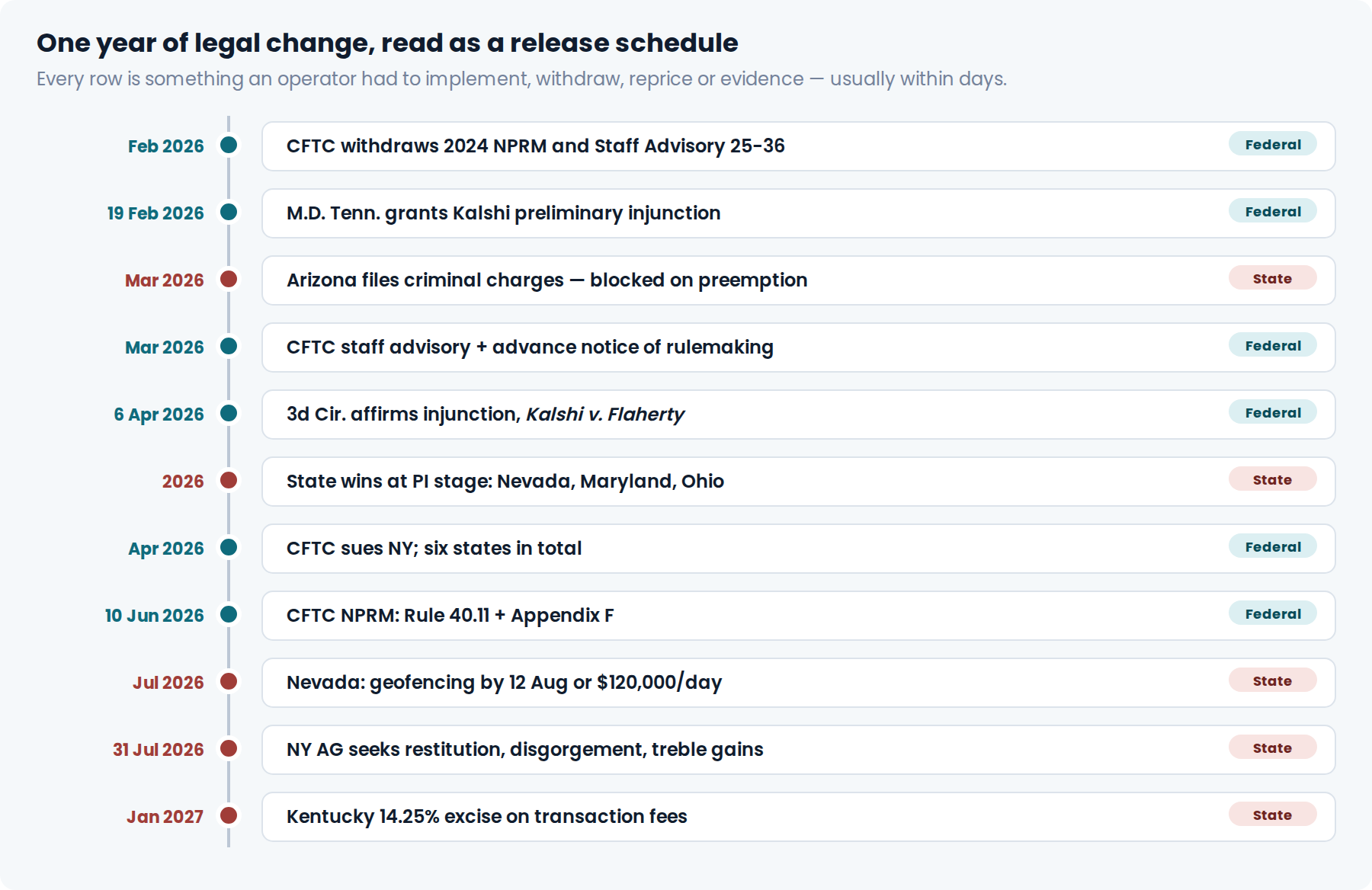
Figure 1. Federal and state authorities moved in opposite directions repeatedly, and
several positions reversed within weeks. Architecture has to absorb that without a deployment.
Read that table as a release schedule, not a news summary. Every row is
something an operator had to implement, withdraw, reprice or evidence, usually inside days. The
Nevada stipulation is the clearest example: the remedy for a compliance failure was not a fine alone
but a technical deliverable with a deadline and a daily penalty attached. An operator whose
geofencing is a third-party SDK behind a feature flag meets that in an afternoon. An operator whose
location logic is compiled into a mobile app that needs app-store review does not.
What a Moving Map Means for the Build
Short answer: Five properties separate a platform that can operate here from one
that cannot: availability is configurable per jurisdiction per contract;
location decisions are evidential; open positions have a defined
treatment when a market becomes unavailable; fees and levies are rules, not
constants; and every state change is reversible, because several
rulings were reversed or stayed within weeks.
Legal event
What the platform must do
Acceptable response time
Court orders a contract type withdrawn in one state
Disable that contract for users resolved to that jurisdiction; handle open positions and
resting orders under a pre-agreed policy; notify affected users
Minutes to hours
Regulator demonstrates access from inside a restricted state
Tighten location verification, add a vendor or signal layer, produce evidence of the
change
Days, with a deadline attached
Injunction stayed or reversed on appeal
Re-enable the same contract in that state, with a clean audit trail of both transitions
Hours
New state tax on transaction fees with a future effective date
Apply a jurisdiction-scoped levy from a specified date, report it separately, show it
pre-trade
Before the effective date
Federal rule changes the review standard for a contract class
Produce the metadata and rationale for every affected listing; potentially suspend
listings during review
Within the review window
Enforcement action seeking disgorgement
Reconstruct, per user and per jurisdiction, what was traded, when, from where, and what
the platform earned
On demand, months later
The last row is the one that quietly determines cost. An operator asked to account for activity in a
specific state over a specific period, months after the fact, either runs a query or runs a forensic
project. That difference is decided at schema design, long before any of this happens.
Geofencing Architecture
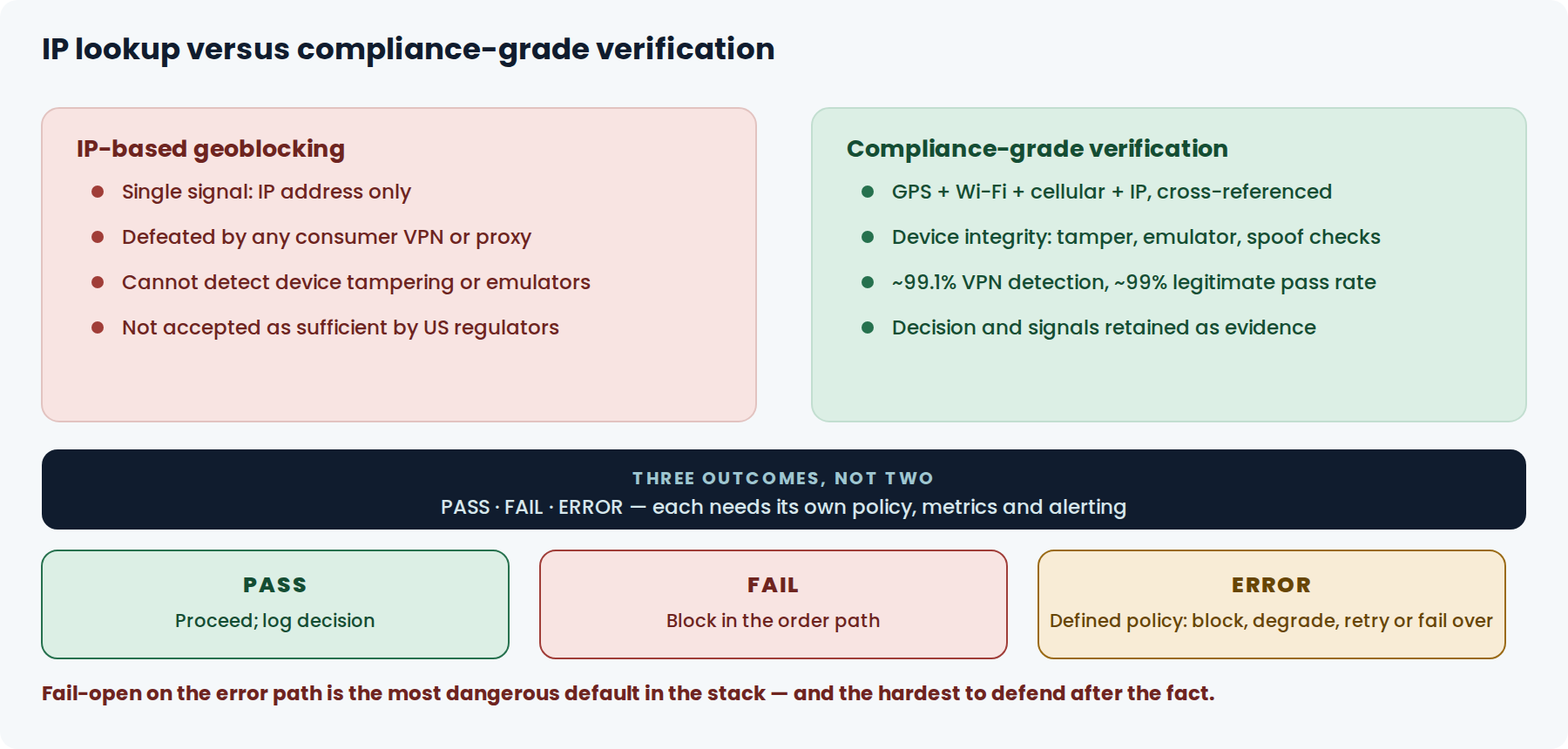
Short answer: IP-based geoblocking is not compliance-grade and regulators do not
treat it as sufficient — any consumer VPN defeats it. Compliance-grade verification cross-references
multiple independent signals (GPS, Wi-Fi triangulation, cellular, IP) through a device-level SDK
that also checks for tampering, emulators and spoofing software. Leading vendors publish VPN
detection around 99.1% with roughly 99% pass rates for legitimate users. The architectural
requirements are a documented failover path, a retention policy, and evidence that survives an
audit.
Figure 2. Pass and fail are the easy cases. The error path is where architecture is
actually tested, and it needs a written policy before launch.
The signal stack
Device-level SDK, not server-side IP lookup. The SDK captures GPS, Wi-Fi access
points, cellular signals and IP together, and inspects the device for tampering, emulators, rooting
and spoofing software. Cross-referenced agreement across four independent signals is difficult to
fake on a standard consumer device; a single IP check is not.
Border handling. Users near a state line generate GPS drift and intermittent
signals, producing both false blocks and false passes. High-accuracy buffers around boundaries, plus
a defined manual-review path, are the standard mitigation — and the buffer distance is a
configuration value, not a constant.
Check cadence. Verification at login is insufficient for a session in which a user
can trade for hours. Define re-check intervals and event triggers (order placement above a
threshold, session resumption, network change) as configuration, because different jurisdictions
expect different frequencies.
Failure behaviour is a policy decision, not a default. When the vendor returns an
error rather than a pass or fail, the platform must choose: block, allow, degrade to read-only, or
retry. Write that decision down before launch, because it will be asked about. Fail-open on a
compliance control is the single most dangerous default in the stack.
Dual-vendor failover. At the scale leading vendors operate — on the order of a
billion checks a month — outages and error rates are operational facts. Routing to a secondary
provider on error is a real architectural pattern, and it has a documentation consequence:
regulators expect the geolocation solution to be described in licence applications and renewals, so
a fallback provider must be disclosed rather than quietly wired in.
Retention and hashing. Raw coordinates are sensitive personal data. Some
jurisdictions have moved to explicit requirements — New Jersey, for example, requires hashing within
a short defined window after the compliance decision. Retention periods must be configurable per
jurisdiction and enforced automatically.
Client-side never decides. The device gathers signals; the server makes the
decision and records it. Any architecture where the client determines its own eligibility will be
defeated, and the defeat will be demonstrated by a regulator's own investigator rather than
discovered internally.
The Nevada episode is the specification. A court ordered an operator to
stop offering certain contracts in the state. The operator complied at the product level. Regulators
then had their own investigators attempt to trade from inside Nevada — and succeeded. The remedy was
a stipulation to install third-party geofencing by a fixed date or pay $120,000 per day. Three
engineering lessons follow directly. First, "we removed it from the lobby" is not enforcement; the
block must sit in the order path on the server. Second, assume your controls will be tested
adversarially by the regulator, not just by users. Third, your own verification that a block works
must be independent of the system implementing it — test from a real device in the restricted state,
not with a mocked location header.
Market Listing and Withdrawal Controls
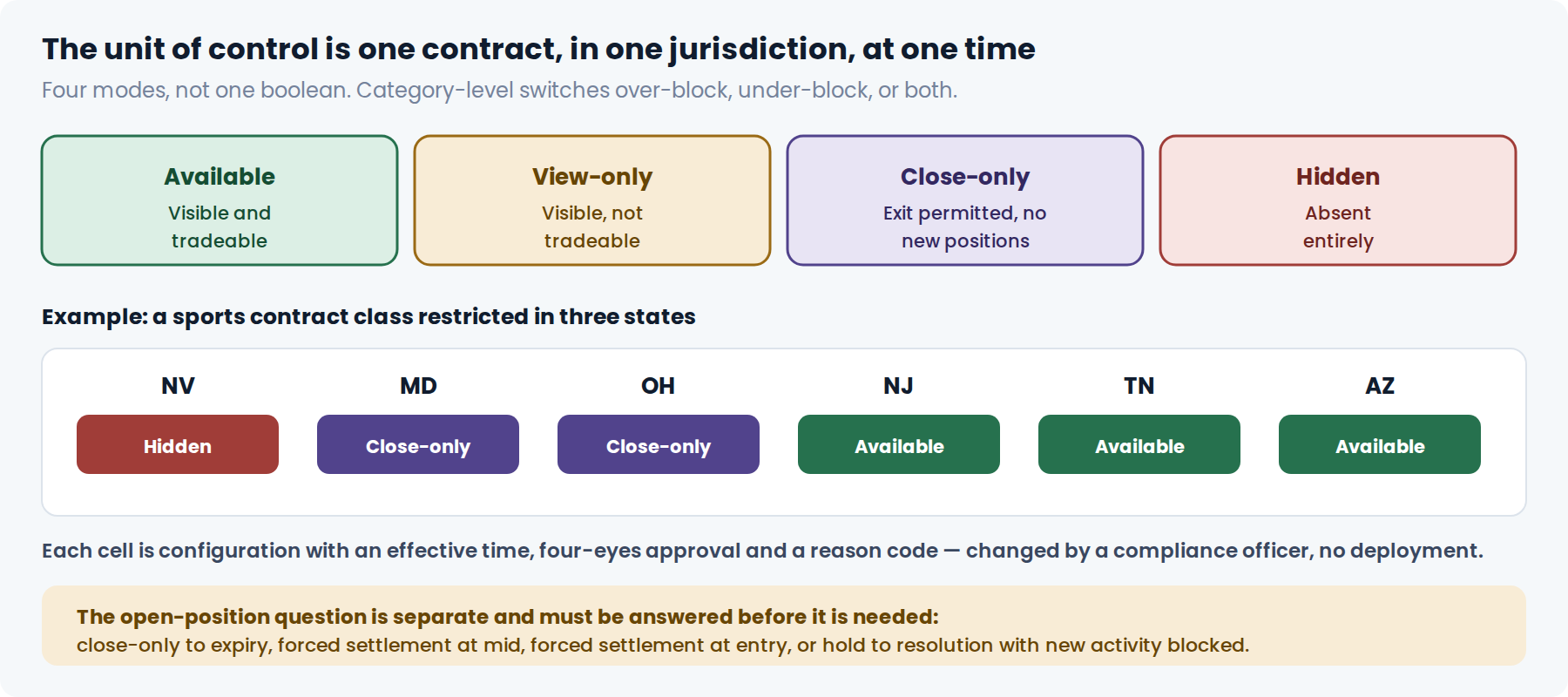
Short answer: The unit of control is not the platform and not the category — it is
the individual contract, in a specific jurisdiction, at a specific time. An operator needs to
withdraw one contract type from one state without touching anything else, decide what happens to
open positions under a pre-written policy, and reverse the change cleanly when a ruling is stayed.
Figure 3. Court orders name specific contract classes in specific states. A
platform-level or category-level switch cannot express that, and costs revenue in every state that
was not restricted.
Control
What it does
Why the granularity matters
Per-contract, per-jurisdiction availability flag
Makes a single market visible and tradeable only where permitted
Rulings have addressed specific contract classes — typically sports — not whole
platforms. Category-level switches over-block and cost revenue
Trade-only vs view-only vs hidden
Three distinct states: fully available, visible but not tradeable, entirely absent
Some restrictions target the offer to transact rather than the display of information.
One boolean cannot express that
Close-only mode
Blocks new positions while allowing existing holders to exit
The usual humane and defensible treatment when a market is withdrawn mid-life, and it
must exist before it is needed
Scheduled effective time
Applies a change at a defined moment rather than on save
Court orders and tax provisions carry dates. Manual execution at midnight is a failure
mode
Reversal with full history
Re-enables a market while preserving the record of both transitions
Injunctions get stayed and reversed. The audit trail must show what was available to
whom, when
Resting order treatment
Defined policy for open orders when availability changes: cancel, retain, or convert to
close-only
The most commonly unhandled case, and the one that generates complaints and disputes
Bulk action by contract class
Applies a change across a tagged group in one operation
When an order covers "sports event contracts", you need to action hundreds of listings
consistently, not individually
Four-eyes approval and reason codes
Requires a second authoriser and a recorded justification
Availability changes are compliance actions. "Who turned this off and why" must have an
answer
The open-position question deserves its own decision, made with counsel and written into the product
before launch. When a contract becomes unavailable in a state where users hold positions, the realistic
options are close-only until expiry, forced settlement at current mid-price, forced settlement at entry
price, or holding positions to natural resolution while blocking new activity. Each has different
fairness, accounting and regulatory implications, and each requires different engineering. Choosing
under time pressure, with an order in hand, is how operators end up with an outcome nobody can defend
afterwards.
The Jurisdiction Model
Jurisdiction is a dimension on every record, resolved at the moment of each action — not a
value on the account that changes when someone updates their address. Photograph:
Pexels, free licence; illustrative stock image, not a Capermint project.
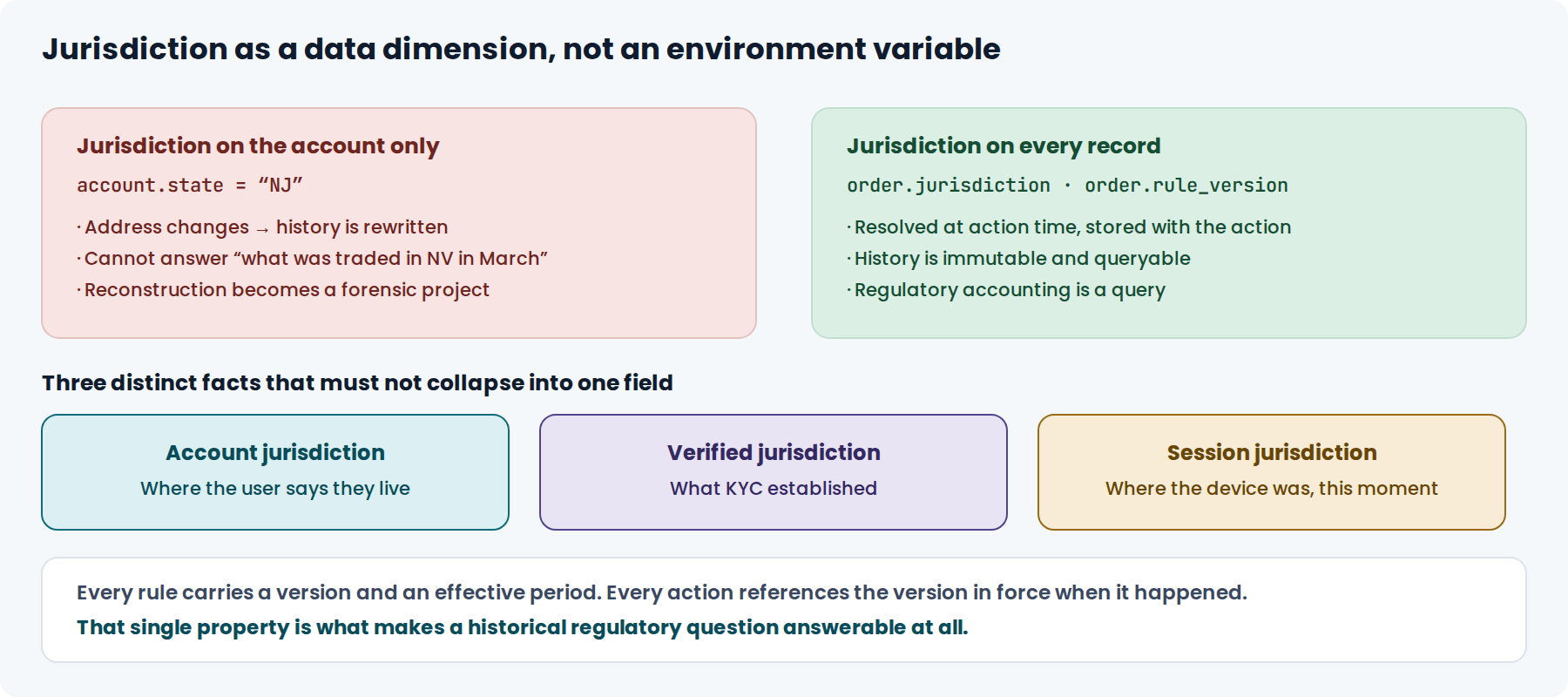
Short answer: Jurisdiction must be a first-class dimension on every record — user,
session, order, position, settlement, fee, report — resolved at the moment of action and stored with
it. Not an environment variable, not a deployment target, not a value derived at query time. The
reason is evidential: an operator must be able to answer "what did users in this state trade,
between these dates, under which rules" without reconstruction.
Resolve at action time, store with the record. A user's jurisdiction can change
between login and order. The jurisdiction that governed a specific order is the one resolved when
that order was placed, and it belongs on the order, not inferred later from the account's current
address.
Separate the three identities. Account jurisdiction (where the user says they
live), verified jurisdiction (what KYC established) and session jurisdiction (where the device was
at this moment) are different facts with different uses. Collapsing them into one field destroys the
ability to answer questions about any of them.
Version the rule set. Every rule — availability, limits, fees, disclosures —
carries a version and an effective period. An order references the rule version in force when it was
placed. This is what makes a historical question answerable at all.
Configuration, not code. Adding a jurisdiction, changing a limit or withdrawing a
contract is a data change made in an admin console with approval and an audit entry. If any of it
requires a release, the platform cannot meet the response times the market demands.
Hierarchy: country, state, and sub-state where needed. US state is the operative
level today, but tribal lands and municipal rules exist, and non-US markets have their own
subdivisions. A two-level model is cheap now and expensive to retrofit.
Explicit allow-lists, never deny-lists. A market is unavailable everywhere until a
jurisdiction is explicitly enabled. The failure mode of a deny-list is offering a product somewhere
nobody considered — which is precisely the allegation in several enforcement actions.
Reporting reads the same store. Regulatory returns, tax calculations and internal
analytics must derive from the same jurisdiction-stamped records. If the compliance report and the
BI dashboard can disagree, one of them is wrong and you will not know which.
Figure 4. Enforcement actions ask historical, per-state questions. Whether that is a
query or a forensic project is decided at schema design, long before anyone asks.
The Fee, Tax and Levy Engine
Short answer: Fees cannot be constants. Kentucky's 14.25% excise on operator
transaction fees, effective January 2027, is the template: a jurisdiction-scoped charge, applied to
a specific revenue base, from a future date, reportable separately. A fee engine needs jurisdiction
scope, effective dating, a defined base, separate accounting and pre-trade disclosure.
Requirement
What it means in the engine
Jurisdiction scope
Every fee and levy rule carries the jurisdictions it applies to; the same trade
generates different totals for users in different states
Effective dating
Rules activate and deactivate on scheduled dates without intervention, because
legislation specifies dates and nobody should be deploying on New Year's Eve
Defined base
A levy on transaction fees is a different calculation from one on volume, on gross
revenue, or on net winnings. The base must be an explicit property of the rule, not an
assumption in code
Layering order
Platform fee, maker or taker fee, settlement fee and statutory levy compose in a defined
sequence. Ambiguity here produces reconciliation breaks that take weeks to unwind
Separate accounting
Statutory levies are remitted, not earned. They must be tracked as a distinct liability
rather than folded into revenue, or the first tax return is a forensic exercise
Pre-trade disclosure
The order ticket shows the actual total the user will pay, including any
jurisdiction-specific charge. Surprise costs after execution generate complaints and, in
a supervised context, worse
Retrospective recalculation
The ability to recompute historical fees under a corrected rule, with a full record of
the original and revised figures, for the case where a rule is applied wrongly or
amended retroactively
Contract Design Under a Review Standard
Short answer: The CFTC's June 2026 proposal would establish a three-step framework
for whether a contract "involves" an enumerated activity — terrorism, assassination, war, gaming, or
conduct unlawful under federal or state law — and, if so, whether it is contrary to the public
interest. It adds a definition of "gaming". Under the existing rule the Commission may open a
review, request suspension of listing during it, and issue a determination. The engineering
consequence: contract metadata must be rich enough to answer that analysis, and listings must be
suspendable individually.
Structured contract metadata, not free text. Underlying event category, settlement
source, expiry rule, edge-case handling, the enumerated-activity assessment and the rationale for
listing. These are fields, because they will need to be queried and exported as a set.
Listing workflow with recorded approval. Who drafted the question, who reviewed it,
against which checklist, and on what date. A market listed by an automated pipeline with no human
record is indefensible under review.
Suspension without deletion. A contract under review may need to stop trading while
remaining fully intact, with its history and open positions preserved. Deleting or archiving
destroys the evidence you will be asked for.
Self-certification records. Where products are listed by self-certification rather
than prior approval, the certification and its supporting analysis are part of the product record
and should live with the contract, not in a shared drive.
Question-writing discipline. Ambiguous wording is the root cause of most settlement
disputes and the easiest thing for a regulator or a claimant to attack. One precise question, one
named settlement source, explicit expiry conditions, written edge cases — enforced by a review queue
rather than by good intentions.
Category tagging for bulk action. When an order or a rule addresses a class of
contracts, you need to identify and action every affected listing reliably. That requires tagging
designed in advance, not a text search over titles at 11pm.
Settlement and Disputes When the Ground Shifts
Short answer: Settlement is where legal uncertainty becomes a payment obligation.
The cases that need pre-written policies: a market withdrawn in one jurisdiction while it remains
live elsewhere; a settlement source that becomes unavailable or is disputed; positions held by users
whose eligibility changed mid-contract; and an outcome contested after payout.
Scenario
Decision required in advance
Market withdrawn in one state, live elsewhere
Do affected users settle early at mid, hold to natural resolution, or go close-only?
Does the answer differ for profitable and losing positions? It should not
User's verified jurisdiction changes mid-contract
Does eligibility attach at entry or persist through the life of the position? Write it
into the terms and enforce it in the engine
Settlement source unavailable or ambiguous
Named fallback source, escalation path to manual resolution, evidence requirements, and
a defined dispute window
Outcome disputed after payout
Rollback capability with full audit, user communication templates, and a policy on
whether payouts are clawed back or absorbed
Oracle disagreement (on-chain models)
Dispute window length, escalation mechanism, and the operator's role if the
decentralised process produces a result the operator believes is wrong
Enforcement action mid-contract
Whether trading halts, whether settlement proceeds, and how funds are handled if an
authority requires segregation or freezing
Audit and Evidence
An enforcement action seeking disgorgement requires an operator to account for per-state
activity months later. That is either a query or a forensic project. Photograph:
Pexels, free licence; illustrative stock image, not a Capermint project.
Short answer: Build for the demand that arrives months later: reconstruct exactly
what a specific user did, from where, under which rules, and what the platform earned from it. New
York's July 2026 proceeding sought restitution, disgorgement and treble gains, with the CFTC noting
the state sought billions pending an accounting. "Pending an accounting" is an engineering
requirement.
Immutable, append-only records for orders, trades, positions, settlements, fees and
balance movements. Nothing is edited; corrections are new entries referencing the original.
Location decisions retained as evidence — the decision, the signals that produced
it, the vendor, the timestamp and the rule version — within the retention and hashing rules of the
relevant jurisdiction.
Rule version stamped on every action, so a historical question is answered against
the rules that were actually in force rather than today's.
Jurisdiction on every financial record, so per-state revenue, fees and levies are a
query rather than a reconstruction.
Configuration change log capturing who changed which availability flag or fee rule,
when, with what approval and what stated reason.
Export in a defensible format — complete, reproducible, timestamped, with a
documented methodology someone else can verify.
Tested reconstruction. Run the drill before you need it: pick a past week, a state
and a contract class, and produce the full account. Whatever breaks in that drill is what would have
broken under subpoena.
The Free-to-Play Fallback
Short answer: Operators who cannot offer real-money event trading in a jurisdiction
sometimes run a virtual-currency or sweepstakes-structured product there instead. Architecturally
this is not a toggle: it is a second economy, and mixing it carelessly with the real-money product
creates exactly the ambiguity an enforcement action feeds on. Whether such a structure is lawful in
any given market is a question for counsel, not for a platform vendor.
Separate ledgers, no bridge. Virtual currency and real funds are distinct ledgers
with no automatic conversion path. Any bridge between them is the precise feature that invites a
gambling characterisation.
Distinct user experience. Different visual treatment, different terminology,
different terms of service. If a user cannot tell from the screen which product they are in, neither
can a regulator.
Jurisdiction decides the mode automatically. The same account in a restricted state
sees the free-to-play product; the mode is resolved by the jurisdiction engine, not chosen by the
user.
Prize mechanics reviewed before build. Sweepstakes structures carry their own legal
requirements including free-entry methods. The engineering follows counsel's structure rather than
an industry pattern copied from a competitor.
Separate reporting. Free-to-play activity is not trading volume and must never
appear in the same revenue or volume figures without clear separation.
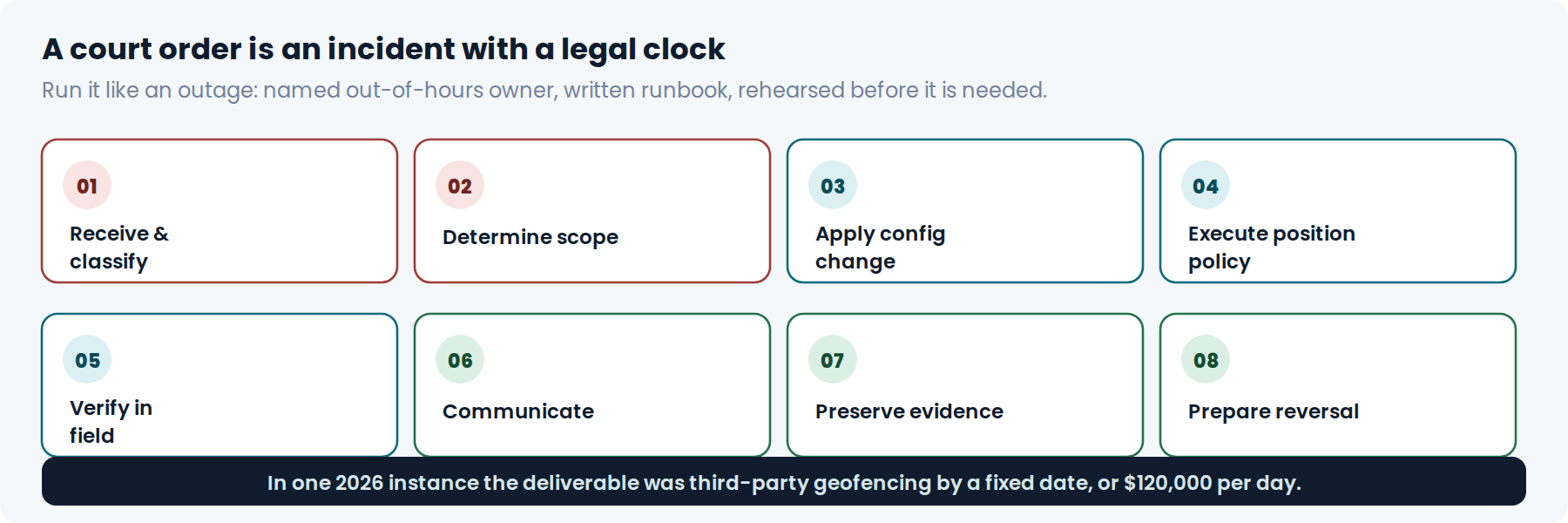
The Incident Playbook
Short answer: A court order or regulator demand is an incident with a legal clock,
and it should be run like an outage: named owner, defined runbook, rehearsed. The operators who
handled 2026 well had a written procedure. The ones who did not discovered their availability
controls were not granular enough while a deadline was running.
Receive and classify
Who receives legal notice out of hours, and how does it reach the person who can act on the
platform? Classify the scope: jurisdiction, contract class, effective date, whether it is a
suspension or a prohibition.
OutputA named on-call owner and a
classified scope within the hour.
Determine technical scope
Query which contracts, users, open positions and resting orders are affected. This is a query if
jurisdiction is modelled properly, and a project if it is not.
OutputExact affected set with position and order counts.
Apply the configuration change
Availability flags set with the correct mode — hidden, view-only or close-only — at the correct
effective time, with four-eyes approval and a recorded reason.
OutputChange applied, logged and independently verified.
Execute the position policy
Apply the pre-written treatment for open positions and resting orders. This is the step that must
never be improvised.
OutputPositions handled per policy, with a full
record.
Verify independently
Confirm the block from a real device in the affected jurisdiction, through a path independent of
the system that implemented it. Assume a regulator will run the same test.
OutputDocumented proof the control works in the field.
Communicate
Affected users, support, and where required the regulator. Templates drafted in advance with
counsel, because the drafting happens badly under pressure.
OutputNotifications sent, support briefed, response logged.
Preserve evidence
Snapshot the configuration state, the affected records and the verification results at the time
of the change, so the response itself is evidenced.
OutputAn evidence
package for the file.
Prepare the reversal
Injunctions get stayed and reversed. Document what would need to change to restore availability,
so the reversal takes minutes rather than a fresh discovery exercise.
OutputA ready reversal plan with its own approval path.
Figure 5. Step 5 matters most and is skipped most often: verify the block from a real
device in the affected state, through a path independent of the system that implemented it.
Reference Architecture
Eligibility is checked server-side in the order path on every material action. A block that
only hides a market from the lobby is not enforcement. Photograph: Pexels, free
licence; illustrative stock image, not a Capermint project.
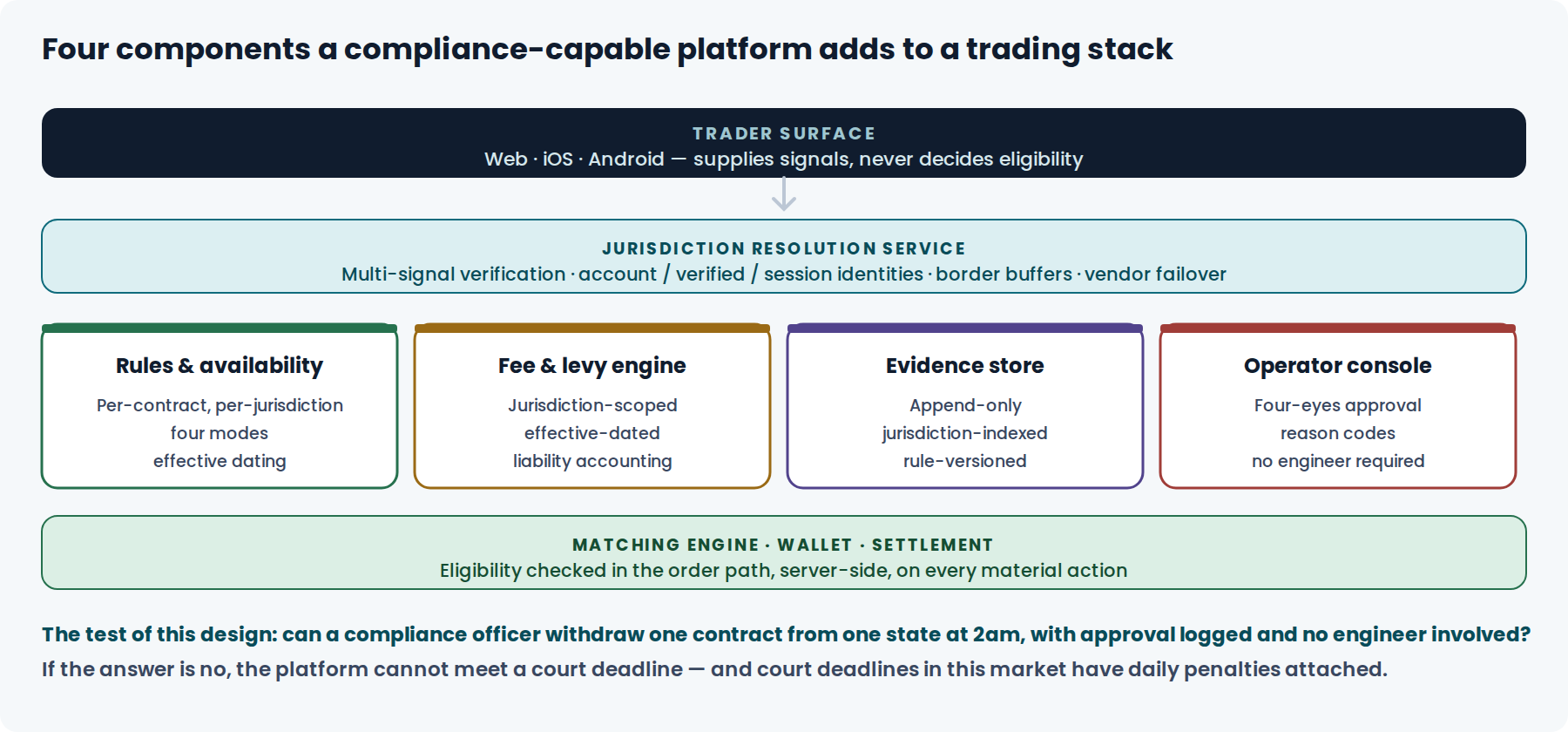
Short answer: A compliance-capable prediction market platform adds four things to a
standard trading stack: a jurisdiction resolution service called on every material
action, a rules and availability engine driven by versioned configuration, an
evidence store that is append-only and queryable by jurisdiction, and
operator tooling that lets a compliance officer act without an engineer.
Jurisdiction resolution service
Called on every material action
Multi-signal device verification via vendor SDK
Account, verified and session jurisdiction resolved separately
Border buffers and manual-review routing
Defined failure behaviour and vendor failover
Decision plus signals written to the evidence store
Design noteServer-authoritative without exception. The client supplies
signals; it never decides eligibility.
Rules & availability engine
Versioned configuration, not code
Per-contract, per-jurisdiction availability with three modes
Effective-dated activation and deactivation
Position and order treatment policies
Limits, disclosures and eligibility rules
Rule versions referenced by every action
Design noteIf a compliance officer cannot withdraw one contract from one
state without a ticket, the design has failed.
Fee, levy & accounting
Jurisdiction-scoped, effective-dated
Layered fee composition in a defined order
Statutory levies tracked as liabilities, not revenue
Pre-trade disclosure of the real total
Retrospective recalculation with full history
Per-jurisdiction revenue and remittance reporting
Design noteKentucky's January 2027 effective date is the test case: the rule
must be configurable today and activate itself then.
Design noteDesign it against the question "account for all activity in this
state over this period" and test the drill annually.
Figure 6. Nothing here is exotic engineering. It is ordinary discipline applied to
the one variable this market changes faster than any other: where you are allowed to operate.
Where the Three Platform Models Differ
Short answer: A centralised exchange model controls its own eligibility and can
enforce jurisdiction server-side at the order path. An on-chain model cannot block a smart contract,
so enforcement moves to the interface, the wallet-screening layer and the geographic availability of
the front end — a materially weaker position with different evidential properties. Free-to-play
sidesteps both but is a different product with its own rules.
Capability
Centralised exchange
On-chain protocol
Free-to-play
Where enforcement sits
Server-side, in the order path
Interface and access layer only
Server-side, lower stakes
Withdrawing a market by jurisdiction
Configuration change, minutes
Front-end and access control; the contract persists
Configuration change
Open position handling
Fully controllable
Constrained by contract logic written at deployment
Fully controllable
Evidence quality
Complete internal record
Public chain plus off-chain interface logs, needing reconciliation
Complete
Fee and levy application
Engine-controlled
Partly fixed in contract logic
Engine-controlled
Identity linkage
KYC-bound accounts
Wallet-based, with screening rather than identity
Light
Upgrade path when rules change
Deploy and configure
Contract upgradeability decided at design time or not at all
Straightforward
This is not an argument that one model is correct. It is an argument that the compliance burden differs
sharply between them, and that the decision should be made with that burden understood rather than on
token economics alone. For on-chain builds specifically, contract upgradeability and pause mechanisms
are compliance features, and the choice to omit them is a choice to be unable to respond. Capermint
builds all three models — the platform development page sets out the trade-offs commercially.
Geolocation Vendors and the Failover Question
Short answer: Three vendors dominate US gambling geolocation: GeoComply as the
incumbent, with published VPN detection around 99.1% and a stated 99% pass rate for legitimate
players; Xpoint; and LocationSmart. Selection matters less than three architectural decisions:
abstracting the vendor behind your own interface, defining behaviour when the vendor errors, and
disclosing any fallback in regulatory documentation rather than wiring it in quietly.
Abstract the vendor. Your code calls your own location service, which calls the
vendor. Swapping providers, adding a second, or running both in parallel for comparison then becomes
a configuration change rather than a refactor.
Error is a third outcome. Pass, fail and error are distinct. The error path needs
its own policy, its own metrics and its own alerting, because at high volume it is not rare.
Failover has a paper trail. Regulators expect the geolocation solution to be
documented in licence applications and renewals. A secondary provider used on error is part of that
solution and belongs in the documentation.
Monitor block-rate anomalies. A spike in a single state during a major event is a
strong signal of coordinated spoofing. Alert on block-rate, latency and error-rate by jurisdiction
rather than in aggregate.
Latency is revenue. Verification sits between intent and execution. Budget it
explicitly, measure it at p99, and decide what happens when the budget is exceeded during peak load
— because peak load is exactly when it will be.
Test in the field. Vendor accuracy claims are measured under their conditions. Your
blocks need verifying from real devices in the affected jurisdictions, periodically, with the
results filed.
What to Monitor
Metric
Why it matters
Alert on
Location pass, fail and error rates by jurisdiction
The core compliance control's health
Any sustained deviation from baseline in a single state
Verification latency, p50 and p99
Sits between intent and execution
p99 above the budget during peak windows
Blocked order attempts by contract and jurisdiction
Shows whether restrictions are being tested
Clustered attempts on a restricted contract
Availability configuration changes
Compliance actions requiring accountability
Any change without an approval record or reason code
Open positions in restricted jurisdictions
Should trend to zero after a withdrawal
Non-zero beyond the policy window
Levy accrual against expected base
Catches fee-engine misconfiguration early
Divergence from modelled expectation
Evidence export drill result
Proves reconstruction actually works
Run quarterly; any failure is a priority defect
Vendor failover invocations
Indicates dependency health and documentation accuracy
Any invocation — it should be rare and reviewed
Need this architecture scoped against your model and target states?
Send your platform model, target jurisdictions and current stack. Capermint returns a scope
breakdown, recommended team shape, timeline, technology fit, budget range and risk surface —
free, within 48 hours, NDA available before detailed discovery.
Vendor Evaluation: Questions on the Compliance Layer
Show me a compliance officer withdrawing one contract from one state, live. Not a
slide. If it needs an engineer, the platform cannot meet a court deadline.
What happens to open positions and resting orders when availability changes? If the
answer is "we'd decide at the time", that decision will be made badly under pressure.
Where is the location decision made? Any answer involving the client is
disqualifying.
What is the behaviour when the geolocation vendor returns an error? Listen for a
defined policy, not "it retries".
Can you run a dual-vendor setup, and is the fallback documentable?
Show me the jurisdiction field on an order record. If jurisdiction is only on the
account, historical questions cannot be answered.
Are rules versioned, and can you reconstruct which version governed a trade last
March?
Can a levy be configured now to activate on a future date? Kentucky's January 2027
date is the concrete test.
Run the evidence drill. Ask for all activity in a named state over a named week,
exported, during evaluation.
Who can change an availability flag, and what is recorded? Four-eyes approval and
reason codes, or it is not a compliance control.
For on-chain builds: are contracts upgradeable and pausable? And if not, what is
the response when a jurisdiction closes?
What does handover include? Source, documentation, infrastructure as code, runbooks
— so the incident playbook does not depend on the vendor answering the phone.
Ten Mistakes That Become Enforcement Problems
IP-based geoblocking treated as compliance. Defeated by any consumer VPN, and not
accepted as sufficient by regulators who test it themselves.
Jurisdiction as an environment variable. Separate deployments per market cannot
answer historical questions and cannot be reconfigured in minutes.
Availability controlled at category level only. Orders target specific contract
classes. Category switches over-block, under-block, or both.
No policy for open positions. The most predictable scenario in the entire market,
improvised on the day, generating complaints and disputes.
Client-side eligibility logic. It will be defeated, and the demonstration will come
from a regulator's investigator.
Fail-open on the location control. When the vendor errors, allowing the trade is
the wrong default and an indefensible one.
Fees hard-coded as constants. A statutory levy with a future effective date then
becomes a release, a migration and a reconciliation problem.
Mutable records. Edited orders and balances destroy the evidential value of the
entire dataset at the moment it matters.
No reversal path. Rulings are stayed and reversed. A one-way switch means
re-enabling becomes a fresh project with no clean audit trail.
Treating a court order as a legal matter rather than an incident. It has a clock, a
technical deliverable and, in at least one 2026 instance, a $120,000 daily penalty attached.
Jurisdiction modelled on every record, resolved at action time and versioned against the rules in
force — so "what did users in this state trade last quarter" is a query, not a forensic project.
Server-Authoritative Controls
Location decisions, eligibility and availability enforced in the order path on the server, never
in the client — with defined behaviour on vendor error and a documented failover route.
Operator Tooling That Does Not Need Engineers
Per-contract, per-jurisdiction availability with hidden, view-only and close-only modes,
effective dating, four-eyes approval and reason codes — usable by a compliance officer at 2am.
Ledger-Grade Fee and Levy Engines
Jurisdiction-scoped, effective-dated levies with defined bases, layered composition, separate
liability accounting and pre-trade disclosure — configurable before the effective date arrives.
Evidence Built for the Demand
Append-only records, retained location decisions, rule versions on every action and a
configuration change log — with the reconstruction drill run before anyone asks for it.
You Own the Response Capability
Source code, infrastructure as code, runbooks and documentation transferred — so your incident
playbook does not depend on your vendor answering the phone on a weekend.
What Capermint does not do. Capermint is a software engineering company.
It is not a law firm, a licensing broker, a regulator or a compliance adviser, and it does not hold
exchange registrations. It will not tell you whether a contract may lawfully be offered in a
jurisdiction — that is a determination for qualified counsel and, where relevant, the regulator.
What it does is build the controls your counsel specifies, and say during scoping rather than in
month six when a requirement is missing, technically unachievable, or architecturally incompatible
with a market you intend to enter.
A tradeable instrument whose payout depends on whether a defined future event occurs, usually
binary, priced between 0 and 100 where the price represents implied probability.
Designated contract market (DCM)
An exchange registered with the CFTC under the Commodity Exchange Act and permitted to list
derivatives including event contracts.
Commodity Exchange Act (CEA)
The US federal statute governing derivatives trading and the basis of the CFTC's jurisdiction over
event contracts listed on registered exchanges.
The Special Rule
CEA Section 5c(c)(5)(C), addressing event contracts involving terrorism, assassination, war, gaming
or unlawful activity, and empowering the CFTC to determine whether such contracts are contrary to
the public interest.
Rule 40.11
The CFTC regulation implementing the Special Rule, substantially revised by the June 2026 proposed
rulemaking, which would add Appendix F to Part 40 and define "gaming".
Self-certification
The process by which a registered exchange may list a new product by certifying its compliance, as
an alternative to prior CFTC review and approval.
Preemption
The doctrine that federal law displaces conflicting state law. Here, whether the CEA displaces state
gaming statutes for DCM-listed event contracts — an unresolved question on which courts have split.
Swap
A category of derivative under the CEA. Whether sports event contracts qualify as swaps is central
to the preemption argument accepted by the Third Circuit in 2026.
Compliance-grade geolocation
Multi-signal, tamper-resistant, logged location verification built to regulator-acceptable
evidential standards. Distinct from IP geoblocking.
Player location check
A single verification event producing a pass, fail or error outcome, with the signals and decision
retained as evidence.
Spoofing
Falsifying device location through VPNs, proxies, GPS manipulation software or emulators. The threat
compliance-grade geolocation is built to defeat.
Border buffer
A configured margin around a jurisdiction boundary within which additional verification or manual
review applies, mitigating GPS drift near state lines.
Jurisdiction-aware configuration
Architecture in which jurisdiction is a dimension on every record and every rule resolves against it
at runtime, so behaviour changes by configuration rather than deployment.
Availability mode
The state of a contract in a jurisdiction: fully available, view-only, close-only or hidden. One
boolean cannot express the distinctions regulators draw.
Close-only
A mode permitting existing position holders to exit while blocking new positions. The standard
treatment when a market is withdrawn mid-life.
Effective dating
Scheduling a rule change to activate or deactivate at a defined future moment without manual
intervention — required because legislation and court orders carry dates.
Rule version
An identifier stamped on every action recording which configuration governed it, making historical
questions answerable against the rules actually in force.
Statutory levy
A jurisdiction-imposed charge such as Kentucky's 14.25% excise on operator transaction fees.
Remitted rather than earned, so it is accounted as a liability.
Evidence store
Append-only, jurisdiction-indexed records of orders, trades, positions, settlements, fees and
location decisions, designed to support reconstruction months later.
Disgorgement
A remedy requiring surrender of gains obtained through conduct found unlawful. Its practical
implication is that per-jurisdiction revenue must be reconstructable.
Optimistic oracle
A settlement mechanism in which a proposed outcome stands unless challenged within a dispute window,
escalating if contested. Used in on-chain models.
Four-eyes approval
A control requiring a second authorised person to approve an action before it takes effect, applied
here to availability and fee changes.
Frequently Asked Questions
What is prediction market compliance engineering?
It is the practice of building a prediction market platform whose jurisdiction rules,
market availability, location controls and fee logic can change without a code release. It exists
because the legal footprint of event contracts now changes faster than most release cycles: in 2026
alone, courts in different circuits reached opposite conclusions on federal preemption within weeks,
the CFTC sued six states, one operator agreed to install third-party geofencing in Nevada by a fixed
date or pay $120,000 a day, and Kentucky legislated a 14.25% excise tax on operator transaction fees
effective January 2027. The architectural response is to treat jurisdiction as a first-class data
dimension and every restriction as versioned configuration rather than code.
Is IP-based geoblocking enough for a prediction market platform?
No. IP-only geoblocking is defeated by any consumer VPN and is not treated as
sufficient by US gaming regulators. Compliance-grade verification uses a device-level SDK that
cross-references multiple independent signals — GPS, Wi-Fi triangulation, cellular and IP — while
also inspecting the device for tampering, emulators, rooting and location-spoofing software.
Spoofing all four signals simultaneously with consistent agreement is difficult on a standard
consumer device; spoofing an IP address is trivial. Leading vendors publish VPN detection rates
around 99.1% with roughly 99% pass rates for legitimate players. Regulators also test this
adversarially: in 2026, Nevada's own investigators were able to place trades from inside the state
after a court order, which led directly to a geofencing stipulation with a six-figure daily penalty.
How quickly does a platform need to be able to withdraw a market from one state?
Minutes to hours, and without a deployment. Court orders in this area name specific
contract classes — typically sports event contracts — in specific jurisdictions, sometimes with a
compliance deadline attached. A platform whose availability controls operate only at platform or
category level will over-block and lose revenue, or under-block and remain exposed. The required
granularity is per-contract, per-jurisdiction, with distinct modes for fully available, view-only,
close-only and hidden, plus effective dating so a change applies at a specified moment rather than
when someone remembers to click save. The change must also be reversible with a clean audit trail,
because injunctions in this area have been stayed and reversed.
What happens to open positions when a market becomes unavailable in a jurisdiction?
That is a policy decision that must be made with counsel and built into the product
before launch, not improvised when an order arrives. The realistic options are close-only until
natural expiry, forced settlement at the current mid-price, forced settlement at entry price, or
holding positions to resolution while blocking all new activity. Each has different fairness,
accounting and regulatory implications, and each requires different engineering. Resting orders need
their own treatment — cancelled, retained, or converted to close-only. In practice this is the
single most commonly unhandled scenario in prediction market platforms, and it is also the most
predictable one.
Why does jurisdiction need to be on every record rather than on the account?
Because the questions you will be asked are historical and per-jurisdiction. An
enforcement action seeking restitution or disgorgement requires an operator to account for what
users in a specific state traded, over a specific period, under the rules in force at the time, and
what the platform earned from it. If jurisdiction lives only on the account, and the account's
address has since changed, that reconstruction becomes a forensic project rather than a query. The
correct model resolves jurisdiction at the moment of each material action and stores it on the
record — order, trade, position, settlement, fee — alongside the version of the rule set that
governed it. It also separates three distinct facts: account jurisdiction, verified jurisdiction
from KYC, and session jurisdiction from the location check.
What is the CFTC's June 2026 proposed rule and why does it matter to a platform
build?
On 10 June 2026 the CFTC published a Notice of Proposed Rulemaking titled 'Prediction
Markets; Public Interest Determinations' (RIN 3038-AF65), proposing amendments to Regulation 40.11
and a new Appendix F to Part 40. It would establish a structured, three-step framework for
evaluating whether an event contract involves an activity enumerated in CEA Section 5c(c)(5)(C) —
terrorism, assassination, war, gaming, or conduct unlawful under federal or state law — and, if so,
whether it is contrary to the public interest. It would also add a definition of 'gaming' and
clarify when a contract 'involves' an underlying activity. Comments were due 27 July 2026. For a
builder, the consequence is that contract metadata must be structured and rich enough to answer that
analysis per listing, and individual listings must be suspendable without deletion during a review.
How should a platform handle a geolocation vendor error?
As a defined policy, not a default. Pass, fail and error are three distinct outcomes,
and at the volumes leading vendors operate — on the order of a billion checks per month — errors are
an operational fact rather than an edge case. The platform must decide in advance whether an error
blocks the action, degrades the session to read-only, triggers a retry with a bounded budget, or
routes to a secondary provider. Fail-open on a compliance control is the most dangerous default in
the entire stack and is very difficult to defend afterwards. If a fallback provider is used, it
forms part of the geolocation solution that regulators expect to see described in licence
applications and renewals, so it should be documented rather than quietly wired in.
Does an on-chain prediction market have the same compliance capabilities as a
centralised one?
No, and the difference is material. A centralised exchange enforces eligibility
server-side in the order path, can withdraw a market by configuration in minutes, and controls open
positions fully. An on-chain protocol cannot block a deployed smart contract, so enforcement moves
to the interface, the access layer and wallet screening — a weaker position with different
evidential properties, since the record is split between a public chain and off-chain interface logs
that must be reconciled. Fee and levy application is also partly fixed in contract logic rather than
engine-controlled. None of this means on-chain is the wrong choice, but contract upgradeability and
pause mechanisms should be understood as compliance features, and choosing to omit them is choosing
to be unable to respond to a jurisdiction closing.
How do you build a fee engine for a tax that starts in the future?
With jurisdiction scope and effective dating as first-class properties of every fee and
levy rule. Kentucky's 14.25% excise on prediction market operators' transaction fees, effective
January 2027, is the template: it applies to a specific jurisdiction, to a specific revenue base
(transaction fees rather than volume or gross revenue), from a specific future date. The rule should
be configurable today and activate itself then, with no deployment. The engine also needs a defined
layering order for platform, maker/taker, settlement and statutory charges; separate accounting so
levies are tracked as a remittance liability rather than folded into revenue; pre-trade disclosure
of the real total the user will pay; and retrospective recalculation with full history for the case
where a rule is applied incorrectly or amended.
What evidence does a prediction market operator need to retain?
Enough to reconstruct, months later, exactly what a specific user did, from where,
under which rules, and what the platform earned from it. Practically that means append-only records
for orders, trades, positions, settlements, fees and balance movements with nothing ever edited;
location decisions retained with the signals that produced them, the vendor and the timestamp,
within each jurisdiction's retention and hashing requirements; a rule version stamped on every
action; jurisdiction on every financial record; and a configuration change log capturing who changed
an availability flag or fee rule, when, with what approval and stated reason. New York's July 2026
proceeding sought restitution, disgorgement and treble gains pending an accounting — and 'pending an
accounting' is an engineering requirement, not a legal formality.
Are prediction markets legal in the United States?
That question is genuinely unresolved and is not one a software vendor can answer. The
core dispute is whether event contracts listed on a CFTC-registered designated contract market fall
within the CFTC's exclusive federal jurisdiction, or whether state gaming law applies. Courts have
split: the Third Circuit affirmed a preliminary injunction for Kalshi against New Jersey in April
2026, and a federal court in Tennessee reached a similar conclusion in February 2026, while state
regulators prevailed at the preliminary-injunction stage in Nevada, Maryland and Ohio. The CFTC has
sued several states arguing their enforcement is preempted, and states have pursued enforcement,
criminal charges and taxation. Any operator needs qualified gaming, securities and derivatives
counsel for every market it intends to serve. This guide addresses only what a platform must be
technically capable of, given that the answer differs by state and keeps changing.
What is the difference between a prediction market and a sportsbook, technically?
A sportsbook prices markets and takes the other side of the bet, earning the overround
built into its odds; it carries market risk and manages exposure actively. A prediction market
matches participants against each other through an order book or an automated market maker and earns
fees or spread, taking no position on the outcome. Structurally, a prediction market is closer to an
exchange than to a bookmaker, which is the basis of the argument that its contracts are derivatives
rather than wagers. From a compliance-engineering standpoint, however, the requirements converge:
both need compliance-grade geolocation, per-jurisdiction market availability, evidential logging and
configurable fees, because both are restricted differently in different places.
Should a court order be treated as a legal matter or an engineering incident?
Both, and the engineering side is routinely underestimated. A court order in this area
typically carries a clock, a defined scope and sometimes an explicit technical deliverable — in one
2026 instance, third-party geofencing installed by a named date or a $120,000 daily penalty.
Treating it purely as a legal matter means the technical response is improvised. The operators who
handled 2026 well ran it as an incident: a named out-of-hours owner, a classification step, a query
to determine exact technical scope, a configuration change with four-eyes approval, execution of a
pre-written position policy, independent verification from a real device in the affected
jurisdiction, user and regulator communication from pre-drafted templates, an evidence snapshot, and
a prepared reversal plan for when the ruling is stayed.
What should we ask a platform vendor about the compliance layer?
Ask them to demonstrate, live, a compliance officer withdrawing one contract from one
state — not a slide. Ask what happens to open positions and resting orders when availability
changes, and treat 'we'd decide at the time' as a failure. Ask where the location decision is made;
any answer involving the client is disqualifying. Ask what happens when the geolocation vendor
returns an error, and listen for a defined policy rather than 'it retries'. Ask to see the
jurisdiction field on an order record, not just the account. Ask whether rules are versioned and
whether they can reconstruct which version governed a trade last March. Ask whether a levy can be
configured now to activate on a future date. Run the evidence drill during evaluation: request all
activity in a named state over a named week, exported. And for on-chain builds, ask whether
contracts are upgradeable and pausable — and if not, what the response is when a jurisdiction
closes.
How much does a compliance-capable prediction market platform cost?
Capermint publishes indicative ranges by build type on its prediction market platform
development page, covering MVP, white-label, Web3 and exchange-grade builds along with timelines and
the factors that drive price. The compliance layer described in this article is not a separate
product but a set of properties of the core architecture — jurisdiction modelling,
server-authoritative controls, versioned configuration, evidential logging and operator tooling.
Building those in from the start costs comparatively little; retrofitting them into a live platform
with open positions and historical records is expensive and, in the case of evidential logging,
partly impossible because the historical data was never captured. Scope and quotation are returned
within 48 hours of a brief, with NDA available.
Can a free-to-play version be offered in restricted jurisdictions?
Whether a virtual-currency or sweepstakes-structured product may lawfully be offered in
a given market is a question for counsel, and the structures carry their own legal requirements
including free-entry mechanics. Architecturally, though, it is not a toggle on the real-money
product — it is a second economy, and the engineering must keep it genuinely separate. That means
distinct ledgers with no automatic conversion path between virtual currency and real funds, because
any bridge is precisely the feature that invites a gambling characterisation. It also means
different visual treatment, terminology and terms of service so a user can tell which product they
are in; automatic mode selection driven by the jurisdiction engine rather than user choice; prize
mechanics designed to counsel's structure rather than copied from a competitor; and completely
separate reporting, since free-to-play activity is not trading volume.
References and Sources
Primary and legal sources, as at September 2026. This area
is moving unusually fast and several items are proposals or interlocutory decisions rather than
settled law. Verify the current status of anything below with qualified counsel before relying on
it. Capermint is not a law firm and this list is provided as sourcing for the engineering analysis,
not as a legal summary.
Commodity Futures Trading Commission, Notice of Proposed Rulemaking, "Prediction Markets; Public
Interest Determinations", RIN 3038-AF65, issued 10 June 2026 and published in the Federal
Register 12 June 2026; proposing amendments to CFTC Regulation 40.11 and the addition of
Appendix F to Part 40, a three-step framework for whether a contract "involves" an enumerated
activity, and a definition of "gaming". Comments due 27 July 2026.
CFTC Press Release 9249-26, "CFTC Seeks Public Comment on Notice of Proposed Rulemaking
Concerning Event Contracts Involving Enumerated Activities", 10 June 2026, including the
statement by Chairman Michael S. Selig.
Congressional Research Service, Prediction Markets: Policy Issues for Congress, IF13187
— including the February 2026 withdrawal of the June 2024 proposed rulemaking and Staff Advisory
25-36, the March 2026 staff advisory on manipulation susceptibility and real-time monitoring,
the March 2026 advance notice of proposed rulemaking, and the CFTC's February 2026 amicus brief
opposing Nevada.
Congressional Research Service, CFTC Issues Proposed Rule Regarding Prediction Markets,
LSB11441, 24 June 2026 — analysis of the substantive and procedural elements of the 2026
proposed rule.
KalshiEX LLC v. Flaherty, 172 F.4th 220 (3d Cir. 2026), decided 6 April 2026, affirming
a preliminary injunction against New Jersey and holding that sports event contracts likely
qualify as swaps traded on a CFTC-licensed DCM within the CFTC's exclusive jurisdiction, with a
dissent arguing for a presumption against preemption.
Arnold & Porter, Prediction Markets at a Crossroads: Congress, Courts, or Chaos? (2026)
— including volume figures of over $40 billion across Kalshi and Polymarket in 2025 against
roughly $9 billion in 2024, and sports contracts at approximately 80% of Kalshi's volume and 39%
of Polymarket's since July 2024.
Holland & Knight, Prediction Markets at a Crossroads: The Continued Jurisdictional Battle
Over Event Contracts (February 2026) — on the CFTC's declaration of exclusive
jurisdiction and enforcement activity in Nevada, Massachusetts and Tennessee, including the 19
February 2026 preliminary injunction granted by the U.S. District Court for the Middle District
of Tennessee.
Holland & Knight, CFTC Proposes Comprehensive Framework for Public-Interest Review of Event
Contracts (June 2026) — noting prediction market volume exceeding $25 billion across
CFTC-registered platforms in 2025.
DLA Piper, Legal status at odds: Tracking developments in prediction markets and sports
betting (September 2026) — on CFTC suits against Arizona, Minnesota, Wisconsin,
Illinois, New York and Connecticut.
Ropes & Gray, Rewriting the Rulebook: CFTC Proposes Rule Changes for Prediction Market
Contracts Against Public Policy (June 2026) — on the three-step analytical framework,
the undefined status of "involve", "gaming" and "public interest" under the existing rule, and
the 90-day review mechanism.
Greenberg Traurig, CFTC Proposes New Rules for Event Contracts on Prediction Markets
(June 2026).
Norton Rose Fulbright, CFTC advances regulatory framework for prediction markets — on
the March 2026 CFTC Division of Market Oversight staff letter and the February 2026 withdrawals.
DarrowEverett LLP, How Courts and Regulators Are Redefining U.S. Prediction Markets
(May 2026) — on mixed outcomes including state regulators prevailing at the
preliminary-injunction stage in Nevada, Maryland and Ohio.
InfoLawGroup LLP, Prediction Markets Enter Their Next Legal Battle (September 2026) —
on the New York Attorney General's 31 July 2026 special proceeding seeking restitution,
disgorgement, treble gains and a $100,000 penalty per unauthorised offer; Kentucky's 14.25%
excise tax on prediction market operators' transaction fees effective January 2027; and the
Nevada joint stipulation requiring third-party geofencing by 12 August 2026 or $120,000 per day.
Free Writings & Perspectives, Sports, Speculation, and the Public Interest (June 2026)
— on contract growth from more than 220 types in 2021 to over 8,000 traded in May 2026, and on
the withdrawn 2024 proposal.
The Regulatory Review (University of Pennsylvania), Regulating the Prediction Market
Boom (August 2026).
Amazon Web Services, Building geolocation verification for iGaming and sports betting on
AWS — on device-specific SDKs, tamper and VPN detection, geofence management, and the
stated limitations of DNS-based geolocation for compliance purposes.
Independent testing and vendor documentation on US gambling geolocation: GeoComply's published
VPN detection rate of 99.1% with 0% false positives (Kingsmead Security testing, 2025), a stated
99% geolocation compliance pass rate, and comparative coverage of GeoComply, Xpoint and
LocationSmart including dual-vendor failover and regulatory documentation requirements; New
Jersey's requirement to hash raw coordinate data shortly after the compliance decision.
Important. This guide is software engineering and architecture
analysis produced by Capermint Technologies. It is not legal, regulatory, tax or financial
advice, and it is not an invitation to trade or to offer event contracts anywhere.
Prediction markets sit at a contested intersection of federal derivatives law and state gaming law in
the United States, and are regulated differently or prohibited in other jurisdictions. Court decisions,
agency rules and enforcement positions described here are summarised from public sources as at September
2026; several are preliminary or proposed, several have already been stayed, reversed or superseded in
this area within weeks, and all should be verified before any reliance. Nothing here states or implies
that any product may lawfully be offered in any jurisdiction, nor that implementing any control
described here achieves legal or regulatory compliance. Operators must obtain qualified gaming,
securities and derivatives counsel in every market they intend to serve, and technical controls must be
built to the requirements those advisers specify. Capermint does not hold exchange registrations or
gaming licences, does not provide legal or compliance advice, and does not act as a licensing
intermediary. Kalshi and Polymarket are trademarks of their respective owners and are referenced for
factual and comparative purposes only; Capermint is not affiliated with either.
Build a Platform That Can Respond in Hours, Not Releases
If your legal footprint can change with a single ruling, the architecture has to absorb that without
an engineer on call. Capermint builds prediction market platforms across regulated exchange,
on-chain and free-to-play models, with jurisdiction modelled as a data dimension,
server-authoritative controls, ledger-grade fee engines and evidence designed for the demand that
arrives months later — source code and IP transferred to you. Scope breakdown, team shape, timeline,
budget range and risk surface within 48 hours, NDA available before detailed discovery.