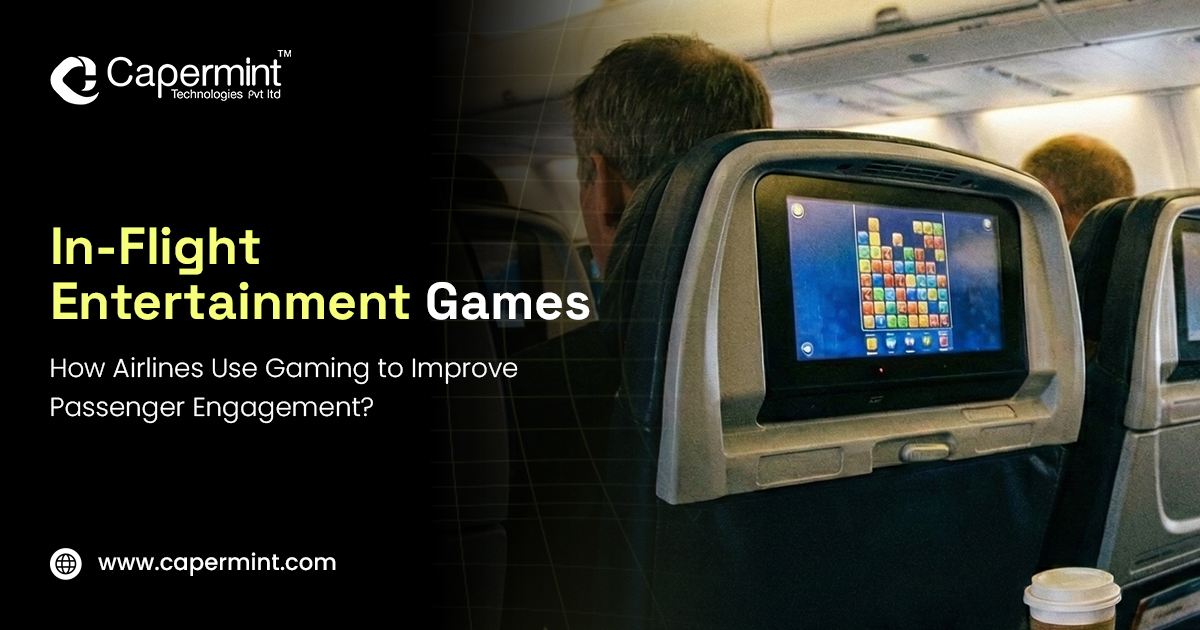
If you’ve flown in the last few years, you’ve probably noticed something changing about in-flight entertainment. It’s no longer just movies, TV shows, and a flight map slowly inching across the screen. Increasingly, passengers are tapping, swiping, and playing games directly on seatback screens or their own devices, sometimes minutes after takeoff.
This shift isn’t accidental. Airlines are under growing pressure to improve passenger experience without adding operational complexity, and interactive entertainment has emerged as a powerful solution.
According to the International Air Transport Association (IATA), passenger experience has become one of the top strategic priorities for airlines as competition intensifies and expectations rise. Games, unlike passive content, actively engage passengers and help reduce the perceived length of a flight.
In-flight entertainment games are designed to work within the unique constraints of air travel – limited or no internet, shared hardware, touch or remote-based inputs, and diverse age groups. When done right, they keep passengers entertained for longer, appeal to families and children, and leave travelers with a more positive impression of the airline.
In this article, we’ll explore how airlines use in-flight entertainment games to improve passenger engagement, the types of games that work best on airplanes, the technical challenges involved in developing them, and what it takes in time and cost to build gaming experiences that perform reliably at 35,000 feet.
What Are In-Flight Entertainment Games?
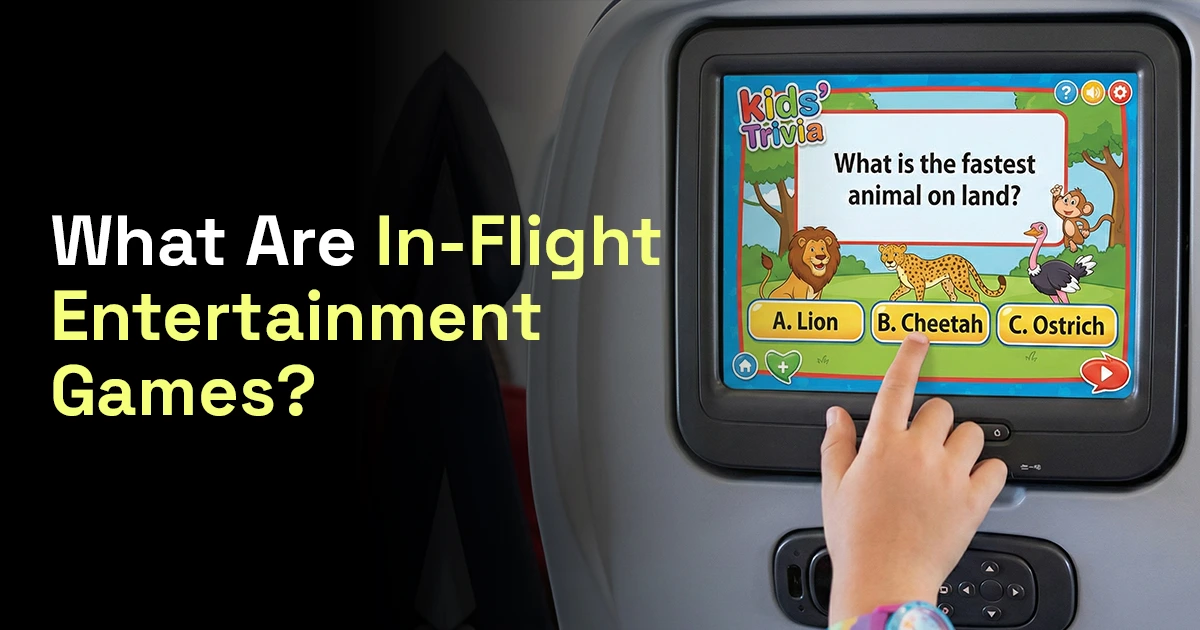
In-flight entertainment games are interactive games designed specifically to run on airline entertainment systems. These games are accessed either through seatback screens or passenger personal devices connected to the aircraft’s internal network. Unlike mobile or console games, they are built to operate in a highly controlled, offline-first environment.
The primary goal of in-flight entertainment games is not depth or long sessions, but engagement within the constraints of air travel. They are designed to be easy to understand, quick to play, and accessible to passengers of all ages.
In-flight games typically differ from standard games in several key ways. They must function without continuous internet access, perform reliably on shared or lower-powered hardware, and support simplified input methods such as touchscreens or handheld remotes. Many are optimized for short play sessions, allowing passengers to jump in and out without losing context.
The History of In-Flight Gaming
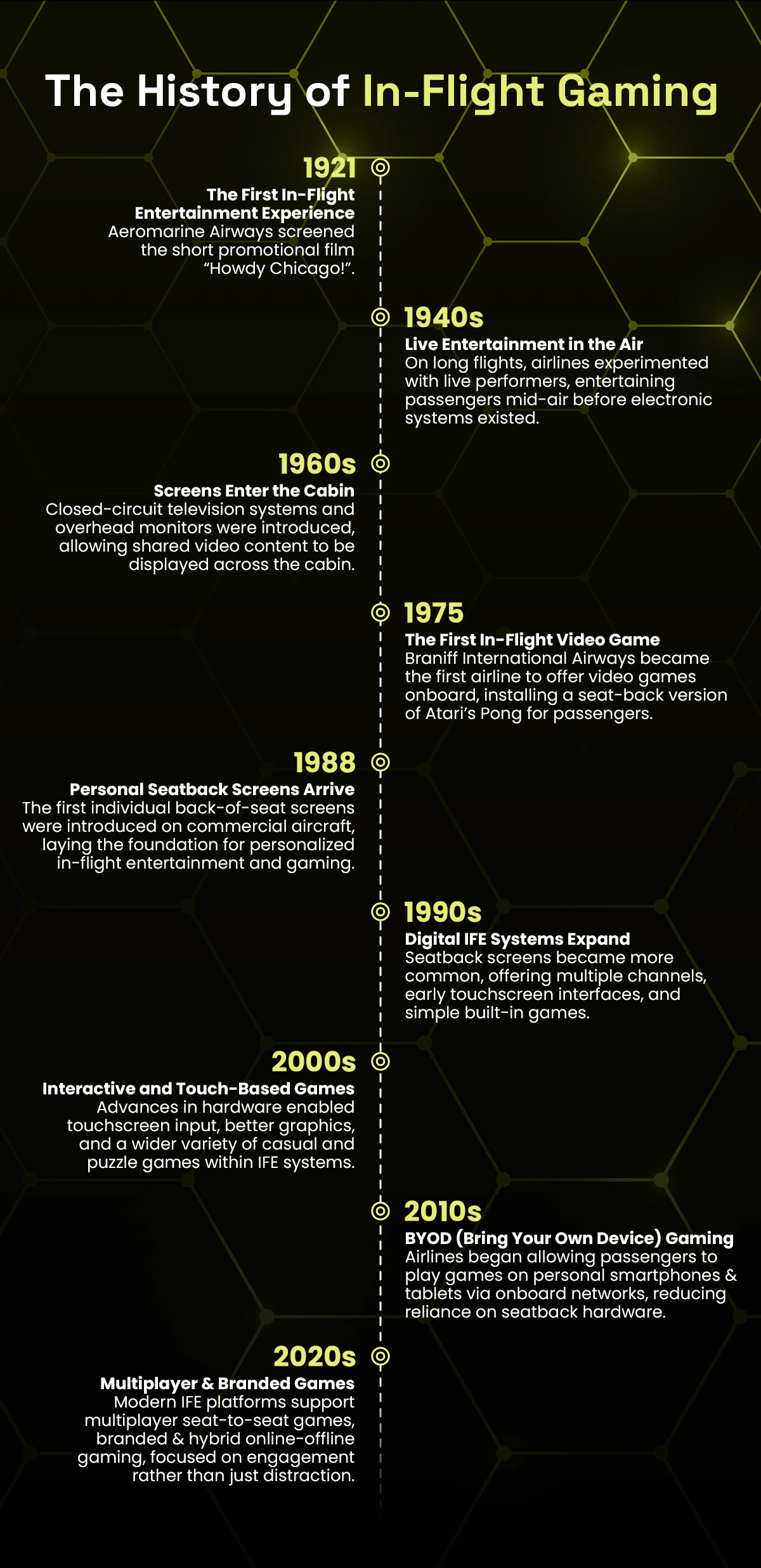
- 1921 – The First In-Flight Entertainment Experience
Aeromarine Airways screened the short promotional film “Howdy Chicago!”, marking the first recorded instance of in-flight entertainment. - 1940s – Live Entertainment in the Air
On long flights, airlines experimented with live performers, including actors and singers, entertaining passengers mid-air before electronic systems existed. - 1960s – Screens Enter the Cabin
Closed-circuit television systems and overhead monitors were introduced, allowing shared video content to be displayed across the cabin. - 1975 – The First In-Flight Video Game
Braniff International Airways became the first airline to offer video games onboard, installing a seat-back version of Atari’s Pong for passengers. - 1988 – Personal Seatback Screens Arrive
The first individual back-of-seat screens were introduced on commercial aircraft, laying the foundation for personalized in-flight entertainment and gaming. - 1990s – Digital IFE Systems Expand
Seatback screens became more common, offering multiple channels, early touchscreen interfaces, and simple built-in games. - 2000s – Interactive and Touch-Based Games
Advances in hardware enabled touchscreen input, better graphics, and a wider variety of casual and puzzle games within IFE systems. - 2010s – BYOD (Bring Your Own Device) Gaming
Airlines began allowing passengers to play games on personal smartphones and tablets via onboard networks, reducing reliance on seatback hardware. - 2020s – Connected, Multiplayer & Branded Games
Modern IFE platforms support multiplayer seat-to-seat games, branded experiences, and hybrid online-offline gaming, focused on engagement rather than just distraction.
Why Airlines Are Investing in In-Flight Gaming
Airlines are turning to in-flight gaming for one simple reason: it keeps passengers actively engaged in an otherwise passive environment.
Instead of relying only on movies and TV, games give passengers something to do, not just watch.
Reason #1: It Makes Flights Feel Shorter
Games reduce perceived flight time by keeping passengers mentally engaged. Active interaction makes long flights feel less tedious, especially on long-haul routes.
Reason #2: It Works for All Age Groups
Simple casual and puzzle games appeal to adults, while kids’ games and trivia keep younger passengers occupied. For families, in-flight games often become one of the most valued features onboard.
Reason #3: It Differentiates One Airline From Another
As ticket prices and routes become similar, experience matters more. Airlines use games to stand out, creating a more memorable and enjoyable journey without changing core operations.
Reason #4: It’s Cost-Effective Compared to Premium Content
Games don’t require the recurring licensing fees associated with movies and TV shows. Once deployed, they can run across fleets with minimal ongoing cost and no constant content refresh.
Reason #5: It Enables Branding and Custom Experiences
Unlike third-party media, games can be customized with airline branding, destinations, loyalty elements, or sponsored experiences – turning entertainment into a subtle brand touchpoint.
The Big Picture
In-flight gaming helps airlines improve passenger satisfaction, reduce perceived travel fatigue, and strengthen brand recall, all through interactive experiences that work reliably at 35,000 feet.
How Games Improve Passenger Engagement on Flights
In-flight games improve engagement because they turn passengers from passive viewers into active participants. This shift has a measurable impact on how people experience a flight.
Active Interaction Over Passive Viewing
Watching a movie is linear. Playing a game requires decisions, reactions, and focus. That active involvement keeps passengers engaged for longer periods and reduces boredom, especially during long or delayed flights.
Reduced Perceived Flight Duration
When passengers are engaged in gameplay, time feels shorter. Games absorb attention more effectively than static content, making long-haul flights feel less exhausting.
Higher Emotional Engagement
Games create small wins, challenges, and moments of fun. These emotional highs, even brief ones, leave passengers with a more positive overall impression of the flight experience.
Stronger Recall of the Airline Experience
Interactive experiences are easier to remember than passive ones. When passengers enjoy an in-flight game, that positive association often transfers to the airline itself, improving brand recall after the journey.
Better Engagement for Families and Kids
For families, games are more than entertainment, they’re a tool. Kid-friendly games help parents manage long flights, which directly improves satisfaction and reduces in-cabin stress.
Engagement That Works Offline
Unlike streaming-heavy content, games are designed to run smoothly without constant internet access. This makes them reliable engagement tools across all routes, including long-haul and international flights.
Types of Games Used in In-Flight Entertainment Systems
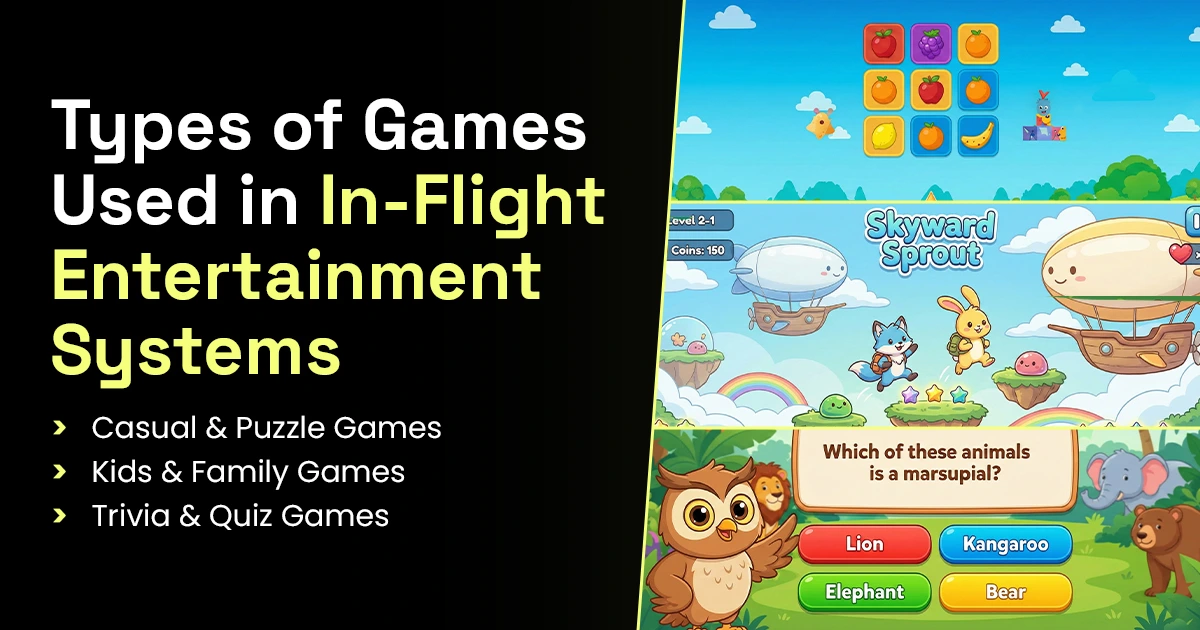
In-flight games are selected based on how passengers behave during a flight, not traditional gaming genres. Airlines curate game libraries to match different travel scenarios, attention spans, and age groups.
Here’s how that plays out onboard.
Casual & Puzzle Games
These are the most common in-flight games. Designed for quick sessions, they allow passengers to start playing instantly without tutorials. Ideal for solo travelers, these games work well when attention is split between meals, announcements, or short flights.
Kids & Family Games
Bright visuals, simple interactions, and familiar mechanics define this category. These games are built to keep children engaged for long periods, making them especially valuable for families. For many parents, this is the most appreciated part of the in-flight entertainment system.
Trivia & Quiz Games
Trivia games are popular because they’re easy to understand and work well in shared spaces. Often themed around travel, destinations, or general knowledge, they appeal to a wide age range and can subtly reinforce airline branding.
Seat-to-Seat Multiplayer Games
Some airlines offer multiplayer games that let passengers compete with nearby seats using the aircraft’s internal network. These experiences feel unique to flying and create moments passengers remember long after landing.
Branded & Loyalty-Driven Games
In premium cabins or modern BYOD systems, airlines sometimes introduce branded mini-games tied to loyalty programs, destinations, or promotions. These games focus less on time-killing and more on brand recall and engagement.
Technical Constraints of In-Flight Game Development
Developing mobile games for in-flight entertainment systems is very different from building standard mobile or web games. These environments come with strict technical limitations that directly shape how games are designed, built, and deployed.
Below are the key constraints developers must work around, and how those constraints influence game design.
Limited or No Internet Connectivity
In-flight games cannot rely on constant internet access. Any interruption would break gameplay and frustrate passengers.
Design response:
Games are built as offline-first experiences, with all logic, assets, and progression handled locally. Any syncing or updates happen only when the aircraft is on the ground.
Older or Shared Hardware
Seatback screens often run on hardware that is far less powerful than modern smartphones. In addition, multiple passengers may be using the system simultaneously.
Design response:
Games are optimized for low memory usage, simple graphics, and minimal processing overhead to ensure smooth performance across the cabin.
Input Limitations
Passengers interact through touchscreens, handheld remotes, or limited physical controls. Precision input cannot be assumed.
Design response:
Controls are simplified, large touch targets are used, and gameplay avoids fast or complex input sequences.
Strict Performance and Stability Requirements
Any crash or slowdown affects passenger experience and airline operations. Unlike mobile games, in-flight games must perform reliably every time.
Design response:
Developers favor predictable mechanics, extensive testing, and conservative performance budgets over experimental features.
Security and Safety Compliance
In-flight systems operate in a regulated environment where software must meet aviation safety and security standards.
Design response:
Games are sandboxed, isolated from flight-critical systems, and built with strict compliance and certification requirements in mind.
Update and Maintenance Constraints
Unlike app stores, in-flight systems cannot be updated frequently or remotely during flight.
Design response:
Games are designed to be robust at launch, with long lifecycles and minimal dependency on frequent content updates.
How Long Does It Take to Develop In-Flight Entertainment Games?
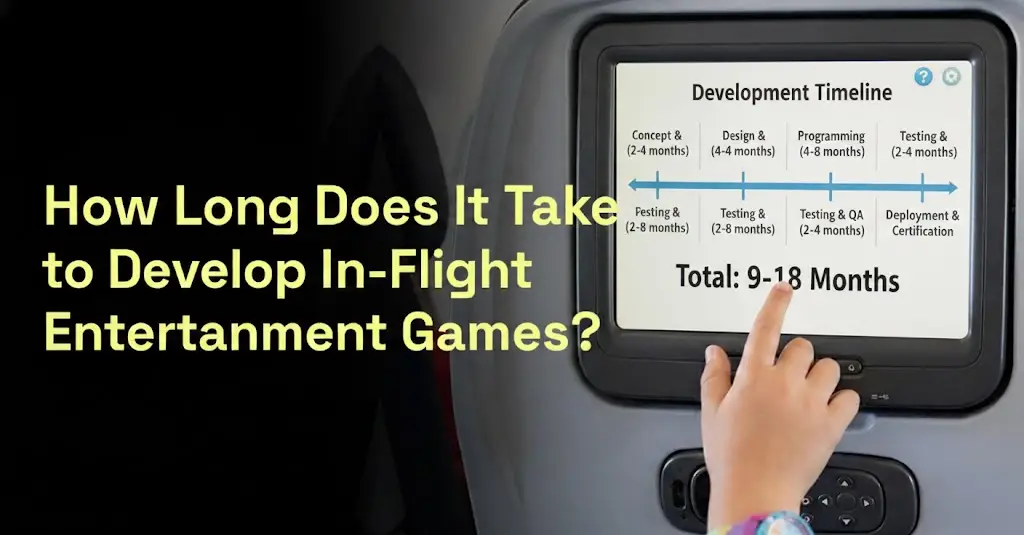
The development timeline for in-flight entertainment games depends on the type of game, the airline’s IFE platform, and certification requirements. Unlike mobile games, in-flight games must be built for offline use, shared hardware, and strict stability standards, which adds extra time.
Simple Casual or Puzzle Games
Timeline: 2 to 4 months
These games focus on basic mechanics, short play sessions, and minimal assets. They are commonly used for solo passengers and children and are designed to run smoothly on seatback screens or BYOD systems.
Most of the time is spent on optimization, input handling, and testing rather than complex gameplay.
Mid-Level Interactive or Trivia Games
Timeline: 4 to 6 months
This category includes quiz games, branded experiences, and light multiplayer features. Development involves additional UI work, content structuring, and deeper testing across different aircraft configurations.
Certification and integration with the airline’s IFE system often become a significant part of the timeline at this stage.
Advanced or Multiplayer In-Flight Games
Timeline: 6 to 9+ months
More complex games, such as seat-to-seat multiplayer or loyalty-integrated experiences, require longer development cycles. These projects involve custom networking within the aircraft, extensive QA, and close coordination with IFE vendors and airline teams.
Stability, synchronization, and compliance testing account for a large portion of the timeline.
Cost of Developing Games for In-Flight Entertainment Systems
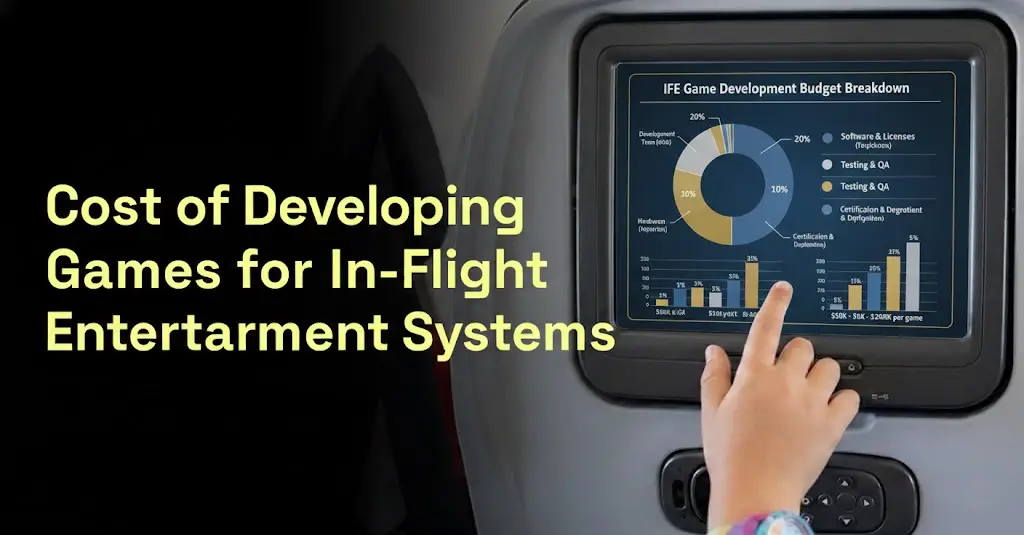
The cost of developing in-flight entertainment games depends on more than just gameplay complexity. Factors such as hardware constraints, certification requirements, and integration with airline IFE platforms significantly influence the final budget. As a result, in-flight games typically cost more than equivalent mobile games with similar mechanics.
Simple Casual or Puzzle Games
Estimated Cost: $20,000 – $35,000
This includes lightweight games with basic mechanics, simple visuals, and offline-first functionality. Costs primarily cover optimization for seatback screens or BYOD systems, input handling, and stability testing rather than complex game logic.
Branded, Trivia, or Interactive Games
Estimated Cost: $40,000 – $70,000
Games in this range include custom UI, airline branding, themed content, or quiz-based gameplay. Additional costs come from deeper integration with the airline’s entertainment system, content customization, and extended QA cycles.
Multiplayer or Advanced In-Flight Games
Estimated Cost: $80,000 – $120,000+
Seat-to-seat multiplayer games or loyalty-integrated experiences require custom networking within the aircraft, extensive synchronization testing, and higher certification overhead. These projects involve longer development timelines and close coordination with IFE vendors.
Common Mistakes in In-Flight Game Development
In-flight entertainment games fail not because the idea is bad, but because developers approach them like standard mobile or web games. The aviation environment has unique constraints, and ignoring them leads to poor performance, certification delays, or low passenger engagement.
Mistake #1: Treating In-Flight Games Like Mobile Apps
Many teams try to port existing mobile games directly to in-flight systems. This usually results in performance issues, broken controls, or unstable gameplay because seatback hardware and input methods are fundamentally different.
In-flight games must be designed specifically for the platform, not adapted as an afterthought.
Mistake #2: Overcomplicating Gameplay and Controls
Complex mechanics, fast reactions, or small touch targets don’t work well in an aircraft cabin. Turbulence, limited screen responsiveness, and shared environments make precision gameplay frustrating.
Successful in-flight games prioritize simplicity, clarity, and forgiving interactions.
Mistake #3: Ignoring Hardware and Fleet Variability
Not all aircraft use the same IFE systems. Differences in screen size, processing power, and operating environments can cause inconsistent behavior if not accounted for early.
Failing to test across multiple configurations often leads to last-minute fixes or certification failures.
Mistake #4: Underestimating Testing and Certification Time
A common mistake is treating testing as a final step. In aviation, testing and certification are ongoing requirements that can significantly extend timelines.
Games that are not built with certification constraints in mind often face costly delays late in development.
Mistake #5: Relying on Frequent Updates
Unlike mobile apps, in-flight games cannot be updated frequently or remotely during flights. Games that depend on constant updates, live services, or content refreshes struggle in this environment.
In-flight games must be stable, complete, and reliable at launch.
Mistake #6: Designing Without Passenger Context
Games that don’t consider real passenger behavior: short attention spans, interruptions, shared spaces, often go unused.
Understanding how passengers actually play during flights is critical to designing experiences that get used.
Why Capermint Is the Right Partner for In-Flight Game Development?
Developing games for in-flight entertainment systems requires a very specific mindset. It’s not just about making games fun – it’s about making them reliable, performant, and compliant in a highly constrained environment. This is where Capermint’s approach to game development fits naturally.
Capermint builds games with a system-first perspective, focusing on stability, performance, and user experience from the earliest stages. This is critical for in-flight environments, where hardware limitations, offline requirements, and certification standards leave little room for error.
The team’s experience in casual, puzzle, and system-driven game development aligns well with what works onboard aircraft. Capermint emphasizes simple mechanics, intuitive controls, and offline-first design, ensuring games remain accessible to passengers of all ages and function smoothly on seatback screens and BYOD platforms.
From a technical standpoint, Capermint prioritizes optimization and testing early in the development cycle. This reduces late-stage surprises during integration and certification, which are often the biggest risks in aviation software projects.
Capermint also offers end-to-end development support, from concept and prototyping to full production and post-deployment assistance. This helps airlines and IFE providers maintain consistency across fleets and ensure long-term reliability without constant rework.
Conclusion
In-flight entertainment has evolved far beyond passive content, and games now play a meaningful role in how passengers experience air travel. By offering interactive, offline-first experiences that work within strict technical and operational constraints, in-flight entertainment games help airlines keep passengers engaged, reduce perceived flight time, and create more memorable journeys.
However, building games for aircraft is not the same as building games for mobile or web. Hardware limitations, certification requirements, offline environments, and diverse passenger behavior all demand a thoughtful, system-driven approach. Airlines that treat in-flight gaming as a specialized product, rather than a simple content add-on, see far better results in both engagement and reliability.
As passenger expectations continue to rise, interactive entertainment will become an increasingly important part of the onboard experience. With the right strategy, technology, and development partner, in-flight entertainment games can deliver long-term value for airlines while transforming idle time at 35,000 feet into moments passengers actually enjoy.
Frequently asked questions
What games are available on airplane screens?
Most airlines offer casual and puzzle games, trivia quizzes, kids’ games, and sometimes seat-to-seat multiplayer games. These games are designed to work on seatback screens or personal devices and are optimized for short, interruption-friendly play sessions.
Do in-flight entertainment games require internet access?
No. In-flight entertainment games are built to work offline-first. All gameplay, assets, and logic run locally on the aircraft’s entertainment system or internal network, ensuring reliability even without internet connectivity.
Are in-flight entertainment games safe and secure?
Yes. In-flight games operate in a sandboxed environment, completely isolated from flight-critical systems. They must meet strict aviation safety and security standards before being approved for deployment on aircraft.
Can airlines customize in-flight games?
Yes. Airlines can customize games with branding, destinations, loyalty elements, or themed content. This allows games to act as subtle brand touchpoints rather than generic entertainment.
How often can airlines update in-flight games?
Updates are typically done while aircraft are on the ground and are far less frequent than mobile app updates. Because of this, in-flight games are designed to be stable and complete at launch, with long lifecycles.
Are in-flight entertainment games expensive to develop?
Costs vary depending on complexity, platform, and certification requirements. While they are generally more expensive than equivalent mobile games, they offer long-term value through repeated passenger use without recurring content licensing fees.