
The global market for mobile gaming is projected to experience robust growth, expanding from a valuation of USD 139.38 billion in 2024 to an impressive USD 256.19 billion by 2030. This growth trajectory represents a Compound Annual Growth Rate (CAGR) of 10.2% over the forecast period from 2025 to 2030.
As we are stepping into 2024, the mobile gaming industry continues to exhibit extraordinary growth, building upon the momentum gained in recent years. The segment has not only withstood the challenges of the COVID-19 pandemic but has also capitalized on them, evolving into a more robust and expansive sector. This growth trajectory has been fueled by a continuous increase in smartphone penetration and the global advancement of high-speed internet services, including the widespread adoption of 5G technology.
The years 2022 and 2023 have been particularly pivotal. In 2023, the industry saw an unprecedented surge in user engagement and market expansion. Key markets, including China, the United States, Japan, South Korea, and emerging players like India, have shown remarkable growth. China maintained its lead with an impressive market size, exceeding $40 billion, reflecting a consistent upward trend from the $29 billion mark in 2021. This growth can be attributed to a combination of factors, including the country’s robust digital infrastructure and the deep integration of mobile gaming into social and entertainment lifestyles.
Top 6 countries & regions in the mobile gaming market segment
Here is the list of the top 6 countries & regions in the mobile gaming market segment.
- China
- United States
- Europe
- Japan
- South Korea
- India
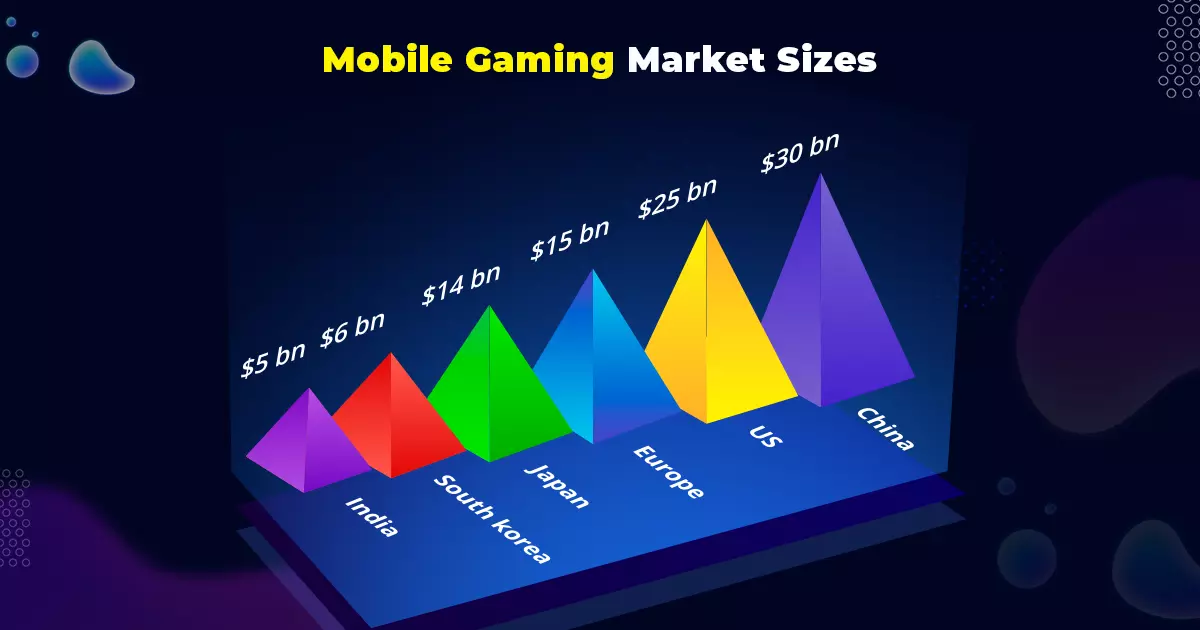
- China Market (2023): Market value estimated at over $40 billion.
- Key Chinese Companies (2023): Dominant players include Tencent, NetEase, miHoYo, and Lilith Games.
- Global Market Leaders (2023): Top markets are China, the United States, Japan, South Korea, and India.
- United States Market Size (2023): Estimated at around $22 billion.
- Japan’s Mobile Gaming Market (2023): Valued at approximately $14 billion.
- South Korea’s Market Size (2023): Around $5 billion, with a focus on eSports and strategy games.
- India’s Market Growth (2023): Rapidly expanding, reaching about $6 billion.
In the dynamic landscape of mobile gaming, the market size varies significantly across countries, reflecting cultural preferences, economic factors, and technological access.
1. China: A Giant in Mobile Gaming
- Market Size: Around $40 billion in 2023.
- Key Fact: Mobile gaming accounts for nearly 70% of the country’s total gaming revenue.
- Regulatory Impact: Stricter regulations have led to a more controlled but still thriving gaming environment.
China’s market is immense, with a strong preference for multiplayer and RPGs, reflecting the social aspect of gaming in the country. China’s mobile gaming market rivalling the US in terms of revenue and player base. Unique in its gaming culture, China sees a predominance of multiplayer and role-playing games. Government regulations, however, play a significant role in shaping the industry, with strict controls over game content and licensing.
2. United States: The Pinnacle of Mobile Gaming
- Market Size: Estimated at $22 billion in 2023.
- Key Fact: Over 60% of smartphone users play mobile games.
- Trend: There’s a growing interest in AR and VR mobile games.
The U.S. stands as a titan in the mobile gaming industry, driven by technological innovations and a culture that embraces digital entertainment. The United States has consistently been a frontrunner in the mobile gaming sector. With a market size surpassing billions, it’s a hub for technological innovation and high consumer spending. Factors contributing to this dominance include widespread smartphone usage, high disposable incomes, and a strong gaming culture. Popular genres include strategy, puzzle, and adventure games, catering to a diverse audience.
3. Europe: A Diverse Gaming Landscape
- Market Size: Collectively around $22 billion in 2023.
- Key Fact: Diverse gaming preferences, with a strong inclination towards puzzle and strategy games.
- Regulatory Trend: Leading in player protection regulations.
Europe’s mobile gaming market has diverse cultures reflected in its gaming trends, with different countries favouring different genres, all under a regulatory environment prioritizing player safety. Countries like the UK, Germany, and France show strong market sizes, with preferences varying from adventure and strategy games to casual puzzles. The European market is also a leader in adopting regulatory measures for player protection, like those addressing in-game purchases and advertising.
4. Japan: The Land of Mobile RPGs
- Market Size: Approximately $14 billion in 2023.
- Key Fact: Mobile games contribute to over 50% of the total gaming revenue in Japan.
- Unique Trend: High player loyalty to RPG franchises.
Japan’s mobile gaming market is notable for its love for role-playing games (RPGs), indicating a deep-rooted affection for story-driven and character-centric games. The market is characterized by high player engagement and spending, despite a smaller population compared to China and the US. Japanese players are known for their loyalty to franchises and characters, driving the success of both domestic and international RPG titles.
5. South Korea: The Epicenter of Competitive Gaming
- Market Size: Estimated at $5 billion in 2023.
- Key Fact: Over 65% of the population engages in mobile gaming.
- Cultural Aspect: A strong eSports culture, with a focus on strategy and MOBA games.
In South Korea, mobile gaming is not just entertainment; it’s a competitive sport. With a strong inclination towards strategy and MOBA (Multiplayer Online Battle Arena) games, the South Korean market is a leader in eSports. South Korea’s advanced internet infrastructure and a culture embracing competitive gaming make it a unique player in the mobile gaming realm.
6. India: A Rapidly Growing Market
- Market Size: Expected to reach $5 billion by 2023.
- Key Fact: Smartphone gaming users have increased by 50% in the last two years.
- Trend: A surge in hyper-casual and social gaming.
India’s mobile gaming market rapidly growing market, driven by affordable internet and smartphone accessibility, which presents vast opportunities for game developers. The market is diverse, with a preference for hyper casual and social games. This growth presents a significant opportunity for both local and international game developers.
Take Away
As we are in 2024, the mobile gaming industry shows no signs of slowing down. The trends of the previous years are not only continuing but also evolving with the introduction of new gaming genres, innovative monetization models, and the integration of advanced technologies like augmented reality (AR) and virtual reality (VR). These technological advancements are not just enhancing the gaming experience but are also attracting a wider, more diverse audience to the world of mobile gaming.
Furthermore, the industry is witnessing a significant shift in strategy, particularly in the approach to game development and distribution. Companies are increasingly focusing on cross-platform compatibility, ensuring that mobile games are accessible on a variety of devices, thereby expanding their user base. The free-to-play model, complemented by in-app purchases and advertising, continues to be a successful strategy, especially for new entrants looking to establish a foothold in this competitive market.
This dynamic period is also marked by the rise of new players in the industry, both in terms of game developers and emerging markets. Countries like India are rapidly climbing the ranks in the mobile gaming sector, driven by a massive young population and increasing digital connectivity. With innovative approaches and continuous growth, the mobile gaming sector is poised to redefine entertainment and connectivity in the digital era.
Key takeaways
Estimates put the mobile gaming market at about US$113–139 billion a year: Newzoo US$113.3 billion (2025), Statista US$116.85 billion (2026 projection) and Grand View Research US$139.38 billion (2024). Mobile earns more than half of games revenue, and Statista ranks the US first. For studios, a casual MVP typically costs $10K–$40K over about 60–90 days; final quote after a scoping call.
Mobile gaming market size: estimates compared
| Metric | Figure | Source and scope |
|---|---|---|
| Global player spending, 2026 | US$116.85 billion | Statista Market Insights; consumer spending on paid downloads and in-app purchases, including taxes; in-game advertising is tracked as a separate market |
| Forecast to 2031 | US$152.61 billion (5.48% CAGR, 2026–2031) | Statista Market Insights |
| Global market, 2024 | US$139.38 billion | Grand View Research; scope as defined in its report |
| Forecast to 2030 | US$256.19 billion (10.2% CAGR, 2025–2030) | Grand View Research |
| Users and spend per user | User penetration 21.13% in 2026, rising to 27.75% (2.27 billion users) by 2031; average revenue per user US$70.21 in 2026 | Statista Market Insights; users are not defined on its public page |
| Largest market | United States (2026) | Statista global comparison |
| Largest region | Asia Pacific (2024); North America held 23.0% of the global market | Grand View Research |
| Mobile games revenue, 2025 | US$113.3 billion, more than half of US$201.6 billion in global games revenue | Newzoo |
Sources use different definitions, base years and currencies, so compare like with like and name the source next to any figure you reuse.
Mobile gaming market by country and region
Rankings depend on the source and on whether you count countries or regions. The table pairs what the public data says with what it means when you plan a launch.
| Market | What the data says | What it means for your launch |
|---|---|---|
| United States | Largest mobile games revenue market in 2026 (Statista) | The main revenue target for most Western publishers and usually the most expensive market for paid installs; plan App Store and Google Play billing, privacy labels and the App Tracking Transparency prompt |
| Canada | Smaller market with player behavior close to the US; no separate figure in the sources above | A common soft-launch market before a US release; plan English and French store listings for Quebec |
| North America | 23.0% of the global mobile gaming market in 2024 (Grand View Research) | Plan US and Canadian store pricing, age ratings and privacy disclosures together, even when Canada soft-launches first |
| Asia Pacific (China, Japan, South Korea and others) | Largest revenue region in 2024 (Grand View Research) | China requires a government licence for each game, and foreign studios typically publish through a licensed Chinese partner; Japan favors story- and character-led games; South Korea has strong mobile esports and requires published odds for paid random items |
| Europe (UK, Germany, France and others) | Multi-country market with strict privacy and player-protection rules | Plan GDPR consent and per-country rules on paid random items; Belgium treats paid loot boxes as gambling |
| India | Large, Android-first player base; online money games prohibited under the Promotion and Regulation of Online Gaming Act, 2025 | Free-to-play, social and e-sports formats with ad-led and low-price in-app monetization |
| Latin America, Middle East and Africa | Mostly Android-first audiences; spend per player varies widely by country | Localize prices and languages and test on the mid-range Android devices common in each market |
Country-level figures from Statista and Grand View Research sit behind paywalls; the rankings above come from their public summaries.
What mobile gaming market data means for your game
Choose launch markets
Many Western studios soft-launch in Canada, often with Australia or New Zealand, then scale in the US once retention holds. In India, online money games are prohibited, so plan free-to-play and ad-led formats there.
Match genre to budget
Strategy, RPG and social casino earn the most per player but need long live operations; casual and hybrid-casual games cost less to build and earn more from ads. See how free games make money and the hybrid-casual games handbook.
Do the unit economics
Market size does not pay for installs. Track D1, D7 and D30 retention, average revenue per daily active user and lifetime value against cost per install; paid growth works only when lifetime value is higher.
Budget for build and live ops
Plan the build plus the first months of updates and events. Typical build ranges are below; the mobile game development cost guide covers more game types.
Typical budgets to build a game for these markets
| Build | What is included | Typical cost (USD) | Typical timeline |
|---|---|---|---|
| Casual single-game MVP | One core loop, 2D or light 3D art, ads and/or in-app purchases, analytics, release on one or both stores | $10K–$40K | Typically about 60–90 days |
| Mid-scope multiplayer game | Real-time or turn-based multiplayer, player accounts, leaderboards, events, admin panel, iOS and Android | $40K–$120K | Typically about 12–20 weeks |
| Large custom game or multi-game app | 3D or multi-mode game, custom backend, live-ops tooling, several games inside one app | $120K+ | 4–6 months or more, set at scoping |
| Co-development or dedicated team | Specialists added to your existing game after a code and build review: new content, features, porting, live updates | Monthly rate, quoted after the review | Ongoing, billed monthly |
Typical ranges; final quotes follow a scoping call. See our mobile game development services and casual and hyper-casual game development, or add specialists to a live title with game developers for hire.
| Engagement models | Fixed-scope project, dedicated team billed monthly, or co-development and staff augmentation on your existing game |
|---|---|
| Tech stack | Unity (2D and 3D) or Unreal Engine for iOS and Android phones and tablets, where one shared codebase can ship to both stores; store billing, ad mediation, analytics and a custom backend for accounts, events and multiplayer as scoped |
| Testing and store readiness | Functional, compatibility, performance and regression testing on an agreed device matrix; App Store privacy labels, App Tracking Transparency prompt and Google Play Data safety form; odds disclosure for any paid random items |
| Markets | Buyers in the US, Canada and worldwide, with calls scheduled in US and Canadian business hours; Capermint-reported 650+ customers worldwide and over 200 specialists, delivering from our studio in Ahmedabad, India (founded 2014). For players in India: free-to-play, social and e-sports formats only |
How we take a mobile game from market research to launch
Brief and NDA
You share the concept, genre, audience, launch markets and revenue model. An NDA is available before detailed discovery.
Market and scope fit
We map the genre and launch markets (for example a Canada soft launch before the US) to features, art volume, backend and monetization, then send a USD estimate with milestones. Final quotes follow this scoping call.
Game design and prototype
A game design document and economy plan, followed by a playable prototype of the core loop to validate fun and feasibility before full production.
Production sprints
Art, gameplay, backend, ads and in-app purchase integration and analytics built in sprints, with a playable build shared at each milestone.
QA and soft launch
Functional, compatibility, performance and regression testing on an agreed device matrix, then a soft launch in test markets to tune retention and monetization.
Global release and live updates
App Store and Google Play submission for the US, Canada and other markets, followed by live updates, events and new content through a dedicated team or fixed-scope phases.
More detail on each stage: mobile game development process.
Real-money games are a separate, licensed market
Mobile games market figures usually exclude real-money casino, betting and fantasy, which are licensed jurisdiction by jurisdiction. In the US, online casino is legal in only a handful of states (for example New Jersey, Pennsylvania and Michigan), sports betting is legal in most states through state licensing, daily fantasy sports is legal in most states under state rules, and sweepstakes or social casino models rely on dual currency and a free method of entry, with a growing list of states restricting them. In Canada, Ontario runs a regulated open iGaming market through AGCO and iGaming Ontario, Alberta opened its own regulated market through AGLC and the Alberta iGaming Corporation in July 2026, and other provinces offer online gambling through provincial lottery corporations. In India, the Promotion and Regulation of Online Gaming Act, 2025 prohibits online money games, so for India we build free-to-play, social and e-sports formats. For real-money titles, we build RNG and game math ready for independent testing by accredited labs such as GLI, iTech Labs or BMM; certification is obtained by the operator or game owner. Operators are responsible for licensing; we build to the technical requirements of the target jurisdiction. This is general information, not legal advice. Read more in our iGaming industry overview and guide to real-money games in the USA.
Mobile gaming market size FAQs
Why do mobile gaming market size estimates differ so much between sources?
Because research firms measure different things. Statista counts consumer spending on paid downloads and in-app purchases, including taxes, and lists in-game advertising as a separate market; it projects US$116.85 billion for 2026. Newzoo put mobile at US$113.3 billion for 2025, and Grand View Research estimated US$139.38 billion for 2024 under its own definition. Check the scope, base year and currency before comparing figures or putting one in a business plan.
What share of global games revenue comes from mobile?
More than half. Newzoo estimated mobile games revenue at US$113.3 billion in 2025, out of US$201.6 billion for all games, so mobile earned more than PC and console combined. That makes mobile the largest gaming platform, and also the most crowded one for user acquisition.
Is the United States the largest mobile gaming market?
In Statista's 2026 outlook, yes: it ranks the United States first by mobile games revenue. Grand View Research compares regions instead and names Asia Pacific, which includes China, Japan and South Korea, as the largest in 2024, with North America at 23.0% of the global market. Country rankings are hardest to compare for China, where Google Play is not available and Android games are sold through local app stores.
Why do publishers often soft-launch mobile games in Canada?
Because Canadian players behave much like US players while the market is smaller and user acquisition often costs less, Canada is a common test market before a US launch. Studios soft-launch there, often alongside Australia or New Zealand, to measure retention, monetization and install costs before scaling spend. Plan English and French store listings if you want to reach players in Quebec.
Do iOS or Android players spend more on mobile games?
iOS players usually spend more per player, while Android has far more players worldwide. In the US and Canada the App Store typically earns a large share of in-app purchase revenue, while Android dominates in India, Latin America, Africa and much of Asia, where ads matter more. Many studios ship on both from one Unity or Unreal codebase and test on a device matrix that matches their launch markets.
Which mobile game genres earn the most revenue?
Strategy, role-playing (including gacha RPGs), puzzle and casino-style social games are consistently among the top-grossing genres for in-app purchases. Casual and hyper-casual games collect the most downloads but earn more of their income from ads and less per player. The right genre depends on your budget, audience and how long you can fund live operations after launch.
How do I estimate the market a new mobile game can actually reach?
Start from a narrow slice, not the global total. Pick your genre and launch countries, such as puzzle games in the US and Canada, then compare the likely cost per install with the revenue per player that comparable titles earn; a game only scales when lifetime value beats install cost. A soft launch then replaces those assumptions with your own retention and monetization data.
What is the average revenue per user in mobile games?
Statista projects US$70.21 per user worldwide for 2026, based on its own definition of users. It is a global average across markets with very different spending, so do not use it as a benchmark for one game. During soft launch, track your own average revenue per daily active user and lifetime value by country, and compare them with your cost per install.
Do mobile gaming market figures include real-money gaming?
Usually not, though each report sets its own scope. Mobile games market reports generally count paid downloads, in-app purchases and sometimes ads, while real-money casino, betting and fantasy revenue is tracked separately as online gambling or iGaming. Those formats are licensed jurisdiction by jurisdiction, and in India the Promotion and Regulation of Online Gaming Act, 2025 prohibits online money games, so there we build free-to-play, social and e-sports formats. Operators are responsible for licensing; we build to the technical requirements of the target jurisdiction.
Can Capermint build a mobile game for US, Canadian and global players?
Yes. Capermint, a game development studio founded in 2014 in Ahmedabad, India, builds iOS and Android games as a fixed-scope project, a dedicated team billed monthly, or co-development on an existing title. Capermint-reported totals are 650+ customers worldwide and over 200 specialists, including game designers, 2D and 3D artists, gameplay and backend engineers and QA. We schedule calls in US and Canadian business hours.
Planning a mobile game for the US, Canada or global markets?
Share your genre, launch markets, revenue model and budget range. We schedule calls in US and Canadian business hours and reply with a scoped USD estimate and milestones.
Frequently asked questions
What is the current size of the global mobile gaming market?
The global mobile gaming market was valued at around USD 97.81 billion and USD 139.38 billion.
What is the expected growth forecast for the mobile gaming market?
The global mobile gaming market is expected to grow from around $142 billion in 2023 to over $300 billion by 2028, with a CAGR of approximately 16%.
Which regions or countries lead the mobile gaming market in 2023?
The top markets listed are: China, United States, Europe (as a region), Japan, South Korea, and India.
What are the approximate market values for these top countries (2023)?
China — about 31% of global mobile‑gaming revenue, which corresponds to roughly USD ~ 38–39 billion (since global revenue is estimated at ≈ USD 124 billion in 2023).
United States — about 17% share, roughly USD ~ 21–22 billion.
Japan — among the next largest markets, with market reports indicating ≈ USD 12.5 billion in 2023 domestic mobile‑game revenue.
South Korea — also in top ranks, with estimates around USD ~ 4.8 billion for 2023.
What factors are driving growth in the global mobile gaming market?
The blog highlights: increasing smartphone penetration globally, expansion of high‑speed internet (including 5G), and growing user engagement post-pandemic as major growth drivers.
How resilient is the mobile gaming industry after pandemic-related disruptions?
According to the blog, the mobile gaming segment has not only “withstood” the challenges of the COVID‑19 pandemic but also leveraged them, showing sustained growth and evolving into a more robust industry.
Is the growth trend expected to continue beyond 2028?
The blog forecasts growth up to 2028; many industry analyses beyond the blog (from other sources) suggest that rising smartphone adoption, improving mobile infrastructure, and evolving monetization models could drive continued growth beyond 2028.
Why should game developers care about these market statistics?
These statistics show that mobile gaming remains a thriving, expanding market — indicating high potential for revenue, user base growth, and audience reach. For developers, this means opportunities to launch games, target diverse markets, and benefit from increasing mobile penetration worldwide.