To build a prediction market, founders and operators should pick the legal route first: a CFTC-designated exchange (own or partner), a non-US launch where local law allows, or free-to-play. Then build the rulebook, matching engine or AMM, ledger, KYC, geolocation, resolution and admin. Typical software ranges: $10K–$40K MVP, $35K–$120K white-label (6–10 weeks), $60K+ custom.
This guide is for US and Canadian founders, fintechs, sportsbooks and media brands, and for teams in other markets planning event trading. The price and timeline ranges are Capermint’s published iGaming platform bands, used as typical ranges; final quotes follow a scoping call. It is general information, not legal advice; confirm your route with derivatives and gaming counsel.
What is a prediction market and how does it work?
A prediction market lists event contracts: questions about a future event that pay a fixed amount, usually $1, if the outcome happens and nothing if it does not. The price between those points reads as the market’s estimate of probability. A Yes contract at 62 cents implies about a 62% chance; buying 100 costs $62 plus fees and returns $100 if the event happens.
Many US event contracts are fully collateralized, so the maximum loss is paid up front and there is no margin call. Markets come in three shapes: binary (yes or no), categorical (several outcomes, one wins) and scalar or range markets (the result falls in a band).
Order book, AMM or hybrid?
| Factor | Central limit order book | Automated market maker (AMM) | Hybrid |
|---|---|---|---|
| How prices form | Traders post bids and offers, matched by price and time | A formula such as LMSR quotes prices from a pool | Order book for busy markets, AMM or market-maker quotes for new ones |
| Liquidity needs | Market makers or active traders | Seed capital; LMSR caps the operator’s worst-case loss | Both, sized per market |
| Fits | Regulated exchanges, high-volume sports and economics | Long-tail, on-chain and free-to-play markets | Many markets with uneven demand |
| Build effort | Matching engine, risk checks, market data feeds | Pricing math, pool accounting, often smart contracts | Highest: two engines plus routing |
Which legal route should you build for?
The route decides who your customers can be, what you can list, how money moves and what the software must do:
| Route | What it involves | What you control | Main trade-off |
|---|---|---|---|
| Become a CFTC-designated contract market (DCM) | Form DCM, the core principles, a registered derivatives clearing organization (DCO), surveillance and compliance staff | Listings, fees, rulebook, customers | Slowest and costliest route |
| Acquire a registered exchange | Buy a designated DCM and make the required CFTC filings; for example, QCX LLC, designated in July 2025, now operates as Polymarket US | Same as a DCM | Purchase price and CFTC filings |
| Partner with an existing DCM | Become, or work with, a registered futures commission merchant or introducing broker that routes customers to the DCM; Kalshi’s designation was modified to permit intermediated trading in January 2025 | Brand, onboarding, UX, marketing | Revenue share; listings and state decisions stay with the exchange |
| Launch outside the US | Classify and license the product country by country; geoblock US persons and restricted countries | Everything, within local law | Many countries treat event trading as gambling or derivatives |
| Free-to-play or prize-based | Virtual points, leaderboards, sponsor-funded rewards | Everything | No trading revenue; prize models may fall under state sweepstakes bans |
What a CFTC-registered exchange must have
A DCM applies on Form DCM under Part 38 of the CFTC’s rules and must show it can meet the core principles in section 5(d) of the Commodity Exchange Act, including contracts not readily susceptible to manipulation, trade surveillance, financial integrity and system safeguards. The CFTC reviews a materially complete application within the 180-day timeframe in section 6(a) of the Act; an incomplete one does not start the clock. You also need a registered DCO, your own or a partner’s, to clear trades.
Once live, a DCM usually lists new contracts by self-certifying them under Regulation 40.2 or seeking approval under 40.3, and the CFTC can review contracts that involve gaming, terrorism, assassination, war or unlawful activity under Regulation 40.11. The field is growing: the CFTC says that at least seven DCMs offered contracts on sports-related events to US persons, and more than fifteen pending DCM applications had been filed since 2025.
Key CFTC actions on event contracts
- February 6, 2026: formally withdrew its 2024 event contracts proposal.
- March 16: advance notice of proposed rulemaking on prediction markets (comments closed April 30).
- June 12: proposed public-interest review factors for contracts involving gaming, war, terrorism, assassination or unlawful activity, plus a definition of “gaming” (comments closed July 27).
- July 1: proposed alternate data-reporting framework for certain fully collateralized event contracts (comments closed July 31).
- August 12 and September 22: staff advisories on self-certifying market-maker and incentive programs, and on “mention” markets that settle on whether someone says a word or attends an event.
- October 9: a proposed rule to define event contracts on sports, politics, culture and weather as swaps, plus an interim final rule excluding casino-style gambling, such as sportsbook wagers and casino games, from the swap definition. Comments are due 30 days after publication in the Federal Register, and the interim final rule takes effect on publication.
Enforcement is active too. In July 2026 the CFTC ordered a former member of Congress to pay about $35,000 for manipulating a State of the Union attendance contract; in August it sanctioned a former presidential teleprompter operator for insider trading in presidential-speech contracts; and federal prosecutors have brought criminal insider-trading cases over event contracts. Build surveillance, insider lists and restricted-trader controls in from the start.
Why state law still matters
States argue that sports event contracts are unlicensed sports betting, and federal appeals courts are split. The Third Circuit sided with Kalshi against New Jersey in April 2026; the Ninth Circuit (Nevada, August 28, 2026) and the Sixth Circuit (Ohio and Tennessee, September 25, 2026) went the other way, holding that sports contracts are not (Sixth) or likely not (Ninth) swaps, which leaves state gaming law in play there for now. A rehearing petition was pending in the Ninth Circuit case as of the CFTC’s October 9 proposal. New Jersey’s Supreme Court petition (No. 26-299) is pending, with Kalshi’s response due November 9, 2026.
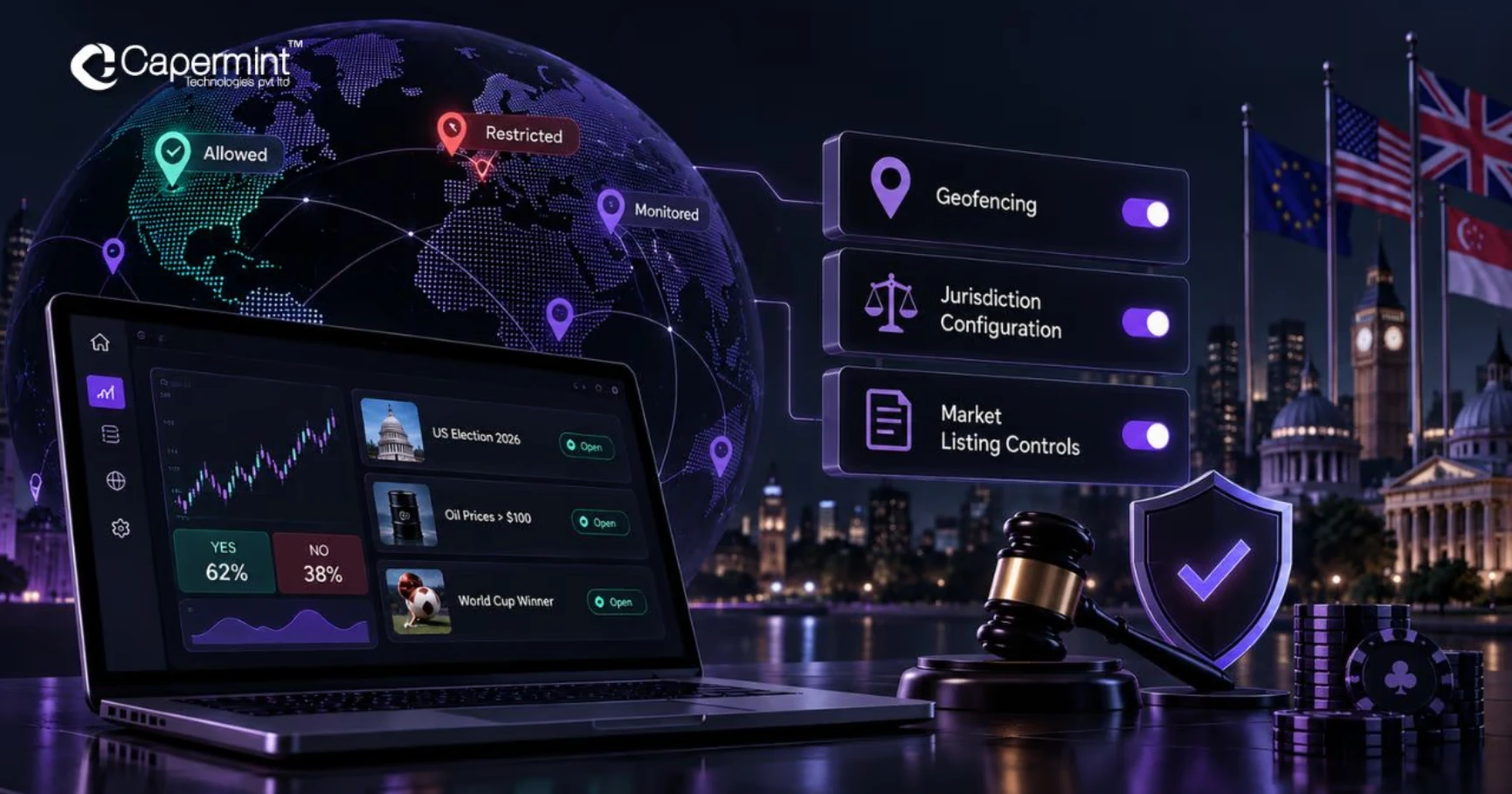
In April 2026 the CFTC sued Arizona, Connecticut, Illinois, New York and Wisconsin to defend its jurisdiction. Minnesota has enacted a law that, as the CFTC describes it, purports to make offering event contracts on sports, elections and other events a felony, and state trial courts have ordered a DCM to geofence sports contracts in Michigan, Washington and Nevada. So build geofencing that can switch off a contract category, such as sports, state by state in hours, and log every location check. For wider US context, see our guide to real-money games in the USA.
Not legal advice. This summary reflects public sources, and the rules are moving. Operators are responsible for licensing; Capermint builds to the technical requirements of the target jurisdiction.
Prediction market rules in Canada, the UK, India and elsewhere
- Canada: outside British Columbia, Multilateral Instrument 91-102 bars offering individuals binary options, including yes/no event contracts, with a term under 30 days; the Ontario Securities Commission settled with Polymarket’s operators over it in April 2025. CIRO’s March 26, 2026 bulletin lets its investment dealers offer economic, environmental and financial-indicator contracts with terms of 30 days or more, with no leverage and no election or political contracts; other types need approval. A CSA and CIRO staff notice of August 27, 2026 says CSA staff consider that sports and entertainment contracts should not be regulated under securities law, while CIRO staff will not approve dealers trading them, so check provincial gaming rules, such as Ontario’s AGCO and iGaming Ontario regime, too.
- United Kingdom: the Gambling Commission’s February 2026 position is that prediction markets offered to consumers in Great Britain likely fall under the Gambling Act 2005, so a licence would likely be needed, most likely as a betting intermediary. The FCA has banned selling binary options to retail consumers since April 2, 2019.
- India: the Promotion and Regulation of Online Gaming Act 2025 prohibits online money games, and its Rules took effect on May 1, 2026. For India, build free-to-play or social prediction formats only, with no cash stakes or paid entries.
- EU, Latin America, Africa, the Middle East and APAC: classify the product in each country as a derivative, a gambling product or neither, then license or geoblock accordingly.
What does a prediction market platform include?
| Module | What it does | Build notes |
|---|---|---|
| Market creation and rulebook | Question, outcomes, expiry, settlement source, edge-case rules | Templates and a pre-listing review |
| Matching engine or AMM | Prices and fills orders | Latency budget, risk checks, self-trade prevention |
| Wallet, ledger and collateral | Balances, positions, fees, payouts | Double-entry ledger, daily reconciliation |
| Payments | Cards, bank transfers, stablecoins where allowed | Separate deposit and withdrawal flows |
| KYC, AML and geolocation | Identity, age, sanctions and location checks | Geofencing by contract category and state or country |
| Resolution and disputes | Settles outcomes from named sources or oracles | Dispute window, evidence archive, correction procedure |
| Surveillance | Flags manipulation, insider trading and wash trades | Insider lists, alerts, case management |
| Admin and reporting | Listings, limits, fees, support, regulatory exports | Role-based access and audit logs |
| Trader apps and API | Web, iOS, Android, market data API | Fees and maximum payout shown before every order |
For data feeds, see our sports data and odds API integration engineers; for trading screens, our UI/UX design services; for smart contracts and wallets, our Web3 development team.
How to build a prediction market in 9 steps
- Pick the legal route and markets with counsel. Choose a DCM, acquisition, partner, non-US or free-to-play route, and list the states or countries you will serve.
- Choose contract categories. Sports draw most state litigation, Canada’s dealer route excludes political contracts and the CFTC flags mention markets for manipulation risk.
- Write the market rulebook. One precise question per market, a named settlement source, an expiry, and rules for postponements, ties and data revisions.
- Pick the liquidity model. Order book, AMM or hybrid, plus market makers or seed liquidity. On a DCM, file any market-maker or incentive program with the CFTC, usually by self-certification, before it starts.
- Design the ledger and fees. Fully collateralized positions, per-contract fees, settlement and withdrawals.
- Integrate partners. KYC, geolocation, payments, data feeds or oracles, and the clearing partner or chain.
- Build apps, admin, surveillance and resolution tools. Show fees and maximum payout before each order.
- Test. Load tests at projected peak, security testing, settlement dry runs, smart contract audits for on-chain builds and geofence tests by state.
- Soft-launch. Open a short market list, watch disputes and surveillance alerts, then add categories and regions.
If you are adding event trading next to sports betting, compare it with a sportsbook platform; for play-money formats, see our stock fantasy app development work.
How much does it cost to build a prediction market?
On a regulated US launch, legal, compliance, clearing and liquidity can cost more than the software. The ranges below are Capermint’s published iGaming platform bands, used here as typical ranges for prediction market builds; final quotes follow a scoping call.
| Scope | Typical range | Typical fit |
|---|---|---|
| MVP | $10K–$40K | One category; free-to-play pilot or branded front end on a partner exchange |
| White-label or turnkey platform | $35K–$120K | Configured engine, wallet, KYC and admin under your brand |
| Custom single-vertical platform | $60K–$180K | Your own codebase and engine for one product line |
| Custom multi-vertical platform | $200K–$500K+ | Order book with surveillance, many categories, fiat and on-chain rails, multi-brand |
Budget separately for counsel, DCM and DCO costs or partner fees, clearing and broker fees, KYC and geolocation checks, liquidity incentives, data feeds, audits and marketing. For the rent-or-own trade-off, read white-label vs turnkey vs custom iGaming business models.
How long does it take to launch a prediction market?
| Phase | Typical duration | Notes |
|---|---|---|
| Legal route and market selection | Set with counsel | Runs before and alongside the build |
| White-label or turnkey build | 6–10 weeks | Capermint published band |
| Custom build | Longer; fixed at scoping | Depends on engine, rails and apps |
| DCM designation | 180-day CFTC review, starting once the application is materially complete | Preparing the application comes first |
| Partner onboarding | Varies by partner | Start broker, clearing, KYC and payment talks in week one |
A front end on a partner exchange or a free-to-play launch reaches users fastest; a new DCM is the slowest route.
How Capermint helps you build a prediction market
Capermint Technologies is a game development company founded in 2014 in Ahmedabad, India, with over 200 specialists and, Capermint-reported, 650+ customers worldwide; we are rated 4.9/5 from 13 reviews on Clutch. For prediction market projects we build the platform modules listed above, plus free-to-play prediction games, the format we use for India. Selected clients and products on our clients page include Nostragamus and Real11. Operators are responsible for licensing; we build to the technical requirements of the target jurisdiction. We work as fixed-scope projects, dedicated teams or co-development, and schedule calls in US and Canadian business hours. See our prediction market platform development service and our iGaming portfolio.
FAQs
How do I build a prediction market like Polymarket or Kalshi?
Start with the legal route, because it shapes the product. Kalshi has been a CFTC-designated contract market since November 2020, and Polymarket US operates through QCX LLC, a contract market designated in July 2025. Then build the contract rulebook, an order book or AMM, a collateral ledger, KYC and geolocation, resolution and surveillance tools, and web and mobile apps.
Are prediction markets legal in the US?
Federally, event contracts may be offered to US traders on a CFTC-designated contract market; the CFTC says at least seven such exchanges offered sports-related contracts. States contest sports contracts: appeals courts are split, New Jersey has asked the Supreme Court to decide, and state courts have ordered geofencing in some states. Status changes quickly; this is not legal advice.
Do you need a license to run a prediction market?
In the US, retail customers may trade event contracts only on a CFTC-designated contract market, directly or through a registered futures commission merchant or introducing broker, with trades cleared by a registered clearing organization. In Great Britain a Gambling Commission licence is likely needed, probably as a betting intermediary, and Canada restricts short-term binary options and dealer-offered contracts. Play-money markets generally fall outside these regimes. This is not legal advice.
How much does it cost to build a prediction market?
Using Capermint’s published iGaming platform bands as typical ranges: $10K to $40K for an MVP, $35K to $120K for a white-label or turnkey platform, $60K to $180K for a custom single-vertical build and $200K to $500K or more for a multi-vertical platform. Legal work, partner and clearing fees, KYC checks, data feeds, audits and liquidity sit outside these figures. Final quotes follow a scoping call.
How long does it take to build a prediction market?
A white-label or turnkey platform takes 6 to 10 weeks in Capermint’s published iGaming bands; custom builds take longer, with the schedule fixed at scoping. Regulatory time is separate: the CFTC’s 180-day review of a contract market application starts only once the application is materially complete. Fronting a partner exchange or launching free-to-play reaches users faster.
Should a prediction market use an order book or an AMM?
Use a central limit order book where you expect active traders or market makers, such as high-volume sports or economic markets on a regulated exchange. Use an AMM, such as LMSR, for long-tail or on-chain markets that need a price from day one without counterparties. A hybrid uses order books for busy markets and AMM or market-maker quotes for new ones.
How do prediction markets make money?
The main lever is a trading fee per contract or a share of the spread, plus settlement or withdrawal fees where allowed. Platforms can also license data, sell API access, charge partners for listings or run sponsored free-to-play markets. On a designated contract market, market-maker and trader incentive programs must be filed with the CFTC, usually by self-certification, before they run.
How are prediction market outcomes resolved?
Each market names a settlement source, such as an official statistics release or a league’s final result, and a time after which the outcome is checked. Regulated exchanges settle under their rulebooks; on-chain markets often use an oracle with a dispute window. Either way, publish the rules before listing and keep an evidence archive and a correction procedure for disputed results.
Can you run a prediction market in Canada?
Only within narrow limits, so get Canadian legal advice first. Outside British Columbia, MI 91-102 bars offering individuals binary options with terms under 30 days. A March 2026 CIRO bulletin lets investment dealers offer economic, environmental and financial-indicator contracts of 30 days or more, with no leverage or political contracts, and sports contracts may fall to provincial gaming law. This is not legal advice.
Can I launch a free-to-play prediction market instead?
Yes. A free-to-play market uses virtual points, leaderboards and sponsor-funded rewards with no cash stakes, so it generally sits outside derivatives and gambling licensing, though promotion and consumer rules still apply. It suits media brands, fan apps and India, where the Promotion and Regulation of Online Gaming Act 2025 prohibits online money games. Adding redeemable prizes changes the legal analysis; this is not legal advice.
Sources
- CFTC 9310-26: proposed rule on event contracts as swaps (October 9, 2026)
- CFTC 9309-26: interim final rule excluding casino-style gambling (October 9, 2026)
- CFTC proposed rule text: Further Definition of Swap, Inclusions
- Federal Register: Prediction Markets; Public Interest Determinations (June 12, 2026)
- Federal Register: Prediction Markets ANPRM (March 16, 2026)
- Federal Register: withdrawal of the 2024 event contracts proposal (February 6, 2026)
- Federal Register: data reporting for certain event contracts (July 1, 2026)
- CFTC 9282-26: incentive program advisory (August 12, 2026)
- CFTC 9302-26: mention markets advisory (September 22, 2026)
- CFTC 9276-26: event contract manipulation order (July 31, 2026)
- CFTC 9289-26: presidential-speech contract insider trading order (August 28, 2026)
- eCFR: 17 CFR 38.3, designation as a contract market
- CFTC: Designated Contract Markets list
- CFTC 9206-26: suits against Arizona, Connecticut and Illinois (April 2, 2026)
- CFTC 9218-26: suit against New York (April 24, 2026)
- CFTC 9220-26: suit against Wisconsin (April 28, 2026)
- Supreme Court docket No. 26-299, Flaherty v. KalshiEX
- Ninth Circuit opinion: KalshiEX v. Assad, No. 25-7516 (August 28, 2026)
- CoinDesk: Sixth Circuit ruling on Ohio and Tennessee (September 25, 2026)
- Ontario Securities Commission: Polymarket settlement under MI 91-102 (April 17, 2025)
- Blakes: Prediction Markets, Evolving Regulation in Canada (October 7, 2026)
- RPC via LawCareers.net: UK rules for prediction markets (May 2026)
- Business Today: India online gaming rules from May 1, 2026
Planning a prediction market? Share your target markets, legal route and timeline, and our team will come back with a scoped plan and estimate. Request My Project Scope.