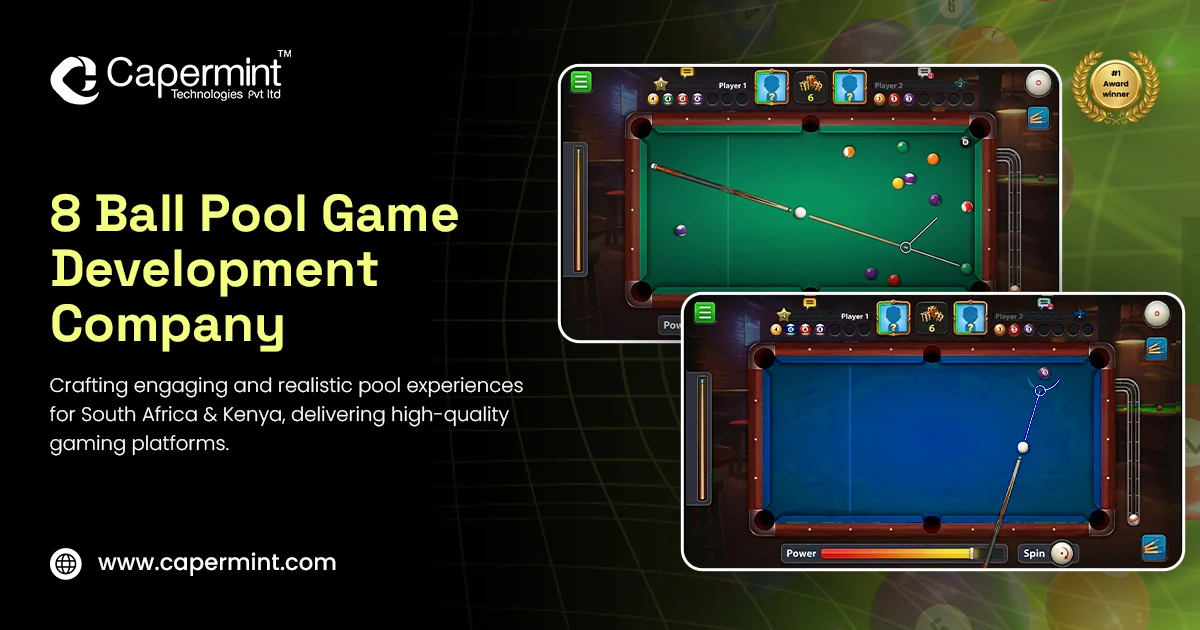
Capermint is a trusted 8 Ball Pool Game Development Company delivering high-quality 8 Ball Pool, Billiards, and Snooker games for fast-growing markets like South Africa and Kenya. Our games are built with smooth gameplay, strong multiplayer systems, realistic physics, and modern visuals, and are designed to scale across Android, iOS, and web platforms.
With extensive experience in real-money and skill-based games, we help businesses launch compliant, engaging, and revenue-driven 8 Ball Pool games tailored for African gaming audiences.
8 Ball Pool Game Development Services
We provide end-to-end 8 Ball Pool Game Development Services tailored specifically for South African and Kenyan gaming markets. Our solutions cover the complete game lifecycle—from concept and design to development, deployment, and post-launch support.
We focus on building high-performance, multiplayer-ready, and revenue-driven 8 Ball Pool games that deliver smooth gameplay, strong user engagement, and long-term scalability.
Our experienced development team ensures every aspect of the game is crafted with market relevance and technical precision.
Our development approach focuses on:
-
Local Player Behaviour
Understanding how players in South Africa and Kenya interact with skill-based and competitive games, ensuring gameplay mechanics, rewards, and progression feel familiar and engaging. -
Mobile-First Performance
Optimised primarily for Android devices, ensuring smooth gameplay on both mid-range and high-end smartphones without performance drops. -
Low-Latency Multiplayer Gameplay
Real-time matchmaking and gameplay powered by stable networking architecture to deliver fair, fast, and responsive multiplayer experiences. -
Regional Payment Compatibility
Seamless integration of region-friendly payment systems, ensuring smooth deposits, withdrawals, and in-game purchases while maintaining security and compliance. -
Long-Term Scalability
Backend systems designed to support increasing player traffic, tournaments, and future feature upgrades without impacting performance.
What is 8 Ball Pool?
8 Ball Pool (also known as Eight Ball Pool) is a popular cue sport game played on a billiard table with six pockets. It is widely known by names such as solids and stripes.
The goal of 8 Ball Pool is simple yet competitive:
-
Players are assigned either solid balls (1–7) or striped balls (9–15)
-
All balls from the assigned group must be pocketed first
-
After clearing the group, the player must legally pocket the 8 Ball (black ball)
-
The first player to do so wins the game
This balance of skill, strategy, and precision makes 8 Ball Pool one of the most engaging and competitive mobile games worldwide.
Capermint 8 Ball Pool Game App Demo Video
How Does the 8 Ball Pool Game Work?
Equipment (In-App)
-
Billiard Table
-
Cue Stick
-
16 Balls (1 cue ball + 15 object balls)
-
Multiplayer options:
-
Play with friends
-
Play with random players
-
Play with AI (practice mode)
-
Pool Balls Explained
-
Cue Ball: White ball used to strike others
-
Solid Balls: Numbers 1–7
-
Striped Balls: Numbers 9–15
-
8 Ball: Black ball (final winning ball)
How to Play the Mobile 8 Ball Pool Game?
-
Balls are arranged at the break position
-
One player breaks the rack
-
First pocketed ball decides the group (solids or stripes)
-
Players must pocket all balls from their group
-
After clearing their group, the player can legally pocket the 8 Ball
-
Pocketing the 8 Ball early results in a loss
-
Pocketing the cue ball gives the opponent ball-in-hand
-
First player to legally pocket the 8 Ball wins
8 Ball Pool Game App Features
In competitive markets like South Africa and Kenya, features directly decide retention and revenue.
Core Features We Build
1. Real-Money & Skill-Based Play
Enable competitive gameplay where players can use their skills to win cash or rewards, based on local regulations.
2. Play With Friends
Invite friends, create private matches, and build social engagement.
3. Fast Deposits & Withdrawals
Optimised for local payment systems, ensuring smooth transactions with minimal friction.
4. Match & Transaction History
Transparent tracking of:
-
Games played
-
Wins & losses
-
Deposits and withdrawals
5. Live Buddy List & Invitations
See who’s online and instantly invite them to play.
6. Live Customer Support
24/7 in-app support to build trust and player confidence.
7. Guest Mode
Allow players to try the game before signing up.
8. Social & Email Login
Login via:
-
Google
-
Email
-
Phone number (OTP-based)
9. Secure OTP Verification
Phone and email verification to reduce fraud and fake accounts.
10. Tournaments & Leaderboards
Competitive tournaments with rankings and rewards to boost engagement.
11. Solo Practice Mode
AI-based practice mode for beginners and skill improvement.
12. Customisation & Skins
-
Cue sticks
-
Tables
-
Avatars
-
Frames
-
Visual themes
13. High-Quality UI & Graphics
Designed for mid-range Android devices, which dominate African markets.
Business & Revenue Model for South Africa & Kenya
1. Pool Coins & Cash
Players can:
-
Earn coins through gameplay
-
Purchase coins using real money
-
Unlock premium cues and tables
Upgraded cues improve performance, encouraging purchases.
2. In-Game Chat Packs
Players can unlock premium quick-chat packs for better in-game interaction.
3. Advertisements
Revenue through:
-
Rewarded video ads
-
Interstitial ads
-
Banner ads
Perfect for free-to-play users.
4. Mini-Games & Lucky Shots
Spin-to-win, lucky breaks, and bonus challenges that offer paid retries.
5. Content & Streaming Revenue
Popular pool games attract:
-
YouTube creators
-
Local influencers
-
Tournament streaming opportunities
How to Develop an 8 Ball Pool Game for Africa?
Building a successful 8 Ball Pool game requires:
-
Multiplayer networking expertise
-
Secure payment handling
-
Anti-fraud systems
-
Scalable backend infrastructure
Team Required
-
Project Manager
-
Unity Game Developer
-
Backend Developer
-
QA Engineer
-
UI/UX Designer
-
Business Analyst
Technology Stack We Use
-
Unity Engine (Android, iOS, Web)
-
Node.js backend
-
AWS or Azure cloud infrastructure
-
MongoDB / SQL databases
-
Socket.IO for real-time gameplay
-
Push Notifications
-
Payment Gateways (Africa-friendly integrations)
-
SMS & Email APIs
Development Cost for 8 Ball Pool Game in South Africa & Kenya
Estimated Cost
-
Single platform: USD 30,000 – 35,000
-
Multi-platform with advanced features: Up to USD 70,000
Hourly Rates
-
Small studios: $15 – $50/hr
-
Mid-size companies: $50 – $100/hr
-
Enterprise teams: $100 – $350/hr
Final cost depends on:
-
Features
-
Platforms
-
Compliance needs
-
Monetisation model
Development Timeline
-
Basic version: ~12 weeks
-
Advanced multi-platform game: Up to 20 weeks
Why Capermint is the Right Choice for South Africa & Kenya?
Capermint Technologies is a global multiplayer and real-money game development company with strong experience in launching games for emerging and high-growth markets.
Key Advantages
1. Multiplayer Specialists
Capermint has deep expertise in building real-time multiplayer games that run smoothly even under high traffic. Our developers understand matchmaking logic, latency handling, synchronisation, and fair-play mechanisms. This ensures players experience fast, competitive, and interruption-free gameplay, which is critical for 8 Ball Pool games where timing and precision matter.
2. Cross-Platform Support
We develop 8 Ball Pool games that work seamlessly across Android, iOS, and web platforms. This allows you to reach a wider audience without maintaining multiple codebases. Cross-platform compatibility ensures consistent gameplay, shared user accounts, and unified leaderboards—maximising both user acquisition and retention.
3. Stable & Secure Gameplay
Our games are optimised for varying internet speeds, which is essential for regions like South Africa and Kenya where network conditions can differ. We implement strong backend architecture, anti-cheat systems, and secure data handling to ensure fair matches, minimal downtime, and high player trust, especially in competitive or real-money modes.
4. Mobile-First UI/UX
We follow a mobile-first design approach, focusing primarily on Android devices, which dominate the African gaming market. The UI is clean, intuitive, and designed for long play sessions without fatigue. Every screen—from gameplay to payments—is optimised for ease of use, faster navigation, and better engagement.
5. Expert 2D & 3D Developers
Our team includes experienced 2D and 3D game developers who create visually rich environments without putting heavy load on devices. We balance realistic graphics and smooth performance, ensuring the game runs well even on mid-range smartphones while still delivering a premium look and feel.
6. Real-Money Game Expertise
Capermint has proven experience in developing secure and scalable real-money games. We understand payment flows, wallet systems, transaction security, and user verification. Our solutions are built with compliance, transparency, and fraud prevention in mind—helping you run a reliable cash-based gaming platform that players can trust.
Conclusion
8 Ball Pool remains one of the most popular skill-based games in South Africa and Kenya. While competition is strong, the revenue potential and user demand are even stronger.
Success depends on:
-
Smooth gameplay
-
Trustworthy transactions
-
Competitive features
-
Local market understanding
With the right development partner, your 8 Ball Pool game can stand out, scale fast, and generate consistent revenue.
If you’re planning to launch an 8 Ball Pool game for South Africa or Kenya, Capermint is ready to build it.
8 ball pool game development in Africa: key facts
8 ball pool game development in Africa means building an Android-first multiplayer pool game that runs on budget phones and patchy networks and accepts the payments local players use. Capermint builds them for studios, publishers, brands and licensed operators in the US, Canada and worldwide; an MVP typically costs $10K–$40K and takes 2–3 months.
| Item | What to expect |
|---|---|
| Delivery models | Fixed-scope project, dedicated team billed monthly, or co-development and staff augmentation on an existing pool game |
| Typical timeline | Android-first MVP 2–3 months; multiplayer launch build 12–20 weeks; large custom platform 4–6 months or more |
| Typical price | From $10K; an MVP typically costs $10K–$40K (USD); final quotes follow a scoping call |
| Tech stack | Unity, Node.js with Socket.IO for real-time play, MongoDB or SQL, AWS or Azure hosting, push notifications, SMS and email APIs |
| Platforms | Android first for African launches, then iOS and a web build (HTML5 or Unity WebGL) on the same backend |
| Payments | App Store and Google Play billing, card and instant-EFT gateways, and direct M-Pesa or other mobile money where the provider and product type allow |
| Compliance and QA | Free-to-play by default; cash-prize modes scoped per jurisdiction with the operator, who holds any licence required; server-side shot validation and anti-cheat; QA on low-cost Android devices and throttled networks |
| Markets | South Africa, Kenya, Nigeria and wider Africa, plus the US, Canada and worldwide; we schedule calls in US and Canadian business hours |
This guide covers the Africa-specific decisions. For scope, stack and team details for any market, see our 8 ball pool game development company page and our social multiplayer game development service.
Cost and timeline by tier for an African launch
| Tier | Scope for an African launch | Typical price (USD) | Typical timeline |
|---|---|---|---|
| MVP / first release | Android first; shot physics, 8-ball rules, AI practice, online 1v1, small install size, coin store and ads | $10K–$40K (typical) | 2–3 months |
| Multiplayer launch build | Android and iOS (web optional); matchmaking, private rooms, tournaments, leaderboards, local payments and an admin panel | $40K–$120K (typical) | 12–20 weeks |
| Large custom platform | Mobile and web; pool variants, clubs, seasons, anti-cheat, wallet and KYC hooks for licensed operators, LiveOps tools | $120K+ (typical) | 4–6 months or more |
| Takeover or dedicated team | Audit of an existing pool game, then a fixed-scope fix list or monthly gameplay, backend, QA or LiveOps capacity | Quoted after audit | Audit first, then ongoing |
Typical ranges, not fixed prices; final quotes follow a scoping call. For how budgets break down by phase, see the mobile game development cost guide; for other cue-sports formats, see the 9 ball pool game development guide.
How we build a pool game for African devices and networks
Scoping call and market brief
We confirm target countries, devices, business model (free-to-play, ads, tournaments or licensed real money), payment methods and launch date, then return a fixed-scope estimate or a dedicated-team plan.
Game design and economy
Rules and variants (8-ball, 9-ball, UK blackball), progression, coin and cue economy, store, tournaments and admin-panel requirements are written into a game design document.
Physics and low-end device prototype
Cue, spin and collision physics plus a playable online 1v1 are built in Unity and tested early on entry-level Android phones to lock frame rate, install size and data use.
Production
Art and UI, Node.js and Socket.IO backend, matchmaking, accounts with OTP login, payments, anti-cheat, analytics and the admin panel are built in two-week sprints with playable builds.
QA and soft launch
Testing across a low-cost device matrix and throttled 3G-like connections, payment sandbox tests, then a soft launch in one country to tune retention and monetization.
Launch and LiveOps
Store submission, server scaling, tournaments, seasonal events and content updates, delivered as a fixed-scope phase or a monthly dedicated team.
Where the rules differ: South Africa, Kenya and beyond
Free-to-play 8 ball pool (coins, cosmetics, ads and non-withdrawable currency) launches like any mobile game. Cash-prize or paid-entry pool is regulated country by country: in South Africa, the National Gambling Act 2004 does not permit online casino-style gambling and online betting is licensed by provincial gambling boards; in Kenya, betting and gaming operators need a licence; other African markets, including Nigeria, set their own rules; in the US the rules differ by state and in Canada by province. India's Promotion and Regulation of Online Gaming Act 2025 prohibits online money games, so builds for India are free-to-play, social or e-sports formats. Real-money formats are scoped separately; operators are responsible for licensing, and we build to the technical requirements of the target jurisdiction. Cash-prize builds are covered on our real money 8 ball pool game development page, and the skill gaming vs luck gaming guide explains why game structure matters. This is not legal advice.
FAQs: building an 8 ball pool game for African players
Does targeting South Africa or Kenya change the cost of an 8 ball pool game?
Not by itself. Typical ranges stay $10K–$40K for an Android-first MVP, $40K–$120K for a multiplayer launch build and $120K+ for a large custom platform. What moves the price is extra platforms, local payment integrations and any real-money features. Final quotes follow a scoping call.
Is real-money 8 ball pool legal in South Africa and Kenya?
Only where the specific cash-prize format is permitted and licensed, so get local legal advice before launch. In South Africa, the National Gambling Act 2004 does not permit online casino-style gambling and online betting is licensed by provincial gambling boards; in Kenya, betting and gaming operators also need a licence. Operators are responsible for licensing; we build to the technical requirements of the target jurisdiction.
Can an 8 ball pool game accept M-Pesa and other mobile-money payments?
Yes, where the payment provider accepts your product type. In Kenya, M-Pesa is the dominant mobile-money service and connects through Safaricom's Daraja API or an aggregator; South African players often pay by card or instant EFT. Digital items sold inside App Store and Google Play apps normally must go through Apple or Google billing (Google Play added M-Pesa as a store payment option in Kenya in 2018), so a direct M-Pesa integration mainly fits web versions and licensed real-money products.
How do you make an online pool game run well on budget Android phones and slow networks?
Design for entry-level and mid-range Android phones from the first prototype: a small install size, compressed art, lightweight physics, small match messages over WebSockets, reconnection that resumes a dropped match, and an offline mode against the AI. We test on low-cost devices and throttled 3G-like connections before soft launch.
Where should game servers be hosted for players in South Africa and Kenya?
Start with a cloud region in South Africa and measure latency from each target city. AWS has an Africa (Cape Town) region and Azure has a South Africa North region in Johannesburg; for Kenya, compare round-trip times from Nairobi to the nearest available regions, including South African and European ones. Matchmaking should pair players by region, because real-time 1v1 pool needs stable latency more than bandwidth.
Should an 8 ball pool game for Africa be a native app or a web game?
Usually an Android app first, with a lightweight web build added for instant play. An HTML5 or trimmed Unity WebGL build lets players join from a shared link without a large download, which helps where mobile data is expensive. iOS can follow later on the same backend and player accounts.
How do you stop cheating and collusion in online pool matches?
Validate every shot on the server instead of trusting the phone. The server checks shot inputs and match state, flags impossible accuracy or timing, and limits modified APKs, emulators and multiple accounts with device and account checks. Paid tournaments also need collusion checks on repeated pairings and a review queue in the admin panel.
Can one 8 ball pool game serve players in Africa, the US and Canada?
Yes. One codebase can ship regional builds with their own prices, payment methods and legal settings, so a common approach is to launch free-to-play everywhere and switch on cash-prize features only where the format is permitted and the operator holds any licence required. We schedule calls in US and Canadian business hours, and our Ahmedabad team's working day overlaps with South Africa and Kenya.
What should I prepare before asking for an 8 ball pool game quote?
Bring your target countries, platforms, business model, must-have features, payment methods, launch date and reference games you like. For an existing game, share the build or repository for a short audit. We then return a fixed-scope estimate or a dedicated-team plan after the scoping call.
Planning an 8 ball pool game for South Africa or Kenya?
Share your target countries, platforms and business model to get a scoped USD estimate and delivery plan. We schedule calls in US and Canadian business hours.
Frequently asked questions
What is an 8-Ball Pool game?
8-Ball Pool is a billiards game played on a six-pocket table. Players use a cue ball to pocket their assigned set (solids or stripes), and after clearing them, aim to pocket the black 8-ball to win.
What features can an 8-Ball Pool mobile game include?
Typical features include online multiplayer (real-time play with strangers or friends), friend invites/social-integration, guest login or social login (Facebook/Google/email), game history and stats, tournaments, solo/AI mode, in-game chat or voice, customisable tables/cues/skins, and secure payment/deposit-withdrawal system (for real-money or in-game purchases).
What technologies are used to build an 8-Ball Pool game app?
Many developers use a game engine like Unity for graphics and cross-platform support; backend may run on Node.js, with real-time communication via Socket.io, databases like MongoDB or SQL, cloud hosting (AWS/Azure), push-notification services, and payment gateway integration.
How much does it cost to develop an 8-Ball Pool game app?
For a basic version (single platform, minimal features), cost estimates start lower; but for full-featured games (multiplayer, real-money support, cross-platform), estimates typically range between moderate to higher budgets — depending on complexity, platform support, and features.
Can an 8-Ball Pool game support real-money play and withdrawals?
Yes — it’s possible if you integrate payment systems, account verification (OTP/email/phone), deposit/withdrawal flow, and secure wallet management.
How long does it take to develop an 8-Ball Pool game app?
The development timeline depends on complexity: a basic pool game may be completed sooner, while a fully-featured real-money multiplayer version can take several weeks to a few months.
What monetization models work for pool games?
Common models include in-game purchases (coins, custom cues/tables), paid “pool cash”, entry fees for tournaments or real-money matches, ads (in free-play or free-to-earn modes), and possibly virtual items or skins.
What modules are typically required in the development team for building such a game?
You commonly need: game developers (for engine & physics), backend developers (server, database, realtime communication), UI/UX designers, QA engineers, project managers — and possibly business/monetization analysts.