
Gamification Mechanics and Elements: 110+ Examples and How to Build Them
Stop building boring apps. Discover the complete psychology-backed framework we use to turn passive users into loyal advocates.
In this guide, you will access:
- 110+ Mechanics: From Leaderboards to Immersive Storytelling.
- Industry Applications: Strategies for Apps, eLearning, and Workplace solutions.
- 2026 Trends: How top businesses use these elements to drive measurable ROI.

Gamification Mechanics vs. Elements: What's the Difference?
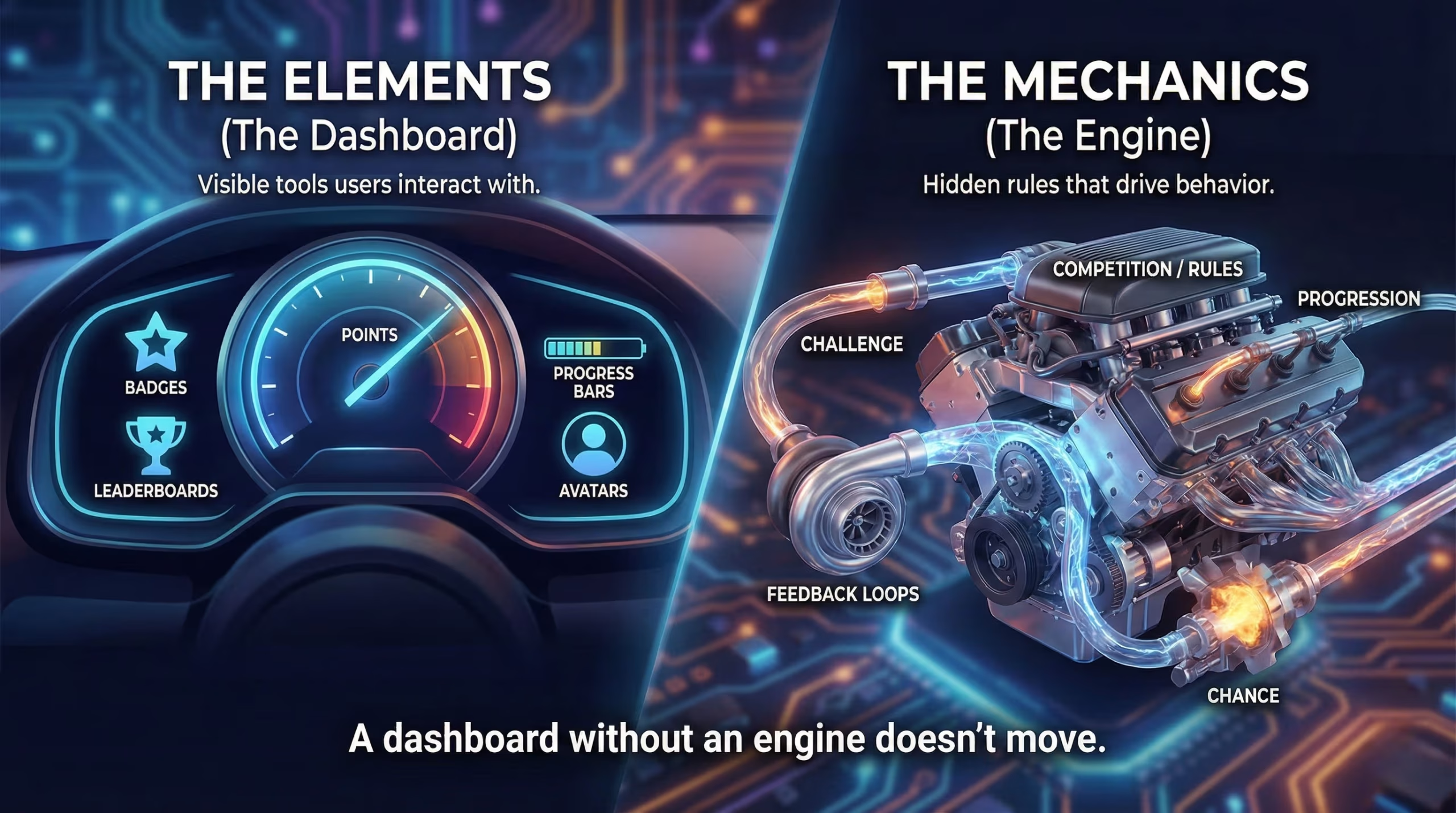
Most apps fail because they confuse "Elements" with "Mechanics." According to the MDA Framework (Mechanics-Dynamics-Aesthetics), knowing the difference is the key to user retention.
The Mechanics
The Hidden Engine (Verbs)Mechanics are the hidden rules and algorithms that drive user behavior. They dictate how the system works and create the challenge loop. Without mechanics, elements are meaningless.
Core Function: Drives Action
- Examples:
- Feedback Loops
- Competition & Cooperation
- Chance / Probability
- Resource Scarcity
The Elements
The Dashboard (Nouns)Elements are the visible tools the user interacts with. They are the feedback signals that tell the user they have successfully engaged with a mechanic.
Core Function: Visualizes Progress
- Examples:
- Badges & Stickers
- Leaderboards
- Points / XP
- Progress Bars
💡 The Psychology of "Sticky" Apps
Adding badges without a strategy isn't gamification; it's just "Pointsification." True engagement happens when your mechanics satisfy the 3 needs of Self-Determination Theory (SDT):
The Framework: The 3 Layers of Engagement
Before diving into the 110+ elements, you must understand where they fit. Successful gamification is built in layers, moving from the Abstract (Emotions) to the Concrete (Buttons).
1. Dynamics (The "Why")
The big-picture constraints and emotions. You cannot "see" these, but users feel them.
Narrative • Emotion • Constraints2. Mechanics (The "How")
The processes that drive action forward. This is the engine of your loop.
Competition • Chance • Feedback Loops3. Components (The "What")
The specific tools and UI elements used to visualize the mechanics.
Points • Badges • Leaderboards • AvatarsThe Complete Collection: 110+ Elements
Browse the comprehensive list of mechanics below. Use the filter bar to jump to specific categories.
🛠 Core Mechanics
The fundamental building blocks that structure the user journey.
Points (XP)
The granular unit of value. Tracks behavior and provides immediate feedback.
Leaderboards
Ranks users against each other to drive competitive behavior and status seeking.
Badges
Visual validation of achievements. Signals "Competence" to the user and others.
Levels
Milestones that unlock new content. Represents the user's journey arc.
Boss Battles
A high-difficulty challenge that tests mastery of previous skills.
Quests / Missions
Specific, directed tasks that guide the user to explore features.
Onboarding Tutorial
A guided "First Time User Experience" (FTUE) to teach mechanics safely.
Activity Loops
The core repeated action (Trigger -> Action -> Reward) that forms habits.
Milestones
Fixed points of progress (e.g., "Reach 100 Sales") that trigger a reward.
Skill Trees
Branching choices that allow users to customize their growth path.
Collections
Sets of items users must gather to complete a set (Scarcity + Curiosity).
Power-Ups
Temporary boosts that give users an advantage or new ability.
Status Titles
Labels (e.g., "VIP," "Master") displayed next to a name to show seniority.
Avatars
Visual representation of the user, allowing for identity and self-expression.
Skins / Cosmetics
Visual upgrades that do not affect gameplay but enhance status.
Progress Bars
Visual indicator of how close a user is to a goal (Zeigarnik Effect).
Hints / Clues
Assistance provided to prevent frustration during difficult challenges.
Constraints
Limitations (e.g., "Use only 3 moves") that force creative problem solving.
Undoing / Forgiveness
Allowing users to fix mistakes, reducing the fear of failure.
Access Keys
Items required to unlock specific areas or levels.
Crafting
Combining basic resources to create higher-value items (The IKEA effect).
Resource Management
Balancing limited assets (gold, energy) to optimize growth.
Grinding / Farming
Repetitive tasks performed to gain resources for future success.
Narrative Arcs
A story that unfolds as the user progresses (The Hero's Journey).
Branching Choices
Decisions that permanently alter the outcome (Autonomy).
Mini-Games
Small, distinct games inside the main experience to break monotony.
Combos
Rewarding rapid, sequential actions with higher multipliers.
Speedruns
Challenges based on completing a task in minimum time.
QTE (Quick Time Events)
Reaction-based inputs required during cinematic moments.
Checkpoints
Safety nets that save progress, reducing frustration.
Exploration (Fog of War)
Revealing new areas of a map or system through activity.
Boss Rush
Facing all previous difficult challenges in a row.
🤝 Social & Community
Mechanics that leverage "Relatedness" and peer pressure to drive retention.
Teams / Guilds
Groups users together to foster cooperation and shared accountability.
Gifting
Allows users to send value to others, creating reciprocity.
Social Discovery
Finding other users with similar interests or skills.
Bragging Rights
Tools that make it easy to share achievements on social media.
Mentorship
High-level users guiding low-level users (Mastery + Relatedness).
Referral Bonuses
Rewarding users for bringing new people into the ecosystem.
1v1 Duels
Direct competition between two users.
Global Events
Server-wide challenges where everyone works toward a common goal.
Spectator Mode
Allowing users to watch top players perform, fostering aspiration.
Chat / Emotes
Communication tools to build community and culture.
Voting
Giving users a say in future updates or content (Autonomy).
Location Check-ins
Real-world social proof based on physical location (e.g., Foursquare).
Friending / Following
Building a personal network within the platform.
Team Leaderboards
Ranking groups rather than individuals to reduce individual anxiety.
Social Trading
Allowing users to swap items, creating an internal economy.
Social Pressure
Notifying users when a friend passes their high score.
Thank You Notes
Mechanisms for gratitude (Karma points).
Roleplay
Allowing users to act out a specific character or job.
Auction House
A player-driven economy where users set prices for goods.
Bartering
Direct exchange of goods between users without currency.
Renting / Leasing
Temporary use of premium assets for a fee (Sharing Economy).
Proximity Events
Triggering events when users are physically near each other.
🎁 Rewards & Feedback
The incentives that close the engagement loop.
Unlockable Content
Access to new features earned through engagement.
Virtual Currency
Soft currency (earned) vs Hard currency (bought) economies.
Coupons / Vouchers
Real-world monetary rewards for digital actions.
Certificates
Formal proof of completion (common in LMS/EdTech).
Mystery Box
Variable rewards that trigger dopamine (Intermittent Reinforcement).
"Juice" / Effects
Visual/Audio feedback (confetti, sounds) when a task is done.
Easter Eggs
Hidden surprises that reward curiosity and exploration.
Lottery / Raffle
Free or earned entries for a chance to win a prize. Paid entry can make it an illegal lottery (see the compliance section below).
Daily Login Bonus
Increasing rewards for returning every 24 hours.
Streaks
Punishing the user for breaking a chain of daily activity (Loss Aversion).
Limited Time Offers
Scarcity-based rewards that expire (FOMO).
Discounts
Price reductions unlocked by activity.
Early Access
Giving top users access to features before the public.
Profile Frames
Visual decoration for user profiles.
Inventory Space
Rewards that allow users to hold more items.
Immunity
Protection from losing a streak or status.
Shiny / Foil Items
Rare variants of standard items.
Battle Pass
A tiered reward system that monetizes engagement over a season.
God Mode / Sandbox
An unlocked mode with no restrictions for pure creativity.
New Game+
Restarting with all items but higher difficulty.
Cutscenes
Non-interactive visual rewards that advance the plot.
🎲 Risk & Chance
Variable rewards that trigger dopamine and excitement.
Countdowns
Visual timers that create urgency to act now.
Decay
Points or status that decrease over time if inactive.
Appointment Dynamics
User must return at a specific time (e.g., "Crop is ready").
Permadeath
Losing all progress upon failure (High Stakes).
Spin the Wheel
A free daily spin for a random reward. Real-world prizes usually need official sweepstakes or contest rules (see the compliance section below).
Loss Aversion
Framing a situation so the user acts to *avoid losing* something.
Gated Content
Visible but inaccessible areas that drive curiosity.
Betting / Wagering
Staking earned in-app points for a chance to double them. Real-money wagering is regulated jurisdiction by jurisdiction (see the compliance section below).
Sunk Cost
Reminding users how much they have invested so they don't quit.
Paywalls
Hard barriers removable only by payment or extreme effort.
Random Events
Unpredictable occurrences that break monotony.
Karma / Morality
Systems where choices (Good vs Evil) impact future options.
Rest Mechanics
Forcing a break to prevent burnout (Energy systems).
Probability Manipulation
Items that allow users to improve their "luck" odds temporarily.
Base Defense
Protecting accumulated resources from loss or attack.
Dynamic Pricing
Costs that change based on demand or user behavior.
🤖 Niche & Future Tech
Advanced strategies for 2026 (AI, Metaverse, Corporate).
AI Personalization
Difficulty that adapts automatically to the user's skill level.
Digital Twins
Virtual replica of a physical object (common in Industry 4.0).
AR Scavenger Hunts
Overlaying digital rewards on the real world (Pokémon GO style).
NFT Assets
True ownership of digital items via blockchain.
Wearable Integration
Using step counts or heart rate to trigger game rewards.
DAO Voting
Decentralized governance as a game mechanic.
Micro-Learning
Breaking complex subjects into 2-minute "playable" chunks.
Corporate Dashboards
Gamifying KPI tracking for sales teams.
Wellness Challenges
Gamifying meditation or health habits.
Sustainability Scores
Tracking carbon footprint reduction as a game score.
Voice Control
Using voice commands as inputs for mechanics.
Eye Tracking
Using gaze duration as an input mechanic (VR/Proctoring).
UGC (User Gen. Content)
Rewarding users for creating levels or art for the platform.
Collaborative Puzzles
Tasks that require multiple users to be online simultaneously.
Proximity Events
Triggering events when users are physically near each other.
Interest / Staking
Earning passive rewards by locking up assets for a period.
Empire Building
Expanding territory or influence over time (4X style).
Automation
Unlocking tools that perform boring tasks automatically.
Prestige / Rebirth
Resetting progress to zero in exchange for a permanent multiplier.
Adaptive Difficulty
AI that makes the game harder or easier based on performance.
Soundscapes
Audio feedback that changes based on user state (Immersion).
Visual Novel
Text-based storytelling with character visuals.
Gamification for Every Industry
We don't believe in "One Size Fits All." Here is how we apply the 110+ elements to specific business models.
Airlines & Travel
Goal: Loyalty & Frequent Flyer Status.
Manufacturing
Goal: Safety Compliance & Efficiency.
Delivery Services
Goal: Driver Availability & Speed.
Healthcare
Goal: Medication Adherence & Recovery.
EdTech & eLearning
Goal: Course Completion & Mastery.
FinTech
Goal: Savings Habits & Transaction Frequency.
Retail & E-Commerce
Goal: Average Order Value (AOV) & Retention.
Corporate & HR
Goal: Employee Training & Culture.
Real Estate
Goal: Virtual Tours & Lead Qualification.
Hospitality
Goal: Guest Experience & Reviews.
Fitness Apps
Goal: Consistent Activity & Social Proof.
Automotive
Goal: Eco-Driving & Maintenance.
Frequently Asked Questions
Everything you need to know about implementing the 110+ elements into your business model.
What is the difference between Gamification Mechanics and Elements?
This is the most common confusion. According to the MDA Framework (Mechanics-Dynamics-Aesthetics), they serve different roles:
1. Mechanics (The Engine): The hidden rules and algorithms that drive the system (e.g., Chance, Competition, Scarcity).
2. Elements (The Dashboard): The visible tools users interact with to see the mechanics (e.g., Points, Badges, Leaderboards).
Think of it like a car: The Mechanics are the engine under the hood; the Elements are the speedometer you see while driving.
How does gamification actually increase ROI and Revenue?
Gamification drives ROI by impacting three key metrics:
1. Retention: Research by Frederick Reichheld of Bain & Company found that a 5% increase in customer retention can raise profits by 25% to 95%. Gamification loops (like streaks) can help reduce churn.
2. Data Collection: Engaged users provide more data, allowing for personalized offers and higher conversion rates.
3. Lifetime Value (LTV): Mechanics like "VIP Tiers" or "Battle Passes" monetize engagement directly, turning free users into paying subscribers.
Is gamification just adding Points, Badges, and Leaderboards (PBL)?
No. Relying only on PBL is often called "Pointsification," and it usually fails long-term.
True gamification must address Intrinsic Motivation (internal drive). This means using mechanics like Narrative, Autonomy (Choice), and Social Relatedness—not just extrinsic rewards like points.
How do I choose the right mechanics for my specific industry?
You must align the mechanic with the user's "Player Type" and your business goal:
• For Sales/Teams: Use Competition mechanics (Leaderboards, Duels) to drive performance.
• For Education/LMS: Use Progression mechanics (Skill Trees, Unlockables) to drive mastery.
• For Healthcare: Use Cooperation mechanics (Team Challenges) to build accountability.
Does gamification work for B2B or Corporate Training?
Yes. In B2B settings, gamification turns mundane tasks (like compliance training or CRM data entry) into measurable achievements.
Common B2B mechanics include Certification Badges (for status) and Team Leaderboards (for healthy competition).
Can Capermint integrate these elements into my existing app?
Yes. We don't just provide the list; we build the infrastructure. Whether you need a simple API integration for a loyalty program or a full-scale Unity/Unreal Engine development for a game, our team can build the architecture behind these 110+ elements.
Tell Us About Your Project. We Reply In 48 Hours With A Custom Quote.
NDA available before detailed discovery. Share only non-confidential information in this form. Just a clear scope, team recommendation, engagement model, and itemized timeline so you can evaluate Capermint against any other vendor on equal terms.
Project Readiness Assessment
Submit your brief and receive a free Project Readiness Assessment: scope breakdown, recommended team shape, estimated timeline, technology fit, budget range, risk surface, and launch checklist. Delivered within 48 hours, no obligation.
- Custom itemized quote within 48 hours
- NDA available before a detailed discovery call
- You choose the engagement model and team structure
- Free Project Readiness Assessment included
- No obligation and complete confidentiality