Gamification in Loyalty Programs is the application of game-design elements and principles in non-game contexts to engage and motivate people to achieve their goals. In loyalty programs, gamification turns routine transactions into engaging and rewarding experiences, driving customer retention and loyalty.
Current Trends in Gamification
The global gamification market is projected to grow from USD 9.1 billion in 2020 to USD 30.7 billion by 2025, at a CAGR of 27.4%. This growth highlights the increasing adoption of gamification across various industries, including retail and hospitality, to enhance customer engagement.
Successful examples include Starbucks’ Rewards program and Nike’s Run Club, which utilize gamified elements to keep customers engaged and returning.
Top 12 Loyalty Program Gamification Strategies
1. Point-Based Systems
 Point-based systems are one of the most common Gamification in Loyalty program strategies. Customers earn points for purchases, social sharing, or other interactions. These points can be redeemed for rewards like discounts, free products, or exclusive experiences.
For instance, Starbucks Rewards allows customers to earn stars for every purchase, which can be redeemed for free drinks, food items, or merchandise. This straightforward approach not only incentivizes repeat purchases but also enhances customer satisfaction.
According to a Bond Loyalty report, 79% of consumers say loyalty programs make them more likely to continue doing business with brands.
2. Tiered Loyalty Programs
 Tiered loyalty programs offer different rewards based on customer spending or engagement. Higher tiers provide more valuable rewards, motivating customers to spend more to achieve higher status.
Sephora’s Beauty Insider program, for example, has three tiers: Insider, VIB, and Rouge. Each tier offers increasing benefits such as exclusive discounts, free shipping, and early access to products. This structure creates a sense of progression and exclusivity.
A study by Accenture found that 57% of consumers spend more on brands to which they are loyal.
3. Badges and Achievements
 Badges and achievements recognize customers for specific actions or milestones, creating a sense of accomplishment. This method encourages continued engagement by rewarding behaviors such as frequent purchases, reviews, or social media interactions.
Foursquare, for instance, awards badges for checking into different locations and fostering a competitive and engaging environment.
Gamified systems can lead to a 100-150% increase in engagement metrics.
4. Challenges and Contests
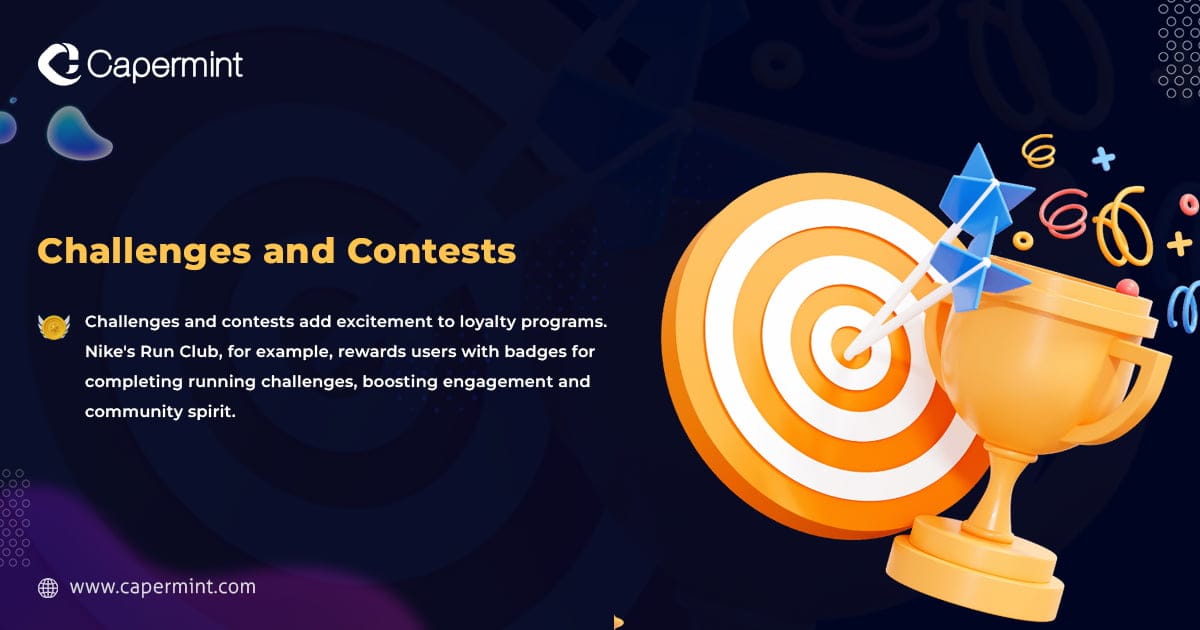 Challenges and contests introduce competition and excitement into loyalty programs. Customers can earn points, badges, or special prizes by participating in various challenges.
Nike’s Run Club app frequently holds challenges that encourage users to run certain distances, rewarding them with badges and recognition. These activities not only engage customers but also build a sense of community and achievement.
According to a study by Harvard Business Review, Gamification in Loyalty Programs can increase employee engagement by 48% and reduce turnover by 36%.
5. Social Sharing and Community Building
 Social sharing encourages customers to share their progress and achievements on social media, enhancing visibility and fostering community.
Fitbit’s community feature allows users to share their fitness achievements, creating a supportive and competitive environment. This strategy not only promotes the loyalty program but also strengthens customer relationships through social interaction.
Nielsen reports that 92% of consumers trust recommendations from friends and family over other forms of advertising.
6. Personalized Rewards and Experiences
 Personalized rewards cater to individual customer preferences, enhancing satisfaction and loyalty. Amazon’s recommendation system suggests products based on past purchases, offering a personalized shopping experience.
Tailoring rewards and experiences to individual behaviors and preferences makes customers feel valued and understood, fostering deeper loyalty.
Epsilon found that 80% of consumers are more likely to make a purchase when brands offer personalized experiences.
7. Progress Bars and Milestones
 Visual progress indicators like progress bars show customers how close they are to their next reward. This motivates them to keep engaging with the program.
Dropbox uses progress bars to show how close users are to earning more storage space, encouraging them to complete specific actions. Visual cues effectively drive customer motivation and sustained engagement.
A study by the University of Chicago found that progress bars can increase user engagement by up to 60%.
8. Quests and Missions
 Quests and missions structure loyalty programs as interactive tasks, making the experience more engaging. Customers complete various tasks to earn rewards, similar to completing levels in a game.
Duolingo uses this approach by setting language learning goals and rewarding users for achieving them. This method keeps customers engaged and motivated to complete the program.
Game-like elements can improve user experience and retention by 23%.
9. Referral Programs
 Gamified referral programs incentivize customers to bring in new clients. Rewards can be given for each successful referral, making it beneficial for both the referrer and the referred.
Dropbox’s referral program offers additional storage space to both parties, making it highly effective. Referral programs leverage word-of-mouth marketing to expand the customer base.
Referred customers have a 37% higher retention rate compared to non-referred customers.
10. Interactive Gamification Techniques
>> Spin Wheel

Spin wheels offer a fun way to win prizes. Customers spin a digital wheel to win discounts, points, or other rewards. This element of chance adds excitement and keeps customers coming back. Shopify uses spin wheels in its loyalty programs to increase engagement and drive sales.
>> Scratch to Win
Scratch cards provide instant gratification by allowing customers to win rewards immediately. This technique can be used both online and offline. Mobile apps often use digital scratch cards to surprise users with discounts or bonus points, enhancing customer experience.
>> Play to Win
 Mini-games integrated into loyalty programs make earning rewards fun. Customers play games to earn points or prizes, increasing their engagement.
McDonald’s Monopoly game is a classic example, where customers collect game pieces to win prizes, driving repeat purchases.
Instant gratification rewards like spin wheels and scratch cards can boost engagement by 38%.
11. Exclusive Access and VIP Perks
 Offering exclusive content, products, or experiences to loyal customers makes them feel special and appreciated. VIP perks can include early access to new products, special discounts, or invitations to exclusive events.
Amazon Prime’s early access to deals and special discounts is a perfect example of VIP perks that enhance customer loyalty.
According to a study by American Express, 70% of consumers say they would spend more money with a brand that offers superior customer service.
12. Gamified Feedback and Reviews
Encouraging customers to leave feedback and reviews through gamification provides valuable insights and improves customer satisfaction. Offering points or rewards for reviews motivates customers to share their opinions.
TripAdvisor, for instance, rewards users with badges for their reviews, encouraging more contributions and providing valuable feedback.
BrightLocal found that 91% of consumers read online reviews, and 84% trust them as much as personal recommendations.
Measuring the Success of Gamified Loyalty Programs
1. Key Metrics and KPIs
To evaluate the success of Gamification in Loyalty Programs, track metrics like engagement rates, customer retention, the number of active users, and the redemption rate of rewards. These KPIs help determine the effectiveness of the loyalty program and guide future improvements.
According to Forrester, properly implemented loyalty programs can increase customer retention rates by 5%, boosting profits by 25% to 95%.
2. Tools and Platforms
Various tools and platforms can help implement and track gamified loyalty programs. Choose solutions that fit your business size and needs. Platforms like Bunchball, Badgeville, and LoyaltyLion offer comprehensive gamification solutions that cater to different business requirements.
The use of advanced tools and platforms can streamline the implementation of gamified loyalty programs and enhance their effectiveness by up to 50%.
Challenges and Considerations
Potential Pitfalls
While gamification can be effective, it also comes with challenges. Avoid making the program too complicated or rewarding actions that do not align with business goals. Learning from unsuccessful implementations can help refine your strategy. Ensuring simplicity and relevance in the gamified elements is crucial for success.
A study by Gartner found that 80% of gamified applications fail due to poor design.
Ethical Considerations
Ensure that your gamification strategies are fair and ethical. Avoid manipulative tactics and prioritize genuine customer engagement. Transparency and honesty build trust and long-term loyalty. Ethical considerations are vital in maintaining a positive brand image and fostering customer trust.
According to Edelman’s Trust Barometer, 81% of consumers say trust is a deal-breaker or deciding factor in their buying decisions.
Future of Loyalty Program Gamification
Emerging Technologies
New technologies like AI, AR/VR, and blockchain are transforming Gamification in Loyalty Programs. These innovations offer new ways to engage customers and enhance loyalty programs. For example, AR can create immersive experiences that make loyalty programs more exciting. Blockchain can add transparency and security to reward systems.
The global AR market is expected to grow from USD 15.3 billion in 2020 to USD 77 billion by 2025.
Innovative Case Studies
Look at examples of cutting-edge gamified loyalty programs to understand future trends. Brands like Nike and Starbucks continue to innovate and set new standards for loyalty programs. These examples provide valuable insights into how gamification can evolve and adapt to changing customer preferences.
Continuous innovation in loyalty programs can increase customer lifetime value by up to 30%.
Read More:- Enterprise Gamification: Examples and Evidence
Want to do Gamification for your app? Capermint Technologies can help you
Capermint Technologies specializes in gamification and loyalty program services. With years of experience, we help businesses create engaging and effective loyalty programs that drive customer retention and satisfaction.
Why Choose Capermint Technologies?
Our unique approach and competitive advantages set us apart. We provide tailored solutions that meet your specific business needs. Our satisfied clients and successful case studies speak for themselves, showcasing our expertise and commitment to excellence.
Services Offered
Capermint offers a range of different services, including Gamification in Loyalty program strategy development, loyalty program design, and implementation. Whether you need a simple points system or a complex tiered program, we have the expertise to help. Our team works closely with you to understand your business goals and create a loyalty program that delivers results.
Reach out to Capermint Technologies for a consultation. Our team is ready to help you create a loyalty program that keeps your customers engaged and coming back. Contact us today to learn more about our personalized solutions and take your customer engagement to the next level.
Quick answer
Gamified loyalty programs add game mechanics such as tiers, progress bars, challenges, streaks, badges and spin-to-win games to a points program so members return and buy more often. Retail, restaurant, travel, fintech and app brands use them. Capermint typically adds one mechanic to an existing program in 4–8 weeks, with budgets from $10K (USD).
Which mechanic fits which loyalty goal
| Loyalty goal | Mechanics that fit | KPI to watch |
|---|---|---|
| Visit frequency | Streaks, visit-count challenges, digital punch cards | Visits per active member per month |
| Basket size | Spend-threshold challenges, tier progress bars | Average order value |
| App adoption | Onboarding quests (complete profile, first mobile order), app-only game plays | Share of members active in the app |
| Referrals | Two-sided referral rewards, referral challenges | Referred sign-ups that make a first purchase |
| Win back lapsed members | Time-limited comeback challenges, surprise bonus rewards | Reactivation rate within 90 days |
| Opt-ins and launch buzz | Spin-to-win or scratch-card game plays, run under sweepstakes rules | New member opt-in rate |
Launch two or three mechanics for one goal and compare members who see them with a holdout group before adding more. Each mechanic is explained in our guide to gamification elements and mechanics.
What a gamified loyalty program costs
| Tier | Scope | Typical range (USD) | Timeline |
|---|---|---|---|
| Single mechanic or branded mini-game | One mechanic (challenges, streaks, tier progress or badges) or one spin-to-win, scratch-card or play-to-win game, connected to your loyalty platform by API | $10K–$40K | Typically 4–8 weeks |
| Full loyalty gamification layer | Tiers, quests and challenges, badges, streaks, referrals and leaderboards with a rules engine, campaign admin panel and analytics across web, iOS and Android | $40K–$120K | Typically 8–16 weeks |
| Custom gamified loyalty platform | Your own points ledger, several branded games, personalization, and POS and CRM integration across brands or regions | $120K+ | 4–6 months or more, in phases |
Typical ranges; final quotes follow a scoping call. Online stores can start with ecommerce gamification, and app-first brands with mobile app gamification.
Loyalty gamification at a glance
| Delivery models | Fixed-scope project, dedicated team (monthly), or co-development and staff augmentation |
|---|---|
| Tech stack | Unity or HTML5 for mini-games; native iOS and Android, React Native or Flutter for app screens; React, Angular or Vue for web; server-side rules and rewards engine with a campaign admin panel; REST APIs and webhooks to your loyalty platform, CRM, POS or ecommerce store |
| Platforms | Web, iOS and Android apps, plus in-store screens or kiosks when scoped |
| Prize-game and launch readiness | For prize games: official-rules pages, free-entry (AMOE) flows, odds tables, prize-inventory caps and audit logs. For every build: server-side reward validation, anti-fraud checks and load tests for campaign peaks. The brand running the promotion owns official rules and legal review |
| Markets | Brands in the US, Canada and worldwide; calls scheduled in US and Canadian business hours; delivery from our Ahmedabad, India studio |
| Track record | Founded 2014; Capermint-reported 650+ customers worldwide and over 200 specialists; Clutch 4.9/5 from 13 reviews |
How we add gamification to a loyalty program
Goals and program audit
Agree the behavior to change (visit frequency, basket size, app adoption or referrals), then review your current earn and burn rules, member data, platforms and the loyalty, POS, CRM or ecommerce systems to integrate.
Scoping call and estimate
We agree the mechanics, platforms and integrations, then send a USD estimate with milestones. Final quotes follow this call.
Mechanic and reward-economy design
Pick two or three mechanics for that goal, then set earn and burn rates, tier thresholds, challenge cadence and a reward budget per member; for prize games, define odds, the prize pool and the free entry route.
Prototype and member test
Build a playable prototype of the core loop and reward screens and test it with a small group of your members to tune difficulty, pacing and clarity before full production.
Production and integration
Build the game clients, rules engine and campaign admin panel, and connect purchase, app and POS events through webhooks or your loyalty platform's API so points, badges and game plays are awarded server-side.
QA, fraud and rules review
Run device and browser QA, load tests for campaign peaks and anti-abuse checks against multi-accounting and bots, while the brand's counsel reviews official rules and disclosures.
Launch, measure and tune
Roll out to a share of members against a holdout group, track incremental lift in frequency and spend, and add seasonal challenges and content on a set calendar.
Step lengths scale with scope; the overall timeline is the range in the cost table, confirmed at scoping.
Prize games and promotion law. Points, tiers, badges and challenges earned for activity are generally not sweepstakes. Prize games inside a loyalty program (spin-to-win, scratch cards, Monopoly-style collect-and-win) can be regulated as sweepstakes or contests.
US: a promotion that combines a prize, chance and a required purchase is generally an illegal lottery, so purchase-linked games of chance need official rules and a free alternative method of entry (no purchase necessary) with the same odds. Letting members spend points to play may also be treated as paying to enter. New York and Florida require registration and a bond or trust account when total prizes exceed $5,000.
Canada: chance-based contests typically add a skill-testing question, and the Competition Act requires fair disclosure of the number and approximate value of prizes, any regional allocation and facts that materially affect the chances of winning. Quebec has its own contest rules.
India and other markets: the Promotion and Regulation of Online Gaming Act 2025 prohibits online money games, so reward games for members in India should be free to play, with no paid entry. The UK, EU and other markets set their own rules.
Who is responsible: the brand running the promotion owns official rules, registrations and legal review; we build entry flows, odds tables, prize caps and audit logs to the technical requirements of the target jurisdiction. This is general information, not legal advice.
Gamified loyalty program FAQs
How do gamified loyalty programs work?
They wrap the earn-and-redeem loop in goals and feedback. Members see progress toward the next reward or tier, take on time-limited challenges and unlock badges or game plays for actions such as a second visit or an app download. A rules engine awards points or plays when purchase, app or POS events meet the conditions.
What are some examples of gamified loyalty programs?
Starbucks Rewards uses Stars and bonus-Star challenges, and Sephora Beauty Insider moves members through Insider, VIB and Rouge tiers by annual spend. In Canada, Tim Hortons' annual Roll Up To Win contest awards digital rolls to Tims Rewards members on eligible purchases. McDonald's Monopoly uses collectible game pieces, while Nike Run Club and Duolingo use challenge badges and streaks that loyalty programs often borrow.
What is the difference between a points program and a gamified loyalty program?
A points program pays a fixed reward for spend, such as one point per dollar. A gamified program adds goals, progress and surprise on top: a tier bar showing what unlocks the next status, a three-visit challenge with a bonus, a weekly streak or a game play earned with a purchase. The points ledger can stay the same; the mechanics change when and why members act.
Do gamified loyalty programs increase repeat purchases?
They can, but only when the mechanics change behavior that would not have happened anyway. The reliable test is a holdout group: keep a share of members out of the mechanics and compare purchase frequency, average order value, active member rate and 90-day retention, plus reward cost per incremental dollar of revenue. Engagement that rises without incremental revenue means the program is paying for existing behavior.
How should points, tiers and rewards be balanced in a gamified loyalty program?
Start from a reward budget per member and work backward. Set earn rates so a typical member reaches a first reward within a few visits, place tier thresholds using your actual spend distribution so the top tier stays reachable but exclusive, and cap challenge bonuses. Review breakage (points never redeemed) and the outstanding points balance with your finance team every month.
How do you keep a gamified loyalty program from going stale?
Run it on a content calendar. Rotate time-limited challenges around seasonal peaks, refresh mini-game themes for holidays and launches, retire mechanics that stop beating the holdout group, and give long-tenure members new perks or badges rather than ever-higher point targets. A campaign admin panel lets your team schedule these changes without a new app release.
What rules apply to a Monopoly-style collect-and-win loyalty promotion?
It is usually run as a sweepstakes, so it needs official rules and, in the US, a free way to get game pieces or entries with the same odds as buying. The rules should list every prize, its approximate value and the odds. New York and Florida require registration and a bond or trust account when total prizes exceed $5,000. In Canada, winners typically answer a skill-testing question and the rules disclose prizes and the chances of winning; Quebec has its own requirements. The brand's counsel signs off, and we build piece allocation, free entry and audit logs to match.
What are the risks of gamifying a loyalty program?
The main risks are reward costs that outgrow revenue, rules too complex to follow, points farming through fake accounts or bots, and pressure tactics that erode trust. Set a reward budget per member, cap daily earning, validate purchases and plays server-side, and keep rules, odds and expiry dates visible.
What drives the cost of a gamified loyalty program?
Scope, integrations and custom art. Typical ranges are $10K–$40K for one mechanic or mini-game, $40K–$120K for a full gamification layer across web and apps, and $120K or more for a custom platform with its own points ledger. POS, CRM and ledger integrations and prize-game compliance push a project up its range. If you already run Antavo, Open Loyalty, LoyaltyLion or Smile.io, use its built-in tiers and referrals and budget only for what it lacks. Final quotes follow a scoping call.
Does Capermint build gamified loyalty programs for US and Canadian brands?
Yes. Capermint, a game development studio founded in 2014 in Ahmedabad, India, builds loyalty gamification, branded mini-games and leaderboards for brands and app teams in the US, Canada and worldwide. We schedule calls in US and Canadian business hours, quote in USD and work as a fixed-scope project, dedicated team or co-development partner.
Planning loyalty gamification for your brand?
Tell our loyalty gamification app development team your program goal, platforms and loyalty or POS systems. We schedule calls in US and Canadian business hours and reply with a scoped USD estimate. See also our gamification services and gamification portfolio.