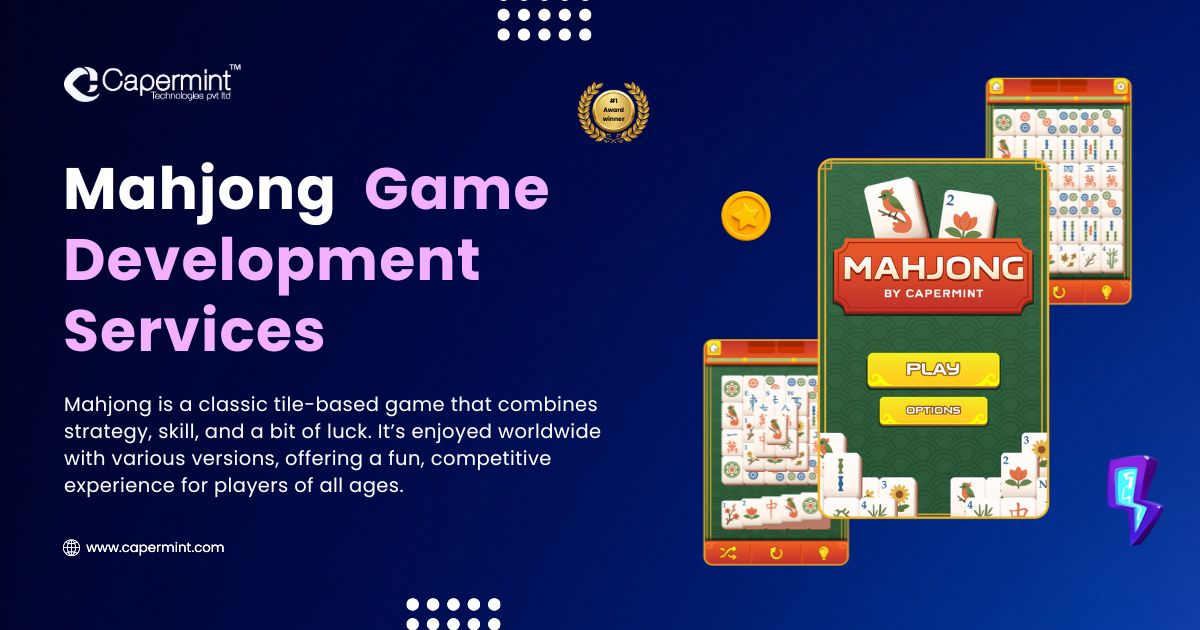
Mahjong is a timeless tile‑matching strategy game that blends pattern recognition, memory, probability, and quick decision‑making. It enjoys strong appeal in East Asia and has grown globally across mobile, web, and console platforms.
For studios and brands, Mahjong offers sticky retention loops, session lengths that balance casual and mid‑core play, and multiple monetisation paths (IAP, ads, battle passes, subscriptions, and premium DLC rule packs). Capermint builds high‑quality Mahjong games with a focus on gameplay depth, cultural accuracy, and commercial success.
What is Mahjong?
Mahjong (Table Game): A four‑player tile game played with 136–144 tiles depending on the ruleset. Players build sets (pungs/pon, chows/chi, kongs/kan) and a valid hand (usually 14 tiles) by drawing and discarding. Scoring is based on patterns and “fans/han/yaku” as per region.
Mahjong Solitaire (Tile‑Matching Puzzle): A single‑player matching game with stacked tiles on a board. Players remove pairs of identical, “free” tiles until the board is clear or no moves remain. It borrows Mahjong tiles and symbols but is a different game from four‑player Mahjong.
Common Tile Groups: – Suits: Characters (Wan/Man), Dots (Tong/Pin), Bamboos (Suo/Sou). Numbered 1–9. – Honours: Winds (East, South, West, North) + Dragons (Red/Chun, Green/Fa, White/Bai/Blank). – Flowers/Seasons: Optional bonus tiles used in several Chinese/HK rulesets.
Sets: – Pung/Pon: Three identical tiles. – Chow/Chi: Three sequential tiles of the same suit (2–3–4 Bamboos, for example). Not allowed with Honours. – Kong/Kan: Four identical tiles (often with replacement draws).
Turn Structure (Four‑Player): Draw a tile → Decide to keep or discard → Other players may claim the discard to complete a set → Repeat until someone wins or the wall ends.
Win Conditions: Complete a legal hand structure (commonly 4 sets + 1 pair) plus any special conditions defined by the ruleset (e.g., at least 1 Yaku in Riichi).
Scoring Keywords by Region: – Riichi (Japanese): Yaku‑based, Han/Fu, Riichi stick bets, Dora indicators, furiten rule, dealer repeats (renchan). – Hong Kong: Fan‑based scoring (e.g., Pung of Dragons, All Simples). Often Flowers/Seasons bonuses. – Chinese Official (MCR): Hand patterns with point values; tournament‑ready. – Taiwanese (16‑tile): Extra tiles and different winning sets.
Monetisation Terms: Soft and hard currency, boosters, energy/stamina, battle pass, gacha for cosmetics, rewarded and interstitial ads, IAP bundles, season events, and live‑ops calendars.
How Mahjong grew into a global evergreen?
Mahjong originated in China in the 19th century, influenced by older card‑style set‑collection games. By the early 20th century, it spread to Shanghai and beyond through trade and popular culture. In the 1920s, it reached the United States and Europe; publisher rulebooks standardised play for new audiences. Over time, regions customised rules to match local tastes Japan developed Riichi with its yaku system and riichi declarations; Hong Kong and Guangdong rules shaped fan‑based scoring; Taiwan introduced 16‑tile play; and mainland China later formalised Chinese Official (MCR) for tournament use.
Digital Mahjong began with early PC titles and arcade cabinets in Japan. As home computers and consoles spread, Mahjong became a staple genre across NEC PC‑98, SNES, PlayStation, and later mobile platforms. Mahjong Solitaire also rose as a separate puzzle sub‑genre on Windows and the web in the 1990s–2000s. On smartphones (iOS/Android), Mahjong thrives because it supports short sessions, offline play, and scalable difficulty. Multiplayer Mahjong built on online lobbies, quick matchmaking, anti‑collusion checks, and cosmetic progression systems. Esports‑style Riichi leagues, online ranked ladders, and creator communities expanded reach.
Today, Mahjong enjoys:- Global adoption: East Asia as the core base, with strong diaspora and worldwide interest. – Evergreen appeal: Low art cost per content update, high replayability from RNG+skill. – Strong retention: Collection, mastery, and social competition. – Flexible products: From premium single‑player to F2P multiplayer with live‑ops.
For a studio or brand, Mahjong provides a proven game loop, cross‑platform potential, and broad IP opportunities (themes, festivals, licensed tilesets). Capermint applies authentic rules, research‑led UX, and modern tech to package this history into a successful, long‑life product.
Ready to Build Your Own Mahjong Game?
Partner with our expert game developers to create a feature-rich, scalable Mahjong game for mobile, web, or desktop platforms. Let’s bring your vision to life.
What to include for fun, fairness, and growth?
A commercially strong Mahjong product balances authenticity, clarity for new users, and depth for veterans. We recommend the following feature layers:
A. Core Game Modes – Four‑Player Mahjong: Choose ruleset(s): Riichi, Hong Kong, Chinese Official (MCR), Taiwanese, or custom house rules. Add quick play, ranked, private rooms, and tournaments. – Mahjong Solitaire: Multiple board layouts, solvable seeds, hints/undo, daily challenges, events, and accessibility options. – Practice & Puzzles: Teaching hands, endgame problems, yaku drills, and bot matches.
B. Progression & Meta – Player levels, MMR/rank tiers, seasonal ladders. – Collections: tilesets, tables, avatars, frames, emotes, effects. – Missions: daily/weekly tasks, achievements, event passes. – Clubs/guilds, leaderboards, and friendly rooms.
C. Monetisation & Live‑Ops – IAP bundles (starter packs, currency, cosmetics, event passes). – Rewarded ads, interstitials with frequency control, ad‑free premium. – Seasonal themes (Lunar New Year, Golden Week, Mid‑Autumn, Diwali), limited cosmetics. – Time‑bound challenges, weekend events, and festival tournaments.
D. Fair Play & Systems – True random shuffling with seed logging for audits. – Anti‑cheat and anti‑collusion detection (IP/device checks, suspicious timing patterns). – Spectator tools with delayed info, report system, and penalties. – Server authoritative state; rollback netcode where relevant; reconnection support.
E. UX & Accessibility – Clear tile visibility, colour‑safe palettes, large‑tile mode. – One‑tap actions, smart prompts, and discard confirmation options. – Tutorials with branching paths for each ruleset. – Localisation and right‑to‑left support where needed.
These features set a strong base for retention (D1/D7/D30), monetisation (ARPDAU/ARPPU), and community growth.
How to Play Mahjong? (Quick learning path for players)
Your onboarding should teach the hand structure, legal sets, turn flow, and win checks without overwhelming new users. A simple 3‑step path works well:
Step 1: Tiles and Sets – Suits: Characters, Dots, Bamboos (1–9); Honours: Winds and Dragons; optional Flowers. – Legal sets: Pung (3 of a kind), Chow (3 in sequence, same suit), Kong (4 of a kind), plus a Pair. – A common winning hand: 4 sets + 1 pair. Show visual examples with highlighted tiles.
Step 2: Turn Cycle and Claims – Player draws one tile, keeps or discards one. – Other players can “call” a discard to complete a set (rules vary by region). Teach Pon/Chi/Kan options. – Explain priorities (e.g., in Riichi, order of claims) and what “closed” vs “open” means.
Step 3: Win & Score – Show what a valid winning hand looks like per ruleset and why it scores. – Riichi: need at least one yaku; explain riichi declaration, dora, ura‑dora, and fu basics. – HK/MCR: fan/points per pattern; how Flowers/Seasons add bonuses.
Player Tips (in‑game helper): – Keep flexible shapes that can grow into multiple sets. – Track discards and visible tiles to read safe/unsafe waits. – Avoid risky tiles late in the hand without strong value. – In ranked, fold when odds are poor; defence is part of winning.
With good UI (auto‑sort, recommended actions, wait highlights, explanation pop‑ups), most new users finish the tutorial in minutes and start winning with confidence. For depth, add strategy lessons, endgame drills, and replay reviews.
Development Process of the Mahjong Game
We use a clear, low‑risk pipeline with measurable milestones and weekly builds:
1. Discovery & GDD – Market fit: target regions, platforms (iOS, Android, WebGL, PC, consoles), and monetisation model. – Ruleset scope: baseline (e.g., HK + Riichi) vs phased rollout. House rules and toggles. – KPIs and content plan for the first 90 days of live‑ops. – Deliverables: GDD, technical architecture, backlog, art style sheet, and schedule.
2. Prototyping – Tile engine: shuffling, draws, discards, claims, and win logic. – UI/UX flows: tutorial, quick match, lobbies, store, and inventory. – Latency tests, bot logic, and initial telemetry.
3. Production – Rule engines per region with automated tests. – Multiplayer: server authoritative design, matchmaking, reconnection, chat/emotes. – Content: tilesets, tables, avatars, effects; store and bundles. – Integrations: payments, ads, analytics, crash reporting, remote config.
4. QA & Compliance – Unit tests, end‑to‑end tests, device matrix, soak tests, seed audits for RNG. – Store checks (App Store, Google Play), privacy policy, age ratings, GDPR/CCPA basics.
5. Soft Launch – Limited regions, CPI tests, ASO, tutorial A/B, economy tuning, difficulty curves. – Retention and monetisation tuning across cohorts.
6. Global Launch & Live‑Ops – UA scaling, events calendar, festival skins, ranked seasons. – Anti‑cheat monitoring, balance updates, content drops. – Regular roadmap updates based on data and community feedback.
Result: predictable delivery, strong first‑time user experience, and a roadmap that supports long‑term revenue.
Why Capermint is the best Mahjong Game Development Company?
-
Authenticity with flexibility: We implement region‑true rule engines while keeping options for house rules and events. This lets you localise fast without code churn.
-
Multiplayer that holds up: Low‑latency design, reconnection logic, fair matchmaking, and strong anti‑cheat. Player trust is a growth asset.
-
Design + growth under one roof: We combine game design, art, engineering, and UA/ASO. You get a single team that thinks about LTV from day one.
-
Clean code, clear docs: Easier updates, faster features, and reliable live‑ops.
-
Data‑driven iteration: We wire analytics to questions that matter (D1/D7/D30, FTUE drop‑offs, payer conversion, ad fatigue). We ship changes that move metrics.
-
Experience with board/card/casual genres: Proven pipelines for content, events, and seasonal themes.
-
Support for brand/IP: Custom tiles, tables, and themes that match your brand guidelines.
Working with Capermint means fewer surprises and a game that is ready for stores, ads, and community from day one.
Cost of Mahjong Game Development
Costs depend on scope (rulesets, platforms, multiplayer depth, content, and live‑ops). Here are common brackets for planning. These are indicative ranges in USD and can be refined quickly after a short scoping call.
Mahjong Solitaire (single‑player, polished): – $25k–$45k: Core game loop, 100–300 layouts, hints/undo, daily challenge, simple store, rewarded ads, basic analytics. – Add‑ons: custom art pack, live events, premium DLC packs, seasonal skins, and bespoke soundtrack.
Four‑Player Mahjong (one ruleset, mobile, casual‑plus): – $70k–$120k: One region‑accurate ruleset (e.g., HK or Riichi), bots, quick play, basic ranked, cosmetics store, IAP + ads, analytics, anti‑cheat basics, and localisation.
Four‑Player Mahjong (multi‑ruleset, ranked, live‑ops): – $150k–$300k+: Multiple rulesets, robust ranked, tournaments, clubs, seasons, deep cosmetics, events calendar, server scaling, anti‑collusion, full analytics suite, UA/ASO pack, and marketing creatives.
What drives cost up or down: – Number of rulesets, tournament formats, and platforms. – Custom art, 3D tables, VFX, and voice packs. – Online features (matchmaking, reconnection, spectating, clubs, cross‑play). – Live‑ops tooling, A/B infra, and event pipelines. – Compliance (age‑gating, data residency, special legal reviews).
We share a line‑item estimate with scope notes so you can prioritise the highest‑ROI features first.
Time to develop Mahjong Game
Development time aligns with scope and content. Typical ranges:
-
Mahjong Solitaire (mobile, polished): 8–12 weeks for v1; +4–6 weeks for events and store polish.
-
Four‑Player Mahjong (single ruleset): 14–20 weeks for v1 soft launch; +6–8 weeks to global launch.
-
Four‑Player Mahjong (multi‑ruleset, ranked, live‑ops): 24–36+ weeks across phases (alpha → beta → soft launch → global).
What adds more time: multiplayer scale, tournaments, deep cosmetics, and heavy localisation. We recommend phased releases to capture value sooner: start with one ruleset and core ranked, then add events and more rulesets by season.
We run weekly sprints, share builds regularly, and measure progress against KPIs (tutorial completion, retention, conversion). This makes time predictable and keeps teams aligned.
Tech Stack to Develop Mahjong Game
-
Engine: Unity or Unreal (Unity is common for 2D/2.5D Mahjong, WebGL friendly).
-
Backend: Node.js/Go/Python microservices with Redis for matchmaking, Postgres for persistence.
-
Realtime: WebSocket or gRPC; server authoritative state, seed‑based RNG.
-
Infra: Kubernetes or managed containers, autoscaling groups, CDN for assets.
-
Tools: Remote Config, feature flags, Crashlytics, A/B testing, analytics (event schema set early).
-
Security: Anti‑tamper, device checks, SSL pinning where needed, PII encryption, audit logs.
This setup gives quick iteration in development and stable ops at scale.
Let’s Get Started!
-
Share your target regions and preferred ruleset(s).
-
Pick platforms for v1 and the monetisation model.
-
Select an art style: classic, minimalist, or branded.
-
We prepare a short scope, a line‑item quote, and an initial schedule.
Contact Capermint to plan your Mahjong game and receive a firm estimate for cost and time, tailored to your goals.
At a glance
Mahjong game development at a glance
Mahjong game development means building four-player Mahjong (American, Riichi, Hong Kong or Chinese Official rules) or a Mahjong Solitaire puzzle. Capermint builds both for mobile, web and PC for US, Canadian and global studios and brands. Typical ranges: Solitaire MVP $10K–$40K in 8–12 weeks; online four-player $40K–$120K in 14–20 weeks to soft launch. Final quotes follow a scoping call.
| Formats | Four-player Mahjong (American, Riichi, Hong Kong, Chinese Official (MCR), Taiwanese or house rules) and single-player Mahjong Solitaire |
|---|---|
| Price from | Typical Mahjong Solitaire MVP from $10K (USD); online four-player in one ruleset typically $40K–$120K; final quote after a scoping call |
| Timeline | Mahjong Solitaire v1 typically 8–12 weeks; four-player, one ruleset 14–20 weeks to soft launch plus about 6–8 weeks to global launch; multi-ruleset with live ops 24–36+ weeks, phased |
| Delivery models | Fixed-scope project, dedicated team (monthly), or co-development / staff augmentation with your studio |
| Tech stack | Typical stack: Unity (common for 2D/2.5D Mahjong, with WebGL export) or Unreal client; Node.js or Go services, WebSocket real-time play, Redis for matchmaking, Postgres; Kubernetes or managed containers; remote config, crash reporting and analytics |
| Platforms | iOS, Android, web (WebGL or HTML5) and PC; consoles scoped on request |
| Fairness and testing | Server-authoritative state, seed-logged RNG for audits and anti-collusion checks; for real-money builds, RNG and game math ready for independent testing by accredited labs such as GLI, iTech Labs or BMM (certification is obtained by the operator or game owner) |
| Markets | Built for US and Canadian buyers (we schedule calls in US and Canadian business hours and quote in USD); also available to buyers in the UK/EU, LatAm, Africa, the Middle East, India (free-to-play, social and e-sports formats only) and APAC |
| Proof | Founded 2014 in Ahmedabad, India; Capermint-reported 650+ customers worldwide and over 200 specialists; Clutch 4.9/5 from 13 reviews; selected board-game clients and products listed by Capermint include Ludo Empire, Chess Castle and SuperStyle Chess; End Game Chess case study |
Formats and rulesets
Which Mahjong format and ruleset to build
Pick the format and ruleset before you request quotes, because they change the rules engine, the tile art, the backend and the budget. Mahjong Solitaire is a single-player puzzle that can run offline. Four-player Mahjong needs a rules engine per ruleset, bots and, for online play, a server-authoritative backend. See puzzle game development for Solitaire and multiplayer game development for online four-player play; both run as part of Capermint's mobile game development services.
| Format or ruleset | Tiles | Winning hand and scoring | Engine work specific to it | Where it is played |
|---|---|---|---|---|
| American (NMJL card) | 152, including 8 jokers | 14 tiles matching one hand on the year's card of hands | Charleston tile passing, joker rules, card of hands stored as data and updated yearly | Widely played in the US |
| Riichi (Japanese) | 136, no flowers | Four sets and a pair (plus special hands) with at least one yaku; han and fu scoring | Riichi declaration, dora indicators, furiten checks, dealer repeats | Japan and online ranked communities |
| Hong Kong (Cantonese) | 144, including flowers and seasons | Four sets and a pair; fan-based scoring, often with a minimum fan to win | Flower bonuses, fan table, house-rule toggles | Hong Kong, Southeast Asia and Cantonese-speaking communities |
| Chinese Official (MCR) | 144, including flowers | Four sets and a pair (plus special hands); 81 scoring patterns, 8-point minimum | Large pattern library and point calculator, tournament settings | International tournaments |
| Taiwanese | 144, including flowers | 16-tile hand; win with five sets and a pair (17 tiles) | 16-tile hand logic and Taiwanese scoring | Taiwan and Taiwanese communities |
| Mahjong Solitaire | 144 in the Turtle layout by default | Clear the board by matching pairs of free tiles | Layout library, solvable-deal generation, hints, undo, reshuffle | Casual players worldwide |
Tile counts are for standard sets; house rules vary. Use this table to plan scope, not as a rulebook.
Cost and timeline
Mahjong game development cost and timeline
| Build tier | Typical scope | Typical range (USD) | Typical timeline |
|---|---|---|---|
| Solitaire MVP | Mahjong Solitaire v1: 100–300 solvable layouts, hints, undo, daily challenge, simple store, rewarded ads and analytics on one platform | $10K–$40K | 8–12 weeks; about 4–6 more weeks for events and store polish |
| Mid-scope multiplayer | Four-player Mahjong in one ruleset: bots, quick play, private rooms, matchmaking, reconnection, basic ranked play, cosmetics store, IAP and ads on iOS and Android | $40K–$120K | 14–20 weeks to soft launch; about 6–8 more weeks to global launch |
| Large custom platform | Several rulesets, ranked seasons, tournaments and clubs, anti-collusion monitoring, live-ops tooling and cross-play on mobile, web and PC | $120K+ | 24–36+ weeks across alpha, beta, soft launch and global launch |
These are typical ranges, not fixed prices; final quotes follow a scoping call. For a wider breakdown, see our mobile game development cost guide.
Compliance
Prize and real-money Mahjong: what to check first
Not legal advice. Free-to-play Mahjong with ads and in-app purchases needs standard app store, privacy and age-rating work. Paid-entry, prize or real-money Mahjong is different: Mahjong combines skill and chance, so whether a format is allowed depends on the jurisdiction and on how the format is structured.
- United States: online casino gaming is legal only in a handful of states (for example NJ, PA, MI, WV, CT, DE and RI). Prize sweepstakes formats rely on dual currency plus a free alternative method of entry (AMOE), and a growing list of states restricts them. Skill-contest rules vary by state.
- Canada: Ontario runs a regulated open iGaming market (AGCO / iGaming Ontario); most other provinces offer online gaming through their provincial lottery corporations.
- India: the Promotion and Regulation of Online Gaming Act, 2025 prohibits online money games, so for India we build free-to-play, social and e-sports formats.
- Other markets: UK/EU, LatAm, Africa, the Middle East and APAC regulate or prohibit real-money gaming country by country; confirm licensing before you scope real-money features.
For real-money builds, we build RNG and game math ready for independent testing by accredited labs such as GLI, iTech Labs or BMM; certification is obtained by the operator or game owner. Operators are responsible for licensing; we build to the technical requirements of the target jurisdiction.
FAQ
Mahjong game development FAQs
How much does it cost to develop a Mahjong game?
A Mahjong Solitaire MVP typically costs $10K–$40K. Online four-player Mahjong in one ruleset, with bots, matchmaking and basic ranked play, typically runs $40K–$120K, and a multi-ruleset platform with tournaments, clubs and live ops starts around $120K. All figures are USD; final quotes follow a scoping call.
How long does it take to build a Mahjong game app?
A Mahjong Solitaire v1 typically takes 8–12 weeks, plus about 4–6 weeks for events and store polish. A four-player game in one ruleset takes about 14–20 weeks to soft launch and 6–8 more weeks to global launch. A multi-ruleset game with ranked seasons and live ops takes 24–36 weeks or more, released in phases.
What is the difference between Mahjong and Mahjong Solitaire?
They are different games that share the same tiles. Four-player Mahjong is a draw-and-discard game in which players build a winning hand, usually four sets and a pair, under a regional ruleset. Mahjong Solitaire is a single-player puzzle in which you clear a stacked layout, by default 144 tiles in the Turtle layout, by matching pairs of free tiles.
Can you build American Mahjong with National Mah Jongg League rules?
Yes. An American Mahjong engine needs the 152-tile set with eight jokers, the Charleston tile-passing phase and win checks against a card of hands rather than fixed set patterns. Because the National Mah Jongg League publishes a new card each year, we store the hands as data so a new card can ship without rewriting the engine. Decide early whether to seek the League's permission to use its card or to design an original hand list, and confirm terms with your own counsel.
Which game engine and tech stack suit a Mahjong game?
Unity is a common choice because it handles 2D and 2.5D tile games well and exports to iOS, Android, WebGL and PC from one codebase; Unreal suits projects that need detailed 3D tables. For online play we pair the client with a server-authoritative backend (Node.js or Go, WebSocket, Redis for matchmaking and Postgres), so the server shuffles, deals and keeps hidden hands off players' devices. HTML5 is an option for a lightweight web or in-app Solitaire.
How do you make sure every Mahjong Solitaire board can be solved?
We generate each deal backwards from a cleared board, or run a solver before a layout is served, instead of shuffling tiles at random. Random deals can leave no legal path: in an analysis of ten million Turtle deals, about 3% could not be solved even when players could see the hidden tiles. Hints, undo and a reshuffle when no pairs remain cover the rest.
Can AI bots fill empty seats in a four-player Mahjong game?
Yes. Bots let a new game start matches before it has enough players online, and they take over a seat when someone disconnects. We build rule-aware bots with several difficulty levels per ruleset, limit them to the same information a human player sees, and keep them out of ranked ladders unless players are told.
What ongoing costs should we budget for after launch?
Budget for content, maintenance, store fees and user acquisition, plus servers if the game is online. Mahjong Solitaire can play offline, so it mostly needs new layouts and events, OS and SDK updates, analytics and ad mediation. Online four-player Mahjong adds game servers, databases and anti-collusion monitoring that scale with concurrent players. Ask for a run-cost estimate alongside the build quote.
Can Capermint build a Mahjong game for a US or Canadian company?
Yes. Capermint is a game development studio founded in 2014 in Ahmedabad, India; we schedule calls in US and Canadian business hours and quote in USD. You can engage us for a fixed-scope project, a dedicated monthly team or co-development with your own studio. Related board-game work listed by Capermint includes End Game Chess, SuperStyle Chess and Ludo Empire.
Planning a Mahjong game?
Share your target markets, ruleset, platforms and launch date, and we will send a scoped estimate and timeline in USD. We schedule calls in US and Canadian business hours.
Frequently asked questions
Which Mahjong ruleset should we pick first?
Start with the ruleset that best fits your core market. For Japan, pick Riichi; for Hong Kong and Southeast Asia, HK rules; for international tournaments, Chinese Official (MCR). You can add others later through modular rule engines.
Can we support both four‑player Mahjong and Mahjong Solitaire?
Yes. They serve different audiences. Solitaire boosts casual reach and ad revenue; four‑player builds community and IAP. A shared art library reduces cost.
How do we keep matches fair?
Use audited RNG with seed logs, server authoritative state, anti‑collusion checks, and report tools. Avoid client‑side authority.
How do we monetise without annoying players?
Use a mix of cosmetics, passes, and limited‑time events. Keep ad frequency in check and give an ad‑free option. Run A/B tests and monitor retention.
Can we add real‑money competitions?
Subject to local laws. Where skill‑gaming is allowed, you must add KYC, deposit/withdraw flows, fraud checks, and responsible play tools.
Do we need localisation?
Yes, especially if you target East Asia. Translate rules text carefully and add region‑specific UX details.
Can we port to WebGL or PC later?
Yes. Plan inputs and UI scaling early. Keep platform abstractions clean so porting is straightforward.
What analytics should we track from day one?
FTUE funnel, D1/D7/D30 retention, session length, payer conversion, ARPDAU, ad views per DAU, match outcomes, churn reasons, and economy sinks/sources.
What about IP themes or brand partnerships?
We can design tilesets, tables, avatars, and music that align with your brand. Time-limited events tied to holidays work very well.
How do updates work after launch?
Monthly content drops, seasonal ranks, balance fixes, and QoL updates. We provide release notes and plan with a live‑ops calendar.