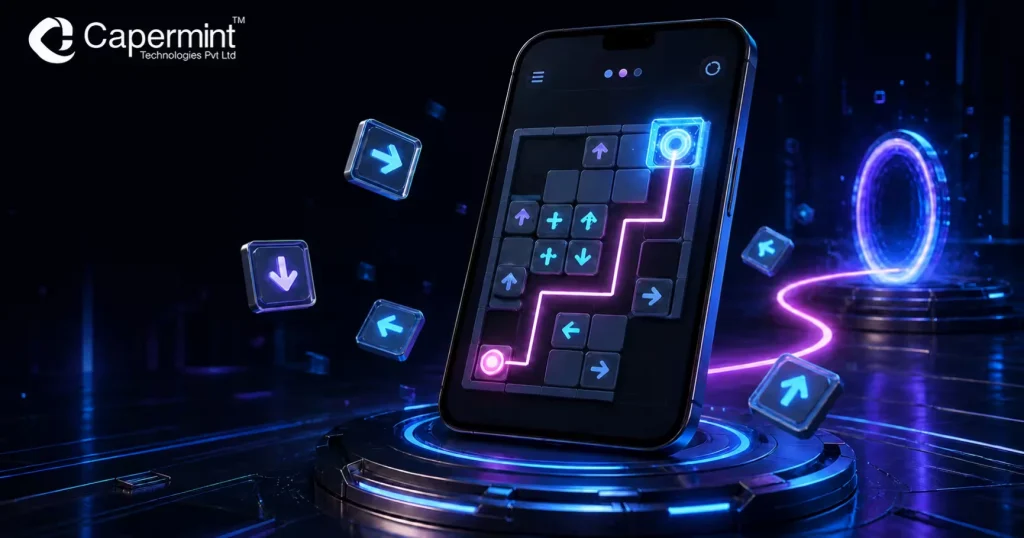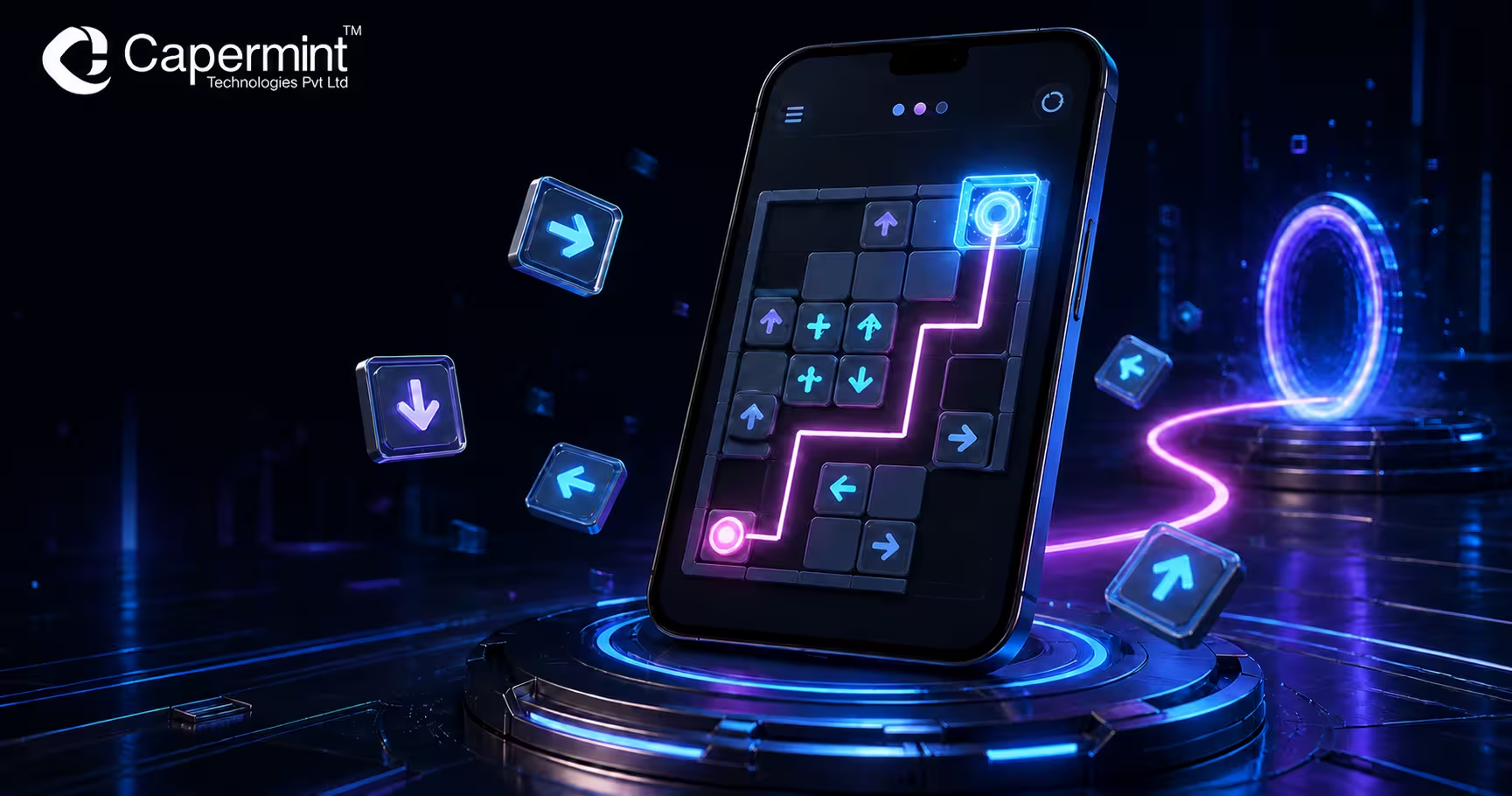
Plan an original arrow puzzle game: define the first playable version, understand cost drivers and agree a development roadmap before investing in a full build.
To develop a game like Arrows Puzzle Escape, start with the directional puzzle mechanic, a level authoring and validation pipeline, clear touch controls and saved progress. Test a playable prototype before expanding the level library, monetisation or online features. Your budget and delivery plan depend on those decisions.
This guide is for founders and publishers planning an original commercial puzzle game. Capermint's puzzle game development team can discuss the build scope with you. Use your own game name, artwork and level content when developing a game in this genre.
What Should the First Playable Version Include?
Agree a small, testable first release. The objective is to establish whether the puzzle is understandable, enjoyable and practical to extend.
- Puzzle engine: directional movement, occupied-path checks, removal rules and clear success or collision feedback.
- Level production: an agreed initial batch, an authoring tool and automated solvability checks backed by human playtesting.
- Player experience: a short tutorial, readable boards, responsive tap targets, progress saving and restart controls.
- Release quality: device testing, crash monitoring and events that reveal where players get stuck or leave.
Scope hints, lives, cloud saves, daily challenges, procedural generation and purchases separately. They add design, integration and testing work; they are not all necessary to validate the core game.
How Much Does an Arrows-Style Puzzle Game Cost?
There is no reliable fixed price without a project brief. A prototype, a store-ready release and a game with ongoing content operations require different work. A useful estimate separates engineering, artwork, level production, integrations and QA.
| Cost driver | What to decide |
|---|---|
| Platforms | Android, iOS or both; supported phones and tablets |
| Content | Initial level count, difficulty progression, manual or generated levels |
| Design and tools | Original artwork, animation, audio and level editor requirements |
| Integrations | Ads, purchases, analytics, accounts and remote content |
| Release and support | Device coverage, store preparation and ongoing updates |
Ask the estimate to state deliverables, exclusions, assumptions and recurring expenses. Marketing, hosting, third-party services and new level batches should be identified explicitly.
Request a scoped estimate: share your platforms, target market, prototype status, initial level scope, budget range and preferred launch window. Include your meeting time zone in the contact form's message field.
What Does the Development Roadmap Look Like?
- Discovery: agree movement rules, audience, release scope and acceptance criteria.
- Playable prototype: test board readability, controls and puzzle difficulty.
- Production: build the content pipeline, create levels and integrate agreed features.
- QA and release preparation: validate puzzles, test devices, purchases and offline behaviour, then prepare store assets.
- Soft launch and iteration: evaluate completion, retention, crashes and monetisation before expanding.
Set dates after the scope and dependencies are agreed. Level creation, feedback cycles, integration requirements and store review can affect the schedule. A working prototype is a useful early milestone.
What Is the Reference Game?
Arrows – Puzzle Escape is a logic puzzle game from Lessmore GmbH. Its official listings describe extracting arrows without collisions, increasing level complexity, minimalist presentation and hints. See Google Play and the App Store for the reference product.
The following development choices describe a proposed original game in the same genre, rather than the reference game's internal implementation.
How Do You Build the Gameplay and Levels?
Represent the board, arrow directions and occupied paths as game state. A tap checks whether the selected arrow has a clear exit under your movement rules. A valid move updates the board; a blocked move gives understandable feedback. Clearing the board completes the level.
Define collision, restart, hint and failure rules before producing content. A solver can check whether a level has a solution, but it does not prove that the puzzle is enjoyable. Playtest onboarding, difficulty progression and repeated patterns. Keep level data separate from presentation so designers can revise content without rebuilding the movement system.


Which Technical Decisions Matter?
Choose the engine around target platforms, the team's experience, content tools and required SDKs. Compare candidate engines, such as Unity or Godot, against those requirements rather than selecting one because the game looks simple.
A single-player prototype can keep levels and progress on the device. Accounts, cross-device saves and remotely delivered challenges introduce backend, security and operating requirements. Confirm those needs before adding infrastructure. Plan purchase restoration, ad failure handling and offline behaviour if they are in scope.
How Can Your Puzzle Game Make Money?
The reference game's Google Play listing identifies ads and in-app purchases; its actual revenue is not disclosed there. For your game, options include optional rewarded ads, interstitials at suitable breaks and purchases such as hints or an ad-removal offer.
Test frequency, pricing and player response during a limited release. Evaluate revenue alongside retention, completion and complaints. Downloads alone do not establish profitability: acquisition costs, audience, ad demand and operating expenses affect the result.
How Should You Validate the Opportunity?
Use a prototype and a limited launch to test your own audience. Measure tutorial completion, level abandonment, return visits and cost per acquired player. Decide which results would justify further investment before spending on a larger content library or paid acquisition.
How Will Your Game Stand Out?
Compare similar games for readability, difficulty pacing, control precision and ad interruptions. Choose a specific improvement to test, such as clearer boards, more varied puzzles or an accessible visual theme. A recognisable mechanic still needs an original product direction and a plan to reach players.
Discuss Your Puzzle Game with Capermint
Explore our Drop Master puzzle game case study, which shows a block-sliding board, touch interaction and line-clear feedback. This is a different puzzle mechanic, offered as an example of our published work.
Bring your concept, any existing prototype and the decisions above to a project discussion with Capermint. Ask for a proposal that explains the prototype milestone, content workflow, release deliverables and support scope. Confirm ownership and handover terms in the project agreement.
Buyer FAQ
How much does a game like Arrows Puzzle Escape cost?
How long does development take?
What should the first version include?
Does the game need a backend?
Should I use ads or in-app purchases?
What should I send Capermint for an estimate?
Plan Your Original Arrow Puzzle Game
Share your platforms, target market, prototype status, initial level scope and optional features. Include your budget range, preferred launch window and meeting time zone so the team can assess development, content and testing requirements.