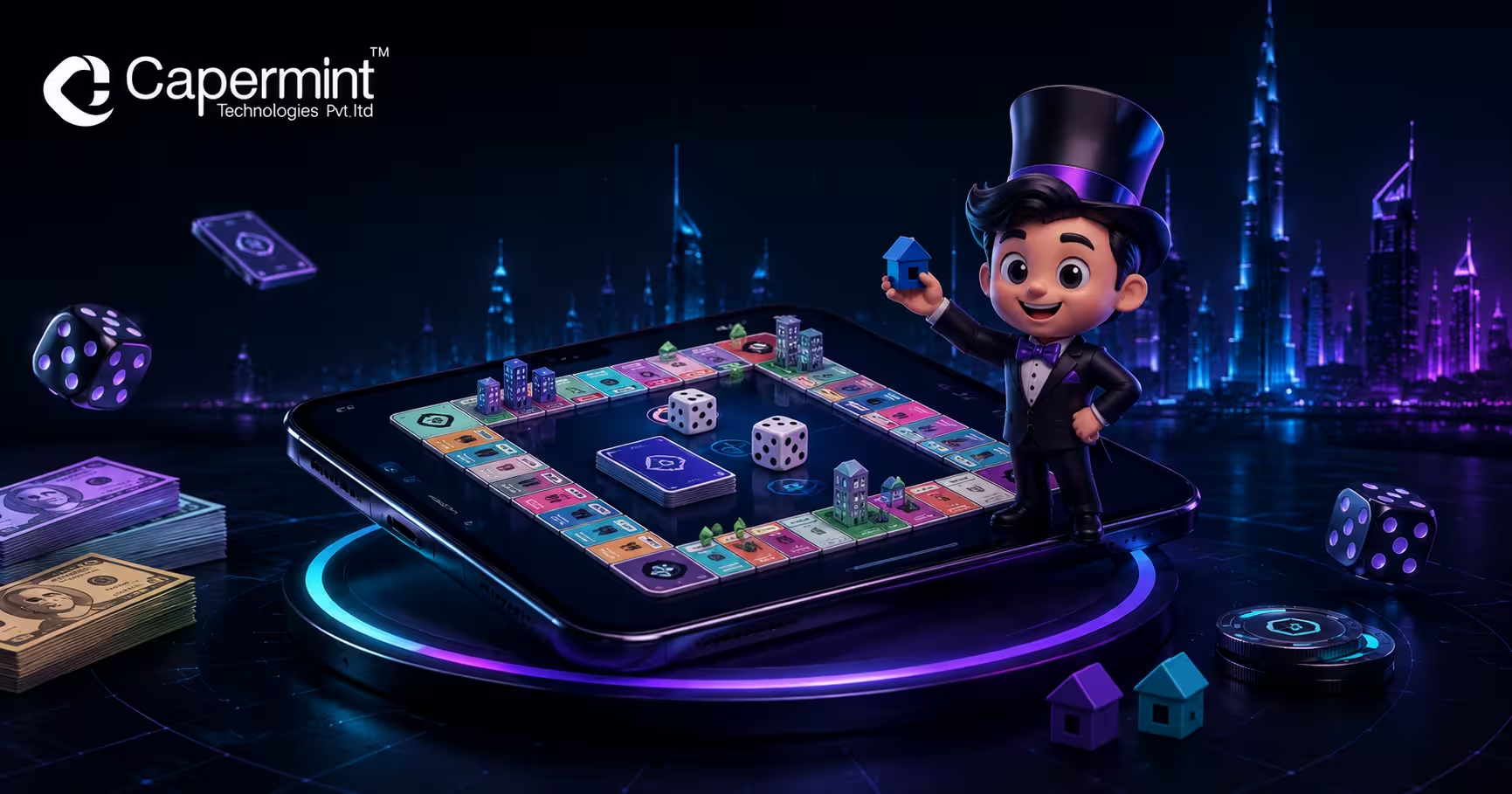
Illustrative mobile board-game concept artwork; not a released project screenshot.
A mobile board game starts with a production decision: what must the first release do, and what can wait? This guide helps founders and studio product owners planning an original iOS or Android game for the United States and Canada prepare a brief that suppliers can estimate consistently.
The main cost drivers are the rules, art and content volume, platforms, network model, backend and release requirements. Separate the playable prototype, production and ongoing operation in your proposal. Start with the cost inputs and three scope options, then use the Mobile project brief to discuss your requirements.
Define the Game Before Comparing Development Quotes
Write down the player action, turn rules, progression, win condition and intended session. Choose an original theme and decide whether the experience is solo, asynchronous or played together in a live match. An approved rules document and a playable reduce ambiguity in estimates.
Give each supplier the same brief. Ask them to state the currency, assumptions, exclusions, review responsibilities and acceptance criteria. For a US or Canadian project, agree working-hour overlap, the person approving builds and who controls store and service accounts.
Validate the Audience Before Expanding the Game
Use a playable to test whether intended players understand the rules, complete the core loop and want another session. Agree the test group, observations and decision criteria before adding more boards, collection systems or events. Revenue from a successful reference game does not forecast the outcome of a new product.
What to Learn from MONOPOLY GO! Without Copying It
Scopely announced MONOPOLY GO! together with Hasbro. It is a useful reference for onboarding, board progression and social interactions. A brief for your own game should describe the intended player experience and a distinct design, rather than request every feature of that product.
Plan original branding, art, interface and rules text, with permission for any third-party material. US and Canadian guidance distinguish game methods or ideas from protected expression; other rights require their own review. See the US Copyright Office’s game guidance, Canada’s copyright guidance and USPTO trademark guidance. Apple also reviews copycat and impersonating apps. A genre reference is not a rights clearance or release guarantee.
What Determines Board Game Development Cost?
A useful estimate connects effort to an agreed scope. Ask for workstreams, staffing or effort assumptions, the pricing model and acceptance milestones. Keep development fees separate from licensed assets, third-party services, hosting, content production, promotion and support. Numerical examples are only comparable when their assumptions match.
| Workstream | Specify in the brief | What to check in the proposal |
|---|---|---|
| Rules and playable | Legal moves, turn flow, randomness, progression and edge cases | Playable deliverables and rule-test acceptance |
| Art and content | Art direction, boards, characters, animation and UI screens | Asset quantities, revision rounds and editable source files |
| Platforms | iOS, Android, orientation, device range and languages | Build, device testing and platform-specific work |
| Backend and multiplayer | Accounts, saved state, social actions, live matches and admin tools | State validation, reconnect behavior, capacity assumptions and service costs |
| Monetization | Purchase types, ads or subscriptions, if required | Entitlements, restore/retry cases, provider setup and economy testing |
| QA and release | Supported devices, review criteria and store responsibilities | Test evidence, release handover and separately scoped support |
Three Scopes to Estimate Separately
| Scope | Proposed deliverable | Acceptance decision |
|---|---|---|
| Playable prototype | One original rules loop and board, representative UI and agreed test cases | Are the rules understandable and suitable for further production? |
| First release | Approved content, target platforms, persistence, chosen network features and release QA | Does the build meet the agreed scope and device/test criteria? |
| Operated product | Agreed content tools, events, monitoring and support responsibilities | Can the assigned team operate and update the product with a defined budget? |
A prototype does not need a full event calendar, multiple themed worlds or every social system. Price those additions separately so their effect on effort and ongoing work remains visible.
Choose the Engine and Multiplayer Model for Your Scope
Compare target devices, existing code, team skills, build workflow and third-party licenses before choosing an engine. The quote should distinguish solo rules and AI, asynchronous social actions and simultaneous multiplayer; each requires a different state and testing plan.
For online play, define who validates moves and rewards, where progress is stored, and what happens after a disconnect or repeated request. Unity’s documentation explains server-authoritative rules and state and session/network choices. Those are technical options, rather than proof of any supplier’s completed implementation.
Agree the First Playable and Optional Features
- Core playable: original rules, readable board/UI, turn or action flow, progression and a clear outcome.
- State: saved progress and defined handling of invalid moves, repeated actions and interruptions.
- Optional production work: AI opponents, online rooms, friends, collections, trading, purchases, notifications and additional content.
- Operational work: admin permissions, event configuration, support tools and monitoring where required.
Specify each included feature’s behavior and acceptance test. A feature name such as “multiplayer” or “LiveOps” is too broad to define a price or delivery milestone.
Plan Monetization and Operating Costs Separately
Decide whether the free-to-play game uses optional purchases, advertising or a subscription. Scope purchase validation, restore and retry behavior, player consent and the relevant store/provider requirements. Balance the economy in the playable and test release; no revenue or retention result is assumed.
Estimate hosting, third-party services, content updates and acquisition separately from development. This guide covers an original free-to-play product without cash-prize or wagering functionality. A product with entry fees, prizes or wagering needs a separate product and jurisdiction review.
Compare Reference Experiences and Supplier Proposals
Record what you observed in a reference experience: onboarding clarity, turn pacing, saved progress, social interactions or update cadence. Turn each observation into a design question for your own game.
When comparing suppliers, ask for an inspectable playable, their exact contribution, rule-edge-case testing, deliverables and handover. Compare the same brief across proposals. Supplier marketing prices, downloads and competitor revenue cannot establish the cost or likely result of your project.
Approve Milestones and Dependencies Before a Launch Date
- Brief and design: confirm rules, originality, platforms and the review owner.
- Playable: test the core loop and decide what proceeds to production.
- Production: approve content and engineering through reviewable builds.
- QA and release: test rules, devices, purchase/state failures and submission materials.
- Handover and operation: verify build instructions, account access, monitoring and support scope.
The schedule depends on content volume, network complexity, testing, approval speed and external store review. Agree deliverables and acceptance at each milestone before promising a release date. Choose any pilot markets and test criteria for the actual audience.
Set Clear Review, Ownership and Support Terms
A defined milestone engagement suits approved scope; iterative capacity can suit rules and content that still need testing. In either model, document scope changes, build reviews, payment, acceptance and support.
List bespoke code and art, assignment terms, reusable components and third-party licenses separately. Define delivery of repositories, editable assets, build instructions, account access and service credentials through an appropriate handover process. CIPO recommends documenting ownership and licensed-material terms. Agree defect support, maintenance, new content and service monitoring separately; payment alone does not establish ownership of every component.
Review Relevant Work and the Proposed Delivery Scope
For adjacent mobile delivery evidence, inspect Runner Runner. In his April 15, 2024 Clutch review, PlaySphere Studios founder and CEO Michael Prozer describes Capermint’s mobile development, UI/UX, 3D modeling, animation and backend admin work.
This is client-reported mobile work. It does not establish a Monopoly-style board-game delivery or independently measured revenue, retention or performance. For your board-game project, request a relevant playable and a proposal identifying the team’s exact production responsibilities.
Continue to the Mobile Production Brief
The Mobile Game Development service explains the production inquiry route. Prepare your rules or prototype, original theme, target devices, content quantities, chosen network model and launch responsibilities. If an existing build is involved, include its engine/version and the work you need reviewed.
Board Game Development Questions
How much does it cost to develop a game like MONOPOLY GO!?
Estimate your original game from its rules, content, platforms, backend, testing and operating scope. Ask for an itemized proposal with currency, assumptions and exclusions. This guide does not establish MONOPOLY GO!’s actual development budget or a universal price for equivalent production.
What should the first playable include?
One original rules loop, readable board/UI, progression or an outcome, and agreed test cases. Add persistence, AI or networking when they are necessary to test the intended experience.
Do I need real-time multiplayer?
Choose based on how players interact. Solo play, asynchronous actions and simultaneous matches have different infrastructure, state and testing needs. For online play, specify server-side validation, persistence and interruption handling, with tamper and abuse cases in acceptance testing.
How long does board-game development take?
The schedule depends on approved scope, content volume, networking, review time and release dependencies. Request milestones with deliverables and acceptance criteria rather than relying on a generic month range.
Can I use the MONOPOLY name, artwork or interface?
Plan original branding and assets, and obtain permission for third-party material. Have the relevant rights reviewed for your release markets. Referencing a genre does not authorize copying a protected product or guarantee store acceptance.
What should handover and post-launch support include?
Specify repositories, editable assets, build instructions, account access and documentation, with assignment terms and third-party licenses. Agree defect support, platform maintenance, monitoring, new content and their budgets separately from initial development.
Key takeaways
To develop a game like MONOPOLY GO!, build an original dice-roll board loop, then add landmarks, social raids, sticker albums and live events. Capermint scopes and builds dice-and-board games for US, Canadian and global studios. Typical ranges: single-platform MVP $10K–$40K; cross-platform launch build $40K–$120K. Schedules follow scoping; Capermint's published multi-platform Ludo benchmark is about 12–20 weeks.
MONOPOLY GO!-style game development at a glance
| Delivery models | Fixed-scope project, dedicated team (monthly), or co-development and staff augmentation with your studio (hire Unity developers) |
|---|---|
| Timeline | Set in a milestone plan after a scoping call. Nearest published Capermint benchmark: about 12–20 weeks for a full-featured multi-platform Ludo app; a MONOPOLY GO!-style build adds an event framework, sticker albums and social raids to that scope. |
| Price from | Typical single-platform MVP from $10K (USD); final quote after a scoping call |
| Tech stack | Typical stack: Unity (C#) client for iOS and Android; server-authoritative backend (for example Node.js with a managed database) for rolls, rewards and balances; App Store and Google Play billing with server-side receipt validation; analytics, remote config and push notifications |
| Platforms | iOS and Android; web build on request |
| Testing and store readiness | Server-side validation of dice rolls, rewards and purchases; tamper, replay and device-clock tests; device QA; odds screen for paid random rewards; App Store privacy labels and Google Play Data safety form; original names, art and UI checked against copycat rules |
| Markets | US and Canada first (calls in US and Canadian business hours), plus UK/EU, Middle East, LatAm, Africa, India (free-to-play and social formats) and APAC; delivery studio in Ahmedabad, India |
| Proof | Founded 2014; Capermint-reported 650+ customers worldwide and over 200 specialists; Clutch 4.9/5 from 13 reviews; selected board-game clients and products listed by Capermint include Ludo Fantasy, Ludo Empire, Chess Castle and SuperStyle Chess; End Game Chess case study; see Ludo game development and chess game development |
Core systems to build, by release
Specify each system with its behavior and acceptance test, then decide which release it belongs to. Capermint's mobile game development services page explains how these become a fixed-scope or dedicated-team engagement.
| System | What to specify | Typical release |
|---|---|---|
| Dice-roll energy | Roll cap, regeneration timer, roll multipliers and server-generated results | MVP |
| Board and tiles | One original board theme; currency, reward, raid-trigger and event tiles | MVP |
| Landmark building | Build costs per board, board-completion rewards and progression to the next board | MVP |
| Accounts and saved progress | Guest login, account linking, cloud save and restore on a new device | MVP |
| Store and billing | Dice and currency bundles, server-side receipt validation, restore purchases; limited-time offers later | MVP (basic store) |
| Friends and social raids | Friend list or social login, raid actions on other players' boards, push notifications | Launch build |
| Sticker albums | Packs, sets, duplicates and trading; odds screen if packs are sold | Launch build |
| Events and tournaments | Timed events with milestone rewards, leaderboards and co-op events, driven by remote config | Launch build (simple events); later (co-op, tournaments) |
| LiveOps and admin | Admin panel, event calendar, economy dashboards, A/B tests | Launch build (admin); later (A/B tests) |
Solo, asynchronous or real-time play: what changes
Games in this genre mostly use asynchronous social actions. Choose the model before you request quotes, because each needs a different backend and test plan. See social and multiplayer game development for real-time work.
| Model | How players interact | Backend needs | Testing focus |
|---|---|---|---|
| Solo | Player against the board only | Cloud save; server checks on rewards and purchases | Save and restore, economy balance |
| Asynchronous social | Raids, trades and team events act on other players' saved state, with no live session | Server-authoritative state, action queues, notifications | Concurrent actions, replayed requests, abuse |
| Real-time | Players share a live match | Real-time servers, matchmaking, reconnect handling | Latency, disconnects, load and capacity |
Cost to develop a game like MONOPOLY GO!
| Scope | What it includes | Typical range (USD) |
|---|---|---|
| Single-platform MVP | One original board, dice-roll energy and movement, tile rewards, landmark building, saved progress, basic store and analytics on iOS or Android | $10K–$40K |
| Cross-platform launch build | iOS and Android, several themed boards, friends and raid actions, sticker albums, event framework, in-app purchases, optional rewarded ads, admin panel | $40K–$120K |
| Large custom live-ops product | Server-authoritative economy at scale, co-op and tournament events, LiveOps tools, A/B testing, localization and a web build if needed | $120K+ |
| Ongoing operation | New boards, event calendar, economy tuning, monitoring and support after launch | Dedicated team, quoted monthly |
Typical ranges, not quotes: they assume original art and a production backend, and exclude hosting, third-party services and user acquisition. Final quotes follow a scoping call. Timelines are set in the milestone plan after scoping; the nearest published Capermint benchmark is about 12–20 weeks for a full-featured multi-platform Ludo app, and an event framework, sticker albums and social raids add to that scope. For wider benchmarks, see the mobile game development cost guide.
This guide covers original free-to-play games monetized by in-app purchases and optional ads. MONOPOLY and MONOPOLY GO! are trademarks of their respective owners, used here only to describe the genre; no affiliation or endorsement is implied, and a genre reference is not a rights clearance. Paid entry, cash prizes or prizes redeemable for cash bring a game under gambling, skill-gaming or sweepstakes rules that vary by US state and Canadian province. In India, the Promotion and Regulation of Online Gaming Act 2025 prohibits online money games, so for India Capermint builds free-to-play and social formats. Operators are responsible for licensing; we build to the technical requirements of the target jurisdiction. Store, privacy and IP notes on this page are general guidance, not legal advice.
Questions buyers ask about dice-and-board game development
What features does a game like MONOPOLY GO! need at launch?
At launch you need the core loop: dice rolls that regenerate over time, board movement with tile rewards, and landmarks players build with earned currency to finish a board. Most teams also ship friends, raid actions, sticker albums and a simple event framework. Tournaments, co-op events and extra boards can follow in later releases.
Which engine and tech stack suit a dice-and-board game like this?
Unity is a common choice because one C# codebase ships to iOS and Android with mature 2D and 3D tooling. Pair it with a server-authoritative backend, for example Node.js with a managed database, plus App Store and Google Play billing, analytics and remote config. Final choices should follow your team's skills and any existing code.
How do games in this genre make money?
Mostly through in-app purchases: dice-roll and currency bundles and limited-time offers. Some titles add event passes, subscriptions or optional rewarded ads. Model the economy in the prototype and tune it in a soft launch before you scale user acquisition.
Do paid sticker packs or random rewards need odds disclosure?
Yes, if players can buy them. Apple's App Store Review Guidelines (3.1.1) and Google Play's payments policy require apps that sell randomized virtual items to disclose the odds of receiving them before purchase. Build the odds screen into the store UI from the first release.
How do you stop players cheating on dice rolls and rewards?
Generate dice results, rewards and currency balances on the server and let the client only animate them. Validate every purchase receipt server-side and reject repeated or out-of-order requests. Include tamper, replay and device-clock cases in QA acceptance tests.
Will Apple or Google reject a MONOPOLY GO! clone?
They can. Apple's guideline 4.1 rejects copycat apps that change little more than another app's name or UI, and Google Play's impersonation policy bars apps that mislead users by imitating another app or brand. Keep other games' names out of your store title, description and keywords too. An original theme, board art, characters and UI copy is the safest route. This is general guidance, not legal advice.
What team does a game like this need?
A typical team includes a producer, a game and economy designer, 2D/3D artists and an animator, Unity engineers, a backend engineer and QA. Capermint can staff the whole team on a fixed-scope project or as a monthly dedicated team, or add specialists to your studio through co-development.
What does LiveOps involve after launch?
LiveOps means running the game as a service: an event calendar, new boards and albums, economy tuning through remote config, A/B tests, monitoring and player support. Budget it separately from development. Capermint quotes ongoing operation as a monthly dedicated team after scoping; hosting and third-party service fees are extra.
Has Capermint built board games before?
Yes, in Ludo and chess. Selected clients and products Capermint lists include Ludo Fantasy, Ludo Empire, Chess Castle and SuperStyle Chess, and End Game Chess has a published case study. Ludo and chess use a different loop and economy from a dice-and-board live-ops game, so ask for a playable close to your scope before you sign.
Does Capermint work with studios in the US and Canada?
Yes. US and Canadian studios, publishers and brands are Capermint's priority market: it quotes in USD and schedules calls in US and Canadian business hours, with delivery from its studio in Ahmedabad, India. It also takes on projects from the UK and EU, Latin America, the Middle East, Africa, India and Asia-Pacific.
Which privacy rules apply to a US or Canadian launch?
Plan for Apple's privacy labels and, if you track users across other companies' apps or websites, its App Tracking Transparency prompt; Google Play's Data safety form; COPPA if the game is directed to children under 13 or knowingly collects their data; US state privacy laws such as California's CCPA; and in Canada, PIPEDA plus Quebec's Law 25. Your counsel confirms which apply. This is general guidance, not legal advice.
Can a MONOPOLY GO!-style game offer cash prizes or real-money play?
Only where the law allows it, and only as a separately scoped product. Paid entry, cash prizes or prizes redeemable for cash bring a game under gambling, skill-gaming or sweepstakes rules that vary by US state and Canadian province, and Apple and Google Play apply their own real-money gaming policies. In India, the Promotion and Regulation of Online Gaming Act 2025 prohibits online money games, so for India Capermint builds free-to-play and social formats. Operators are responsible for licensing; Capermint builds to the technical requirements of the target jurisdiction. This is not legal advice.
Scope your dice-and-board game
Share your rules or concept, target platforms and launch markets to get a milestone plan and a USD estimate.