The character of the game or animation is the one that works as the connection between the story and the audience.
Even the famous Sonic Hedgehog character, which has its own animation and game, was first thought to be designed as a rabbit, as rabbits are very fast, and then it was considered to be an armadillo, and finally, it was designed as the classic Hedgehog that we all love.
The central idea is that characters matter a lot for the success of a game or animation, and designing the right character is the key to a successful game/animation.
Why Character Design Matters?

Various successful games and animations revolve around their characters.
As far as animations are concerned, the story of all the animations is formed around the main character, and then there are various other characters that have small or significant parts in the story.
When we talk about games, some games do not have any characters, but when we talk about big successful games, they all have some character to create a story for the game and provide the game with something that can help the gamers connect with the game.
For example, when we talk about “Candy Crush,” the game is to match the candies, however, to connect the gamers with the game, the game has the main character “Tiffi” which is introduced in the first episodes of the game. She is the main protagonist played by the users.
Therefore, characters are so much more than just a visual representation. They work as the bridge that helps the users connect with the story of the game or the animation.
4 Basic Principles of Character Design
1. Decide the look and feel of the character
Ask what you want from your character. It is always advisable to think of a design that goes well with the character’s usual nature within a game. There are archetypes of every different character based on the type of game/animation.
Mind the following principles for deciding the look and feel of the character.
- Knowing the design preferred by the target audience: You have to come up with a design based on who is going to play the game/ was the animation. Often when you know the audience you are designing the character for, you have very clear guidance for your help.
- Build a 2D or 3D Character: Many things differ between characters in 2D and 3D graphics. While many principles just work the same, there are also several unique aspects. For 2D and 3D characters, you need to ensure different effects. 3D character design is a little more challenging, especially for human faces.
- Backstory for Every Character: Before designing, you need to come up with a backstory for every character that will define every character’s actions and behavior.
- Learn from other games/animations: Have a look around and see the type of characters that do good in ideal games/animations of your choice. Learn from other successful games of your niche.
2. Design a defining and unique character
You need to design the unique characters that define a game/animation and its story. Here are some quick-to-grab tips.
- Make the character unique and distinct: The character should be not only attention-grabbing but also truly unique and distinct to create a lasting impression.
- Distinct line qualities that tell about the character: The depth of the lines used to draw the characters often tells a lot about the characters. You have an array of your choice ranging from thick, even, soft, round, sharp, uneven, and also scratchy lines.
- Maintain consistency: When designing characters is also important to maintain a kind of coherence and relational sync among characters. Soldiers in a military attack game/animation should have a consistent look in uniform.
3. Bring the character to life
You need to ensure that the characters represent people and certain emotions that are likely in the context. All the characters should have a personality, expression, and shape.
- Personality: The character should have a befitting personality that will easily help the audience connect with the game/animation.
- Offer unique shape: The character’s body shape clearly should conform to the personality and what it does.
- Expression: The most important thing is to create characters with the expression for different occasions. The expressions should conform to the personality besides manifesting reaction.
- Make use of Exaggeration: Closely related to character expression; exaggeration helps characters come to life and appeal to the audience directly.
- Be particular in color: Colour also plays a key role in creating the look, feel, and personality of the character. Remember, darker colors always go well with dubious and villainous characters.
Give your characters accessories: Accessories are part of a character that defines its location and the kind. The designer needs to be meticulous in maintaining logical conformity.
4. Make the characters push a certain objective
Finally, every character should have a clear objective that should drive him through various actions. These objectives should be felt through their appearance and demeanors. Only then a character can engage the audience and make a memorable experience. Here are some key tips.
- Keep Design Simple: With a simple and minimalist design of the character, you can easily push the audience to the next level.
- Detailed Background: To give your character a clear motivation, you need to chalk out a backstory with details like their origin, the way they came, any event that happened in the story, where the characters live, what they do, their preferences, etc.
Step By Step Guide to Design a Character – 11 Steps Guide

1. Prepare a rough sketch
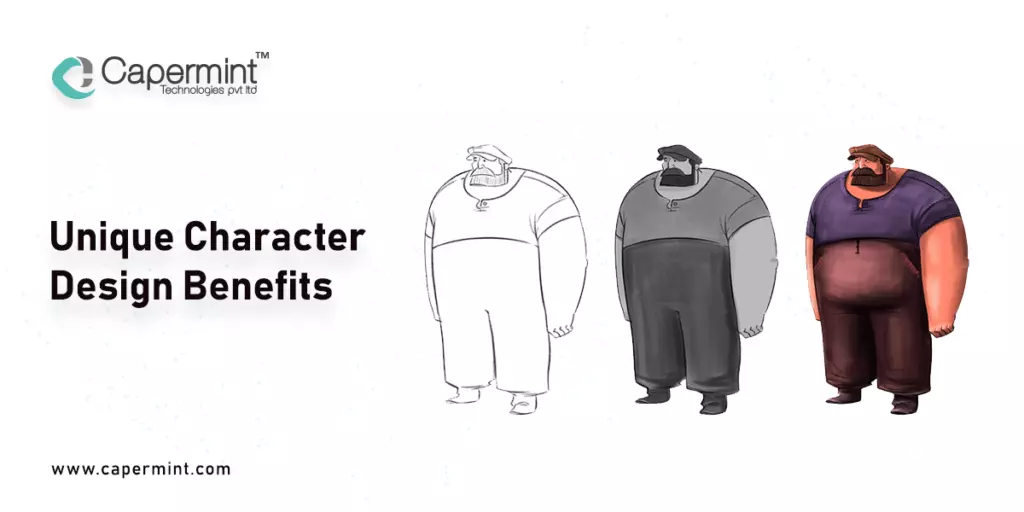
The first step is to prepare a rough sketch of the character with all the accessories and the costume inspired by the above-mentioned points.
2. Redraw in Vector/Raster
Now, draw the character in the designing program and make sure that you use the decided line art and color versions of the character.
3. Modelling
For 3D character development, the character is required to be created in the 3D space of a computer program. It is an essential process for first and third-person experience in games and animation.
4. Unwrapping
It is the process of unfolding the mesh to create a 2D texture that fits the 3D objects.
5. Texturing
If the character is a 3D one, design the texturing of the character from the colored version of the concept.
6. Rigging in 2D/3D
In rigging, build the skeleton and the muscles of the character. Attach the skin of the character and create a set of animation controls for the same.
7. Skinning
Weight painting all the bones from the Joints and turning parts of the character.
8. Animation/Pose
The animator animates characters on the timeline by taking care of each moment and time frame.
9. Camera Angles
In Storyboarding, the artist makes sure that Diaphragm contains sufficient scenery. It also helps to save time by excluding extra things while preparing a scene.
10. Lighting
Lighting throws photons to the scene, haha! not physically but digitally. It enlightens the scene and makes it living.
11. Final Gather and Post Processing
After setting up the whole thing, it’s time to render the artwork. And then there is some post-processing. Post Processing enhances the scene and its appeal. Scene by scene Color Grading is a huge part of post-processing.
How can a unique character design benefit your game?
A good character is the one that helps the users enjoy the game, a great character makes the player fall in love with the game, however, the ultimate character can not only make the users fall in love with the game, but it will also help in sales of merchandises and console/device that is used to play the game.
 For example Kratos from the God of War.
Kratos not only helped in selling the game, but it also helped in the sales of the Play Station as God of War was a PlayStation exclusive game.
Throughout the journey of Kratos, there have been many ups and downs, and the journey has become a magical story, and this is what people look forward to in character.
A character is not merely a 2D/3D art, but the character is who defines the game and has a detailed back story and a great future. The character should evolve throughout the journey.
If you fail to evolve the character, it can become the sole reason for your game’s failure, and recently this has been the case of the failure of the recent Assassin’s Creed Game. The same story for the character was told in each version of the game, and there was very little character evolution.
Therefore, if you are looking to develop the ultimate character, ask yourself the following questions: Why? What? How?
Why: It describes the profile of the character and the background of the character.
For Example: If the game is a shooting game and the character is killing many people in the game, why is the player doing so?
What: It describes the appearance and looks of the character.
For example: When the God of War game was decided, they wanted to create a character that will fight the Gods, and therefore the character has to be super strong, and it should have badass looks. They have to go with the ancient dressing. Just imagine Kratos wearing suits and carrying Blades of Chaos.
How: It describes how you will build the character.
Will you design the character yourself, or will you simply outsource the character design to a Character Designing Company?
Game Character Designing
After you have figured out the answer to the questions mentioned above, you can follow the process of designing a character to design the ultimate character for your game. Remember, before connecting to the story, the gamers connect with the character and therefore make sure that the looks of the character highlight all the attributes associated with it, and the looks should also be in sync with the story and the period of the game.
If you are not well-versed with various designing software or with character designing at all, the best option for you is to hire a game character design company to create the perfect character for your game, as a character is a very important element for the success of a game.
Ease up your Character Designing process by outsourcing
Character is the key element to the success of any game or animation. To design and create the perfect characters for your game/animation, make sure that you hire the best character designing company. If you are planning to hire a character designer for your game or animation, Capermint Technologies is the one-stop destination for all your character designing needs. With our designers’ widespread skillsets, we will design the perfect characters that will become the new definition of your game or animation.
Key takeaways
Character design principles are four rules that make a game character readable and memorable: fit the audience and genre, make the design unique (silhouette, shape language, line), bring personality to life (expression, exaggeration, color) and give the character a clear goal. Outsourced character art is scheduled and quoted after a scoping call; casual game MVPs with characters typically run $10K–$40K.
The 4 character design principles at a glance
| Principle | What it covers | Quick check |
|---|---|---|
| 1. Audience and look-and-feel | Proportions, palette, 2D or 3D style and level of detail follow who will play and the genre's conventions; a backstory defines behavior | Would your target player pick this character from a store screenshot? |
| 2. A unique, readable design | A distinct silhouette, shape language that matches the role (round reads friendly, square sturdy, triangle fast or dangerous), deliberate line quality and a consistent look across the cast | Fill the design solid black and line up the cast at the same scale; each character and role should still be clear |
| 3. Personality brought to life | Expression, exaggeration, color and accessories show attitude before any dialogue; darker, desaturated tones often mark villains | An expression sheet covers every emotion the game needs, and the palette holds up against real backgrounds and UI |
| 4. A clear objective | A simple design and a detailed background give the character a goal that shows in appearance and demeanor | Can you state the character's goal in one sentence? |
The same principles apply to 2D and 3D characters; a 3D character must also read from every camera angle.
Character appeal for children, adults and seniors
| Audience | Shapes and proportions | Color, contrast and detail |
|---|---|---|
| Young children | Round shapes, large heads and eyes, simple silhouettes | Bright, saturated colors and friendly expressions; very little fine detail |
| Teens and adults | Proportions and detail set by genre, from stylized to realistic | Palette and silhouette tuned to the genre; detail kept readable at real game size |
| Seniors and older players | Larger faces, clear expressions and simple, familiar shapes | Strong contrast against backgrounds, less clutter, and cues that never rely on color alone |
What to ask a character designer to deliver
Concept stage
Several rough sketches and silhouette options with costume and accessories, then one chosen direction with a short backstory and goal.
Final 2D design
Turnaround or model sheet, expression sheet, pose sheet, color palette with exact hex values, and layered PSD or vector source files. If the character will be animated, ask for separated body parts ready for a 2D skeletal rig in Spine or your engine's 2D animation tools.
3D production
Mesh with clean topology and UVs, textures in your art style, a rig with skin weights exported as FBX for Unity or Unreal, and a short test animation running in your engine at real game size.
Approve the turnaround and a rig test before full animation. Changing proportions after rigging means redoing the rig and skin weights.
Budgeting for characters
Art-only character work is quoted after a scoping call, based on 2D or 3D, detail, expressions, poses and rigging. When characters are part of a full build, typical ranges are $10K–$40K for a casual or skill single-game MVP, $40K–$120K for a mid-scope multiplayer game with a character roster and $120K+ for a large custom game or platform (USD). Capermint sets the final quote and schedule after scoping, and work runs as a fixed-scope project, a dedicated team billed monthly, or co-development inside your pipeline. For per-character cost drivers, see our game character design cost breakdown and the 3D character modeling cost guide.
Applying these principles in production? Capermint’s 2D character design services and 3D character modeling services take characters from brief to game-ready files, concept art services cover early exploration, and you can hire 2D artists to work inside your own pipeline. To see finished work, browse the games portfolio.
Character Design Principles FAQs
What are the basic principles of character design?
The four basic principles are audience fit, a unique and readable design, a personality brought to life, and a clear objective. In practice, that means designing for the people who will play, giving the character a distinct silhouette, shape language and line quality, showing personality through expression, exaggeration and color, and backing every visual choice with a backstory and goal.
What is shape language in character design?
Shape language is the use of basic shapes to signal personality before a player reads any text. Round shapes usually read as friendly or harmless, squares as stable and strong, and triangles as fast, sharp or dangerous. Most characters mix shapes, with one dominant shape that matches the role.
Why does silhouette matter for game characters?
A clear silhouette lets players recognize a character instantly, even at small mobile sizes or in a crowded scene. A quick test is to fill the design solid black: if the character and its role are still recognizable, the silhouette works. This matters most in games where players must tell allies, enemies and classes apart quickly.
How does color show a character's personality?
Color sets mood and role before players read anything. Warm, saturated palettes tend to read friendly or energetic, cool or muted ones calm or distant, and darker, desaturated tones often mark villains. Keep the main palette to a few colors, keep strong light-dark contrast so the character still reads in grayscale, and test it against real backgrounds and UI.
How do character design principles change for children and seniors?
The four principles stay the same; proportions, color and detail change with the audience. Characters for young children usually use round shapes, large heads and eyes, bright colors and simple silhouettes. For seniors and other older players, use larger faces and clear expressions, strong contrast against the background, less fine detail, and cues that do not rely on color alone.
How do you show a character's role in a game?
Show the role through body shape, costume and props before any stats appear. A tank usually reads as broad and heavily armored, a rogue as lean with light gear, and a healer through robes, soft shapes and a calm palette. Keep these cues consistent across the cast so players can read a class at a glance.
Do character design principles differ for 2D and 3D characters?
No, the four principles are the same; what changes is how they are checked. A 2D character is judged mainly on its silhouette, line and color from the camera angles the game uses. A 3D character must read from every angle and adds modeling, UV unwrapping, texturing, rigging and skinning, and faces are harder to get right in 3D.
How do you design player-customizable characters?
Design one base body and proportion system first, then build face, hair, skin tone, clothing and accessory options on top of it. Every option should share the same line weight, palette rules and level of detail, and should be tested in combination so no mix breaks the silhouette or clips through the model.
What are the most common character design mistakes?
The most common mistakes are a silhouette that disappears at real game size, fine detail that turns to noise on a phone screen, a palette that blends into backgrounds or UI, a cast that looks like it came from different games, and changing proportions after rigging, which means redoing the rig and skin weights.
How do you keep a character design original and culturally respectful?
Start from your own backstory and draw references from many sources instead of reworking one existing character. When costume, symbols or features come from a real culture, research them and have them reviewed, ideally by people from that culture, and avoid traits that turn a group into a caricature. Whether a design infringes someone else's rights is a question for your legal counsel.
How do character design choices affect the art budget?
2D or 3D, level of detail, the number of expressions and poses, and whether the character needs rigging and animation drive the art budget most. Art-only character work is quoted after a scoping call. When characters are part of a full build, typical ranges are $10K–$40K for a casual or skill single-game MVP, $40K–$120K for a mid-scope multiplayer game and $120K+ for a large custom platform.
Can Capermint design characters for my game?
Yes. Capermint, a game development studio founded in 2014 in Ahmedabad, India, designs 2D and 3D game characters as a fixed-scope project, a dedicated team billed monthly, or co-development inside your pipeline. Its team of over 200 specialists includes game designers, 2D and 3D artists and animators. Scope and schedule are set after a scoping call, and we schedule calls in US and Canadian business hours.
Need characters for your game?
Send your genre, target audience, style references, character count and engine, and we will scope the work and quote a budget range. We schedule calls in US and Canadian business hours.