The world's most downloaded mobile game runs zero in-app purchases and earns half a million dollars every single day. Here is what makes it work and how you can build your own version.
In 2025, one mobile game surpassed Roblox, Subway Surfers, and every other title on earth to become the most-downloaded app in the world, for the second year in a row. Block Blast, a block puzzle game with no in-app purchases, no shop, and no social features, generated 368 million downloads in a single year while earning an estimated $584,000 every day purely from advertising.
If you're an entrepreneur, startup, or gaming company thinking about entering the mobile puzzle market, this article is your complete guide. We break down exactly how Block Blast works, why it prints money, what it takes to build a similar game, and what Capermint's mobile game development team can deliver for you.
What Is Block Blast?
Block Blast is a free-to-play mobile puzzle game developed by Hungry Studio, a Hong Kong-based gaming company established in 2021. Launched in 2022 on both Android and iOS, it is a modern take on the Tetris formula, but with a crucial difference: instead of blocks falling in real time, players receive three blocks simultaneously and can place them anywhere on the grid at their own pace.
"Block Blast is Tetris without the anxiety—and that one change made it the most downloaded game on the planet."
Key Facts About Block Blast
- Developer: Hungry Studio (Hong Kong, established 2021)
- Released: 2022 on Android and iOS
- Platform: Available in Google Play and App Store in 200+ countries
- Price: Free to download, zero in-app purchases
- Monetisation: 100% advertising revenue (banners, interstitials, rewarded ads)
- Downloads: 793 million+ total; 368M in 2025 alone
- Daily Active Users: 70 million as of early 2026
- Monthly Active Users: 300 million as of early 2026
- Revenue: ~$584,000/day (~$17.5M/month) estimated
- Top markets: Indonesia (73M+ downloads), USA, Brazil, India
- A/B tests run in 2025: 10,000+ (50 tests per week)
The Market Opportunity
Block Blast didn't just succeed. It exposed a massive underserved opportunity in casual mobile gaming. The puzzle genre is now the highest-volume download category in mobile gaming, and the numbers show it's nowhere near peaked.
Global Mobile Puzzle Game Market Growth (2024-2033, USD Billions)
The puzzle genre accounts for 20% of all mobile game downloads globally, equal to simulation and ahead of every other genre. And with Block Blast proving that a simple, no-friction casual game can outperform heavily monetised mid-core titles, the investment case for a Block Blast-style game has never been stronger.
How Block Blast Works: Gameplay Mechanics Explained
Understanding the game's mechanics is the first step to building something competitive. Block Blast's brilliance is in what it removes, not what it adds. Here is a complete breakdown of how the game loop functions.
Block Blast: Complete Gameplay Loop
Core Game Loop
3 Blocks Appear
Three random block shapes (tetrominoes) appear in the tray below the 8×8 grid
Drag & Place
Player drags each block onto the grid. No time limit. Pure logic and strategy.
Line Clears
Full rows or columns are cleared instantly, earning points. Multiple clears = bonus multiplier
Score + Feedback
"Perfect!", "Unbelievable!" and other dopamine-triggering praise with haptic feedback
Loop Repeats
Next trio of blocks appears. Game ends when no blocks can be placed anywhere on the grid
Hidden AI System: Dynamic Difficulty Adjustment (DDA)
3 Game Modes
Original Block Blast Game Screenshots & Interface
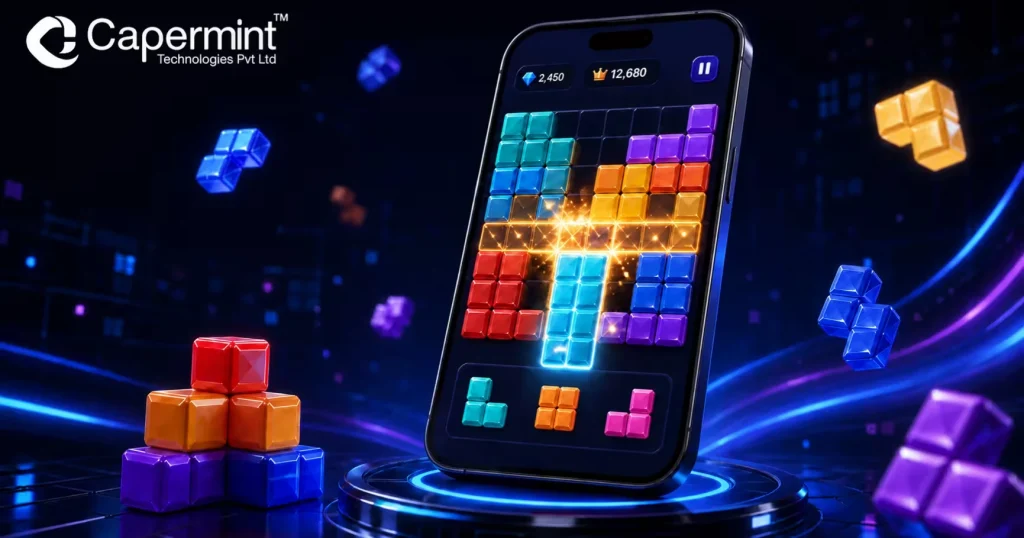
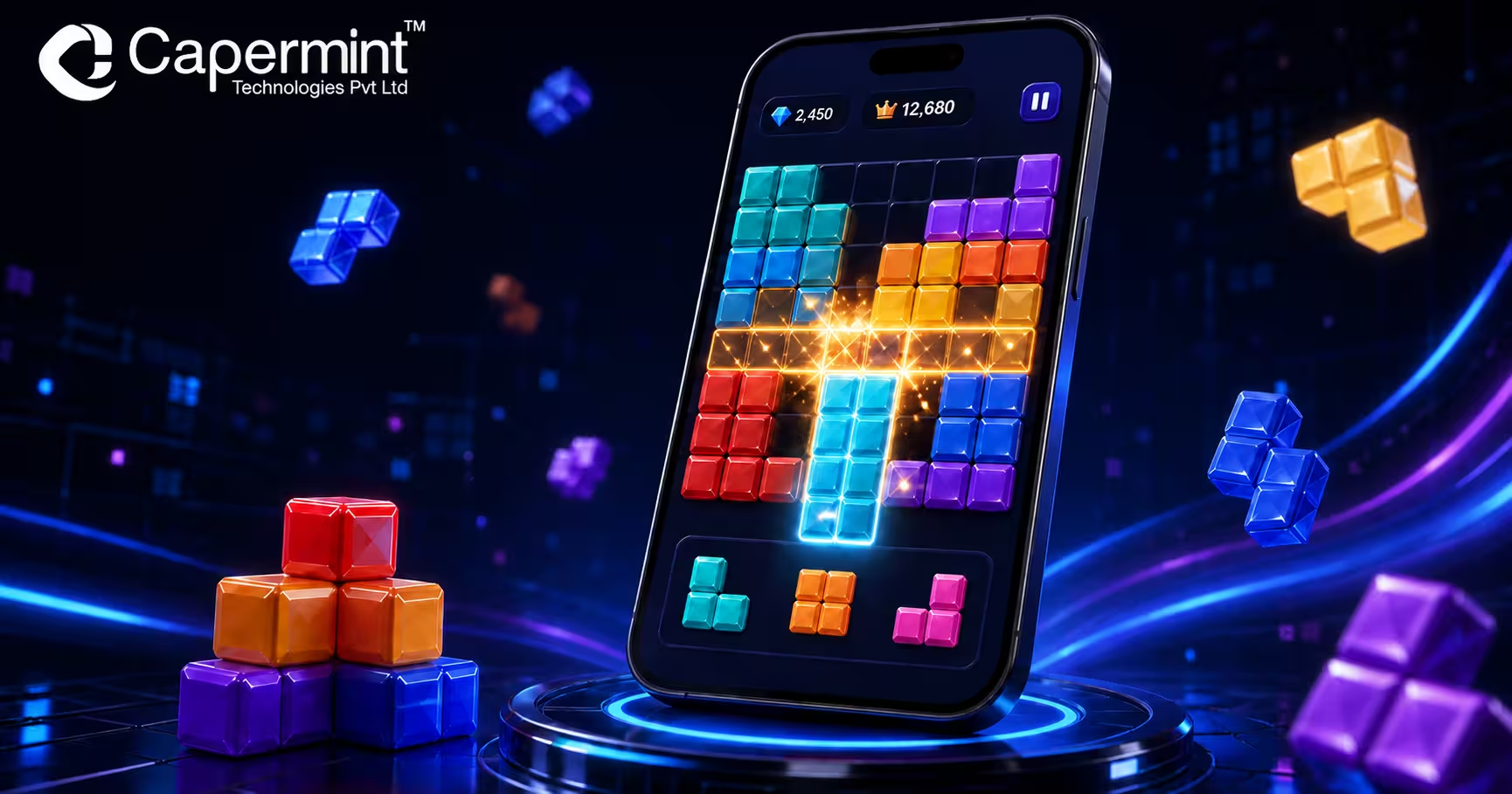
The game's visual design is deliberately minimal: a clean 8×8 wooden-textured grid, coloured block pieces, and a persistent score counter. No cluttered UI, no pop-up menus, no distractions. Below are key interface zones from the actual game:


How Block Blast Generates $584,000 Per Day
This is the most important lesson for anyone building a game like Block Blast: its entire monetisation is ad-based. There is no shop. There are no gems or coins to buy. Not a single in-app purchase. And yet it out-earns the vast majority of games that have all three.
Interstitial Ads
Full-screen ads shown after each Adventure level or after Classic mode game-over. Higher CPM than banners. On iOS: between sessions only. On Android: during levels too (per user complaints).
Rewarded Ads
Players voluntarily watch 15-30 second videos to revive a failed game session. Highest CPM of all formats (high user intent). One rewarded ad permitted per game session maximum.
Block Blast Revenue Trajectory: Estimated Daily Revenue (USD)
Why the All-Ad Model Works for Block Blast
- No paywall friction: Players never hit a "buy coins to continue" wall. Sessions feel unlimited, which drives longer play and more ad impressions per user.
- Massive scale means massive impressions. With 70M DAU, even a $0.008 ARPDAU (average revenue per daily active user) produces $560,000/day.
- Offline mode removes ad dependency. Players who play offline see no ads, which reduces the motivation to pay for an "ad-free" tier. Smart design for retention.
- High session frequency: Casual players open Block Blast multiple times per day, each session generating fresh banner and interstitial impressions.
- Optimised ad networks: Hungry Studio partners with AdMob, InMobi, and Digital Turbine Exchange, running header bidding to maximise CPM for every impression.
Must-Have Features for a Game Like Block Blast
To build a competitive block puzzle game in 2026, these are the non-negotiable features your development must include:
| Feature | What It Does | Why It Matters |
|---|---|---|
| 8×8 (or 10×10) Grid System | 2D array-based board with real-time block placement detection | Core game loop. Must be pixel-perfect on all screen sizes. |
| Drag & Drop Controls | Touch/mouse interaction for intuitive block placement | Defines the entire UX; must feel smooth and responsive (<16ms) |
| Line Clear Engine | Detects full rows/columns and removes them with animation | Primary satisfaction mechanic. Must feel satisfying with haptics and sound. |
| Block Trio Generator | Algorithm that generates sets of 3 blocks, weighted by available space | Defines difficulty balance. Too hard causes churn; too easy causes boredom. |
| Dynamic Difficulty AI (DDA) | Predicts player state and adjusts block generation to match skill | Block Blast's secret weapon. Directly drives retention above industry average. |
| Score System + Multipliers | Points for clears + bonus multipliers for multi-line combos | Keeps players chasing their high score. Primary re-engagement hook. |
| Classic + Adventure Modes | Endless high-score mode + level-based progression | Appeals to both casual and achievement-oriented players |
| Rewarded Ad Integration | Watch-to-revive mechanic powered by AdMob or equivalent | Highest-CPM ad placement; monetises the moment of maximum player motivation |
| Banner + Interstitial Ads | Always-on banner + post-session full-screen ads | Backbone of daily revenue; must be integrated with mediation for max CPM |
| Feedback System | "Perfect!", "Excellent!", "Unbelievable!" text + sound + haptics | Triggers dopamine release. Shown to directly increase session length. |
| Offline Play Support | Core game functions without internet connection | Broadens target market; Block Blast's offline mode is a key install driver |
| Cross-Platform (iOS + Android) | Single codebase deployed to both major stores | 2× addressable market from launch day |
| Cloud Save / Progress Sync | Firebase or equivalent backend for save-state persistence | Reduces churn from device switches; increases lifetime value (LTV) |
| Analytics Integration | GameAnalytics or Firebase for retention, session, funnel tracking | Without data you cannot run A/B tests. Essential for long-term growth. |
| A/B Testing Framework | Feature flagging system for continuous mechanic testing | Hungry Studio runs 50 tests per week, the primary driver of their retention edge. |
Tech Stack for Block Blast-Style Game Development
Choosing the right technology foundation directly affects your development speed, performance quality, and long-term update costs. Here's what we recommend at Capermint based on delivering similar casual puzzle titles:
| Layer | Recommended Tool | Why for Puzzle Games |
|---|---|---|
| Game Engine | Unity (primary) / Godot (budget) | Unity dominates mobile puzzle development. 2D pipeline, cross-platform in one build, massive asset ecosystem. Godot is excellent for indie-budget casual titles. |
| Programming Language | C# (Unity) / GDScript (Godot) | C# gives robust OOP structure for grid systems, DDA algorithms, and ad SDK integration. Fast iteration cycles for puzzle logic. |
| Physics / Grid Logic | Custom 2D array engine (no physics engine needed) | Block Blast uses simple collision detection. A custom grid array is faster and lighter than a full physics engine for this genre. |
| Backend | Firebase (Firestore + Auth + Remote Config) | Real-time cloud save, remote feature flags for A/B testing, push notifications, and leaderboards. Zero-maintenance scaling. |
| Ad Monetisation | AdMob + Mediation (ironSource, MAX by AppLovin) | Header bidding between multiple ad networks maximises CPM. Block Blast partners with AdMob, InMobi, and Digital Turbine Exchange. Minimum 3 networks recommended.. |
| Analytics | GameAnalytics + Firebase Analytics | GameAnalytics is purpose-built for game retention tracking. Firebase for funnel, session, and A/B experiment data. |
| Push Notifications | Firebase Cloud Messaging (FCM) | Day-1 and Day-7 re-engagement pushes significantly improve 30-day retention for casual games. |
| UI Framework | Unity UI Toolkit / TextMeshPro | Crisp text rendering for score displays; responsive layout across iPhone, Android, and tablets. |
| Version Control | Git + Unity Version Control (Plastic SCM) | Essential for team development; Plastic SCM handles large Unity asset files efficiently. |
| CI/CD Pipeline | Unity Cloud Build / GitHub Actions | Automated builds for both iOS and Android on each commit, dramatically speeding release cycles. |
Development Timeline: From Concept to App Store
How long does it take to build a Block Blast-style game? It depends on what tier of product you're building. Here are realistic timelines for each development scope:
| Phase | MVP (Basic) | Standard | Advanced |
|---|---|---|---|
| Game Design & Prototyping | 2-3 weeks | 3-4 weeks | 4-6 weeks |
| UI/UX Design | 2 weeks | 3-4 weeks | 5-6 weeks |
| Core Game Engine (grid, block logic, DDA) | 4-6 weeks | 6-8 weeks | 8-12 weeks |
| Game Modes (Classic + Adventure) | 3-4 weeks | 4-6 weeks | 6-8 weeks |
| Ad Integration (AdMob + mediation) | 1-2 weeks | 2-3 weeks | 3-4 weeks |
| Backend (Firebase, cloud save, A/B framework) | 2-3 weeks | 3-4 weeks | 5-7 weeks |
| Analytics + Dashboards | 1 week | 2-3 weeks | 3-4 weeks |
| QA Testing (all devices) | 2 weeks | 3-4 weeks | 4-5 weeks |
| App Store Submission + Review | 1-2 weeks | 1-2 weeks | 1-2 weeks |
| Total Timeline | 3-5 months | 5-8 months | 9-14 months |
Development Cost: Market Rates & Capermint Pricing
Development cost for a Block Blast-style game varies based on feature depth, team size, and target quality. Below we provide both market-research benchmarks and Capermint's own pricing tiers so you can compare accurately.
Market Research: What Others Charge
Block Blast-Style Game Development Cost: Industry Benchmarks
Capermint Pricing: Build Your Own Block Blast
We offer three clearly scoped packages for block puzzle game development, each with fixed deliverables and no hidden costs. All packages include iOS + Android delivery.
- 8×8 grid + drag & drop engine
- Classic mode (endless high score)
- Block trio generator (basic)
- AdMob banner + interstitial
- Firebase cloud save
- iOS + Android delivery
- Basic analytics dashboard
- App store submission support
- 30 days post-launch support
- Everything in MVP +
- Classic + Adventure modes
- AI-driven DDA system
- 3-network ad mediation (AdMob + 2)
- Rewarded video ad integration
- Score feedback system + haptics
- Push notification system
- A/B testing framework (Firebase Remote Config)
- Full analytics funnel setup
- 60 days post-launch support
- Everything in Standard +
- Custom visual theme (3D blocks, wood, neon)
- Multiple game modes (3-5)
- Leaderboard + social sharing
- Daily challenges + streak system
- Custom AI difficulty engine (ML-based)
- 5+ ad network mediation + header bidding
- CTV & OEM partnership readiness
- Live ops infrastructure
- 6 months post-launch support + updates
Why Choose Capermint to Build Your Block Blast Game?
There are hundreds of game development companies. Here's what makes Capermint the right partner specifically for a casual puzzle game like Block Blast:
11+ Years Mobile Game Experience
Capermint has shipped mobile games across puzzle, casual, hyper-casual, and mid-core genres. We understand what mechanics retain players, not just what looks good on a demo.
Full Ad Monetisation Stack
We integrate and configure AdMob, ironSource, AppLovin MAX, Unity Ads, and InMobi with full header bidding setup to maximise your day-one CPM and ARPDAU from launch.
Unity + Godot Certified Developers
Our engineers have shipped Unity-based puzzle and casual games that have crossed 1M+ downloads. We know the mobile performance traps that kill ratings and how to avoid them.
Dedicated Team Model
You get a dedicated Game Designer, Unity Developer(s), UI/UX Designer, QA Engineer, and Project Manager. Not a fragmented freelancer pool. One point of contact, full accountability.
DDA + A/B Framework Included
We build the Dynamic Difficulty Adjustment system and Firebase Remote Config A/B framework into Standard and Advanced packages, so you can start optimising from week one post-launch.
Post-Launch LiveOps Support
New levels, seasonal events, new block types and ad network optimisation: we provide ongoing LiveOps development after launch to keep your DAU growing instead of decaying.
Ready to Build Your Own Block Blast?
Get a free scoped estimate. We will review your concept, identify the right package, and deliver a full project plan within 48 hours. No commitment required.
Frequently Asked Questions
The most common questions we receive from founders and gaming entrepreneurs looking to build a game like Block Blast:
How much does it cost to develop a game like Block Blast?
How long does it take to build a Block Blast-style game?
Can Block Blast really earn money with no in-app purchases?
What game engine should I use to build a block puzzle game?
What is Dynamic Difficulty Adjustment (DDA) and do I need it?
What markets have the highest demand for a Block Blast-style game?
How many downloads does a game need to be profitable with ads only?
Does Capermint provide post-launch support and updates?
Your Block Blast Is Waiting to Be Built
The puzzle gaming market is generating billions in revenue and Block Blast has proven the model works. The only question is: who builds the next breakout hit? Let Capermint help you get there, with the right tech, the right ad strategy, and a team that's shipped mobile games players actually play.
At a glance
What it takes to build a game like Block Blast
Developing a game like Block Blast means building an original 8×8 block puzzle with drag-and-drop placement, line clears, a tuned three-piece generator and ad-led monetization. Capermint builds these games in Unity for publishers, studios, startups and brands in the US, Canada and worldwide; a Classic-mode MVP typically costs $10K–$40K and takes about 3–5 months.
| Delivery models | Fixed-scope project, dedicated team (monthly), or co-development and staff augmentation with your studio (hire Unity developers) |
|---|---|
| Timeline | Classic-mode MVP in about 3–5 months; full iOS and Android launch build in about 5–8 months; large custom game in about 9–14 months |
| Price from | Typical MVP from $10K (USD); final quote after a scoping call |
| Tech stack | Typical stack: Unity (C#) client with a custom 2D grid engine (no physics engine needed); Firebase for cloud save, Remote Config A/B tests and push; one ad mediation platform (for example AppLovin MAX, Unity LevelPlay or AdMob mediation) with AdMob and other networks bidding; GameAnalytics or Firebase Analytics |
| Platforms | iOS and Android from one codebase; web builds (Unity WebGL or HTML5) on request; see our HTML5 game development service |
| Testing and store readiness | Device-matrix QA on iOS and Android, including low-end Android phones; ad, consent and App Store and Google Play policy checks; privacy flows for Apple ATT, Google Play Data safety, US state privacy laws, COPPA if the game is directed to children under 13, Canadian privacy law and GDPR |
| Markets | US and Canada first (calls in US and Canadian business hours), plus UK/EU, LatAm, Middle East, Africa, India (free-to-play and social formats) and APAC; delivery studio in Ahmedabad, India |
| Proof | Founded 2014; Capermint-reported 650+ customers worldwide and over 200 specialists; Clutch 4.9/5 from 13 reviews; see the Wood Nuts & Bolts case study |
Typical cost and timeline to develop a game like Block Blast
Typical USD ranges for an original game with a production backend and device QA. Our puzzle game development team scopes each tier, and the mobile game development costs guide explains the cost drivers. For a sliding-block puzzle in the same genre, see develop a game like Color Block Jam.
| Tier | Scope | Typical range | Timeline |
|---|---|---|---|
| Classic-mode MVP | 8×8 grid, drag-and-drop placement, line clears and combos, three-piece generator, banner, interstitial and rewarded ads, cloud save, basic analytics; one store or both from one Unity codebase | $10K–$40K | About 3–5 months |
| Full launch build | MVP plus Adventure levels, adaptive difficulty, mediation across three or more ad networks, remove-ads or subscription purchase, score feedback and haptics, push notifications, Remote Config A/B testing, soft-launch support | $40K–$120K | About 5–8 months |
| Large custom game or puzzle portfolio | Custom theme or 3D blocks, several modes, leaderboards, daily challenges and streaks, LiveOps tooling, web build, or several titles on one shared codebase | $120K+ | About 9–14 months, then monthly live ops |
Typical ranges for a casual single-game MVP, a mid-scope build and a large custom game, not fixed packages; final quotes follow a scoping call.
What moves the budget, and how to keep it lean
Piece generator and difficulty
A three-piece generator that feels fair, plus adaptive difficulty, needs several rounds of playtesting. To save: start with weighted rules and move tuning values to Remote Config, so changes ship without a new build.
Ads, consent and analytics
Each ad network, the mediation setup, ATT and consent prompts and analytics events adds integration and QA time. To save: launch with one mediation platform and a short network list, then add networks once soft-launch data shows which ones pay.
Art, modes and feel
A custom theme, 3D blocks, extra modes, effects and haptics add art and production weeks. To save: ship Classic mode with one polished theme and add Adventure levels and seasons after launch.
Platforms and live ops
A web build, leaderboards, daily challenges and LiveOps tooling each add scope and monthly cost. To save: prove iOS and Android retention first, then add web and live features.
How we build a block puzzle game, step by step
Durations are for a Classic-mode MVP. Some steps overlap, and the build totals about 3–5 months before soft launch; a full launch build takes about 5–8 months. For other casual genres, see our mobile game development services.
Scoping call and estimate
We agree platforms, modes, the twist that sets your game apart, monetization and target markets, then send a tiered estimate with timeline and team. Final quotes follow this call.
Game design and differentiation (MVP: about 2–3 weeks)
Game design document, original name, theme and art direction, piece-generator rules and the ad and purchase plan, so the game sits in the genre without copying Block Blast's name, art or UI.
Playable prototype and core engine (MVP: about 4–6 weeks)
Grid, drag-and-drop placement, line clears, combos and the three-piece generator in Unity. The first playable build comes early in this phase and is playtested on real phones until placement feels instant and fair.
Production (MVP: about 5–8 weeks)
UI and art, game modes, feedback and haptics, ad SDKs and mediation, Firebase cloud save and Remote Config, and analytics events, delivered in sprints with a playable build each sprint.
QA and store submission (MVP: about 3–4 weeks)
Device-matrix testing on iOS and Android, ad and consent-flow checks, App Store and Google Play policy review, then submission and review support.
Soft launch and tuning
Release in one or two test markets for at least a month, so Day-30 retention can be read alongside session and ad metrics, then tune the piece generator, difficulty, ad frequency and onboarding before a global launch.
Global launch and live ops
Ongoing A/B tests, new modes and seasonal content, ad-network optimization and OS and SDK updates, run on a dedicated-team engagement.
IP, store and real-money rules to know first
Block Blast and related names belong to their respective owners and are used here only to describe the genre. Capermint is not affiliated with Hungry Studio, and a genre reference is not a rights clearance.
This page covers free-to-play games funded by ads and optional in-app purchases or subscriptions. Adding paid entry fees, cash prizes or prize tournaments brings in real-money, skill-gaming or sweepstakes rules, which are set jurisdiction by jurisdiction and differ by US state and Canadian province; Apple and Google Play also apply their own policies to real-money games and contests. In India, the Promotion and Regulation of Online Gaming Act 2025 prohibits online money games, so for India we build free-to-play and social formats.
Operators are responsible for licensing; we build to the technical requirements of the target jurisdiction. Store, privacy and IP notes on this page are general guidance, not legal advice.
Questions buyers ask about building a game like Block Blast
Is it legal to make a game like Block Blast?
Generally yes, if the game is original. In the US and many other countries, copyright protects a game's expression, not its general rules, so grid placement and line clears are not off-limits on their own. Copying the look is: in Tetris Holding v. Xio Interactive (D.N.J. 2012), a court found that a Tetris clone infringed by copying its visual design. Do not copy the Block Blast name, logo, art, sounds, UI or store assets, or put its name in your store title or keywords. We build original names, themes and art and recommend a trademark check with your counsel; this is general guidance, not legal advice.
Who made Block Blast, and is Capermint affiliated with it?
Block Blast is developed by Hungry Studio, and its US App Store listing names the seller as ARETIS LIMITED. Capermint is not affiliated with Hungry Studio or the game. We use Block Blast only as a genre reference and build original games for our clients.
Should a game like Block Blast use ads only, or add a subscription?
Plan ads plus an optional paid tier from launch. Block Blast is built around banner, interstitial and rewarded ads, and its US App Store listing also offers subscriptions at $4.99 a week, $9.99 a month and $49.99 a year. For a new game we usually set up mediated banner, interstitial and rewarded ads plus a remove-ads or subscription purchase, then tune the mix with Remote Config A/B tests.
How difficult is it to code a game like Block Blast?
The core loop is the easy part: the first playable grid, drag-and-drop and line-clear build comes early in the 4–6 week core-engine phase of an MVP. The hard parts are a piece generator that feels fair, smooth performance on low-end Android phones, ad mediation, analytics and post-launch A/B testing, which is where most of the budget goes.
How can a block puzzle game stand out from Block Blast?
Change a rule or add a layer, not just the colors. Options include a different grid shape, objective-based levels, daily puzzles with streaks, themed seasons or a light meta layer such as collecting or decorating. We can prototype two or three variants and keep the one players return to most.
Can a game like Block Blast run in a web browser?
Yes. A block puzzle is light enough to ship as a Unity WebGL or HTML5 build for web portals or your own site, alongside the iOS and Android apps. Web builds need their own ad setup and mouse and touch testing, so we scope them separately.
What should a Block Blast-style game track in soft launch?
Track Day-1, Day-7 and Day-30 retention, session length, sessions per day, ad impressions per daily user, ARPDAU and cost per install. Day-30 retention needs at least a month of soft-launch data. We agree targets with you per market before soft launch, then tune the piece generator, ad frequency and onboarding until the numbers support a global launch.
Which privacy rules apply to an ad-funded puzzle game in the US and Canada?
In the US, plan for Apple's App Tracking Transparency prompt, Google Play's Data safety form and state privacy laws such as California's CCPA. COPPA applies if the game is directed to children under 13, or if you know you collect personal information from under-13 users, and Google Play's Families policy limits ads and data collection when children are in your target audience. In Canada, plan for PIPEDA and provincial laws such as Quebec's Law 25; add GDPR consent for EU launches. We build the consent flows and your counsel approves the privacy policy; this is not legal advice.
Can a block puzzle game offer cash prizes or paid tournaments?
Only as a separate product reviewed for each target jurisdiction. Paid entry fees, cash prizes or prize tournaments bring in real-money, skill-gaming or sweepstakes rules that differ by US state and Canadian province, and Apple and Google Play apply their own policies to real-money games and contests. In India, the Promotion and Regulation of Online Gaming Act 2025 prohibits online money games, so there we build free-to-play and social formats. Operators are responsible for licensing; we build to the technical requirements of the target jurisdiction.
Can Capermint work as a dedicated team or alongside my studio?
Yes. We offer fixed-scope projects, a dedicated team billed monthly, and co-development or staff augmentation with your in-house developers. We schedule calls in US and Canadian business hours, and delivery runs from our studio in Ahmedabad, India.
What should I prepare before asking for a quote?
A one-page brief is enough: target platforms, game modes, the twist that sets your game apart, monetization plan, target markets and launch date. Reference games and any existing art or code help us estimate accurately. Final quotes follow a scoping call.
Planning a block puzzle game?
Share your concept, platforms and target markets to get a tiered USD estimate with timeline and team. Final quotes follow a scoping call.