Have you ever played a game where a single push, drop, or collision created an outcome you didn’t fully expect – but somehow it felt right?
The object bounced differently, structures collapsed in a unique way, or a puzzle solved itself through experimentation rather than instruction. That moment of unpredictability is exactly what makes physics-based games so satisfying.
Physics-based games don’t rely on scripted outcomes alone. Instead, they simulate real-world forces like gravity, momentum, and collision, allowing players to interact with the game world in organic and often emergent ways.
This approach has proven its appeal at scale – Rovio has reported that Angry Birds, one of the most iconic physics-based games, has surpassed 5 billion downloads worldwide, demonstrating the massive reach and longevity physics-driven gameplay can achieve (rovio.com).
From casual mobile hits and physics-based puzzle games to complex sandbox and action titles, physics-driven mechanics create gameplay that feels dynamic, replayable, and deeply engaging.
But behind that “natural” feel lies significant technical and design complexity. Physics-based game development requires careful balance between realism and fun, performance and accuracy, control and chaos. Poorly implemented physics can break gameplay, frustrate players, or cripple performance, especially on mobile devices.
In this article, we’ll explore how to develop a physics-based game, breaking down the core mechanics, the most common development challenges, and the realistic cost involved. Whether you’re evaluating this genre for your next project or planning to build one from the ground up, this guide covers the design, technology, and business considerations that actually matter.
What Is a Physics-Based Game?
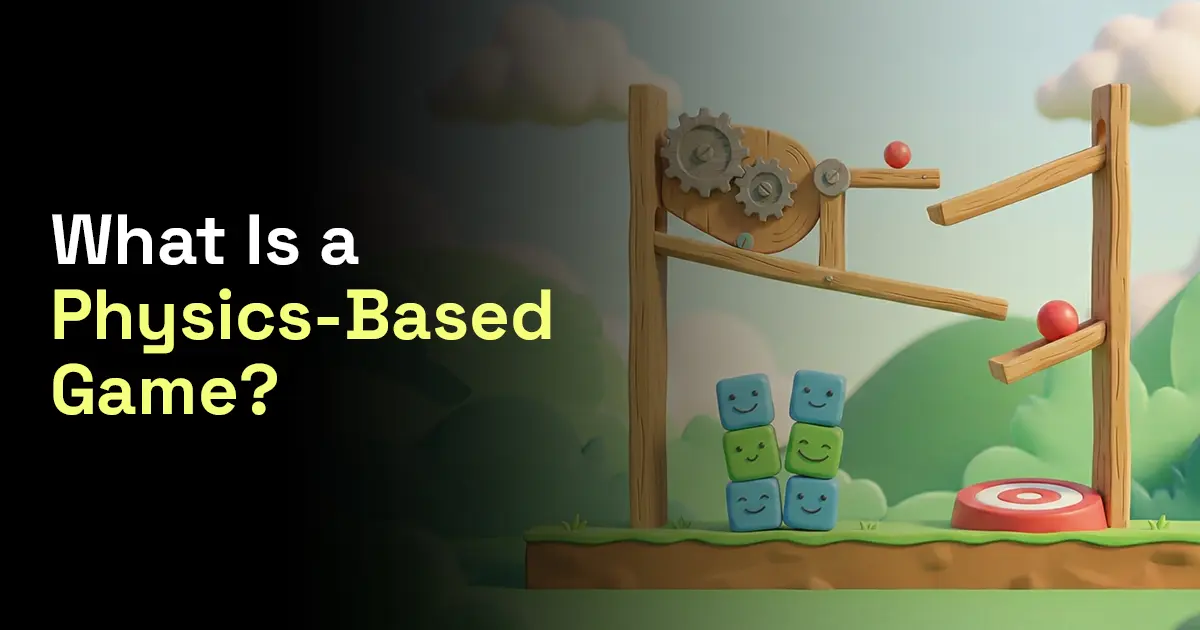
A physics-based game is a game where gameplay interactions are governed by simulated physical laws rather than fully scripted outcomes. Instead of pre-defined animations or fixed results, the game uses real-time physics calculations to determine how objects move, collide, fall, rotate, or break.
In simple terms, the game reacts based on forces and interactions, not just player inputs.
For example:
- An object falls because of gravity, not because an animation says so
- A structure collapses differently depending on where and how it’s hit
- A puzzle can be solved in multiple ways because physics allows variation
This makes physics-based games feel more dynamic, unpredictable, and player-driven.
How Physics-Based Games Differ From Scripted Games
In traditional scripted games:
- Outcomes are pre-planned
- Animations play the same way every time
- Player interaction follows narrow paths
In physics-based games:
- Outcomes emerge from real-time calculations
- Interactions feel organic rather than choreographed
- Players can experiment and discover solutions
This difference is why physics-based games often feel more immersive and replay able.
How Do Physics-Based Games Work?
Physics-based games work by continuously simulating physical laws in real time and applying them to in-game objects. Instead of relying on pre-scripted animations, the game calculates how objects should behave based on forces, mass, velocity, and collisions, often dozens of times per second.
At the core, every interaction is the result of math and simulation, not fixed outcomes.
Real-Time Physics Simulation
Physics-based games use real-time simulation to calculate movement and interaction. Each frame, the game engine updates object positions based on:
- Gravity and external forces
- Object mass and velocity
- Friction and drag
- Constraints like joints or hinges
These calculations determine how objects fall, slide, swing, or collide in a way that feels natural to the player.
Physics Steps and Game Loops
Most physics-based games run physics calculations on a fixed timestep. This ensures consistent behavior across devices and prevents instability in the simulation.
In practice, this means:
- Physics updates run at regular intervals
- Rendering and input can run independently
- The game remains stable even when frame rates fluctuate
This separation is critical for maintaining predictable gameplay while still allowing dynamic interactions.
Collision Detection and Response
When objects interact, the physics engine first determines if and how they collide. It then calculates how they should respond – whether they bounce, slide, stop, or break apart.
Collision systems handle:
- Contact points between objects
- Force transfer during impact
- Constraints that limit movement
Accurate collision handling is essential for making interactions feel fair and responsive rather than random or broken.
Emergent Gameplay Through Physics
One of the defining traits of physics-based games is emergent gameplay. Because interactions are not fully scripted, small changes in input or timing can lead to different outcomes.
This allows:
- Multiple solutions to the same problem
- Unexpected but logical results
- High replay ability without extra content
It’s why physics-based games often feel fresh even after repeated play sessions.
Why Physics-Based Games Are So Popular
Physics-based games succeed because they trigger specific player behaviors that traditional scripted games struggle to achieve. The table below breaks down why players gravitate toward these games and what effect that has on engagement.
| Player Behavior | What Physics Enables | Why It Matters |
|---|---|---|
| Emergent gameplay | Interactions respond to forces, timing, and positioning rather than fixed scripts. | Players discover outcomes instead of memorizing solutions. |
| High replayability | Different results from the same action every time. | Levels stay interesting without adding new content. |
| Strong player agency | Players control how outcomes happen, not just when. | Success and failure feel earned, not imposed. |
| Viral moments | Unexpected, funny, or chaotic physics interactions. | Encourages sharing, clips, and organic visibility. |
Core Mechanics in Physics-Based Games
Physics-based games are built on a stack of mechanics that work together to simulate believable interactions. These mechanics aren’t isolated features – they constantly influence each other, which is why tuning them correctly is critical.
Below is a mechanics stack commonly used in physics-based game development.
1. Forces and Motion (The Foundation)
At the lowest level, physics-based games rely on forces that control how objects move.
This includes:
- Gravity pulling objects downward
- Applied forces from player input
- Acceleration and deceleration
- Momentum carrying motion forward
These mechanics define how “heavy,” “floaty,” or “snappy” a game feels. Small tweaks here can completely change player perception.
2. Collision Detection and Collision Response
Once objects move, they inevitably collide.
Physics systems must handle:
- Detecting when objects intersect
- Calculating contact points
- Resolving overlaps without jitter
- Applying impact forces
Good collision handling ensures interactions feel solid and predictable instead of buggy or random.
3. Rigid Bodies and Mass
Rigid bodies define how objects exist in the physics simulation.
Key properties include:
- Mass (how hard an object is to move)
- Shape (how it collides)
- Inertia (resistance to rotation)
These values determine how objects push, block, tip over, or resist movement — and heavily influence puzzle difficulty and fairness.
4. Constraints, Joints, and Hinges
Constraints control how objects are allowed to move relative to each other.
Common examples:
- Hinges for doors or levers
- Springs for elastic motion
- Fixed joints for stacked or welded objects
Constraints enable complex interactions while keeping the simulation stable and controllable.
5. Friction, Drag, and Damping
These mechanics prevent motion from feeling endless or unrealistic.
They control:
- How quickly objects slow down
- How surfaces interact when sliding
- How much energy is lost over time
Without proper damping, physics-based games can feel chaotic or difficult to control.
6. Breakage and Environmental Interaction
Many physics-based games allow the environment itself to react.
This includes:
- Objects breaking under force
- Structures collapsing dynamically
- Pieces interacting after destruction
Environmental interaction is often what creates memorable and shareable moments in physics-based gameplay.
Types of Physics-Based Games
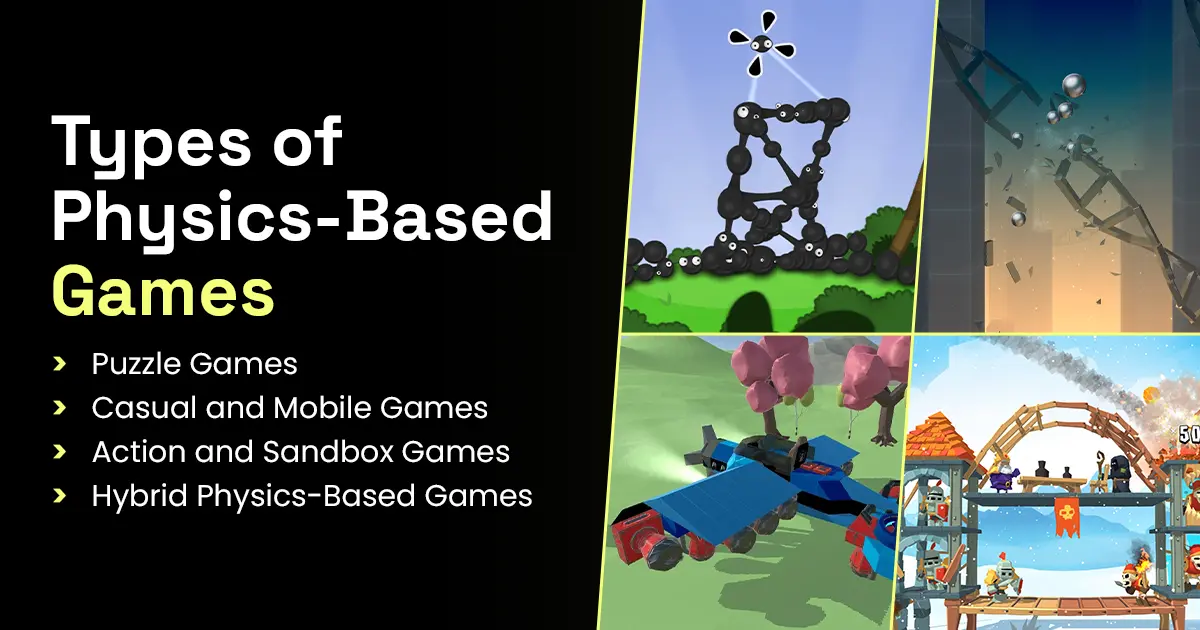
Physics-based games are not a single genre. They span multiple styles of gameplay, each using physics in a different way to shape player experience. What changes from one type to another is not the presence of physics, but how central it is to decision-making and moment-to-moment play.
1. Physics-Based Puzzle Games
In physics-based puzzle games, physics is the puzzle itself. Players are not asked to find a single correct solution but to experiment with forces, timing, and object interactions until something works. Gravity, momentum, and collisions are the tools players use to progress, which naturally leads to multiple valid solutions for the same challenge. This design encourages experimentation and makes even simple levels feel replay-able, as players often return to try different approaches.
Games like Angry Birds and World of Goo show how physics-driven puzzles can remain engaging without complex controls or lengthy explanations.
2. Physics-Driven Casual and Mobile Games
Physics-driven casual and mobile games use physics less as a challenge and more as a source of fun, unpredictability, and satisfaction. Here, physics enhances movement, balance, or interaction rather than demanding precision or deep understanding from the player.
The appeal lies in the unexpected objects tipping over, characters stumbling, or environments reacting in amusing ways. These moments often feel unscripted, which makes them entertaining to watch as well as play. This is why many physics-based casual games perform well on mobile platforms and generate viral clips through social sharing.
Titles like Human: Fall Flat demonstrate how loose, exaggerated physics can create memorable experiences without complex systems.
3. Physics-Based Action and Sandbox Games
In physics-based action and sandbox games, physics governs how the world behaves at scale. Movement, combat, destruction, and environmental interaction are all influenced by physical simulation rather than fixed rules.
Players are given systems instead of instructions, allowing them to solve problems creatively, whether by building structures, collapsing environments, or manipulating objects in unconventional ways. Because physics affects every interaction, these games often produce emergent gameplay that feels unique to each player.
Games such as Besiege and Teardown rely heavily on this approach, using physics to support freedom and experimentation rather than tightly controlled outcomes.
4. Hybrid Physics-Based Games
Hybrid physics-based games strike a balance between scripted gameplay and physical simulation. Physics enhances realism and interaction but does not fully dictate success or failure. Instead, it works alongside traditional mechanics such as progression systems, combat rules, or narrative elements.
This approach allows developers to benefit from the immersion and variability of physics without taking on the full complexity of a pure physics-driven design. Hybrid physics systems are common in games that aim for a broad audience, where consistency and accessibility are just as important as emergent behavior.
Games like The Legend of Zelda: Breath of the Wild show how physics can enrich gameplay without overwhelming players or performance budgets.
Game Engines Used in Physics-Based Game Development
Physics engines power how objects move, collide, and react inside a game. In physics-based game development, the engine choice affects performance, realism, and platform compatibility, making it a critical early decision.
Unity Physics (PhysX and Box2D)
Unity’s physics systems are widely used across mobile and PC games. PhysX handles 3D physics, while Box2D is designed for 2D simulations. Together, they offer a balanced mix of performance, realism, and fast iteration, making them suitable for physics-based puzzle games, casual titles, and mid-scale projects targeting multiple platforms.
Havok
Havok is a high-performance physics engine commonly used in large-scale PC and console games. It is designed to handle complex interactions and high object counts with strong stability. Due to its depth and cost, Havok is typically chosen for higher-budget projects that require advanced optimization.
Bullet Physics
Bullet Physics is an open-source engine known for its flexibility and support for simulation-heavy gameplay. It is often used in sandbox or experimental physics-based games where developers need more control over physical behavior. Bullet offers powerful features but usually requires additional effort to optimize effectively.
Custom Physics Engines
Some games use custom physics engines when existing solutions cannot support specific gameplay needs. This approach allows full control over how physics behaves but significantly increases development time and technical complexity. Custom engines are usually reserved for games where physics defines the core experience.
Mobile vs PC Considerations
On mobile platforms, physics engines must be optimized for limited processing power and battery efficiency, often requiring simpler simulations. PC and console platforms allow more complex physics interactions due to higher hardware capabilities. Aligning the engine choice with the target platform helps avoid performance issues later in development.
Physics-Based Game Development Challenges
1. Performance Bottlenecks
The challenge:
Physics simulations can become computationally expensive, especially when many objects interact simultaneously. This is particularly problematic on mobile devices, where hardware resources are limited.
The solution:
Developers limit the number of active physics objects, simplify collision shapes, and control physics update rates to maintain stable performance without sacrificing gameplay quality.
2. Unpredictable or Unstable Physics Behavior
The challenge:
Physics-driven interactions can sometimes produce unexpected results, such as jittering objects, clipping, or unstable collisions that break immersion.
The solution:
Careful tuning of physics parameters, fixed timestep simulations, and extensive edge-case testing help stabilize behavior while preserving natural interactions.
3. Balancing Realism with Fun
The challenge:
Highly realistic physics can make gameplay feel frustrating or difficult to control, while overly simplified physics may feel unsatisfying.
The solution:
Successful physics-based games prioritize consistency and responsiveness over realism, adjusting physical rules to support enjoyable gameplay rather than real-world accuracy.
4. Platform Inconsistencies
The challenge:
Physics simulations may behave differently across devices due to varying hardware performance, frame rates, or floating-point precision.
The solution:
Using deterministic simulations where possible and validating physics behavior across a wide range of devices ensures consistent gameplay experiences.
5. Debugging Physics Issues
The challenge:
Physics bugs are often difficult to reproduce because they depend on timing, interaction order, and player input.
The solution:
Developers rely on visual debugging tools, simulation playback, and controlled test environments to isolate and resolve physics-related issues efficiently.
How Long Does It Take to Develop a Physics-Based Game?
The development timeline for a physics-based game depends on the complexity of its mechanics, the level of simulation accuracy, and the target platforms. While small physics-based games can be built relatively quickly, projects with advanced interactions and performance requirements take significantly longer.
Below is a realistic breakdown of development timelines based on scope.
Basic Physics-Based Game (MVP)
Timeframe: 3 to 5 months
This version focuses on validating the core physics mechanics and gameplay loop. It typically includes basic object interactions, simple levels, and minimal content. An MVP is often used for prototyping, early testing, or soft launches to evaluate player response before further investment.
Mid-Level Physics-Based Game
Timeframe: 6 to 9 months
A mid-level physics-based game includes refined mechanics, improved stability, and broader content. At this stage, developers focus on tuning physics behavior, optimizing performance across devices, and adding more complex interactions. This version is suitable for public release with a polished gameplay experience.
Advanced Physics-Based Game
Timeframe: 9 to 15+ months
Advanced physics-based games feature complex simulations, large environments, and extensive testing. Development includes deep optimization, platform-specific adjustments, and thorough quality assurance to ensure stability. These projects are common in sandbox or physics-heavy action games and require longer development cycles.
How Much Does Physics-Based Game Development Cost?
The cost of developing a physics-based game depends largely on the complexity of the physics systems, the number of interactive elements, and the platforms being targeted. Because physics-based gameplay relies on real-time simulation and extensive testing, these games are generally more expensive to build than fully scripted ones.
Basic Physics-Based Game (MVP)
Estimated Cost: $25,000 – $40,000
This budget covers a simple physics-based game focused on validating the core mechanic. It typically includes basic physics interactions, limited content, standard UI, and minimal optimization. MVP builds are often used for concept validation, early user testing, or pitching to publishers.
Mid-Level Physics-Based Game
Estimated Cost: $50,000 – $90,000
At this level, the game includes refined physics behavior, improved stability, multiple levels or scenarios, and performance optimization across devices. This budget usually accounts for more testing, better visuals, and platform-specific adjustments, making it suitable for a commercial release.
Advanced Physics-Based Game
Estimated Cost: $100,000 – $180,000+
Advanced physics-based games feature complex simulations, large interactive environments, and extensive optimization. Costs increase due to longer development cycles, deeper QA, and potential custom physics behavior. These projects are common in sandbox or physics-heavy action games designed for long-term engagement.
Why Capermint Is the Right Company for Physics-Based Game Development
Physics-based games require more than visual polish or basic mechanics. They demand a deep understanding of real-time systems, performance optimization, and gameplay balance. Capermint approaches physics-based game development with this system-level mindset, focusing on building interactions that are stable, scalable, and enjoyable across platforms.
Strong Foundation in System-Driven Game Design
Physics-based gameplay depends on how well multiple systems work together. Capermint emphasizes designing physics as a core gameplay system, not a secondary feature. This ensures interactions feel consistent, responsive, and intentional rather than unpredictable or fragile.
Experience Balancing Performance and Realism
One of the biggest challenges in physics-based games is maintaining performance without sacrificing gameplay quality. Capermint’s development process prioritizes early optimization, platform-specific tuning, and controlled physics complexity—especially important for mobile and cross-platform projects.
Technical Expertise Across Engines and Platforms
Capermint works with modern game engines and physics systems, allowing flexibility in choosing the right tools for each project. Whether the game relies on built-in physics engines or requires custom logic, the team focuses on selecting solutions that align with gameplay goals and long-term scalability.
Focus on Stability, Testing, and Iteration
Physics-based games require extensive testing due to the unpredictable nature of real-time simulation. Capermint integrates testing and iteration throughout development, identifying edge cases early and refining physics behavior to ensure stable gameplay at launch and beyond.
End-to-End Game Development Support
From concept validation and prototyping to full development and post-launch support, Capermint offers end-to-end physics-based game development services. This holistic approach helps ensure that design, technology, and performance remain aligned throughout the project lifecycle.
Conclusion
Physics-based games stand out because they turn simple interactions into dynamic, engaging experiences. By relying on real-time simulation instead of scripted outcomes, these games give players freedom, unpredictability, and a sense of genuine control. That’s what makes them memorable, and why they continue to perform well across mobile, PC, and console platforms.
At the same time, physics-based game development comes with real challenges. From performance optimization and stability to platform consistency and cost, success depends on treating physics as a core system rather than a visual layer. Games that invest in proper physics design, testing, and iteration are far more likely to deliver long-term engagement and replayability.
For developers and businesses considering this genre, physics-based games offer a powerful opportunity – but only when built with the right balance of creativity, technical expertise, and planning. With a clear understanding of mechanics, challenges, timelines, and costs, physics-driven gameplay can evolve into a high-quality product that players return to again and again.
Quick answer
Physics-based game development builds gameplay on real-time simulation of gravity, collisions, joints and friction, typically in Unity (PhysX for 3D, Box2D for 2D) or Unreal Engine's Chaos on a fixed timestep. Capermint builds them for US, Canadian and global studios and brands: an MVP typically takes 3–5 months and $10K–$40K, with final quotes after a scoping call.
Physics-based game development at a glance
| Delivery models | Fixed-scope project, dedicated team (monthly), or co-development/staff augmentation |
|---|---|
| Timeline | MVP 3–5 months; mid-level release 6–9 months; advanced simulation or sandbox game 9–15+ months |
| Typical cost | MVP $10K–$40K; mid-scope $40K–$120K; large custom game $120K+ (typical ranges; final quote after a scoping call) |
| Common physics stacks | Unity with PhysX (3D) and Box2D (2D) for most mobile and casual games; Unreal Engine with Chaos for high-fidelity PC and console; Havok, Jolt or Bullet for simulation-heavy titles; custom solvers only when physics is the product |
| Platforms | iOS, Android, PC and web (WebGL/HTML5); console targets discussed at scoping |
| QA approach | Fixed-timestep simulation, per-device profiling, edge-case and replay testing, and playtests before soft launch |
| Markets | US and Canada (calls in US and Canadian business hours, USD quotes) and worldwide, including UK/EU, Middle East, APAC, Africa, LatAm and India |
| Company | Capermint Technologies Pvt Ltd, founded 2014 in Ahmedabad, India; Capermint-reported 650+ customers and over 200 specialists; Clutch 4.9/5 from 13 reviews |
How to develop a physics-based game, step by step
Discovery and physics brief (1–2 weeks)
Define the core interaction, 2D or 3D, target platforms and markets, expected object counts, monetization and the feel you want (heavy, floaty or snappy); agree on scope and milestones.
Physics prototype (3–5 weeks)
Build a greybox of the core mechanic, tune gravity, mass, friction and damping, confirm the engine, and decide now whether any physics must be networked.
Pre-production (1–2 weeks)
Lock art style, UI/UX, level design rules and the level pipeline, and set frame-time and physics budgets per target device.
Production (about 6–8 weeks for an MVP)
Build gameplay systems, levels, art, audio, monetization and any backend, with playable builds for review every sprint. Larger tiers extend this step.
Optimization and stability (during production, plus a final pass)
Simplify collision shapes, let idle bodies sleep, prune the collision layer matrix, pool objects, tune the fixed timestep and enable continuous collision detection where fast objects tunnel.
QA, playtests and soft launch (2–3 weeks)
Run edge-case and replay testing across a device matrix, playtest difficulty, then soft launch to check retention and crash data.
Launch and live operations
Submit to the stores, monitor performance and player data, and ship new levels, events and fixes.
For an MVP, steps 1–6 add up to about 13–20 weeks, inside the 3–5 month range; mid-level and advanced games extend production, optimization and QA.
Which physics engine should you use?
| Engine | 2D or 3D | License | Best for |
|---|---|---|---|
| Unity built-in physics (PhysX for 3D, Box2D for 2D) | Both, as two separate systems | Included with Unity | Mobile, casual, puzzle and hyper-casual physics games; mid-scale 3D |
| Unreal Engine with Chaos | 3D | Included with Unreal Engine | High-fidelity PC and console games and large-scale destruction |
| Havok | 3D | Commercial license | Large PC and console titles with high object counts |
| Jolt Physics | 3D | Open source (MIT) | Godot 3D projects and custom engines that need fast, multi-threaded rigid-body simulation |
| Bullet | 3D | Open source (zlib) | Simulation-heavy or experimental games in custom engines |
| Box2D, Planck.js, Matter.js | 2D | Open source (MIT) | Lightweight 2D games and HTML5 browser games |
| Custom solver | Either | Built in-house | Only when physics is the product, such as vehicle handling, soft bodies or deterministic netcode |
Unity is the usual choice for mobile, casual and 2D physics games because both physics systems are built in and one project exports to iOS, Android and the web; see our Unity game development services. Unreal Engine suits high-fidelity PC and console games with large-scale destruction; see Unreal Engine game development. We confirm the engine during the physics prototype, before art production starts.
Physics-based game development cost and timeline
| Tier | Scope | Typical range (USD) | Timeline |
|---|---|---|---|
| Physics MVP | One core physics mechanic (launch, stack, swing or break), simple levels, standard UI, ads, one platform, basic optimization | $10K–$40K | 3–5 months |
| Mid-level commercial game | Tuned and stable physics, multiple level sets or scenarios, iOS and Android, cross-device optimization, ads and IAP, analytics | $40K–$120K | 6–9 months |
| Advanced simulation or sandbox | Complex simulation, destruction, ragdolls, large environments, optional networked physics, PC or console targets, deep QA | $120K+ | 9–15+ months |
| Dedicated team or co-development | Gameplay engineers for physics work, designers, artists and QA added to your studio or run as a monthly team | Monthly, quoted by team size | Ongoing, billed monthly |
Typical ranges for physics-based games; final quotes follow a scoping call. A build that reuses a proven mechanic, as in our Smash Fest physics game cost guide, can be faster than a new mechanic that needs a full physics prototype. Single-mechanic arcade titles are scoped by our hyper-casual game development team, and studios that want physics programmers in their own sprints can hire Unity developers.
Cash prizes, kids and loot boxes: compliance basics
Most physics-based games are free-to-play or premium entertainment titles, but three features change that. Cash prizes, paid-entry tournaments or wagering bring a game under real-money gaming, skill-contest or sweepstakes rules, which vary by jurisdiction. In the US, each state sets its own rules. In Canada, each province regulates online gaming: Ontario runs an open iGaming market through the AGCO and iGaming Ontario, Alberta has legislated its own regulated market, and most other provinces offer online gaming through their provincial lottery corporations. In India, the Promotion and Regulation of Online Gaming Act 2025 prohibits online money games, so we build free-to-play, social and e-sports formats there. In the US, COPPA requires verifiable parental consent before a game directed at children under 13 collects their personal information, including persistent identifiers used for targeted ads. Apple and Google require the odds of randomized paid items such as loot boxes to be disclosed before purchase. Operators are responsible for licensing; we build to the technical requirements of the target jurisdiction. This is general information, not legal advice.
More questions about building a physics-based game
How long does it take to develop a physics-based game?
Most physics-based games take 3 to 15 or more months, depending on simulation depth and platforms. A basic MVP that proves the core mechanic takes 3–5 months, a polished mid-level release 6–9 months, and an advanced sandbox or physics-heavy action game 9–15 months or more. Physics tuning and device testing take a larger share of the schedule than in scripted games.
Should my game use 2D or 3D physics?
Use 2D physics when play happens on a single plane, as in launch-and-topple, ball or many puzzle games, and 3D physics when objects need depth, stacking or destruction in space. In Unity, 2D physics runs on Box2D and 3D physics on PhysX, and the two systems do not interact. 2D simulation is usually cheaper to run, which makes it a common choice on mobile.
What is a fixed timestep, and why does it matter in physics games?
A fixed timestep runs physics updates at a constant interval, separate from the rendering frame rate. Unity's default is 0.02 seconds, or 50 physics updates per second. Keeping the step fixed makes launches, jumps and collisions behave consistently whether a device renders at 30 or 120 frames per second, which keeps levels fair and bugs easier to reproduce.
How do you stop fast objects from passing through walls?
Turn on continuous collision detection for fast-moving bodies, so the engine checks the path between steps rather than only the end position. Teams also raycast ahead of projectiles, avoid very thin colliders and cap maximum speeds. This tunneling problem is a common physics bug found in QA.
Can a physics-based game be multiplayer?
Yes, but the physics has to be synchronized deliberately. Built-in engines such as PhysX are not guaranteed to give identical results on different devices, so online games usually run physics on an authoritative server with client-side prediction, or use a deterministic engine for lockstep or rollback netcode. Decide this before production, because retrofitting networked physics is expensive.
What is ragdoll physics, and when should a game use it?
Ragdoll physics simulates a character as rigid body parts linked by joints, so it falls and reacts to hits instead of playing a fixed animation. It suits knockdowns, comedic falls and destruction-heavy action games. Active ragdolls, which use joint motors to pull the body toward animated poses, give more control but need more tuning and testing.
Can a physics-based game run in a web browser?
Yes. Unity's Web (WebGL) build target keeps its built-in PhysX and Box2D physics, and lightweight 2D web games often use JavaScript engines such as Matter.js or Planck.js, a port of Box2D. Browser builds have less CPU headroom than native apps, so keep object counts and collider complexity low and test in mobile browsers early.
How do physics-based mobile games make money?
Most are free-to-play and earn from rewarded and interstitial ads plus in-app purchases. Common purchases are level packs, boosters, skins and ad removal, and hybrid-casual titles add progression and live events to lift retention. Choose the model early, because it shapes level pacing and difficulty.
Can you add physics features or fix physics bugs in our existing game?
Yes, through co-development or a dedicated team working in your repository and tools. Typical work includes fixing jitter and tunneling, re-tuning mass, friction and damping, simplifying colliders for mobile frame rates and adding new physics mechanics. We quote it after reviewing the project and profiler captures from your target devices.
What should I prepare before requesting a physics-based game quote?
Bring a short description of the core physics mechanic, reference games, 2D or 3D, target platforms and markets, a monetization model and a budget range. A rough level count and launch date also help. Final quotes follow a scoping call that fixes features, platforms and timeline.
Does Capermint build physics-based games for US and Canadian studios?
Yes. Capermint, founded in 2014 in Ahmedabad, India, builds games for studios, publishers and brands in the US, Canada and worldwide, with a Capermint-reported 650+ customers. We schedule calls in US and Canadian business hours, quote in USD and work as a fixed-scope project, a dedicated monthly team or co-development.
Plan your physics-based game
Share your core mechanic, platforms and target markets and we will return a scoped plan with cost and timeline; physics puzzles run through our puzzle game development team. We schedule calls in US and Canadian business hours. See finished work in our games portfolio, including the Wood Nuts & Bolts puzzle game case study.
Frequently asked questions
Are physics-based games harder to develop?
Yes, physics-based games are generally more complex to develop than scripted games. They require careful tuning, extensive testing, and performance optimization to ensure stability and consistent behavior across devices. Small issues in physics systems can significantly impact gameplay.
Which physics engine is best for game development?
The best physics engine depends on the type of game and target platform. Unity Physics (PhysX and Box2D) is commonly used for mobile and PC games, Havok is suited for large-scale or AAA projects, and Bullet Physics is popular for simulation-heavy or sandbox games. Some projects also use custom physics engines for specialized needs.
Are physics-based games expensive to build?
Physics-based games typically cost more to develop than fully scripted games due to longer development cycles, deeper testing requirements, and performance optimization. Costs vary depending on complexity, platforms, and whether custom physics systems are required.
Do physics-based games work well on mobile devices?
Yes, physics-based games can perform well on mobile when designed correctly. Developers often simplify simulations, limit active physics objects, and optimize performance to accommodate hardware constraints while still delivering satisfying gameplay.
What makes a physics-based game successful?
Successful physics-based games focus on consistency, responsiveness, and fun rather than strict realism. Clear mechanics, stable simulations, and thoughtful performance optimization help ensure that physics enhances gameplay instead of causing frustration.